


Job costing means adding up everything a job costs you (labour, materials, vehicle, tools, overheads and the on-costs on wages) before you set a price, then comparing that estimate with what the job actually cost once it’s done. Do it on every job and you quote with confidence, see where money leaks, and stop finding out at tax time that a busy month wasn’t a profitable one.
This guide walks through the method with a worked example in Australian dollars, the employment costs most tradies forget, and a simple routine for comparing estimate and actual.
TL;DR
- Cost every job in four buckets: labour (with on-costs), materials, job-specific costs, and a share of overheads.
- Your wage cost is more than the wage. Super is 12% of ordinary-time earnings, and workers compensation is on top.
- Set your price from cost and a target margin, not from a gut feel about what the market will wear.
- After each job, compare estimated and actual hours and materials. That gap is where next quote’s accuracy comes from.
- Capture the numbers on site, as the job happens, so you aren’t rebuilding them from memory on Sunday night.
Table of Contents
- What job costing is and why it matters
- The four parts of a job cost
- The wage costs most tradies underestimate
- A worked example: replacing a hot water system
- Setting your price from the cost
- Comparing estimates with actuals
- Common job costing mistakes
- What to track and where
- Where Ask Hayley fits
- FAQ
- Sources
What job costing is and why it matters
A job cost is the full price of delivering one job to the customer, before any profit. It is not your hourly rate, and it’s not the materials invoice. It’s everything that had to be spent so the job could happen.
Tradies who skip it usually quote in one of two ways: copy the last similar job, or take a guess at the hours and add materials. Both work until a job runs long, a supplier lifts prices, or you realise the “similar job” had easier access. Job costing replaces the guess with a repeatable method, so each quote is built the same way and each finished job teaches you something.
It also answers the question every owner asks at some point: which of my jobs actually make money? Without costs recorded per job, you only see the bank balance. With them, you can see that the bathroom renos pay and the small repair calls don’t, or the other way round.
The four parts of a job cost
1. Labour, including on-costs
Labour is your time and your crew’s time on the tools, plus travel between supplier, yard and site, plus the time spent measuring up and ordering. The national unit of competency for calculating construction costs says labour costing should include time for manufacture, delivery and installation, PPE, and wages and on-costs for the different types of workers, as set out in the CPCCCM3005 unit of competency on training.gov.au. That’s a good checklist, because it reminds you that the clock starts before you arrive and ends after you’ve cleaned up.
If you work on your own, your labour cost is not zero. Give yourself a wage for the job. If you leave it out, the number you think is profit is really your pay, and you have no cushion for slow weeks.
2. Materials
Count everything that goes into the job at what you actually pay, including delivery, freight, wastage and consumables such as sealant, screws, blades and disposal fees. Wastage is the quiet one. Tiles, timber, pipe and cable all have offcuts, and the offcuts are your cost, not the customer’s.
3. Job-specific costs
These are costs that exist because of this job: hired equipment, a skip bin, permits, a subcontractor, extra insurance for a larger project, fuel for a long drive. They’re easy to miss because they don’t sit in the materials invoice. A quick prompt on every quote helps: do I need to hire, dispose, travel or sub anything out?
4. Overheads
Overheads are the costs of running the business whether you work today or not. The same national unit lists administration, insurance, transport and the use of communication technology among them. Add the ute running costs you can’t tie to one job, tool replacement, software, phone, accounting, licences, and the time you spend on quotes and invoices.
The simplest way to share them across jobs is to turn them into a rate per billable hour. Add up a year of overheads, divide by the billable hours you realistically expect to work, and add that rate to every hour on every job. If you’re unsure how to arrive at a realistic hourly figure, our guide on using real job time to calculate charge-out rates covers it in detail.
The wage costs most tradies underestimate
If you employ people, an hour of their time costs more than the hourly rate on their payslip. Three items matter most.
Superannuation. The Superannuation Guarantee rate is 12% of ordinary-time earnings from 1 July 2025. Since 1 July 2026, employers are also required to pay super at the same time as wages. That changes when the cash leaves your account, not what the super costs, but it’s worth remembering when you plan cash flow around a long job.
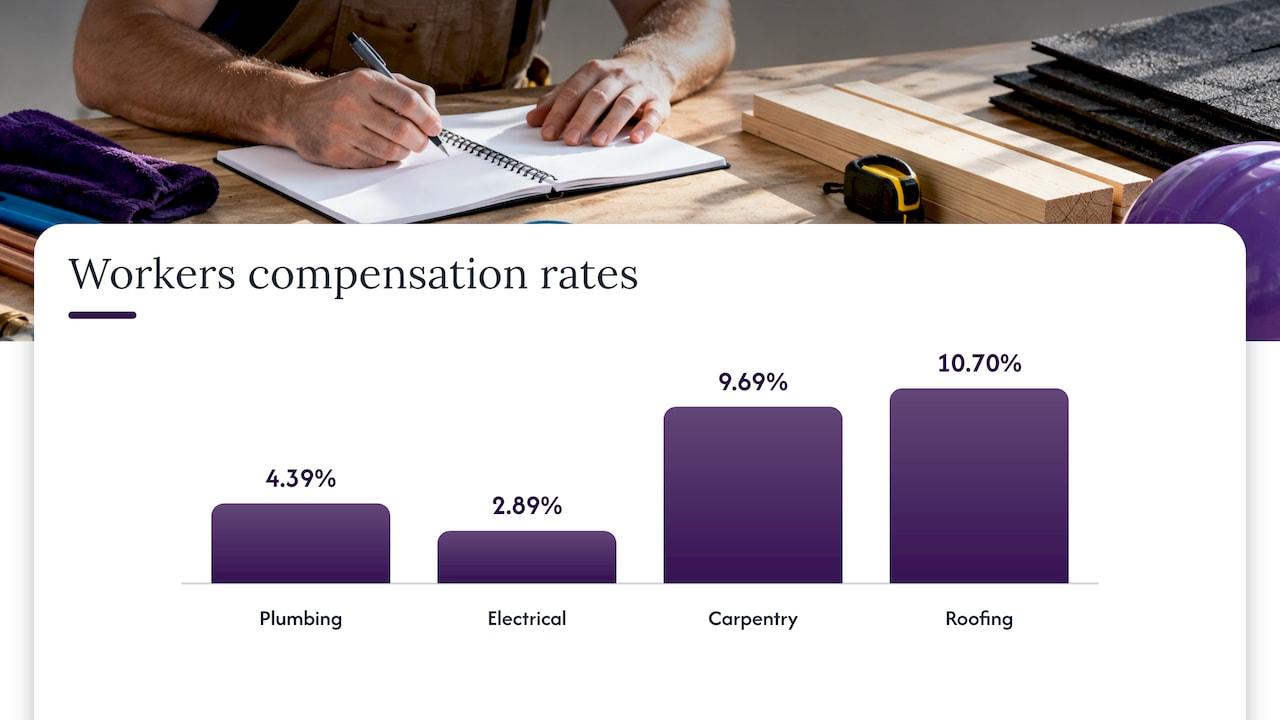
Workers compensation. Premiums are a percentage of wages and vary a lot by trade. For 2025-26, icare’s NSW rate table shows plumbing services at 4.39%, electrical services at 2.89%, carpentry at 9.69% and roofing at 10.70% of wages. Other states have their own schemes and rates, so check yours with your insurer. The point for costing is that two employees on the same wage can carry quite different on-costs depending on the trade.
Leave, public holidays and payroll tax. Paid leave and public holidays are part of what you pay for productive hours. Payroll tax applies only once total wages pass your state or territory threshold. One employer cost guide lists NSW at 5.45% over $1,200,000 and Victoria at 4.85% over $1,000,000, so most small trade businesses won’t pay it, but a growing crew might. The same guide estimates the true cost of a salaried employee at roughly 13% to 17% above base salary once compulsory super and workers compensation are included. Check your award or agreement for anything else that applies.
We’ve built a related walkthrough on how super lifts your labour cost if you want the quick version for quoting.
A worked example: replacing a hot water system
The numbers below are an illustration to show the method, not a price guide. All figures exclude GST. Swap in your own.
Step 1: the loaded labour rate. Say an employed plumber is paid $45.00 an hour.
| Item | Per hour |
|---|---|
| Base wage | $45.00 |
| Super at 12% | $5.40 |
| Workers compensation at 4.39% of wages | $1.98 |
| Loaded labour cost | $52.38 |
This still leaves out leave and public holidays, so a real figure for a full-time employee would be higher. Keep it simple at first, then refine.
Step 2: estimate the job.
| Cost item | Estimate |
|---|---|
| Labour: 8 hours at $52.38 | $419.04 |
| Materials: unit, fittings, consumables | $640.00 |
| Job costs: disposal and fuel | $60.00 |
| Overheads: 8 hours at $18.00 an hour | $144.00 |
| Total cost | $1,263.04 |
Step 3: add the margin. Suppose you want a 20% profit margin. Margin is a share of the price, not a share of the cost, so you divide: $1,263.04 ÷ 0.80 = $1,578.80. Profit is $315.76. If you had added 20% to cost instead, you’d quote $1,515.65 and earn a margin of only about 16.7%. That gap is one of the most common ways a tradie ends up with thinner profit than planned.
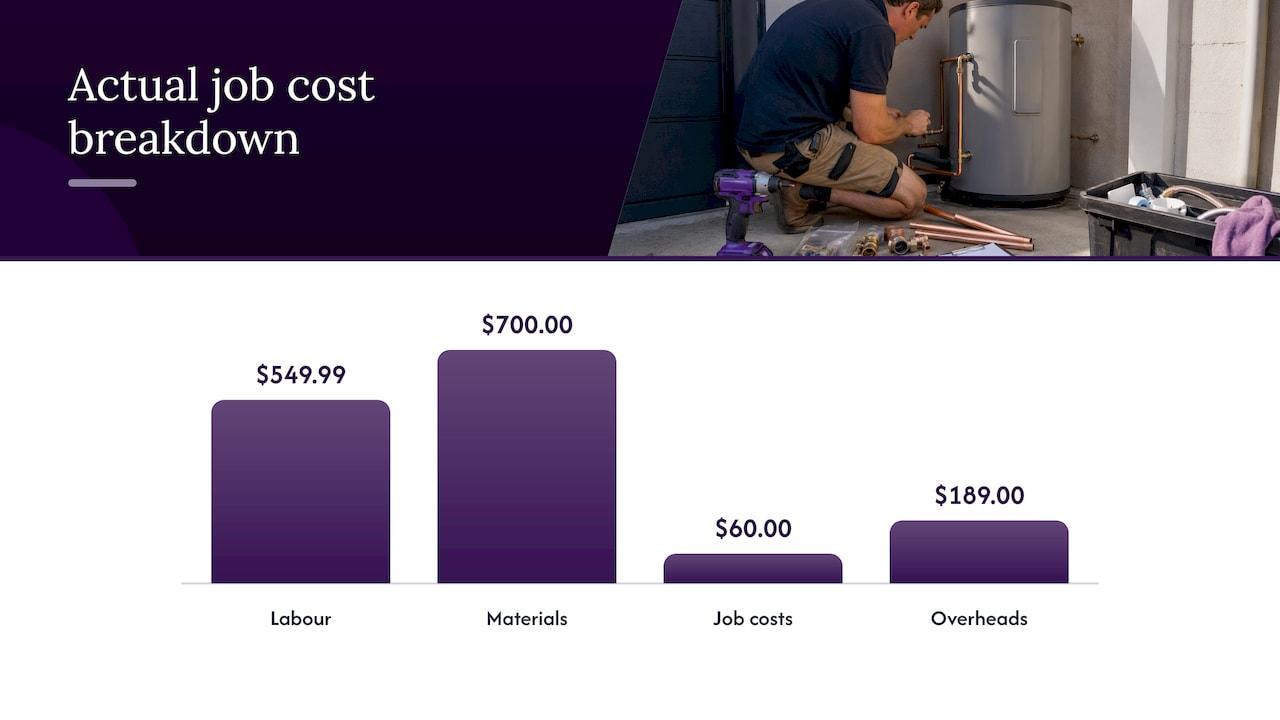
Step 4: compare with the actual. The job takes 10.5 hours because the old unit was hard to get out. Materials come in at $700.
| Cost item | Estimate | Actual |
|---|---|---|
| Labour | $419.04 | $549.99 |
| Materials | $640.00 | $700.00 |
| Job costs | $60.00 | $60.00 |
| Overheads | $144.00 | $189.00 |
| Total | $1,263.04 | $1,498.99 |
Against the $1,578.80 price, profit is $79.81, a margin of about 5.1% instead of the planned 20%. Two things caused it: 2.5 extra hours and $60 more in materials. Now you know what to do next time: allow more time for tight access on older installs, and confirm the unit price on the day you order, not the day you quote.
If the extra time came from something the customer changed or something you couldn’t see at the quote stage, that’s a variation, and the quote terms should cover it. Our piece on quote terms that protect your price and deposits shows where to put that protection.
Setting your price from the cost
Once you have a total cost, there are a few ways to turn it into a price.
Cost plus margin. The method used above. It’s the clearest, and it works best when you can estimate the job well.
Fixed price versus time and materials. Fixed prices suit well-defined work where you trust your estimate. Time and materials suit work with unknowns, such as renovations behind walls. A governance-focused article on choosing fixed price or time and materials lays out the questions to ask before you pick, and the same logic applies to a kitchen reno as it does to software projects. For trade work, the question that usually decides it is how much of the scope you can see before you start.
Hourly versus project pricing. If you charge by the hour, the cost method gives you the floor for that rate. If you charge by the project, it tells you whether the project number leaves enough room. This comparison of hourly rates versus project pricing is a helpful companion when you decide which suits each type of job in your mix.
Whichever you use, never let the price fall below your cost plus the minimum margin you set. That floor is the entire point of costing. For the five costs we think belong in every quote, see job pricing: the costs every Australian tradie must include.
Comparing estimates with actuals
The estimate is a forecast. The actual is the lesson. A short review at the end of each job is enough, and it only takes a few minutes if the data is already captured.
Ask four questions:
- Did hours match? Compare estimated and actual hours for each stage, not just the total. A job that ran on time overall can hide one stage that ran double.
- Did materials match? Compare quantities and unit costs separately. Overuse and price rises need different fixes.
- Did anything unexpected get added? Hire, rework, return trips, waiting for the customer.
- What was the final margin? Compare against your target and write down the single biggest reason for any difference.
After ten or twenty jobs of one type, you’ll have your own averages: how long a switchboard upgrade really takes, how much waste a tiled shower produces, how many trips a gutter replacement needs. Those averages are worth more than any rule of thumb you’ll find online, because they come from your crew, your suppliers and your area.
Common job costing mistakes
- Pricing from the last job, not from this one. Access, height, the age of the property and the customer’s finishing expectations all change the hours.
- Forgetting the unbillable hours. Quoting, driving to the supplier, invoicing and chasing payments all take time. Put them into overheads or into the job.
- Treating margin and markup as the same thing. The example above shows the difference.
- Leaving out your own wage. If the job only covers materials and a bit of cash, you’re subsidising the customer.
- Not recording the actuals. Without them, every quote starts from scratch.
- Losing time data on site. Writing hours on the back of a hand or a receipt means they don’t make it into the review.
What to track and where
You don’t need complicated software to start. A spreadsheet with one row per job and columns for estimated and actual hours, materials, job costs and final price will do. What matters is that you fill it in on the day.
As the business grows, the common pain points are the same: quotes in one place, timesheets in another, supplier invoices in a third, and the accounting package last. The more you can capture at the moment the work happens, the less you rebuild later. Look for a setup where quotes, invoices, tasks and reports sit together, and where entering a number takes seconds rather than a trip back to the office. Our guides on automated quoting for tradies and a hands-free quote to invoice workflow show what that can look like in practice.
Our view on job costing
We built Ask Hayley around one observation: tradies don’t skip job costing because they don’t care about profit. They skip it because it needs a laptop, and they’re on a roof, under a sink or in a ceiling cavity with their hands full.
So we think the best costing system is one you can use by talking. Hayley is designed to be voice-first, so you can capture quotes, tasks and admin through natural voice prompts instead of forms and dashboards. It’s designed to answer inbound calls when you can’t and pre-qualify leads before they land in your inbox, so the details of a job reach you before you price it, not after.
Our aim is simple: give you back the time you lose to admin and missed calls, without adding another app to learn. When quotes, invoicing, task management and reporting sit in one place, and connect with tools like Xero and AroFlo, the numbers you need for a job review are already there.
Costing is a habit, not a spreadsheet skill. The easier it is to capture, the more likely it is to happen.
Hayley
Where Ask Hayley fits
If your costing falls apart because the admin piles up after hours, that’s the problem Ask Hayley is designed to solve. It’s a voice-first business management platform for Australian tradies and small service businesses, with lead capture, call answering, quote generation, invoicing, task management, calendar, compliance tracking and reporting, plus integrations with Xero and AroFlo. There are two core plans, Assistant and Office Manager, with optional add-ons such as an AI Sales Agent and an AI Website Chatbot.

We also help with the professional side of winning work: a one page website, tender preparation, and safety and compliance documentation. See what Ask Hayley can do for your business and talk to us about the plan that suits the way you work.
FAQ
What is the difference between job costing and quoting?
Job costing is working out what a job costs you to deliver. Quoting is the price you give the customer, which should be built from that cost plus your target margin. Good quotes depend on good costing, and good costing improves after each job when you compare the estimate with what happened.
Do I need to include my own wage in a job cost?
Yes. If you work on the tools, your time is a real cost to the job, even if you don’t pay yourself a formal wage per hour. Leaving it out makes a job look more profitable than it is and leaves nothing for the weeks when work is slow.
What on-costs should I add to an employee’s hourly wage?
At a minimum, add super at 12% of ordinary-time earnings and your workers compensation premium, which varies by trade and state. Then allow for paid leave and public holidays, and check your award or agreement. Payroll tax only applies if your total wages pass your state or territory threshold. Your accountant or insurer can confirm the exact figures for your business.
How long does job costing take once I’m set up?
Once your labour rate and overhead rate are set, an estimate for a standard job takes a few minutes. The review afterwards takes about the same if hours and materials were recorded as you went. The time is made up quickly by fewer underpriced jobs.
Should I use a margin or a markup?
We recommend working in margin, because it shows what share of the price you keep. A 25% markup on cost gives a 20% margin. If you set your target as a margin and divide the cost by one minus that margin, your profit lands where you planned.
Sources
- CPCCCM3005 Calculate costs of construction work, training.gov.au
- The True Cost of Hiring an Employee in Australia, Expert360
- Understanding the Super Guarantee, AustralianSuper
- NSW workers compensation premium rates 2025-26, icare
- Employer Cost Calculator Australia, OneBookPlus
- Fixed price or time and materials, Ampersand
- Hourly rates versus project pricing, ExpressPlanner


