


Your first time fix rate is the share of jobs you finish on the first visit, with no return trip for parts, a second look or a missing detail. Work it out by dividing first-visit jobs by total jobs, then multiplying by 100. Most of what decides that number happens before you reach the driveway: how the call was taken, what you were told about the fault, and whether the right gear was in the ute. That is where Ask Hayley sits, answering calls and capturing job details by voice, so the information reaches you before you leave the yard.
TL;DR
- First time fix rate = jobs completed on the first visit ÷ total jobs × 100. Pick one clear definition of “fixed” and stick to it.
- Aquant’s 2026 benchmark puts the industry figure at 77%, top performers at 88% and bottom performers at 60%.
- Failed visits eat into margin: they make up 25% of total service cost at the benchmark and 44% for bottom performers.
- The biggest causes are wrong or missing parts, a gap in experience, too little time on site and no access. Most are fixed with better information at the first call.
- Triage every call, record the fault and the site details, then dispatch with the right gear and the right person.
Table of Contents
- What first time fix rate means for a tradie
- What a good first time fix rate looks like
- Why jobs don’t get fixed on the first visit
- How to lift your first time fix rate
- What a missed first visit really costs
- Why we built Ask Hayley around the first call
- Put it to work in your business
- FAQ
- Sources
What first time fix rate means for a tradie
First time fix (FTF) is a service-industry measure. It asks one question: did the job get resolved on the first visit? IBM’s guide gives the formula as first-visit jobs divided by total jobs handled, multiplied by 100. Its example is 160 jobs fixed first time out of 200, which is 80%.
Here is the same maths on a small crew. An air con installer and servicing business handles 40 service jobs in a month. 31 were finished on the first visit. The other 9 needed a return trip for a part, a second tradesperson or a change to the scope.
31 ÷ 40 × 100 = 77.5%
That sits right on the industry benchmark. It also tells you that nine return trips cost you travel, fuel, a second slot in the calendar and a customer who is waiting longer than they expected.
What counts as “fixed”
Decide this up front, because the number is only useful if you measure it the same way each month.
- Count it as first time fix when the job was completed, or the fault resolved, on the first on-site visit.
- Don’t count it when you had to come back for parts you didn’t carry, a skill or licence the first person didn’t have, or information you should have collected beforehand.
- Leave out planned multi-stage work. A bathroom reno or a re-roof was always going to take several visits. Measure the service and repair jobs, where one visit should be enough.
It is also not the same as first-contact resolution. IBM separates the two: FTF is about the on-site visit, while first-contact resolution is about solving the issue on the first phone, chat or email contact. A quick phone fix for a tripped switch is the second one.
How it differs from callbacks and repeat visits
Three terms get mixed up. A repeat visit is a return to the same property. A callback is a return because of work you already finished. A plumbing business guide draws that same line. A low first time fix rate means you are making repeat visits because the first one was incomplete. A callback means the work was done but came back to bite you. Track both, but don’t blend them into one figure.
What a good first time fix rate looks like
The best public yardstick comes from Aquant’s 2026 Field Service Benchmark Report, built on 161 service organisations and nearly 30 million service events.
| Performance level | First time fix rate | Failed visits as a share of total service cost |
|---|---|---|
| Top performers | 88% | 14% |
| Industry benchmark | 77% | 25% |
| Bottom performers | 60% | 44% |
The same report found each failed visit adds roughly 13.7 days to the time it takes to resolve the issue. For a tradie, that is a customer waiting two weeks for something that should have been done in one go. It is also a customer who rings someone else.
Use these as a rough guide, not a pass mark. Those organisations work across a range of equipment and service types. A sparkie doing fault-finding in old switchboards will see a different number from a gutter cleaner with a standard job. Your best target is your own number from last quarter, nudged up.
Why jobs don’t get fixed on the first visit
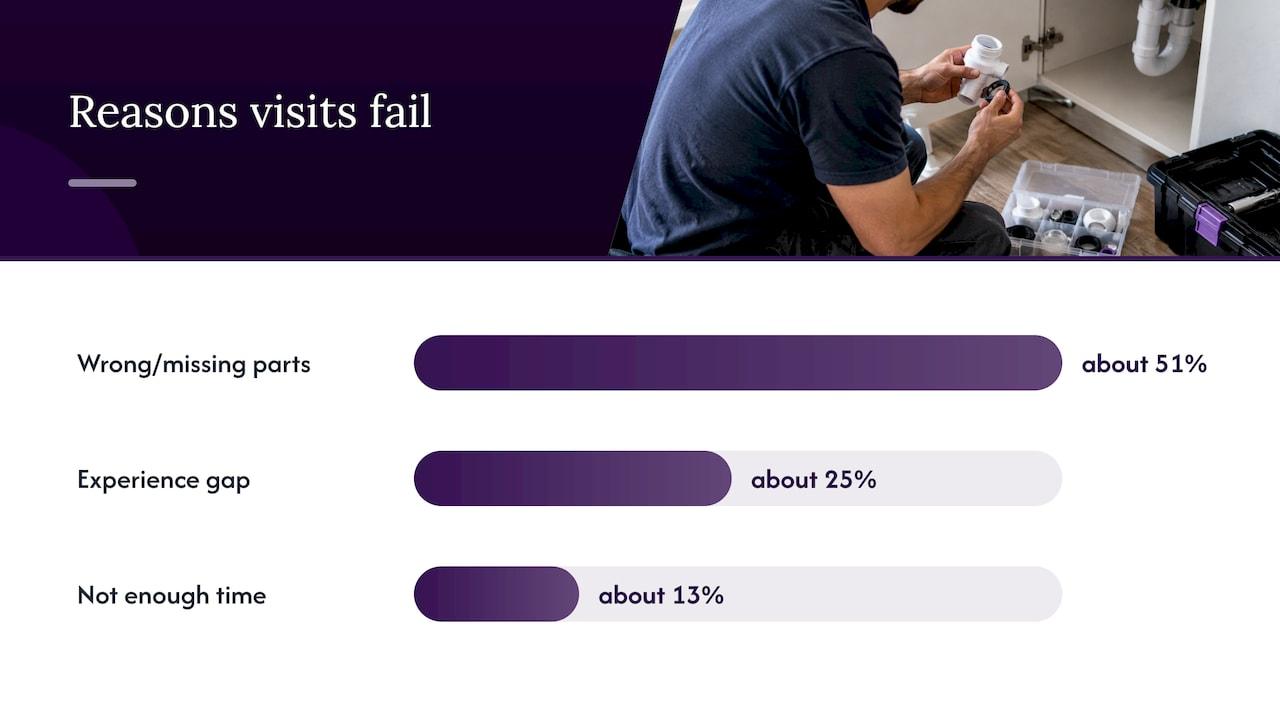
IBM lists five common causes of low first time fix: technician skill gaps, poor communication at dispatch, incomplete documentation, not enough inventory, and complex or obsolete equipment.
Research from Aberdeen, reported by Ventavid, puts rough numbers on the main reasons visits fail:
- Wrong or missing parts: about 51%
- A technician without the necessary experience: about 25%
- Not enough time on site: about 13%
- A further recurring cause: no access, or the site wasn’t ready
Read that list again as a tradie. Nearly all of it is information. The wrong part gets loaded because the fault was described badly. The job is booked for an hour because nobody asked how big it was. The gate is locked because nobody confirmed access. The wrong person turns up because the job was never matched to the skill.
Where it goes wrong on a normal week
- The vague call. “My hot water’s gone off” could be an element, a thermostat, a pressure relief valve or a gas supply issue. Without the make, model and what the unit is doing, you load the ute for a guess.
- The missed call. You’re on a roof, the phone rings out and the customer books the next business that answers. When they do get through later, the details come in a rush, or not at all. Our guide on first call answer rate covers why that first pickup matters.
- The squeezed slot. A job that needs two hours is booked into a 45-minute gap because the calendar looks tidy.
- The wrong person. The job needs a licence, a tool or experience the person sent doesn’t have.
- The unrecorded history. Last time someone was at the property, they noted a seized isolator. That note is in someone’s head or on a scrap of paper.
How to lift your first time fix rate
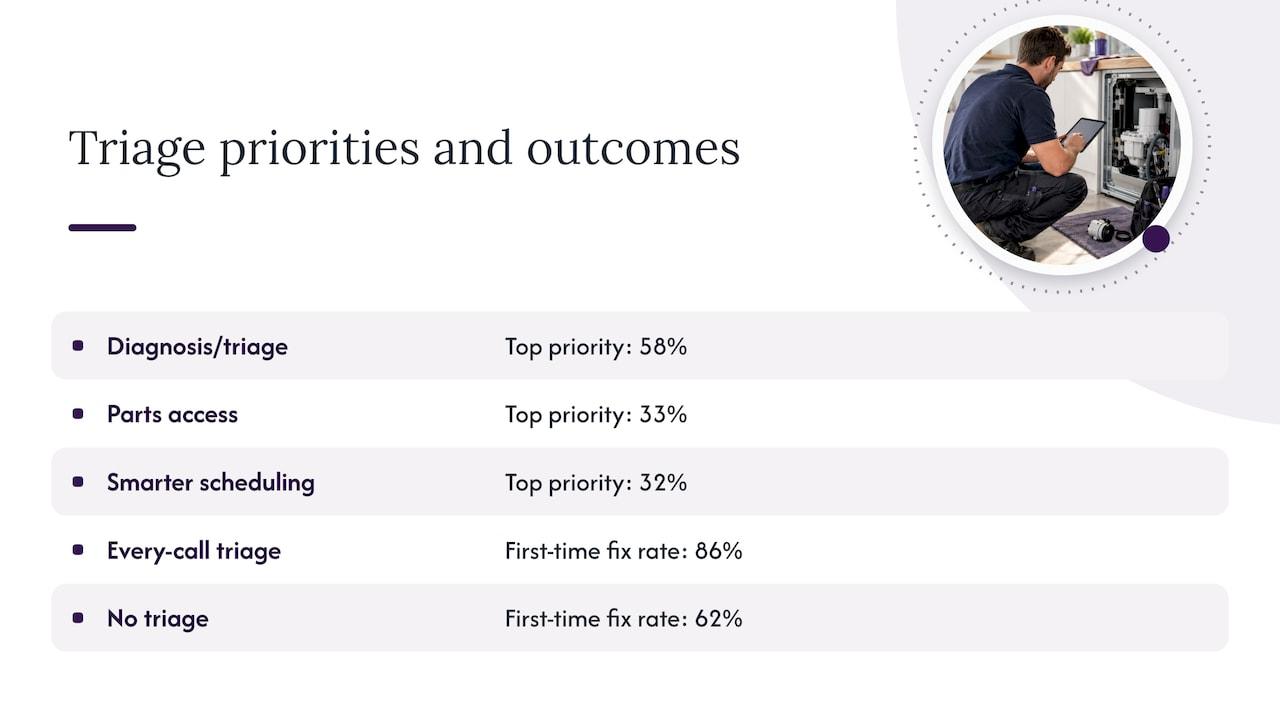
The pattern in the research is clear: the fix starts at the desk, or in your case at the phone, not in the van. Ventavid’s reading of the Aberdeen data says 58% of organisations put better diagnosis or triage at the first call as their top priority, ahead of parts access at 33% and smarter scheduling at 32%. The same source reports organisations that triaged every incoming call had an 86% first time fix rate against 62% for those with no triage.
Here is the routine, step by step.
1. Triage every call, including the ones you can’t pick up
Triage means asking a short, fixed set of questions so you know what you are walking into. Ask what the problem is, what it is doing, where it is, how urgent it is and whether anyone will be there to give access. Trade by trade, those questions differ: a roofer asks about roof type and where the leak shows inside, a pool maintenance tech asks about pump model and what the water looks like.
The weak point is that triage only works if someone is free to do it. On a job site, you’re not. Ask Hayley answers inbound calls when you can’t and pre-qualifies leads before they land in your inbox. You can see how that works in our guide to AI call triage for Australian tradies, and the lead prequalification questions page shows the kind of questions worth asking. If a missed call has already happened, missed call recovery is the next step.
2. Get the identifiers and the evidence
Before you book, collect what lets you prepare:
- Make, model and age of the equipment
- Any fault code, error display or noise description
- A photo or short video, where the customer can send one
- Access details: gate codes, pets, strata or building manager, parking
- What has already been tried
This is the information that decides whether the right part is on the truck. Ventavid’s analysis points to the equipment identifier, the fault display and video as the details worth capturing, along with customer details and job and asset history, before dispatch.
3. Match the job to the person
This is where the skills gap shows up. Put the licensed or experienced person on the job that needs it, and don’t send an apprentice alone to something they haven’t seen. Where your team is stretched thin on experience, adding a skilled hire is a real fix, and fixed-fee recruitment for trades roles is one way to keep that cost predictable.
4. Book the right amount of time
The second most common reason is simply not enough time on site. Book by job type, not by gap in the diary. If the diagnosis is uncertain, book a longer slot, or split it into a short diagnostic and a quoted repair, and tell the customer that is what you’re doing. Our guides to field service dispatch and hands-free job scheduling go deeper on this.
5. Load the ute from the job, not from habit
Once you have the model and fault, check the likely parts against what’s on board. A short list of the ten parts you most often return for is usually enough to cut a lot of second trips. Don’t overdo it either. Carrying everything ties up cash and slows you down, so build the list from your own return-trip history.
6. Write the history down where you can find it
Record what you found, what you did and what you would need next time against the customer and the site. Work order tracking keeps one record per job so the next visit doesn’t start from zero.
7. Measure it monthly
Count your service jobs, count how many needed a return trip, and note the reason in one word: parts, skill, time, access, information. After three months you will know which of the five is costing you most. Our page on field service KPIs and the one on utilisation rate calculation show how to put it next to your other numbers.
What a missed first visit really costs
It’s easy to think of a return trip as a minor annoyance. Put numbers on it. Say a return visit costs you 90 minutes of travel and setup time, fuel and a lost slot you could have sold at your normal rate. Nine return trips a month, as in the earlier example, is over 13 hours, close to two working days that you could have spent on paid work.
Aquant’s data shows the same pattern at scale: failed visits are 25% of total service cost at the benchmark, and 44% for bottom performers. The way out isn’t working faster. It’s walking in with the right information.
There’s also the customer side. A job fixed first time is the one that gets the review, the referral and the next call. A job that drags over a fortnight gets a polite message, and sometimes a refund request.
Why we built Ask Hayley around the first call
Most tradies we talk to describe the same week. The phone rings while you’re on the tools, you call back at 6pm, the details are fuzzy, and then you load the ute on a guess.
We built Ask Hayley as a voice-first platform because that’s the reality of trade work: hands full, on site, no time to sit at a screen. Hayley answers calls when you can’t and pre-qualifies leads before they land in your inbox, so the job arrives with its facts attached.
From there you run the business by talking: quotes, invoices, tasks and your calendar, with Xero and AroFlo integrations behind it. We don’t think a tradie should need another app to learn.
First time fix is a number about preparation. The sooner the right questions are asked, the better the visit goes. That’s the job we designed Hayley to do.
Hayley
Put it to work in your business
If you want the calls answered and the job details captured before you head out, Ask Hayley is built for exactly that. It runs on two plans, Assistant and Office Manager, with an AI Sales Agent and AI Website Chatbot as add-ons for wider coverage across calls, leads and customer enquiries.

We also build the front end that sends you better-qualified enquiries: a One Page Website that tells customers what to have ready when they call, plus tendering and safety and compliance documentation for the bigger jobs. See everything at Ask Hayley.
FAQ
What is a good first time fix rate for a trade business?
The 2026 Aquant benchmark puts the industry figure at 77%, with top performers at 88% and bottom performers at 60%. Measure your own repair and service jobs for a quarter, then aim to lift that number steadily. Your trade, the age of the equipment you work on and the kind of customers you have will all move it.
How do I calculate first time fix rate?
Divide the number of jobs finished on the first visit by the total number of jobs, then multiply by 100. If you completed 31 of 40 service jobs first time, your rate is 77.5%. Leave out planned multi-visit projects so the number reflects repair and service work only.
Is first time fix the same as a callback rate?
No. First time fix measures whether the first visit completed the job. A callback is a return trip because work you already finished has failed or needs adjusting. Track both so you can tell whether the problem is preparation or workmanship.
What’s the quickest way to improve it?
Improve what you know before you leave. Ask a fixed set of questions on every call, collect the model, the fault and any photos, and book enough time. Reported Aberdeen data shows organisations that triaged all incoming calls had a first time fix rate of 86% against 62% without triage.
Sources
- 2026 Field Service Benchmark Report, Aquant
- What is First-Time Fix Rate (FTFR)?, IBM
- How to improve first-time fix rate, Ventavid
- Plumbing Callback Rate: What Is A Good Benchmark?, KMF Business Advisors


