


For most small jobs, Net 7 or Net 14 is the right call. These terms keep cash moving, reduce the risk of clients forgetting, and are increasingly standard among Australian tradies and service providers. Reserve Net 30 for established clients with a solid payment history or for larger negotiated projects where the relationship justifies the wait.
Here is what to add to every invoice before you send it:
- Exact due date — write “Payment due by 15 July 2026”, not “due upon receipt” or “payable within 30 days”
- Accepted payment methods — bank transfer (BSB and account number), credit card, or a payment link
- Your ABN and GST wording — required for any tax invoice over $82.50
- Late fee policy — state the fee clearly so it is enforceable; more on this below
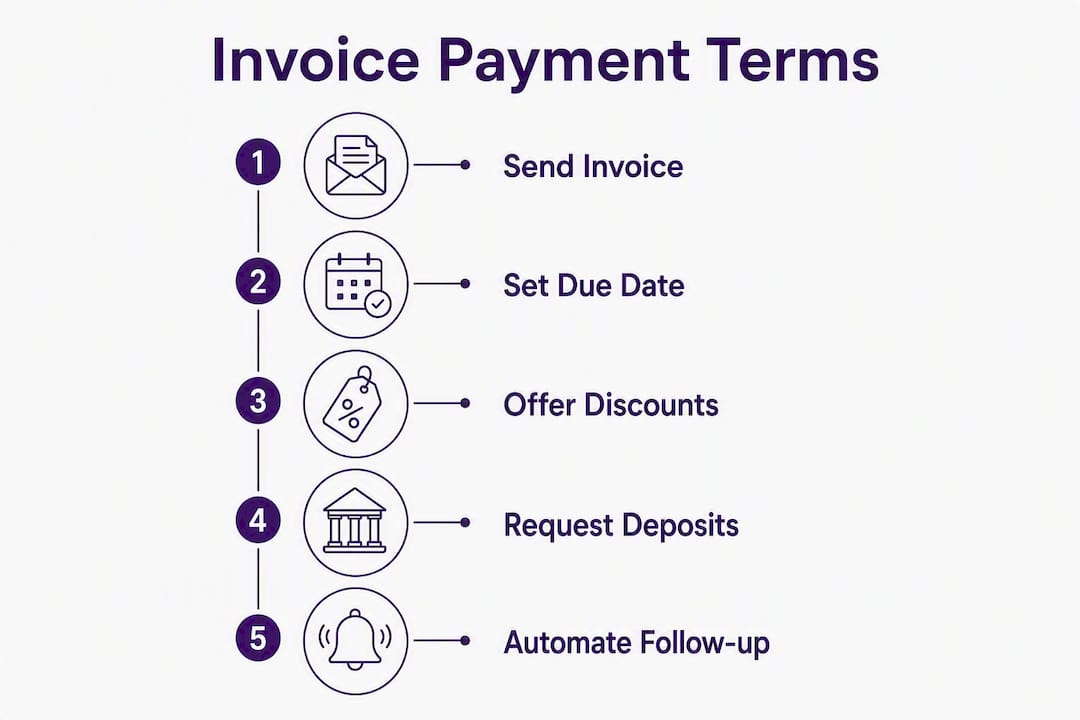
Send the invoice the moment the job is done. The payment clock starts on receipt, so every hour you wait is an hour added to your wait for payment.
Pro Tip: Set up an invoice template today with all four fields pre-filled. The only thing you should be changing job to job is the line items, the amount, and the due date.
Table of Contents
- What are invoice payment terms and why do they matter?
- What are the most common payment terms used in Australia?
- How do you choose the right payment terms for your business?
- How do you write payment terms on invoices and what does the ATO require?
- What do you do when a client pays late?
- How does automation reduce the time it takes to get paid?
- Key takeaways
- Why consistent payment terms changed how I think about cash flow
- Ask Hayley helps tradies get invoices out faster and get paid sooner
- Useful Australian sources and templates
What are invoice payment terms and why do they matter?
Payment terms are the conditions you and your client agree on for when and how an invoice gets paid. They cover the due date, accepted payment methods, and the consequences of paying late. Simple enough in theory. In practice, they are one of the most overlooked levers a small business has for managing cash flow.
Without written payment terms, Australian contract law implies payment within a “reasonable time.” That phrase sounds harmless, but it is legally vague, hard to enforce, and almost always interpreted in the client’s favour — not yours.
The difference between “payment due 22 July 2026” and “payment due within a reasonable time” is the difference between a clear legal obligation and an argument. When terms are consistent across your quotes, contracts, and invoices, clients know what to expect, disputes drop, and your average days sales outstanding (DSO) shrinks. DSO is simply the average number of days it takes to collect payment after an invoice is issued — the lower it is, the healthier your cash flow.
Sprintlaw’s legal guide for Australian businesses confirms that the absence of agreed terms leaves payment timing open to interpretation under contract law. That is a risk no tradie or small service business needs to carry.
What are the most common payment terms used in Australia?
Business.gov.au lists Net 7, Net 14, and Net 30 as the most common shorthand terms, with shorter windows increasingly preferred by small and medium businesses. Here is what each one means in plain English, when to use it, and how to word it on an invoice.
| Term | Meaning | Best for | Cash-flow impact | Sample invoice wording |
|---|---|---|---|---|
| Net 7 | Full payment due 7 days from invoice date | Small jobs, new clients, high-volume work | Excellent | “Payment due by [exact date], 7 days from invoice date.” |
| Net 14 | Full payment due 14 days from invoice date | Mid-size jobs, regular clients | Good | “Payment due by [exact date], 14 days from invoice date.” |
| Net 30 | Full payment due 30 days from invoice date | Larger projects, established clients | Moderate | “Payment due by [exact date], 30 days from invoice date.” |
| Due on receipt | Payment expected immediately on receiving the invoice | Small cash jobs, one-off clients | Best | “Payment due immediately upon receipt of this invoice.” |
| Payment in Advance (PIA) | Full payment before work starts | New clients, custom orders, high-risk jobs | Best | “Full payment required before work commences.” |
| Cash on Delivery (COD) | Payment at the time goods or services are delivered | Supply-only or delivery jobs | Very good | “Payment required at time of delivery.” |
| Instalment / milestone | Agreed payments at project stages | Large builds, long-term contracts | Varies | “Deposit of 30% due on signing; balance due on practical completion.” |
| EOM + days | Payment due a set number of days after end of month | Ongoing supplier relationships | Moderate | “Payment due 14 days after end of month of invoice.” |
| 2/10 Net 30 | 2% discount if paid within 10 days; full amount due by day 30 | Clients you want to incentivise | Good if taken up | “2% discount applies if paid within 10 days; full amount due by [date].” |
A few practical notes on which term to reach for:
- New client, small job: start with Net 7 or due on receipt. You have no payment history with them yet.
- Established trade client, larger project: Net 14 to Net 30 is reasonable, with a deposit upfront.
- Ongoing supply of goods: consider a retention of title clause so you retain ownership of materials until paid in full. This protects you if a client becomes insolvent.
- Large construction or fitout: milestone invoicing tied to project stages is standard practice and reduces your exposure on long jobs.
Early payment discounts like 2/10 Net 30 are a legitimate tool for improving cash flow, as noted in invoicing guides for small businesses. They work best when the discount cost is less than the benefit of receiving cash sooner.
How do you choose the right payment terms for your business?
The right terms depend on four things: your cash-flow needs, the client’s size and reliability, the contract value, and what is normal in your industry. Here is a practical decision checklist.
Before agreeing terms, ask yourself:
- How long can my business operate comfortably without this payment?
- Is this a new client or an established one with a clean payment record?
- What is the total contract value? Higher value means higher risk if payment is delayed.
- Does my industry have a standard (e.g. construction progress claims, creative services 50% deposit)?
- Am I supplying physical goods? If so, a retention of title clause is worth adding.
Questions to ask the client before starting work:
- How does your accounts payable process work, and what is your standard payment cycle?
- Do you prefer bank transfer, credit card, or another method?
- Who approves invoices on your end, and how long does that take?
Knowing their internal approval cycle before you agree terms prevents the classic situation where you invoice on Net 14 and their accounts team only processes payments once a month.
Red flags that should trigger tighter terms:
- New client with no references or credit history
- Offshore client or one operating through multiple entities
- Client who has been slow to respond during the quoting stage
- Any client who pushes back hard on a deposit or advance payment
When red flags appear, tighten the terms. Ask for a deposit of 30–50% upfront, shorten the payment window, or require payment in advance. Smaller businesses should set terms that suit their own cash-flow needs rather than defaulting to the longer windows that large corporates prefer.
Pro Tip: For larger jobs, break the invoice into milestones: a deposit before work starts, a progress claim at the halfway point, and a final invoice on completion. This limits your exposure and keeps cash flowing throughout the job.
How do you write payment terms on invoices and what does the ATO require?
Getting the wording right on your invoice matters for two reasons: it protects you legally, and it keeps your GST claims valid. The ATO sets out mandatory tax invoice requirements that every GST-registered business must follow.

ATO tax invoice checklist
For any taxable sale of $82.50 or more, your invoice must include:
- The words “Tax Invoice” at the top
- Your ABN
- The date the invoice was issued
- A description of the goods or services supplied (including quantity where applicable)
- The GST amount payable, or a statement that the total price includes GST
- For sales over $1,000: the buyer’s identity or ABN
The business.gov.au invoicing guide confirms these fields are mandatory. Missing any one of them can invalidate your client’s GST claim, which creates friction and delays payment while they ask you to reissue.
ATO thresholds and record-keeping at a glance
| Threshold | Requirement |
|---|---|
| Under $82.50 (GST-inclusive) | Tax invoice not required, but good practice to issue one |
| $82.50 and above | Tax invoice required on request; must be provided within 28 days |
| Over $1,000 | Must include buyer’s identity or ABN |
| Record-keeping period | Keep all tax invoices for a number of years as required by law |
How to state the due date clearly
Avoid phrases like “payment due upon receipt” or “net 30 days” without an actual date. Write the exact calendar date: “Payment due by 22 July 2026.” This removes any ambiguity about when the clock started and gives you a clear reference point if you need to chase the debt.
Payment method details to include
List every method you accept and provide the details needed to pay:
- Bank transfer: BSB, account number, and account name
- Credit card or payment link: include the URL or QR code directly on the invoice
- BPAY: biller code and reference number if applicable
Practical invoicing advice consistently shows that including a payment link on the invoice reduces friction and improves on-time payment rates. Make it as easy as possible for your client to pay.
What do you do when a client pays late?
Late payment is one of the most common stressors for small Australian businesses. A clear escalation process takes the emotion out of it and gives you a consistent, lawful approach every time.
Escalation timeline
- Day 0: Send the invoice immediately on job completion. Include all required fields and the exact due date.
- Day 1–7 (before due date): Send a brief, friendly reminder a few days before the due date. Keep it short.
- Day 1–7 after due date: First overdue notice. Polite but clear. Reference the invoice number and due date.
- Day 8–14 after due date: Second notice. Firmer tone. Mention your late fee policy and that you may suspend further work or supply.
- Day 15–30 after due date: Final written demand. State the total amount owing including any accrued late fees, and give a final deadline (e.g. 7 days) before you refer the matter.
- Post-30 days: Formal demand letter, debt collection agency, or legal action depending on the amount.
Sample reminder templates
Friendly pre-due reminder (Day 3–5):
“Hi [Name], just a quick note that Invoice #[number] for $[amount] is due on [date]. Please let me know if you have any questions. Payment details are on the invoice. Thanks, [Your name].”
First overdue notice (Day 1–7 after due date):
“Hi [Name], Invoice #[number] for $[amount] was due on [date] and remains unpaid. Please arrange payment at your earliest convenience or contact me if there is an issue. Late fees apply as per our agreement.”
Final demand (Day 15–30):
“Dear [Name], Invoice #[number] for $[amount], issued [date] and due [date], remains outstanding. A late fee of $[amount] has been applied in accordance with our signed agreement. Payment of $[total] is required by [final date]. If payment is not received, I will refer this matter to a debt collection agency / solicitor without further notice.”
Late fees must represent a genuine pre-estimate of the loss you suffer from late payment. An arbitrary or excessive penalty can be struck down by a court as unenforceable. State the fee clearly in your signed service agreement before work starts — that is what makes it stick.
Legal recovery options in Australia
- Debt collection agency: suitable for amounts under $10,000–$15,000 where the cost of legal action outweighs the debt. Agencies typically charge a percentage of the recovered amount.
- Small claims / VCAT / NCAT / QCAT: state-based tribunals handle small business disputes quickly and cheaply. Limits vary by state but are generally up to $25,000–$100,000.
- Solicitor’s letter or legal proceedings: appropriate for larger amounts or where the debtor is disputing the debt.
- Limitation periods: in most Australian states, the limitation period for a simple contract debt is several years from the date the debt became due. Do not let a debt sit unactioned for years.
A numbered internal checklist helps keep your team consistent:
- Invoice sent on day of job completion
- Payment reminder scheduled 3 days before due date
- Overdue notice sent on day 1 after due date
- Second notice sent on day 8 after due date
- Final demand sent on day 15 after due date
- Refer to collection or legal on day 30 if unpaid
How does automation reduce the time it takes to get paid?
Sending invoices immediately and automating follow-up reminders are the two most effective ways to cut DSO. Xero’s invoicing guide makes this point directly: the payment clock starts when the client receives the invoice, so every delay in sending is a delay in getting paid. Businesses that invoice on completion and automate reminders consistently collect faster than those that batch invoices at the end of the week or month.

For tradies, the practical challenge is that you are on-site, hands full, and the last thing you want to do at the end of a job is sit in the van filling out an invoice form. That is where voice-first tools change the equation.
Here is how a tradie would use Ask Hayley’s voice-first admin platform to get an invoice out before leaving the site:
- Voice capture: say “Job done, invoice Mrs Chen for the hot water system replacement, $1,450 including GST, due in 7 days”
- Instant invoice generation: Hayley creates the invoice with all required ATO fields, the exact due date, and your payment details
- Payment link included: the client receives an invoice they can pay immediately from their phone
- Automated reminders: if the invoice is not paid by day 5, Hayley sends a polite reminder automatically
The cash-flow and productivity benefits are straightforward:
- Fewer hours spent on end-of-day or end-of-week admin
- Invoices out faster, which means the payment clock starts sooner
- Consistent follow-up without you having to remember or feel awkward chasing
- Reduced disputes because every invoice includes the correct ATO fields and agreed terms
- Integration with Xero means your accounts stay current without double-handling
Pro Tip: If you are currently batching invoices at the end of the week, try switching to same-day invoicing for just one week and track how it affects your payment timing. Most tradies who try it never go back.
Key takeaways
Clear, short payment terms — sent immediately and followed up consistently — are the single most effective way for small Australian businesses to reduce late payments and protect cash flow.
| Point | Details |
|---|---|
| Use short terms by default | Net 7 or Net 14 suits most small jobs; reserve Net 30 for established clients with a strong payment history. |
| Include exact due dates | Write the calendar date on every invoice — “Payment due by 22 July 2026” — not vague phrases like “net 30 days.” |
| Meet ATO tax invoice requirements | Include “Tax Invoice,” your ABN, issue date, description, and GST amount; add buyer identity or ABN for sales over $1,000. |
| State your late fee policy upfront | Late fees must be a genuine pre-estimate of loss and must appear in your signed agreement before work starts. |
| Ask Hayley automates the process | Ask Hayley’s voice-first platform lets tradies generate invoices on-site and send automated reminders, reducing DSO without extra admin. |
Why consistent payment terms changed how I think about cash flow
Most tradies I speak with treat payment terms as an afterthought. They finish a job, send an invoice whenever they get a chance, and then feel awkward chasing when it goes overdue. The terms themselves are often vague — “due upon receipt” on an invoice sent three days after the job, with no follow-up plan.
The shift that makes the biggest difference is not the specific term you choose. It is the consistency. When you use the same terms on every quote, every contract, and every invoice, clients stop questioning them. They become a normal part of doing business with you. The awkwardness of chasing disappears because the expectation was set before work started, not after.
Net 7 feels aggressive to some tradies at first. It is not. It is a professional standard that signals you run a tight operation. Clients who baulk at Net 7 on a small job are often the same ones who will test your patience on payment. That is useful information before you start work, not after.
The other shift worth making: stop waiting until you are back at the office to send the invoice. The job is done, the client is happy, and you are standing right there. That is the moment to send it. Every hour you wait is an hour added to your DSO.
From next job: set your terms in the quote, include the exact due date on the invoice, and send it before you drive away.
Ask Hayley helps tradies get invoices out faster and get paid sooner
Chasing late payments is one of the most draining parts of running a trade business. You did the work. You should not have to fight for the money.
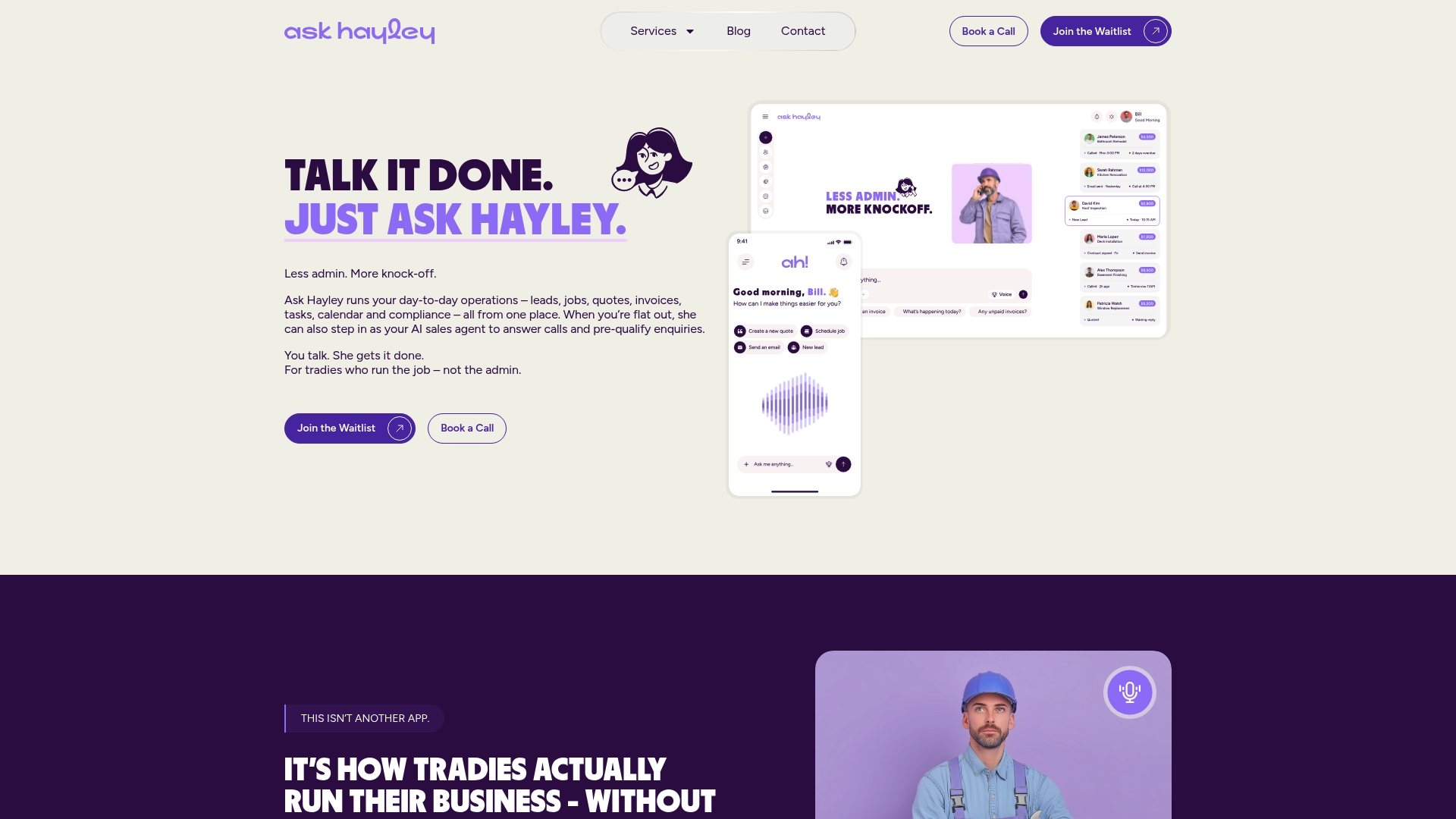
Ask Hayley is built for exactly this situation. It is a voice-first business management platform for Australian tradies that handles invoicing, reminders, and follow-up without you needing to sit at a screen. Finish the job, tell Hayley what to invoice, and the invoice is out before you start the drive home. Automated reminders go out on schedule, integrated with Xero so your accounts stay current, and you never have to feel awkward chasing a client again.
No extra app to learn. No end-of-week admin pile. Just faster payments and more time on the tools.
See how Ask Hayley works or explore the full services to find the plan that fits your business.
Useful Australian sources and templates
These are the authoritative sources to bookmark for payment terms, tax invoice compliance, and late payment guidance.
- ATO: Tax invoices — the primary source for mandatory tax invoice fields, GST thresholds ($82.50 and $1,000), the 28-day rule for providing invoices on request, and the 5-year record-keeping requirement.
- business.gov.au: Payment terms — covers common term types (Net 7/14/30), retention of title clauses, and practical guidance on setting terms that protect your business.
- business.gov.au: How to invoice — step-by-step invoicing guidance including mandatory fields, sample invoice layouts, and what to do if a client disputes an invoice.
- Sprintlaw: Setting invoice payment terms — legal analysis of payment term enforceability in Australia, including late fee rules, the “reasonable time” default under contract law, and when to involve a solicitor.
- Xero AU: Invoice payment terms guide — practical accounting guidance on DSO, why shorter terms and immediate invoicing improve cash flow, and how to automate reminders.
Template notes:
- Invoice wording template: use the sample wording in the common terms table above. Copy the relevant row’s sample wording into your invoice template and replace the bracketed date with the exact calendar date.
- Reminder templates: the three-stage templates in the late payment section (friendly, firm, final demand) are ready to copy into your email drafts or invoicing software.
- Escalation checklist: the numbered six-step checklist in the late payment section gives you a repeatable internal process.
Record keeping: the ATO requires you to keep tax invoices and related records for 5 years. Store them in your accounting software (Xero, for example, retains records automatically) or in a secure cloud folder. This applies to both invoices you issue and invoices you receive from suppliers.
This article provides general information about invoice payment terms in Australia. It is not legal or financial advice. For guidance specific to your situation, consult a qualified accountant, solicitor, or visit ato.gov.au and business.gov.au directly.


