


Yes, retention is invoiced in Australia, and GST on the retained portion is attributable only at the earlier of when you actually receive the money or when you issue a valid tax invoice for the retention after the defects period ends. That single rule, drawn from ATO guidance on GST in property and construction, shapes every bookkeeping and BAS decision you make around retention money.
Three actions to take right now:
- Issue a separate tax invoice for each retention release, never roll it into another progress claim document.
- Track the defects liability expiry date as a hard calendar trigger, not a mental note.
- Reconcile your retention receivable accounts against your BAS periods, or ask your accountant to do it before each lodgement.
The worked example in the GST timing section below shows exactly how the maths plays out across a typical job.
Key takeaways
GST on retention money in Australia is attributable only when the retention is received or a valid tax invoice for the retention is issued after the defects period ends, not when the original progress claim is submitted.
| Point | Details |
|---|---|
| GST timing on retention | Attributable at the earlier of receipt or a valid tax invoice issued after the defects period ends. |
| Separate retention-release invoice | Always issue a standalone tax invoice for each retention release to control GST timing and the audit trail. |
| Bookkeeping accounts | Use dedicated Retentions Held (asset) and Liability for Defects (liability) accounts in Xero or MYOB. |
| State trust-account rules | Check NSW and WA thresholds — some projects require retention to be held in a trust account, not general funds. |
| Record-keeping | Keep all tax invoices, progress claims, and DLP certificates for seven years as required by the ATO. |
| Ask Hayley | Automates DLP reminders, draft invoice creation, and Xero integration so no retention release date is missed. |
Table of Contents
- What retention money is and how it flows through an Australian construction contract
- When to invoice retention and when GST is attributable under ATO guidance
- How to account for retention amounts correctly
- Practical bookkeeping workflow, tax invoice checklist and record-keeping
- State-level trust and ring-fencing rules for retention money
- A practical checklist and workflow for managing retention per job
- Common mistakes contractors make with retention invoices
- Why treating each retention like a mini-project changes everything
- How Ask Hayley helps contractors stay on top of retention timing
- Sources
What retention money is and how it flows through an Australian construction contract
Retention money is the portion of each progress payment that a principal or head contractor withholds to secure the subcontractor’s obligation to fix defects. It is not a penalty. It is a conditional debt, owed to you, that sits in limbo until specific contract milestones are met.
In most Australian construction contracts, retention is structured around two release points:
- Practical completion: typically half the total retention is released when the works reach practical completion and a certificate is issued.
- End of defects liability period (DLP): the remaining half is released after the DLP expires, typically following the end of the defects liability period, provided defects have been rectified.
A typical job timeline looks like this: you submit progress claims throughout the build, each reduced by the retention percentage. At practical completion, you claim half the retention. The DLP clock starts. Twelve months later, you issue a final retention-release invoice for the balance, provided defects are cleared. That final invoice is where most GST timing mistakes happen.
Some contracts, particularly those using NEC3 or NEC4 forms, offer alternatives to cash retention, such as retention bonds or retention funds under clause X16. These reduce the cash-flow drag of traditional retention but are less common in the Australian residential and small commercial market.
When to invoice retention and when GST is attributable under ATO guidance
The core attribution rule
ATO guidance (PAR 2017/2) is clear: GST on the retention portion of a progress claim is attributable at the earlier of:
- The date you actually receive the retained amount, or
- The date you issue a valid tax invoice for the retained amount, provided the defects period has ended.
This means you do not owe GST to the ATO on the retained portion just because you included it in a progress claim. The entitlement has not yet crystallised. HIA confirms this position with a worked example showing that GST on the withheld sum is calculated and invoiced separately, only when the retention becomes due for release.
Accrual vs cash BAS reporters
For cash-basis BAS reporters, the rule is straightforward: GST is reported in the period you receive the cash. Retention money sits outside your BAS until the money lands in your account.
For accrual-basis reporters, the special retention attribution rule is what protects you. Without it, you would owe GST in the period you issued the original progress claim, even though you have not received the retained portion. The ATO’s position defers that liability to the period in which a valid retention-release tax invoice is issued or the cash is received, whichever comes first. Check the ATO’s BAS guidance for how attribution periods interact with your reporting cycle.
Worked example: splitting a progress claim
Imagine a subcontract with a total value of $220,000 (including GST).
Progress claim 3:
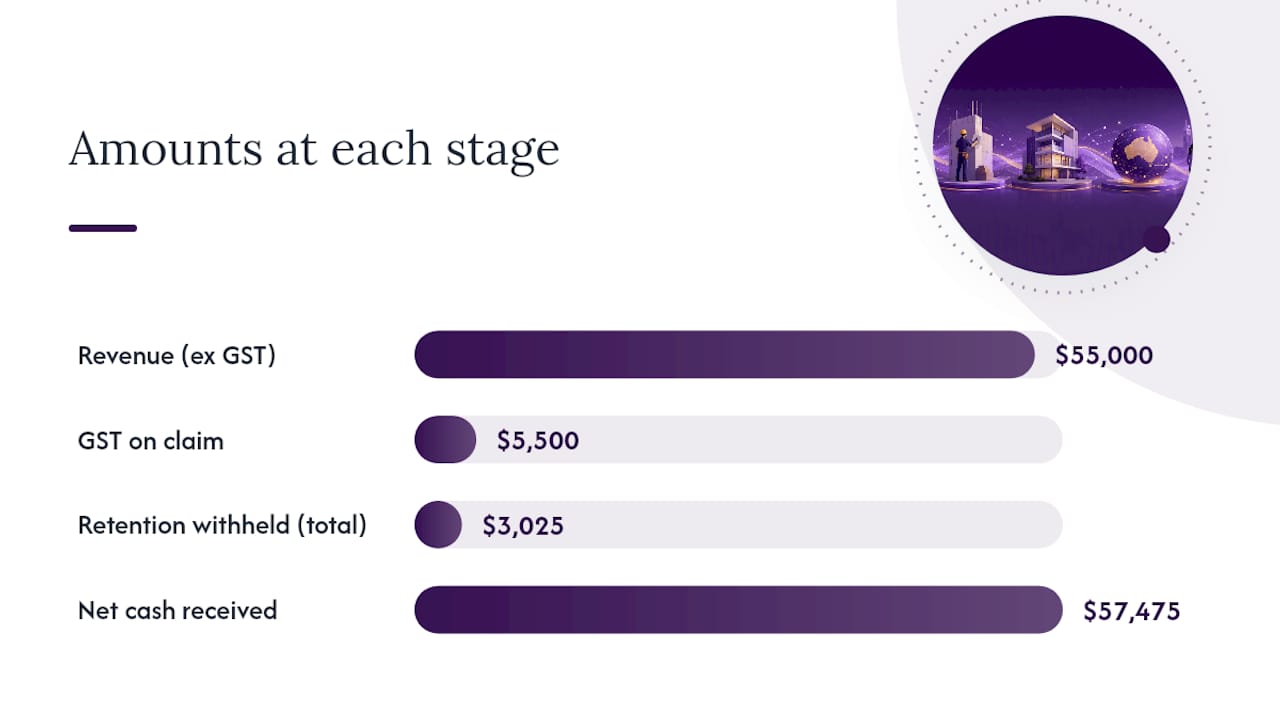
- Gross value of work completed this period: $55,000 (ex-GST)
- GST on gross value: $5,500
- Retention withheld (5% of $55,000): $2,750 (ex-GST)
- GST on retention: $275
- Net payable now: $55,000 + $5,500 − $2,750 − $275 = $57,475
- GST attributable this BAS period: $5,225 (GST on the net payment only)
- GST deferred on retention: $275 (attributable only when retention is released and invoiced)
When the DLP expires and you issue the retention-release tax invoice for $3,025 ($2,750 + $275 GST), that $275 GST hits your BAS in that period, not the period of the original progress claim.
Pro Tip: Always issue a distinct, standalone tax invoice for each retention release. Never fold the retention amount into the next progress claim or a variation invoice. A separate document gives you clean control over GST timing and makes the audit trail obvious for your accountant and the ATO.
How to account for retention amounts correctly
AASB 15 and revenue recognition
Under AASB 15 (Revenue from Contracts with Customers), revenue is recognised when, or as, a performance obligation is satisfied. For most construction contracts, this is over time as work progresses. However, the retained portion carries a condition: the principal can call on it if defects arise during the DLP. Until that condition is resolved, the retained amount sits in a grey zone between earned revenue and contingent liability.
In practice, most contractors recognise the full contract revenue progressively (as the performance obligation is satisfied), but present the retained portion as a separate receivable, not yet collected, and offset it against a liability for defects provision until the DLP expires.
Journal entries
The table below shows the correct accounting treatment at each stage.
| Stage | Debit | Credit | Account names | GST treatment |
|---|---|---|---|---|
| Progress claim issued (gross $55,000 + GST) | Trade receivables — | Revenue $55,000 + GST payable $5,500 | Trade Receivables; Revenue; GST Payable | GST on net portion only ($5,225) attributable this period |
| Retention withheld ($2,750 + $275 GST) | Retentions Held (asset) $3,025 | Trade receivables $3,025 | Retentions Held (current asset); Trade Receivables | GST deferred — not yet attributable |
| Net progress payment received ($57,475) | Bank $57,475 | Trade receivables $57,475 | Bank; Trade Receivables | No GST entry — already recorded above |
| Retention-release tax invoice issued | Trade receivables $3,025 | Retentions Held $3,025 | Trade Receivables; Retentions Held | GST $275 now attributable — include in BAS |
| Retention payment received | Bank $3,025 | Trade receivables $3,025 | Bank; Trade Receivables | GST already attributed on invoice date |
The common incorrect approach is to debit trade receivables for the full gross amount (including retention and its GST) and credit revenue and GST payable in full at the time of the progress claim. This overstates GST liability in the current BAS period and inflates revenue before entitlement is clear.
The correct approach, as Link Advisors confirms, is to park the retained portion in a Retentions Held current asset account and defer the GST entry until the retention-release invoice is issued or cash is received.
Key balance-sheet presentation points:
- Retentions Held sits as a current asset (if release is expected within 12 months) or non-current asset if the DLP extends beyond that.
- Liability for Defects is a separate current liability representing your obligation to rectify defects during the DLP. It is released to nil when the DLP expires and the retention is paid.
- Move amounts from Retentions Held into your trade receivables only when you issue the retention-release tax invoice.
Practical bookkeeping workflow, tax invoice checklist and record-keeping
Keep retention as a tracked receivable in a dedicated account and carry a matching liability for defects. Only bring GST into your BAS when entitlement or payment occurs. That single discipline prevents the most common BAS errors contractors face.
Sample retention-release tax invoice wording
For a progress claim, the retention deduction line reads:
Tax invoice checklist for retention-release invoices
Every retention-release tax invoice must include:
- Your ABN
- The words “Tax Invoice” displayed prominently
- The date the invoice is issued
- A clear description: “Release of retention — [project name], DLP expired [date]”
- The GST amount stated separately (or a statement that the total includes GST)
- A unique invoice number
- The recipient’s name or trading name
- The contract reference or project number
Pro Tip: Attach a copy of the practical completion certificate or DLP expiry notice to the retention-release invoice. It removes any ambiguity about entitlement and speeds payment approval from the principal’s accounts team.
Chart of accounts and record-keeping
Set up these accounts in Xero or MYOB:
- Retentions Held (current asset) — tracks all retention receivables across active jobs
- Liability for Defects (current liability) — tracks your obligation during the DLP
The ATO requires you to keep tax invoices and related records for seven years. That includes the original progress claims, the retention-release invoices, the practical completion certificates, and any correspondence about defect rectification. Store them in a cloud folder linked to the job, not just in your accounting software, so they survive a platform change.
MYOB’s retention payment workflow recommends using an N-T (not taxable) code when recording the initial retention in the liability account, then switching to the correct GST code when the paid retention invoice is raised. This keeps your BAS clean at every stage.
State-level trust and ring-fencing rules for retention money
Not all retention money can be held however a principal likes. Several Australian states have introduced, or are actively discussing, rules that require retention funds to be ring-fenced or held in trust, particularly on larger projects.

NSW
NSW legislation has historically included provisions requiring retention monies to be handled under specific trust or prescribed arrangements for certain project types and thresholds. The Building and Construction Industry Security of Payment Act (NSW) and related regulations set out when and how these obligations apply. If you are working on a project in NSW above the applicable threshold, check whether the principal is required to hold your retention in a dedicated trust account rather than their general operating account.
WA
The WA Building and Construction Industry (Security of Payment) Act 2021%20Act%202021%20-%20%5B00-00-00%5D.pdf?OpenElement=) governs payment claims and dispute resolution in that state, including provisions that interact with retention release timing. If a principal in WA fails to pay a retention claim, the Act provides a statutory payment claim process with strict response timeframes.
Key practical points for contractors across both states:
- Confirm whether your project value triggers trust-account obligations before signing the contract.
- Ask the principal to confirm in writing how and where your retention is held.
- Keep a copy of every payment schedule or payment withholding notice issued under the relevant security-of-payment legislation.
- Note that penalties for improper handling of trust funds can be significant, so the obligation sits with the principal, not you, but you need to know your rights.
If you suspect your retention is being held improperly or is at risk: gather your contract, all payment schedules, and any correspondence about the retention. Contact the relevant state building authority (NSW Fair Trading or the WA Building and Energy regulator) or seek legal advice from a construction law specialist. Do not wait until the DLP expires to raise concerns — by then, the principal may be insolvent or the funds may be gone. Kennedys Law’s 2025 commentary on retention reform notes that the risk of retention loss through insolvency remains a live issue in Australia, and reform discussions are ongoing.
A practical checklist and workflow for managing retention per job
Run this sequence for every contract that includes a retention clause.
Per-job retention checklist
- Contract review: identify the retention rate, cap, release triggers (practical completion certificate, DLP duration), and any state trust-account obligations.
- Set up accounts: create job-specific tracking in your Retentions Held and Liability for Defects accounts in Xero or MYOB.
- Enter retention on each progress claim: record the withheld amount at N-T (no GST) in the retention asset account; record the matching liability for defects.
- Set a calendar reminder: enter the expected DLP expiry date as a hard reminder, at least 30 days before expiry, so you have time to prepare the invoice and check defects are cleared.
- Prepare a draft retention-release invoice: create it in Xero or MYOB as a draft the moment the DLP reminder fires. Do not approve or send it until entitlement is confirmed.
- Confirm entitlement: obtain written confirmation that the DLP has expired and defects are rectified (or that the principal has no outstanding defect notices).
- Approve and send the tax invoice: approve the draft, send it, and move the amount from Retentions Held to trade receivables.
- Reconcile and report: include the GST on the retention in the BAS period in which the invoice was issued.
Xero and MYOB workflow notes
- In Xero, use a tracking category per project so retention balances are visible by job. Create the retention-release invoice as a draft invoice against the Retentions Held account and only approve it when the DLP expires.
- In MYOB, follow the MYOB retention payment steps: record the unpaid retention with an N-T code, then raise a new sales invoice for the paid retention with the correct GST code, and journal to clear the retention accounts.
Ask Hayley’s tendering and job management features include calendar and task automation that can drive the retention workflow above. You can set a voice prompt on site to log a DLP expiry date, and Ask Hayley will trigger a reminder and help prepare the draft invoice without you needing to sit at a screen. The Xero integration means the draft invoice flows directly into your accounting software. Pair that with your accountant reviewing the final entries, and the process runs with minimal manual effort.
Always confirm your accounting treatment with your accountant before changing processes. The journal entries and GST timing rules above are general guidance. Your specific contract terms, accounting method, and state obligations may require adjustments.
Common mistakes contractors make with retention invoices
Most retention-related BAS problems come from a handful of repeatable errors. Here is what to watch for and how to fix each one.
-
Recognising the full invoice as income immediately. The fix: split the progress claim into the net payable portion and the retention portion in your chart of accounts. Revenue on the retention is recognised only when the DLP expires and entitlement is clear.
-
Failing to issue a separate retention-release tax invoice. Rolling the retention into the next progress claim or a variation invoice removes your control over GST timing and creates confusion in the audit trail. The fix: always issue a standalone tax invoice for each retention release, as described in the bookkeeping section above.
-
Mixing retention GST with progress claim GST on the BAS. This overstates GST collected in the current period and understates it in the release period. The fix: use separate line items and separate invoice documents so each BAS period captures only the GST that is actually attributable.
-
Poor tracking of defects liability expiry dates. Missed DLP dates mean delayed invoicing, delayed payment, and sometimes forfeited entitlement if the contract has a claim window. The fix: enter the DLP expiry as a calendar event the day you sign the contract, not the day practical completion is certified.
-
Not using dedicated retentions ledger accounts. Without Retentions Held and Liability for Defects accounts, retention balances hide inside trade receivables and the liability is invisible. The fix: set up the accounts as described in the bookkeeping section and reconcile them monthly.
-
Failing to escalate unpaid retentions. Many contractors let retention debts age past the DLP without issuing a formal payment claim under the relevant security-of-payment legislation. The fix: if payment is not received within the contract’s payment terms after the retention-release invoice is issued, issue a formal payment claim under the applicable state Act immediately.
Research into international retention practices, including the Pye Tait report on retention payments, consistently identifies cash-flow pressure from withheld retentions as one of the most significant financial risks for subcontractors. The pattern holds in Australia: retentions that are not actively tracked and invoiced promptly tend to be paid late, disputed, or lost entirely when a principal becomes insolvent.
Why treating each retention like a mini-project changes everything
There is a mindset shift that separates contractors who get paid on time from those who chase retention money for months. The contractors who get paid treat each retention as its own deliverable, with a start date (practical completion), a milestone (DLP expiry), and a close-out task (retention-release invoice). The ones who struggle treat retention as a vague entitlement they will sort out “later.”

Consider a plumbing subcontractor on a mid-size commercial fit-out. The DLP is 12 months. Without a system, that $9,000 sits in a mental to-do list. The DLP expires. Three months pass. The contractor finally raises the invoice, the principal’s accounts team asks for supporting documentation, and another six weeks go by. The cash arrives 15 months after practical completion, and the GST hits a BAS period nobody planned for.
With the mini-project approach, the DLP expiry is in the calendar from day one. A draft invoice is prepared at month 11. At month 12, the invoice is approved and sent within 48 hours of the DLP expiring. Payment follows within the contract’s standard terms.
Pro Tip: Use Ask Hayley’s voice-first task entry to log the DLP expiry date and set a 30-day advance reminder while you are still on site at practical completion. Say it once, and the reminder is in the system. No spreadsheet, no sticky note, no forgotten deadline.
The Small Business Development Corporation WA makes the same point: treating the retention release as a tracked deliverable, with a draft invoice prepared in advance, is the single most reliable way to get paid promptly when entitlement arises.
How Ask Hayley helps contractors stay on top of retention timing
Retention tracking is exactly the kind of admin that falls through the cracks when you are on site all day. Ask Hayley is built for that gap.

With Ask Hayley’s voice-first platform, you can log a DLP expiry date, set a retention reminder, and trigger a draft invoice workflow without touching a screen. The platform integrates directly with Xero, so draft retention-release invoices flow into your accounting software ready for your accountant to review and approve. Calendar and task automation means the reminder fires at the right time, not when you happen to remember.
The Ask Hayley services include invoicing, task management, and compliance tracking, all accessible through natural voice prompts. For tradies juggling multiple jobs with staggered DLP dates, that means every retention is tracked, every reminder is set, and no release date is missed.
Pair Ask Hayley with your accountant for the journal entries and BAS reconciliation, and you have a complete retention workflow: Hayley handles the reminders, draft invoices, and admin triggers; your accountant handles the tax treatment and lodgement. Book a demo or send an enquiry to see how the workflow fits your business. And as always, confirm your specific accounting treatment with a registered tax agent or accountant before changing your processes.
Sources
These are the authoritative references behind the guidance in this article. Each one is worth bookmarking.
- ATO guidance — GST issues for the property and construction industry (PAR 2017/2)
- HIA — GST on retention money
- NSW legislation (historical/legislative reference for retention trust arrangements)
This article provides general information only and is not a substitute for professional tax or legal advice. Confirm your specific GST treatment, accounting method, and state obligations with a registered tax agent, accountant, or construction law specialist before changing your processes.


