


Send an itemised, signed quotation with clear exclusions and a validity date. That single habit protects your margin and turns enquiries into paid work far more reliably than being the cheapest option on the list.
Before you write another quote, run through this:
- Do a proper site measure and note access, conditions and client preferences.
- List every cost: materials, labour, subbies, equipment, disposal, permits.
- Add overhead and profit on top of raw cost, not buried inside it.
- Write your exclusions and assumptions in plain English.
- Set a validity period and payment terms.
- Send it as a PDF, not a text message.
For GST treatment, check the Australian Taxation Office guidance for your business structure, and confirm contract rules with your State or Territory Fair Trading office before you quote anything over the small-jobs threshold. A tool like Ask Hayley can generate and send that quote for you while you’re still packing up the ute.
Key Takeaways
Accurate job quoting comes down to itemising every cost, adding overhead and margin deliberately, and presenting the quote fast with clear exclusions.
| Point | Details |
|---|---|
| Quote, don’t guess | Send an itemised, signed quotation with exclusions and a validity date to protect your margin. |
| Use burdened labour rates | Factor payroll tax, super, insurance and non‑productive hours into your hourly rate before pricing. |
| Separate cost from price | Add overhead and profit deliberately on top of raw job cost, not buried inside it. |
| Protect yourself legally | A written quote can be binding once accepted, so exclusions and variation clauses matter. |
| Speed and follow-up win jobs | Send within 24 to 48 hours and follow up 2 to 3 days later instead of dropping your price. |
| Ask Hayley speeds the process | Ask Hayley generates quotes from voice prompts and integrates with Xero and AroFlo for faster quote-to-invoice flow. |
Table of Contents
- Step 1: Calculate every cost on site before you quote how to quote jobs correctly
- Step 2: Add overheads, margin and turn cost into a defensible price
- Step 3: Write the quote using a template that protects you
- Legal and practical protections to include in every quote
- How to present the quote and follow up so you win the job
- Tools, templates and how Ask Hayley speeds quoting
- Frequently asked questions
- Sources
Step 1: Calculate every cost on site before you quote how to quote jobs correctly
Every accurate quote starts on site, not at your desk. Walk the job before you price it. Check access (can a trailer get in, is there a lift needed, is parking a problem), take real measurements, note the existing condition of whatever you’re replacing or repairing, and ask the client directly about preferences that affect cost, like brand, finish, or timing.
Once you’re on site, capture every cost category you’ll need later:
- Direct materials, priced at current supplier rates, not last year’s memory.
- Direct labour, calculated using your burdened rate, not just the wage you pay.
- Subcontractor quotes, locked in before you commit to a price.
- Equipment hire or depreciation on gear you already own.
- Travel time and vehicle costs, especially for jobs outside your usual radius.
- Disposal fees, permits, and a contingency line for the unknown.
Pro Tip: Take photos of everything, scribble a quick annotated sketch on your phone, and record a 30 second voice note describing what you saw. You’ll thank yourself when you’re pricing the job that night instead of trying to remember it.
If the scope is still fuzzy, such as when you can’t see behind a wall or the client hasn’t decided on finishes, send an Estimate, not a Quotation. Save the formal itemised quote for jobs where the scope is locked in.
Step 2: Add overheads, margin and turn cost into a defensible price
Cost is what the job takes out of your pocket. Price is what keeps your business running. Confusing the two is one of the fastest ways to work flat out and still end the financial year broke.
Overheads include your office or storage costs, insurance, tools, vehicle running costs, and admin time, including the hours you spend writing quotes. Most tradies allocate overhead either as a flat percentage of every job or as a fixed daily rate spread across expected billable days.

Your labour rate also needs work. A burdened labour rate adds payroll tax, superannuation, insurance, and non-productive hours (travel, training, meetings) on top of the base wage. A $40/hour tradesperson can cost significantly more once burden is factored in due to payroll tax, superannuation, insurance, and non-productive hours.
Here’s an illustrative example of turning cost into price:
- Total job cost (materials, burdened labour, subbies, equipment): $2,000.
- Add overhead allocation as a reasonable percentage of the total job cost.
- Add profit margin by adjusting the price above cost to achieve a business-sustainable margin, considering markup vs margin distinctions.
That’s the difference between markup (added on top of cost) and margin (a percentage of the final price). Confusing the two quietly erodes profit on every job.
What counts as overhead, and where contingency belongs:
- Rent, insurance, software subscriptions, vehicle costs, admin wages.
- A contingency line of roughly 10 to 15% for jobs with discovery risk, like renovations or older properties.
Step 3: Write the quote using a template that protects you
A professional quote needs the same core sections every time, regardless of trade. Build a template once and you’ll never start from a blank page again.
Your template should include:
- Business and client details, plus a reference number for tracking.
- Itemised scope of work, broken into tasks.
- Materials and labour, listed separately with allowances noted.
- Exclusions and assumptions.
- Timeline, payment terms, deposit amount, and validity period.
- An acceptance block for signature and date.
Copy-ready exclusion wording: “This quote excludes electrical, plumbing or structural work not specified above, and any costs arising from concealed damage discovered once work begins.”
Variation clause: “Any changes to scope requested after acceptance will be quoted separately and require written approval before work proceeds.”
A validity period of 7 to 14 days works for most residential jobs; commercial or material-heavy quotes may need up to 30 days to account for price volatility.
Pro Tip: Send the quote as a PDF attached to a short email that restates the price, the timeline, and the next step. Clients forward emails to partners and accountants far more often than screenshots of a text message.
Legal and practical protections to include in every quote
A written quote can become a binding offer once the client accepts it, which is exactly why your exclusions matter as much as your inclusions. Consumer Affairs Victoria recommends using “Estimate” only when scope is genuinely unclear, and issuing a formal Quotation once you know exactly what’s involved.
Build these protective clauses into every quote:
- A stated validity period, so old prices can’t be accepted months later.
- A variation or change-order process for anything outside original scope.
- Deposit and progress payment terms.
- Liability, warranty, and consumer guarantee statements where they apply.
Rules on deposits, cooling-off periods, and contract thresholds vary by state, so confirm the current requirements with your State or Territory Fair Trading office before finalising your template. If a client agrees to something over the phone, follow up in writing and attach it to the quote. Verbal agreements without a paper trail are where disputes start.
How to present the quote and follow up so you win the job
Speed matters more than most tradies think. A quote sent within 24 to 48 hours signals that you run an organised business, and that impression can outweigh a slightly higher price.
Presentation basics that make a real difference:
- Use a clean layout with labour and materials shown separately.
- State assumptions clearly instead of burying them in legal language.
- Highlight the value included, like warranty or clean-up.
- Avoid long paragraphs of fine print that nobody reads.
Follow up 2 to 3 days after sending rather than waiting for the client to chase you. If a client hesitates on price, walk them through the quote line by line instead of dropping the number. Most pushback comes from confusion about what’s included, not the total itself.
Tools, templates and how Ask Hayley speeds quoting
A repeatable process beats a blank Word document every time. Start with a printable quote template, a simple job costing spreadsheet with five columns (labour, materials, subbies, equipment, overhead), and a quoting tool that can attach your site photos and notes directly.
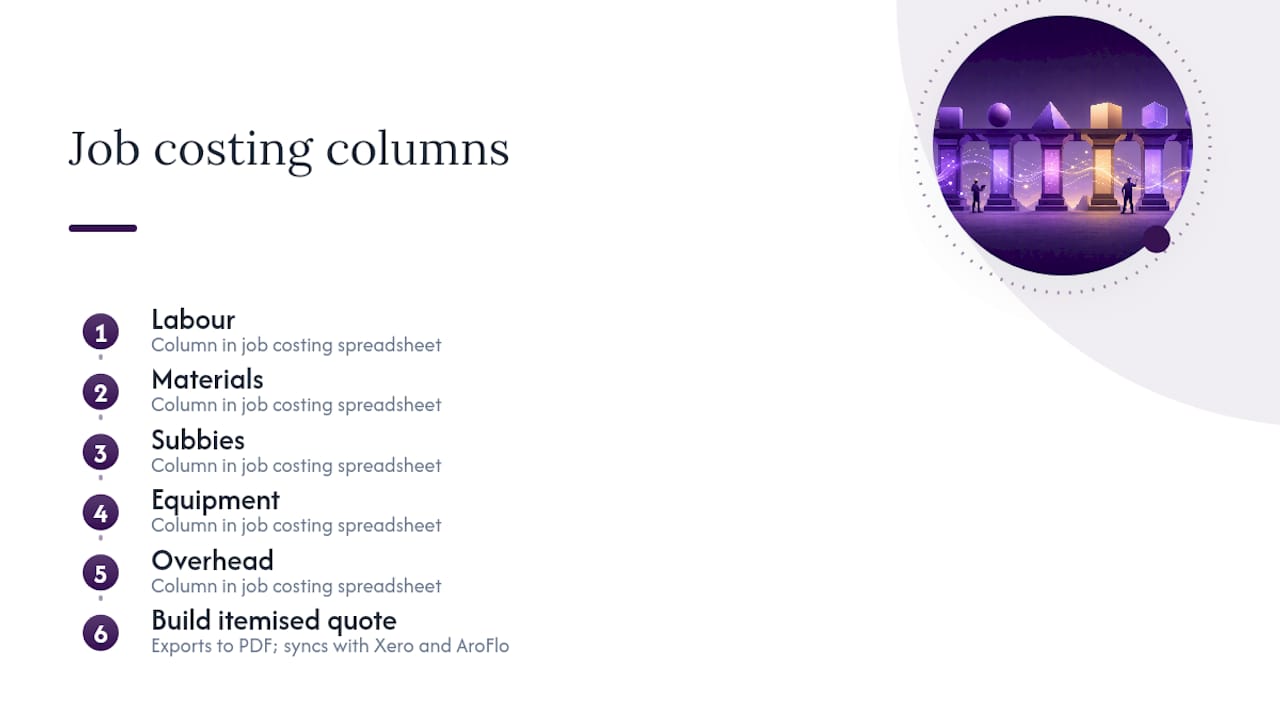
Ask Hayley builds quotes from voice prompts on site, attaches your photos and notes automatically, and exports straight to PDF, so you’re not retyping the same job twice. It also connects with Xero for GST handling and reconciliation, and AroFlo for job management, so a quoted job flows into an invoice without double-entry.
Pro Tip: Set up your template once inside whichever tool you use, then reuse it for every job in that category. Consistency in your quotes builds the same trust as consistency on site.
Common quoting mistakes and a one-page checklist to fix them
Run through this before sending: scope fully itemised (yes/no), burdened labour used, overhead included, exclusions listed, deposit stated, validity set, contingency allowed, follow-up scheduled.
Six mistakes that cost tradies money:
- Vague scope. Fix: itemise every task, not just “bathroom reno.”
- Missing overheads. Fix: allocate a fixed percentage or daily rate every time.
- No exclusions. Fix: copy your standard exclusion wording into every quote.
- Slow delivery. Fix: send within 48 hours or explain the delay.
- No follow-up. Fix: calendar a call or email for day three.
- Underestimating hidden hours. Fix: add a buffer for prep, travel and clean-up.
Why clarity beats being cheapest
Clarity builds trust faster than a low price ever will. A tightly itemised quote tells the client you know exactly what the job involves, and that reduces disputes down the track. Adopt the checklist and templates here before you race to shave dollars off your number.
If you want to save quoting time, here’s how Ask Hayley can help
Writing a proper quote the way this guide describes takes real time, and that’s before you’ve answered the calls that come in while you’re on the tools. Ask Hayley’s Assistant and Office Manager plans handle inbound calls, pre-qualify leads before they land in your inbox, and generate quotes from voice prompts so you can price a job standing in the driveway, not hunched over a laptop at 9pm.
Office Manager adds deeper admin support, including quote-to-invoice flow through your Xero and AroFlo setup, which cuts the double-handling that eats into evenings and weekends. If you also need a faster way for enquiries to find you in the first place, the one-page website option gets a professional presence live quickly.
Head to Ask Hayley to see which plan fits your business and start turning quotes around faster.
Frequently asked questions
What’s the difference between an estimate and a quote?
An estimate is a rough figure used when scope is still unclear. A quote is a firm, itemised price for defined work, and it can become a binding offer once your client accepts it.
How long should a quote stay valid?
Most residential jobs work well with a 7 to 14 day validity period. Commercial jobs or those with volatile material prices may need up to 30 days.
Should GST be included in the quoted price?
State clearly whether your price is GST inclusive or exclusive. Check the Australian Taxation Office for your specific registration and reporting obligations before finalising your quote wording.
What should I do if a client wants extra work mid-job?
Use a variation clause. Quote the extra work separately in writing and get approval before proceeding, rather than absorbing it into the original price.
Does software actually save time when quoting jobs?
Yes. Tools that capture site notes by voice and generate a PDF quote on the spot cut out double-handling, and integrations with platforms like Xero and AroFlo mean the quote flows straight into invoicing once the job’s done.
Sources
- Giving quotes: tradespeople and small works — Consumer Affairs Victoria
- Job costing for contractors: a step-by-step 2026 guide – Contractor Guide Pro
- How to write a quote for a job without undercharging – BSH


