


A capability statement is your business CV for tenders, government contracts and B2B pitches. If you need one fast, start with a concise snapshot suitable for networking and quick opportunities, then build a longer master document when you’re chasing formal tenders.
Every version needs the same Australian basics before anything else:
- Your ABN or ACN, clearly displayed
- A named contact with direct phone and email
- A clear line stating your primary uses: government tenders, council contracts, major project subcontracting, or B2B pitching
Councils, government agencies and head contractors all expect the same core proof. Get that structure right once, and you can reshape it for every opportunity that lands on your desk.
Key Takeaways
A tailored capability statement built from an up-to-date master document consistently outperforms a generic, one-size-fits-all version in tenders and B2B pitches.
| Point | Details |
|---|---|
| Start with the right version | Use a 1-2 page snapshot for networking and a full master document for formal tenders. |
| Include all six required blocks | Overview, competencies, personnel, projects, contact details and supporting credentials. |
| Use measurable outcomes | Replace generic praise with specific results like budget, timeframe or percentage improvement. |
| Tailor every submission | Swap projects and reorder competencies to match each buyer’s own language before sending. |
| Get help with the admin load | Ask Hayley’s tendering and compliance documentation services keep evidence organised and current. |
Table of Contents
- Capability statement examples: what buyers actually expect inside
- Annotated capability statement examples and templates you can copy
- Which version to use when: master, snapshot or quad chart
- How to draft a capability statement you’ll actually use in tenders
- Checklist and top tips for format, tone and upkeep
- How Ask Hayley helps tradies get tender documents sorted
- Why tailoring beats templates every time
- How Ask Hayley can help you get tender ready
- Sources
Capability statement examples: what buyers actually expect inside
Tender assessors and procurement officers skim fast. They’re checking boxes, not reading prose, so structure matters more than polish here.
Business Queensland’s guidance treats the capability statement as a genuine sales tool, one that proves capacity in sectors like construction, mining and government infrastructure. The Northern Territory Government’s framework breaks the required content into six blocks:
- Business overview. Two to three lines on what you do and who you serve. Skip the mission statement waffle.
- Core competencies. Three to six bullets written in the buyer’s own vocabulary, not yours. If the tender says “traffic management,” don’t write “logistics coordination.”
- Key personnel. Name, role, relevant experience and qualifications, kept short. A site supervisor with 12 years and a White Card beats a paragraph of soft skills.
- Past projects. Three recent, relevant jobs with measurable outcomes, contract value, timeframe and result. “Delivered $180,000 fit-out two weeks ahead of schedule” does far more work than “completed successfully.”
- Contact and corporate data. ABN/ACN, named contact, phone, email, website and the areas you actually service.
- Supporting items. Licences, insurances, safety accreditations and industry memberships.
That last block often decides whether you even get scored. The NT Government notes that licences, insurances and safety accreditations are common buyer filters in construction, mining and government procurement, and missing one can knock you out before anyone reads your project list.
Pro Tip: Write your core competencies section last. Once you’ve listed your past projects, you’ll notice patterns in what you’re actually good at, and that’s more accurate than guessing upfront.
Annotated capability statement examples and templates you can copy
Different trades need different emphasis. Here’s how the same six blocks flex across common Australian business types.
- Electrician or plumber (sole trader or small crew). One page. Standout element: licence numbers and safety certifications front and centre, next to a photo of recent domestic or light commercial work. Tender tweak: add “council-approved contractor” language if you’re chasing local government maintenance panels.
- Small civil contractor. Two pages. Standout element: a plant and equipment list alongside project value ranges. Tender tweak: lead with road, drainage or earthworks experience matching the specific tender’s scope, not your full service range.
- Subcontractor on large projects. One to two pages. Standout element: named head contractor relationships and safety statistics (LTIFR if you track it). Tender tweak: mirror the head contractor’s own terminology for trade packages.
- Professional services (bookkeeping, engineering, consulting). Two pages. Standout element: qualifications and professional memberships given equal weight to project examples. Tender tweak: swap in case studies from the same sector as the tendering body.
- Indigenous-owned business. One page snapshot plus a longer master document. Standout element: Indigenous business certification and community engagement outcomes, which many government panels weight explicitly. Tender tweak: reference the specific Indigenous procurement policy the tender falls under.
Templates with annotated notes show that past performance rows work best when they list customer, contract period, value and one measurable outcome, not a paragraph of description. That structure alone can shift a project entry from ignorable to persuasive.
Contractology’s annotated template demonstrates this pattern well: name, dates, dollar value, one outcome line. Nothing more.
For design and layout inspiration, Capability Statement Australia runs a gallery of example layouts that lean on clean design, concise content and prominent contact blocks, all of which register as trust signals to a reviewer flicking through a stack of PDFs.

Which version to use when: master, snapshot or quad chart
Think of these as three cuts of the same document, each built for a different moment.
- Master document. Your complete evidence base. Every project, every contract, every certification, every policy. This never leaves your files, but you draw everything else from it. Business Queensland recommends keeping this as a living file you update as jobs finish, not something you rebuild from memory before every tender.
- 1-2 page snapshot. The essentials only, built to grab attention fast at a networking event, a first meeting, or a website download.
- Quad chart. A single page split into four blocks: proven track record, areas of expertise, key capabilities and value proposition. Procurement panels often ask for this specifically when they want a one-glance overview before shortlisting.
For file format, save as PDF, name it clearly (something like “SmithElectrical_CapabilityStatement_2026.pdf” rather than “Document1.pdf”), and keep the file under 5MB for portal uploads.
How to draft a capability statement you’ll actually use in tenders
You don’t need a marketing agency for this. You need an afternoon and your own job records.
- Collect your evidence first. Pull together contracts, safety documents, licences and insurance certificates before you write a single sentence. Trying to draft from memory is where most statements go generic.
- Translate activities into outcomes. Small Business WA’s guidance pushes plain language over jargon. “Installed switchboards” becomes “upgraded switchboard capacity for a 40-lot residential development, completed on schedule.”
- Write tight bullets for the snapshot. Choose three or four past projects with genuinely measurable outcomes, not your favourite jobs. A smaller project with a hard number beats a bigger one with none.
- Tailor fast for each tender. Swap in the most relevant projects, bump up plant, staff or safety credentials that match the scope, and reorder your competencies to match the tender’s own language.
- Run final checks. ABN/ACN visible, named contact current, file size sensible, PDF readable on mobile, filename sensible.
Pro Tip: Keep a spare copy of your master document open while tailoring a snapshot. Copy and trim, never rewrite from scratch. It’s the difference between a 20 minute tailoring job and a two hour one.
Checklist and top tips for format, tone and upkeep
Before anything goes out the door, run it against a short list.
- Six required blocks present: overview, competencies, personnel, projects, contact, supporting credentials
- ABN/ACN and named contact visible without scrolling
- At least one measurable outcome per project listed
- File saved as PDF with a sensible filename and manageable size
On design, keep fonts legible and stick to one accent colour that matches your branding, not five. Size your logo sensibly, big enough to register, not so large it crowds the content. Skip generic stock photography of hard hats and handshakes; a real photo of your own work does more.
On tone, write in plain English and cut anything that sounds like marketing copy. “Industry-leading” tells a reviewer nothing.
On maintenance, update your master document every time a job finishes, not once a year in a scramble. Refreshing a snapshot from an up-to-date master should take fifteen minutes.
How Ask Hayley helps tradies get tender documents sorted
Chasing down old contracts and safety certificates eats the time most tradies don’t have. Ask Hayley’s tendering support and safety and compliance documentation service exist for exactly this gap.
- Voice capture means you can log job details and outcomes on-site, straight after a project wraps, instead of trying to reconstruct them months later
- Compliance documents get organised and kept current, ready to drop into a master document
- Support extends to preparing tender-ready files, not just admin busywork
Why tailoring beats templates every time
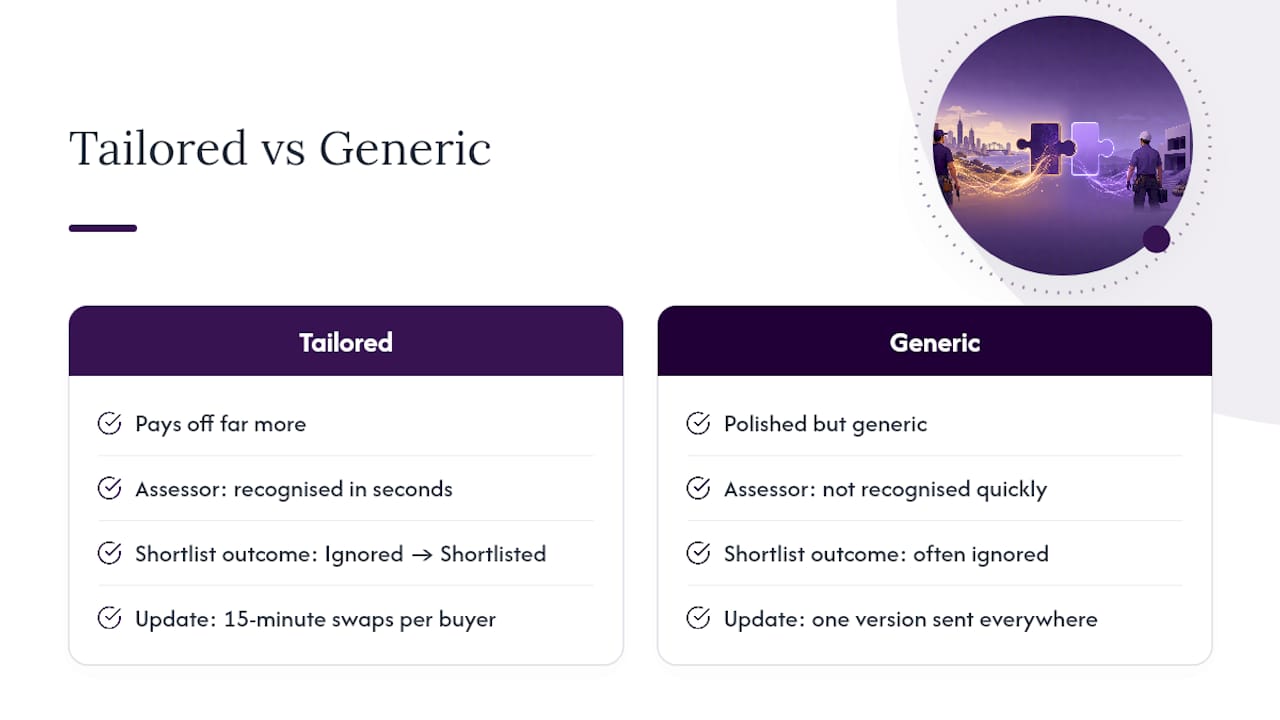
Here’s what I’d tell any tradie staring at a blank page: a genuinely tailored capability statement pays off far more than a polished generic one, because assessors can tell the difference in seconds.
The single biggest mistake is writing one version and sending it everywhere. The fix is small: keep your master document complete, then spend fifteen minutes swapping the right projects and language for each buyer. I’ve seen tradies go from ignored to shortlisted purely by matching a tender’s own wording back to it. Do that swap before your next submission.
How Ask Hayley can help you get tender ready
Preparing a capability statement is genuinely doable on your own, and this guide gives you everything you need to draft one. Where Ask Hayley fits in is the grunt work around it, the part that eats your weeknights.
If your safety certificates, insurance documents and licences are scattered across emails, glove boxes and old folders, Ask Hayley’s safety and compliance documentation service pulls them into one place, ready to reference whenever a tender asks for proof. Need somewhere to host your snapshot for a quick download link? A one-page website does that without you touching a website builder. And when you’re ready to chase a specific tender, Ask Hayley’s tendering support helps you assemble and tailor the actual document, not replace the evidence work you’ve already done, but speed up everything around it. Book a free consult to see what’s involved.
Sources
- Writing a business capability statement | Business Queensland
- Business Capability Statements | Northern Territory Government
- Does your business need a capability statement? | Small Business Development Corporation (WA)
- Capability Statement Australia | Templates & Design Service


