


Recording a phone call in Australia can be perfectly legal, but the rules shift depending on which state or territory you’re calling from, and getting it wrong carries real penalties. The safest default for any business fielding calls from across the country is simple: announce the recording, get consent, and offer a way out.
Some states demand agreement from everyone on the line before you hit record. Others only need one participant, including you, to be aware. New South Wales, the ACT, South Australia, Western Australia and Tasmania generally sit in the all‑party consent camp, while Victoria, Queensland and the Northern Territory allow one‑party consent. If your business takes calls nationally, you can’t realistically check a caller’s postcode before every conversation.
That’s why a conservative, all‑party approach is the practical answer for most Australian businesses:
- Play a clear recording notice at the start of every call, regardless of where the caller is based
- Give callers a genuine, easy opt‑out (a keypress or a spoken request) that routes them to an unrecorded line
- Document consent and keep it consistent across every jurisdiction you operate in
Pro Tip: If you only fix one thing today, fix the opening announcement. A five‑second notice at the start of every call removes almost all of the jurisdictional guesswork.
Key Takeaways
A compliant call recording default in Australia means announcing the recording, offering a genuine opt‑out, and treating the strictest applicable state law as your baseline.
| Point | Details |
|---|---|
| Default to all‑party consent | Treat every call as if all‑party consent applies, since it’s the safest standard nationally. |
| Know your state split | NSW, ACT, SA, WA and TAS require all‑party consent; VIC, QLD and NT allow one‑party consent. |
| Announce and log consent | Play a clear notice on every call and record which opt‑out choice the caller made. |
| Treat recordings as personal information | Apply the Privacy Act and APPs to storage, access limits and retention schedules. |
| Let Ask Hayley manage the script | Ask Hayley answers calls, delivers a consistent recording notice, and routes opt‑outs automatically. |
Table of Contents
- Understanding call recording laws in Australia: the legal framework
- Consent types explained: one‑party, all‑party, express and implied
- State and territory rules: where consent requirements differ
- Handling interstate and international calls
- A step‑by‑step checklist to record calls lawfully
- Policies and notices your business should have on record
- Workplace recordings: what employers need to watch for
- Storing, sharing and retaining recorded calls
- EEAT note for tradies: cutting the admin without cutting corners
- Why practical compliance matters more than perfect compliance
- Let Ask Hayley handle the calls you can’t get to
- Sources
Understanding call recording laws in Australia: the legal framework
Call recording compliance in Australia sits across two layers of law, and both matter. The first is the Telecommunications (Interception and Access) Act 1979 (Cth), which deals mainly with interception carried out by a third party while a call is in transit, such as tapping a line you’re not part of. If you’re a participant in the call and you’re the one recording it, this federal Act usually isn’t the main hurdle. The real action happens at state and territory level.
Each state and territory has its own listening device or surveillance device Act, and these are what actually govern whether you can record a private conversation you’re part of without everyone’s consent. They’re not uniform. What’s fine in Melbourne can be an offence in Sydney, even for the exact same call script.
Layered on top of that is the Privacy Act and the Australian Privacy Principles (APPs). A voice recording that captures someone’s name, account details, or even just their voice pattern is commonly treated as personal information. Once you’re collecting and storing that, the OAIC’s guidance on privacy compliance applies to how you handle it, not just whether you were allowed to press record.
Three things worth remembering:
- Federal interception law and state listening device law solve different problems, and both can apply to the same call
- A recording that’s lawful under state law can still trigger Privacy Act obligations once it’s stored
- Because the state rules genuinely differ, a single national policy is far easier to manage than eight separate ones
Consent types explained: one‑party, all‑party, express and implied
Consent isn’t a single concept, and mixing up the types is where most businesses trip up.
One‑party consent means only one person on the call, which can be you, needs to agree to the recording. All‑party consent means every participant needs to know and agree. Then there’s how that consent is captured:
- Express consent is explicit, an announcement asking the caller to confirm out loud, or a keypress before the call proceeds
- Implied consent relies on a clear notice being given upfront, with the caller’s decision to stay on the line taken as agreement
- No consent is only defensible in narrow, specific exceptions, and shouldn’t be treated as a fallback position
In practice, a business operating in an all‑party jurisdiction is safer relying on express consent rather than assuming silence equals agreement. A basic script works well: “This call may be recorded for training and quality purposes. If you’d prefer not to be recorded, press 1 or let us know now,” which is a strategy explained in quote follow-up for Australian air‑con cleaning businesses.
Pro Tip: Log the exact wording of your consent script alongside the date it was last updated. If a recording is ever challenged, you’ll want to show precisely what the caller heard, not just that a notice existed.
State and territory rules: where consent requirements differ
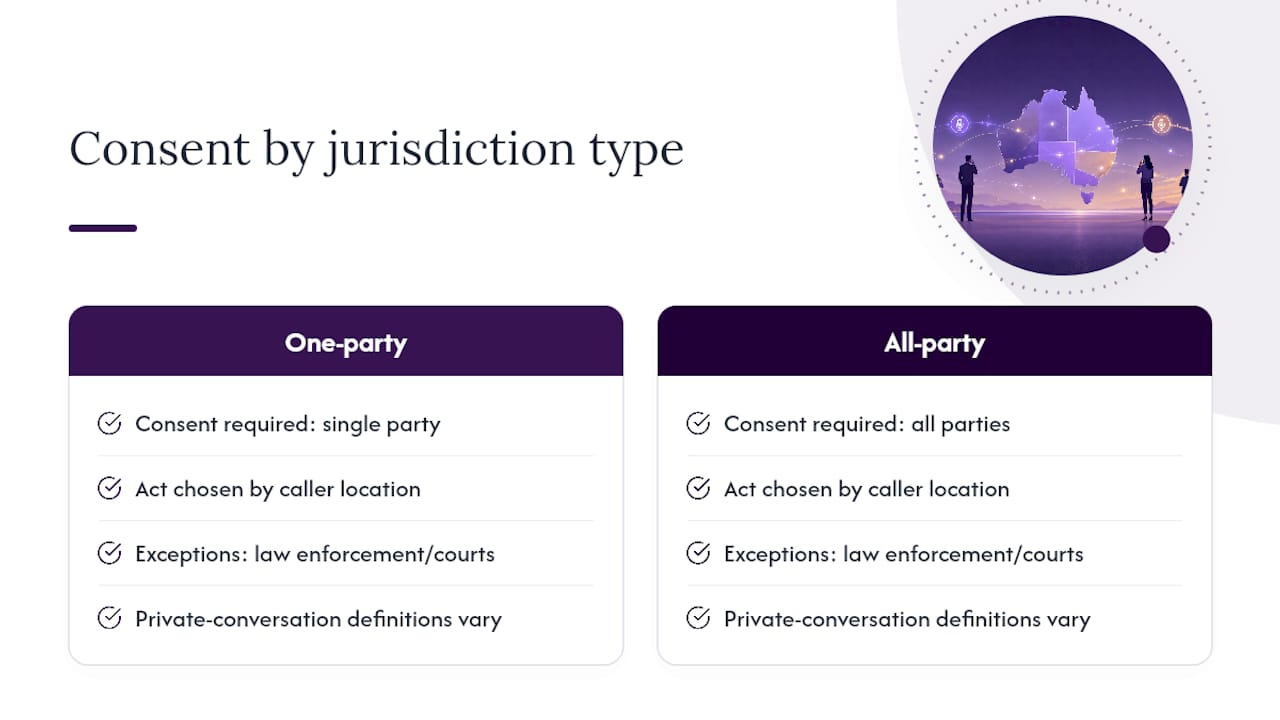
Where your caller is physically located generally determines which listening device Act applies, not where your business is registered. That’s the detail most guides skip, and it’s the one that catches national call centres out.
The jurisdictions split fairly cleanly into two groups:
A couple of caveats matter here. Each Act defines “private conversation” slightly differently, and some carve out exceptions for law enforcement, court orders, or situations where a party reasonably believes recording is necessary to protect their own interests. None of those exceptions were designed with everyday customer service calls in mind, so don’t lean on them as a compliance strategy.
It’s also worth noting that a conversation someone might expect to be overheard, like a loud call in a public place, can be treated differently to a genuinely private one. That distinction has come up in disputes before, which is exactly why relying on an announcement and consent beats trying to argue the call wasn’t private in the first place.
Handling interstate and international calls
A single phone call can cross more legal borders than you’d think. If your Sydney office calls a customer in Perth, both New South Wales and Western Australian law could theoretically apply, and both happen to require all‑party consent, so you’re covered either way. The problem arises when one end sits in a one‑party state and the other doesn’t.
The simplest rule of thumb: follow whichever jurisdiction’s rule is strictest, and capture consent before you start recording, not partway through.
- Treat every interstate call as if the toughest applicable state law governs it
- Get consent up front rather than trying to identify the caller’s location mid‑call
- Be extra cautious with international callers, since foreign privacy and wiretap laws may also apply, and publishing or sharing that recording overseas can trigger additional obligations you won’t have considered
A step‑by‑step checklist to record calls lawfully
Getting this right doesn’t require a legal team on retainer. It requires a short list of habits, applied consistently.
- Define your purpose. Are you recording for training, dispute resolution, or proof of instructions? Write it down. A documented purpose tied to a retention schedule is far easier to defend if a regulator asks questions later.
- Script the announcement. Keep it short, clear, and consistent across every line, every time.
- Build a real opt‑out. A keypress, a spoken request, or a transfer to an unrecorded line. It has to actually work, not just exist on paper.
- Log consent. A timestamp and a note of which option the caller chose is usually enough.
- Limit access. Only staff with a genuine reason should be able to pull up a recording.
- Vet your vendors. If a third‑party platform stores your recordings, check where that data lives and what contractual protections apply.
- Set retention limits. Delete recordings once their purpose has been served, not indefinitely “just in case”.
- Train your team. Everyone answering phones needs to know the script and the opt‑out process cold.
Pro Tip: Run a monthly spot check where someone calls in and deliberately asks not to be recorded. If the opt‑out doesn’t work smoothly every single time, you’ve found your biggest compliance gap.
Policies and notices your business should have on record
A written Privacy Policy should explicitly mention that calls may be recorded, why, and how long recordings are kept. A workplace recording policy should set out when staff can record calls themselves and what happens if they don’t follow the rules. Customer‑facing notices matter too:
- IVR scripts stating clearly that calls may be recorded before the call connects
- A line on your website’s contact page repeating that same notice
- Order forms or booking confirmations that reference your recording and privacy practices
Businesses that need these documents built properly, rather than copied from a template, can look at safety and compliance documentation support designed for exactly this gap.
Workplace recordings: what employers need to watch for
Employees sometimes record conversations with managers or colleagues, and employer policy should set clear expectations around this rather than leaving it to chance. Fair Work Commission decisions and courts retain discretion to admit covert recordings as evidence, but they generally discourage the practice rather than treating it as reliable proof. HR teams should train staff on the policy, set a clear reporting process for disputes, and handle any existing recordings carefully rather than assuming they’ll simply be accepted as evidence.

Storing, sharing and retaining recorded calls
Once a call is recorded, it usually becomes personal information under the Privacy Act, which means the APPs apply to how you store and use it. That’s where the real exposure tends to sit. The legal risk for most businesses comes from what happens after recording, not the act of recording itself.
- Set a retention period tied to the recording’s stated purpose, and delete it once that purpose is served
- Restrict access to staff with a genuine business reason, and keep a log of who accessed what
- If you use cloud storage, confirm where the data is hosted and what access controls the vendor offers
- Never forward or share a raw recording casually. Treat it the way you’d treat a customer’s financial details
EEAT note for tradies: cutting the admin without cutting corners
You don’t need new hardware to get this right. A short IVR notice plus a one‑touch opt‑out covers most of the legal groundwork. Route anything sensitive, quotes, disputes, personal details, to a non‑recorded line quickly. Keep your records simple: who listened, when, and why. Don’t forward audio files around the business casually.
Why practical compliance matters more than perfect compliance
Most small business owners I talk to about this expect call recording law to be complicated in a way that requires a lawyer on speed dial. It doesn’t, not for the day‑to‑day version of the problem. What trips businesses up isn’t the law itself, it’s inconsistency: a script that works on the office line but gets skipped on mobile, or a recording that sits on someone’s laptop for two years because nobody set a deletion date.
The businesses that get this right treat it as an operational habit, not a legal project. A five‑second announcement, a working opt‑out, and a retention date on every file will cover the vast majority of everyday situations. Where it gets genuinely complex, disputes, employee recordings used as evidence, cross‑border data sharing, that’s when you bring in a lawyer rather than guessing.
— Hayley
Let Ask Hayley handle the calls you can’t get to
Building a compliant call script is one thing. Actually answering every call, qualifying the lead, and keeping consistent records while you’re up a ladder or under a vehicle is another problem entirely. Ask Hayley is built for exactly that gap: a voice‑first assistant that answers inbound calls when you can’t, delivers a consistent recording notice every time, and routes callers who want an unrecorded conversation without you lifting a finger.

Because Hayley handles the call itself, your opt‑out process never depends on whoever happens to be free to pick up the phone. Leads get pre‑qualified before they land in your inbox, and your notice script stays identical on every single call, whether that’s your fifth job of the day or your fiftieth. If your business also needs the paperwork tightened up, from workplace recording policies to a proper privacy notice on your website, that’s the natural next step. Head to the Ask Hayley homepage to see how a voice‑first setup can take the admin off your plate this week.
Sources
- Business call recording laws in Australia (Sprintlaw)
- Recording private conversations: the law in Australia – Lexology
- OAIC guidance on privacy compliance


