


A capability statement is your business’s résumé for procurement. It tells buyers, tender panels, and prime contractors exactly what you do, how well you do it, and why they should choose you. Business Queensland describes it as a document showing what your business is able to do and deliver, covering your overview, core competencies, key personnel, past projects, and contact details including your ABN or ACN.
Here is the standard capability statement structure you can copy right now:
- Company snapshot — trading name, ABN/ACN, location, years in business, and a two-sentence summary of what you do
- Core competencies — four to six capability statements written as client-focused outcomes
- Key differentiators — two to three verifiable points that set you apart
- Past performance — three to five project summaries with scope, value, and completion date
- Certifications and compliance — relevant licences, insurances, and safety accreditations
- Key personnel — one to three concise profiles with roles and credentials
- Contact details — phone, email, website, ABN/ACN, and physical address
For a marketing leave-behind, keep this concise. For a formal tender attachment, a longer document with technical appendices may be appropriate.
Key takeaways
A well-structured capability statement built around evidence, clear project summaries, and correct Australian business identifiers gives procurement teams exactly what they need to assess your business quickly and confidently.
| Point | Details |
|---|---|
| Use the seven-section structure | Company snapshot, competencies, differentiators, past performance, certifications, key personnel, and contact details with ABN/ACN. |
| Match length to purpose | One to two pages for a marketing leave-behind; up to eight pages for a formal tender attachment with compliance evidence. |
| Write competencies as outcomes | Phrase each capability with a measurable scope, not a service name, so procurement officers can match it to RFT criteria. |
| Keep a master document | Maintain one source-of-truth document and create tailored versions for each tender, swapping in the most relevant projects and mirroring RFT language. |
| Ask Hayley tender support | Ask Hayley can audit, build, or prepare a full tender pack for Australian tradies and small service businesses. |
Table of Contents
- What does a capability statement do, and when do you need one?
- A copyable one-page structure you can use straight away
- What exactly goes in each section?
- How to present past projects so procurement teams can verify them quickly
- Layout and design rules that make your statement scannable
- How to keep a master document and create tailored versions
- Common mistakes that get capability statements dismissed
- A step-by-step checklist to create or update your capability statement
- An annotated one-page example for an Australian tender
- What I’d tell every tradie writing their first capability statement
- Ask Hayley can take the hard work out of tender preparation
- Sources
What does a capability statement do, and when do you need one?
A capability statement serves two distinct purposes, and mixing them up is one of the most common mistakes small businesses make.
The first version is a marketing leave-behind: a concise, one-page document you hand to a potential client at a networking event, attach to a quote, or email after a first meeting. Its job is to create a strong first impression quickly. Procurement officers, panel managers, and prime contractors receive dozens of these, so scannability matters more than depth.
The second version is a tender attachment: a more detailed document submitted alongside a formal Request for Tender (RFT) or Request for Quote (RFQ). This version can run from two to eight pages and needs to address specific evaluation criteria, safety and compliance evidence, and technical capacity. Capabilitystatement, marketing versions typically sit at one to two pages for quick scanning, while tender-focused documents in Australia can range up to eight pages to accommodate technical, safety, and compliance evidence.
The audiences reading these documents have different priorities. A procurement officer assessing a government panel application is looking for evidence of capacity, compliance, and past performance against specific criteria. A project manager at a prime contractor is checking whether your trade licence covers the scope and whether you have done similar work before. Knowing who reads your statement shapes every decision you make about what to include.
Use the short marketing version when you are networking, following up on a referral, or attaching it to a quote. Switch to the expanded tender version when responding to a formal RFT, applying for a government panel, or submitting through a procurement portal.
A copyable one-page structure you can use straight away
This ordered template works for most Australian small and medium-sized businesses. Paste it into Word, Google Docs, or Canva and populate each section.
Company snapshot (40–60 words)
Trading name, ABN or ACN, year established, location or service area, and a two-sentence description of what you do and who you serve. Keep this factual. Avoid marketing language here.
Core competencies (60–80 words across four to six dot points)
Each dot point names one capability and frames it as a client outcome. “Electrical installation and testing for commercial fitouts up to 5,000 m²” is better than “we do electrical work.”
Key differentiators (30–50 words across two to three dot points)
These must be verifiable. Specialised equipment, a niche licence, a geographic reach, or a certified process. If you cannot prove it with a document or a reference, cut it.
Past performance (one to three lines per project, three to five projects)
Project name or type, client sector, scope, approximate value, and completion date. A government tender panel will check these, so be accurate.
Certifications and compliance (30–40 words)
List only what is relevant to the work you are tendering for. Include licence numbers where applicable. Insurances, safety certifications, and industry memberships belong here.
Key personnel (two to four lines per person, one to three people)
Name, role, and the credentials or experience that prove they can deliver. Keep this tight.
Contact details (one short block)
Phone, email, website, ABN or ACN, and a physical or postal address. ABN and ACN should appear here and in the company snapshot. Government contractor guidance consistently places contact information and business identifiers in a clearly labelled section so procurement teams can verify them without searching.
File format: Export as a PDF with embedded fonts. Name the file clearly: BusinessName_CapabilityStatement_2026.pdf. Keep the file under 5 MB for email and portal submissions. Use A4 at 300 dpi if printing is likely.
What exactly goes in each section?
Getting the content right matters more than getting the design right. Procurement teams read for evidence, not adjectives.
Company overview
Include your trading name, legal entity name if different, ABN or ACN, year established, registered office address, and service area. Two sentences describing your business should follow. Mention your team size and any relevant capacity indicators, such as the number of licensed tradespeople or the geographic area you cover. ABN and ACN should appear exactly as registered on the Australian Business Register. Do not abbreviate or transpose digits.
Core competencies
This is the section most businesses get wrong. Listing services by name (“plumbing, drainage, gas fitting”) tells a procurement officer nothing about your capacity or the outcomes you deliver. Instead, phrase each competency as a scoped capability:
- “Domestic and commercial plumbing installations for projects up to $500,000”
- “Gas fitting and compliance certification for multi-unit residential developments”
- “Emergency drainage response with four-hour call-out across metropolitan Brisbane”
Four to six dot points is the right number. More than six and you start to look unfocused.
Key differentiators
A differentiator is only useful if it is specific and verifiable. “We are committed to quality” is not a differentiator. “We hold a current ISO 9001 certification and carry out internal audits quarterly” is. Think about what you have that a competitor in your sector typically does not: a specialised piece of equipment, a dual licence, a bilingual team, a certified safety management system, or a track record in a niche sector.
Past performance and project history
This section carries the most weight in a formal tender. Include the project name or a description that preserves confidentiality, the client type (local government, private developer, mining company), the scope in measurable terms (square metres, number of units, contract value), the completion date, and whether a reference or completion certificate is available on request.
If a client has asked you to keep the contract value confidential, state the value as a range or percentage of a total project value. Do not omit it entirely; procurement teams use it to assess whether you have delivered at the required scale.
Pro Tip: Keep a folder of completion certificates, safety audit reports, and signed-off project photos for every job over a certain value. When you need to update your capability statement, the evidence is already there.
Certifications, insurances, and compliance
List only what is relevant to the opportunity. A long list of certifications that do not relate to the work you are tendering for wastes space and dilutes the relevant ones. For each certification, include the issuing body, the licence or certificate number, and the expiry date. For insurances, state the type and the coverage amount. Ask Hayley’s safety and compliance documentation service can help you organise and present this evidence in a format procurement teams expect.
Key personnel
One to three people is enough for a one-page version. For each person, include their name, role, and the specific credentials or experience that prove they can deliver the work. A licensed electrician with 15 years of commercial experience is a stronger statement than “our team is highly experienced.”
How to present past projects so procurement teams can verify them quickly
Procurement officers are time-poor. A project summary that takes more than 20 seconds to read will be skimmed or skipped. A short, consistent format for every project entry solves this.
Use this single-row format for each project:
| Field | What to include |
|---|---|
| Project name or type | A descriptive title or anonymised description |
| Client sector | Local government, private developer, resources, health, education |
| Scope | Measurable description (e.g., 2,400 m² commercial fitout, 48-unit residential complex) |
| Approximate value | Dollar figure or range; use “available on request” only if contractually required |
| Completion date | Month and year |
| Reference available | Yes / No / On request |
Three to five rows in this format gives a procurement officer everything they need to assess your experience at a glance. For a tender attachment, you can add a brief two-sentence narrative under each row describing the key challenge and how you resolved it.
Pro Tip: If a client’s name is commercially sensitive, replace it with the sector and project type. “State government infrastructure project, South East Queensland, 2024” is still useful evidence. Never leave the row blank.
When it comes to contract values, include the figure if you can. Procurement panels use it to confirm you have delivered at the scale required by the RFT. If the value is genuinely confidential, a percentage of a larger project total or a stated range is acceptable. Avoid vague descriptors like “large” or “significant.”
Keep verification-ready documents in a single folder: signed completion certificates, safety audit reports, client reference letters, and any relevant project photos. When a tender requires supporting evidence, you can attach them without scrambling.
Layout and design rules that make your statement scannable
Procurement professionals treat capability statements as assessment tools, not marketing brochures. A document that looks professional signals operational credibility before a single word is read.
Typography and spacing
Use a body font of readable size and clear headings for legibility. Sans-serif fonts such as Arial, Calibri, or Open Sans read cleanly on screen and in print. Leave adequate white space between sections; a crowded page is harder to assess quickly. Stick to two font sizes and one accent colour.
Branding versus neutrality
For a marketing leave-behind, use your full brand treatment: logo, brand colours, and a professional header. For a formal tender attachment, tone the design down. Some government procurement portals specify plain formatting or have accessibility requirements. A clean, neutral layout with your logo in the header is usually the safest choice for formal submissions.
File naming and submission
Name your file clearly and consistently; embed fonts before exporting to ensure correct rendering. Flatten the PDF if the portal requires it. Check the file opens correctly on both Windows and Mac before submitting. Keep the file under 5 MB unless the portal specifies otherwise.
Accessible PDFs matter for government submissions. Add alt text to any images or logos, and make sure the document is tagged so screen readers can navigate it. This is a requirement under the Australian Government’s accessibility guidelines for digital documents.
How to keep a master document and create tailored versions
Using a single generic statement for every tender is one of the most common and costly mistakes in procurement. The Small Business Development Corporation WA notes that the information and length you include depends on complexity and audience, and that tailoring for different readers is the right approach.
A master document approach solves this without doubling your workload. Here is how to set it up:
- Build a master capability statement that includes every section at full length: all projects, all certifications, all personnel profiles, and all competency statements. This is your source of truth, not a document you send to anyone.
- Create a folder structure with subfolders for each tender or client type: Government, Private, Resources, Health, and so on.
- Copy the master into a new file for each tender. Name it with the client name, RFT reference, and date:
BusinessName_CapabilityStatement_DeptXYZ_RFT2026-04.pdf. - Swap in the three to five most relevant projects for that specific opportunity. Match the scope, sector, and scale to what the RFT is asking for.
- Adjust the competencies wording to mirror the language in the RFT. If the tender uses “civil infrastructure maintenance,” use that phrase rather than your generic version.
- Log the version in a simple changelog: date created, client or RFT reference, sections modified, and who prepared it.
A short changelog entry might look like this: April 2026 — DeptXYZ RFT-2026-04 — swapped projects 2, 4, 5 for infrastructure examples; updated competencies to match RFT language; reviewed by J. Smith.
This system means you spend 30 minutes tailoring rather than two hours rewriting from scratch.
Common mistakes that get capability statements dismissed
Most capability statements that fail in procurement fail for the same reasons. Here is what to watch for and how to fix each one.
- Vague competency claims. “We deliver quality outcomes” tells a procurement officer nothing. Replace every adjective-led claim with a scoped, measurable statement. “Structural steel fabrication for projects between $200,000 and $2 million” is specific enough to assess.
- Feature-dump formatting. A list of 15 services with no context or evidence reads as unfocused. Cut to the four to six competencies most relevant to the work you are tendering for.
- Outdated ABN or contact details. An incorrect ABN is a red flag in any government tender. Verify your ABN on the Australian Business Register before every submission. Check that your phone number, email, and address are current.
- No past performance evidence. A capability statement with no project history is a marketing brochure, not a procurement document. Include at least three project summaries with scope and value.
- Overlong marketing language. Procurement audiences are not your end customers. Cut brand story paragraphs, mission statements, and vision language. Replace them with evidence.
- Inconsistent document versions. Sending a version with last year’s certifications or a project that has since been completed incorrectly damages credibility. Your changelog system prevents this.
- Unreadable PDFs. A scanned document, a low-resolution logo, or a file that does not open on the assessor’s system will be set aside. Always export from source, embed fonts, and test the file before submitting.
A step-by-step checklist to create or update your capability statement
Work through these steps in order. Each one builds on the last.
- Gather your evidence. Collect your ABN/ACN confirmation, trade licences, insurance certificates, safety certifications, industry memberships, and completion certificates for your three to five best projects.
- List your projects. For each one, note the client sector, scope in measurable terms, approximate value, completion date, and whether a reference is available.
- Draft your competencies. Write four to six capability statements as client-focused outcomes with measurable scope. Use plain language.
- Identify your differentiators. Write two to three points that are specific and verifiable. Check that each one can be backed by a document or a reference.
- Write your company snapshot. Two sentences, factual, with ABN/ACN and service area.
- Write key personnel profiles. One to three people, name, role, and the credentials that prove delivery capacity.
- Compile certifications and compliance. List only what is relevant to the opportunity, with licence numbers and expiry dates.
- Design and format. Apply your template, check font sizes, add white space, and insert your logo. Use your brand colours for a marketing version; tone down for a formal tender.
- Proofread. Check every number, every name, and every date. Verify your ABN on the Australian Business Register. Read the document aloud to catch awkward phrasing.
- Export and name the file. Save as PDF with embedded fonts. Name it clearly. Check the file size and test it opens correctly.
- Distribute. Upload to the tender portal, attach to your email, or print for a leave-behind. Log the version in your changelog.
An annotated one-page example for an Australian tender
Here is how a completed one-page capability statement looks in practice, with notes on why each element is there.
ACME Electrical Services Pty Ltd
ABN: 12 345 678 901 | Established 2011 | Brisbane, QLD | Service area: South East Queensland
[Note: ABN appears here and in the contact block. Procurement teams verify this against the Australian Business Register.]
What we do
Commercial and industrial electrical installation, testing, and compliance for projects up to $3 million. We hold a current Queensland Electrical Contractor Licence and carry public liability insurance to $20 million.
[Note: Two sentences, factual, with licence type and insurance coverage stated upfront.]
Core competencies
- Commercial fitout electrical installation (up to 5,000 m²)
- Industrial switchboard design, supply, and installation
- Electrical compliance testing and certification for multi-tenancy buildings
- Emergency response and after-hours fault rectification, metropolitan Brisbane
[Note: Each point names a capability and a scope. Procurement officers can match these directly to RFT criteria.]
Key differentiators
- Dual-licensed for both Queensland and New South Wales electrical contractor work
- In-house testing and tagging team, reducing subcontractor reliance and project timelines
- ISO 9001:2015 certified quality management system, audited annually
[Note: Each differentiator is verifiable. A procurement officer can request the licence or the audit certificate.]
Past performance
[Note: Three rows, consistent format, values included. References available on request.]
Certifications and compliance
QLD Electrical Contractor Licence No. 12345 (exp. June 2027) | Public liability $20M | Workers compensation current | ISO 9001:2015 certified
Key personnel
Jane Smith, Licensed Electrical Contractor — 18 years commercial experience, QLD and NSW licences.
Contact
P: 07 3000 0000 | E: info@acmeelectrical.com.au | W: acmeelectrical.com.au
ABN: 12 345 678 901 | PO Box 123, Brisbane QLD 4000
Pro Tip: When redacting sensitive client details, replace the client name with the sector and a geographic descriptor. “State government infrastructure project, South East Queensland, 2024” preserves the proof of experience without breaching confidentiality. Never leave a project row blank just because the client name is sensitive.
This annotated layout maps directly to the Business Queensland guidance on what procurement teams expect to find. You can download templates and attend Business to validate your structure against government expectations.
What I’d tell every tradie writing their first capability statement
Most tradies who come to this process for the first time think they need to write something impressive. They do not. They need to write something clear.
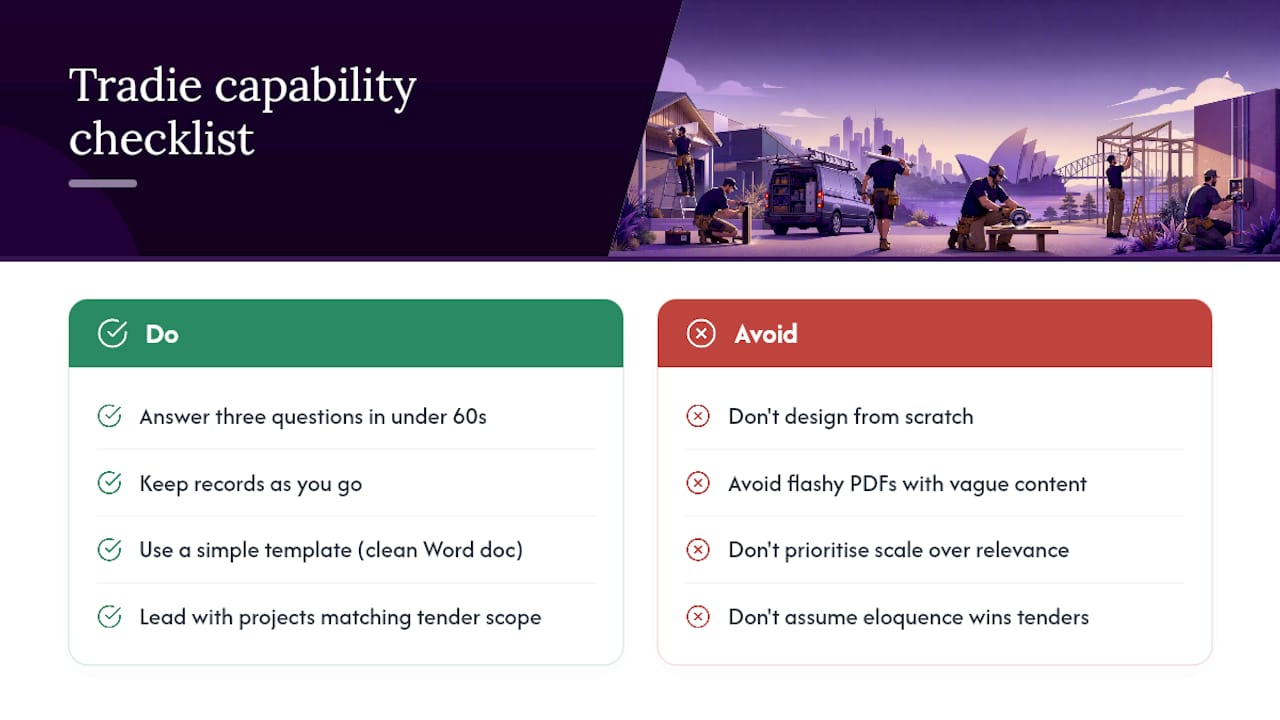
Procurement officers are not looking for the most eloquent document in the pile. They are looking for the one that answers their questions fastest. Does this business have the right licences? Have they done this kind of work before? Can I verify it? If your statement answers those three questions in under 60 seconds, you are ahead of most of your competitors.
For low-resource businesses, two things matter most. First, keep records as you go. A photo of the completed job, a signed completion certificate, and a client email saying “great work” are the raw material for your past performance section. Second, use a template. You do not need to design from scratch. A clean Word document with the right headings and consistent formatting will outperform a flashy PDF with vague content every time.
If you are choosing which three projects to lead with, pick the ones that are closest in scope and sector to the work you are tendering for. Relevance beats scale. A $200,000 project in the exact sector the tender covers is more persuasive than a $2 million project in a completely different industry.
Ask Hayley can take the hard work out of tender preparation
Putting together a tender-ready capability statement takes time you probably do not have spare. Ask Hayley’s tendering support service is built for exactly this situation: Australian tradies and small service businesses who need a professional, compliant document without spending days on it.
The team at Ask Hayley can audit your existing capability statement, build a master document from scratch, or prepare a full tender pack including your capability statement, method statements, and compliance evidence. If your certifications and safety documentation need organising before you can write the statement, the safety and compliance documentation service gets that sorted first. Book a free discovery call through Ask Hayley’s services page and have a tender-ready document in your hands without the scramble.
Sources
These are the most reliable starting points for Australian businesses preparing capability statements.
- Writing a business capability statement | Business Queensland
- Does your business need a capability statement? | Small Business Development Corporation WA
- Capability Statement Australia | Templates & Design Service
- Capability Statement Guide for Government Contractors | GovCB


