


AusTender is the federal government’s central portal for business opportunities, and every state and territory runs its own separate tender site. Your first move: register on AusTender, set your business category codes, and activate email alerts so matched opportunities land in your inbox automatically.
- Federal: AusTender publishes all Commonwealth opportunities valued at $10,000 or above
- State and territory: each jurisdiction maintains its own portal with separate registration and search tools
- Immediate action: register, select your UNSPSC codes, and save a search to trigger email notifications
Table of Contents
- Where do you find government tenders in Australia?
- How does AusTender work and how do you set up your account?
- How do you search for tenders and set up notifications?
- Tactics that lift your win rate and mistakes to avoid
- How tradies can manage tendering without an office team
- Where to get help and official training
- Key takeaways
- The reality of bidding for government work as a small contractor
- Ask Hayley takes the admin out of tendering
- Useful sources
Where do you find government tenders in Australia?
The short answer is: it depends on which level of government is buying. Business.gov.au confirms that the Australian Government publishes all opportunities at or above $10,000 on AusTender, while state and territory governments each operate independently. You need to be registered on the portals relevant to where you work and what you do.
| Portal | Jurisdiction | What it publishes |
|---|---|---|
| AusTender | Federal | Approaches to Market, contract awards, annual procurement plans |
| Buy.NSW | New South Wales | Open tenders, RFTs, panels, standing offers |
| Tenders SA | South Australia | Current open opportunities with advanced search and category filters |
| Tenders WA | Western Australia | State government procurement notices |
| QTenders | Queensland | State and local government opportunities |
| Tenders ACT | Australian Capital Territory | ACT Government procurement notices |
| Tenders SA | South Australia | Open tenders and contract award notices |
| Tasmanian Government Tenders | Tasmania | State procurement opportunities |
| Quotations and Tenders Online | Northern Territory | NT Government tenders and quotations |
Beyond the main portals, some agencies publish notices on their own departmental pages. The Department of Infrastructure, for example, maintains a dedicated tenders page alongside its AusTender listings. For ICT-specific work, check buyICT, which is a specialist procurement channel for technology-related contracts.
Pro Tip: Don’t assume AusTender covers everything. A council or state agency may post an opportunity only on its own portal, so set up alerts on every portal relevant to your trade and region.
How does AusTender work and how do you set up your account?
AusTender is the Australian Government’s central procurement information system. It publishes Approaches to Market (ATMs), contract award notices, and annual procurement plans from Commonwealth agencies. The $10,000 publication threshold means most meaningful contracts appear here, though some agencies also post notices on their own pages.
Setting up properly from the start saves you hours of manual searching later.
- Register a supplier account — on AusTender using your ABN and business details.
Large-scale federal opportunities, such as the High Speed Rail Authority’s multi-package EOI, show exactly how scope, submission routing, and lodgement instructions appear within an AusTender entry. Reviewing a few live ATMs before you bid gives you a clear picture of what agencies expect.
Pro Tip: UNSPSC codes are the engine behind matched alerts. Spend 20 minutes selecting every code that genuinely applies to your business — not just the obvious one — because agencies categorise the same type of work differently.
Key stat: Registering for automated email alerts on AusTender and correctly setting UNSPSC codes is the most effective way to receive relevant opportunities without constant manual searching.
How do you search for tenders and set up notifications?
Finding the right opportunities quickly comes down to knowing which filters to use and setting up alerts that do the work for you.
- Log in to AusTender and navigate to the ATM search page.
- Filter by agency if you have a target department or council in mind.
- Filter by category using UNSPSC codes relevant to your trade (e.g., electrical installation services, plumbing, civil construction).
- Filter by closing date to prioritise opportunities you can realistically respond to.
- Save the search and activate email notifications for new matches.
- Repeat the process on each relevant state portal — Buy.NSW, Tenders WA, QTenders, and others — using the same category logic.
Effective search terms for trades and common services include your trade category (e.g., “electrical services”, “plumbing maintenance”, “building maintenance”), your region or state, and the agency type (local government, health, education). State portals like Tenders SA offer advanced search and category filters that mirror AusTender’s functionality.
- Check your alerts daily during active tender periods.
- Review Annual Procurement Plans on AusTender to spot upcoming opportunities before they’re advertised.
- Register interest in ATMs early — some agencies send addenda only to registered respondents.
Tactics that lift your win rate and mistakes to avoid
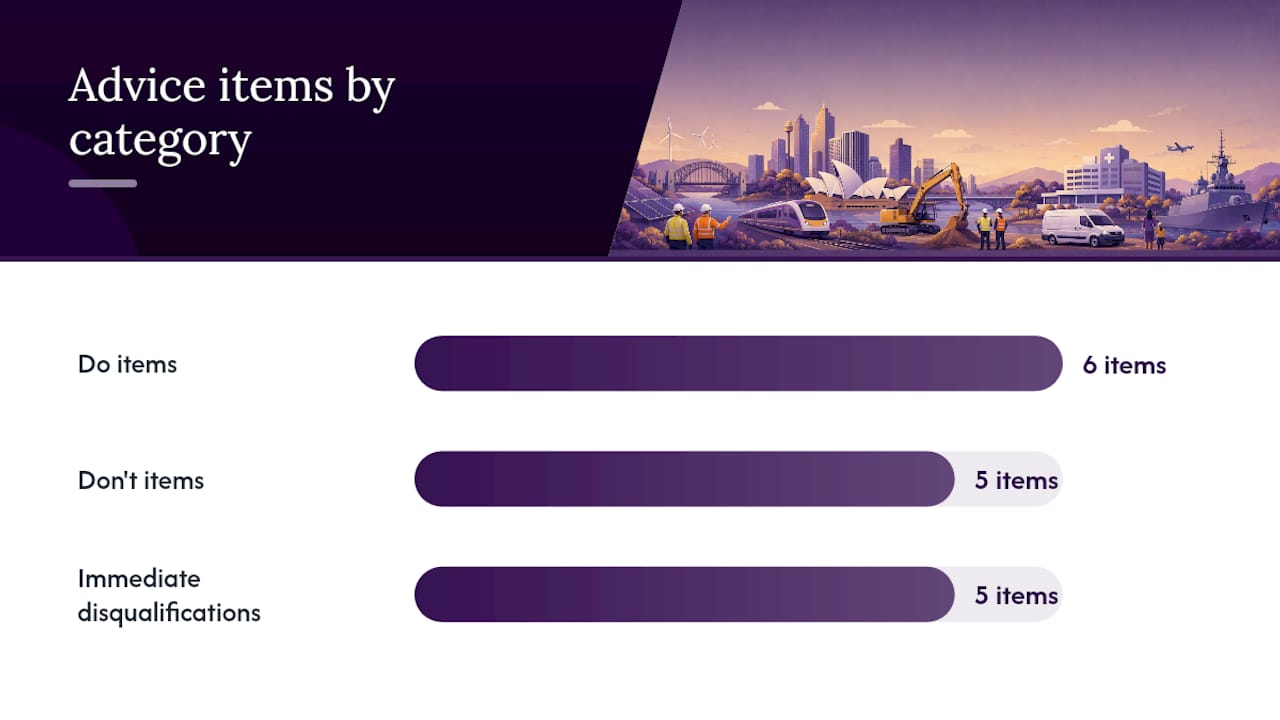
A compliant bid gets you past the gate. A competitive bid wins the work. These are the practical differences.
Do:
- Answer each criterion directly and in the order it appears in the tender documents. Evaluators score against a marking guide — make their job easy.
- Use named examples with measurable outcomes (project value, timeline, client contact) rather than general claims about capability.
- Include referees who can speak specifically to the type of work being tendered, not just your longest-standing clients.
- Address risk management explicitly. Agencies want to see that you’ve thought about what could go wrong and have a plan.
- Quantify social, economic, or environmental value where the criteria invite it. Local employment, apprenticeship numbers, and waste reduction figures all strengthen a response when agencies weight these factors.
Don’t:
- Hide your day rates or hourly rates in small print or appendices. Pricing schedules should be clear and complete.
- Submit a generic capability statement as your methodology response. Agencies can tell immediately.
- Ignore addenda. If an agency issues a clarification or amendment, your response must reflect it.
- Miss the mandatory declarations. A missing statutory declaration or conflict of interest form is an automatic fail.
- Submit at the last minute. Portal congestion near closing time is real, and late submissions are not accepted.
Common pitfalls that cause immediate disqualification:
- Missing or expired insurance certificates
- Unsigned declarations or pricing schedules
- Responses that don’t address a mandatory criterion at all
- File formats the portal doesn’t accept
- Submissions lodged after the closing time, even by one minute
How tradies can manage tendering without an office team
You’re on the tools most of the day. Tendering admin doesn’t stop because you’re on-site — but it does need a system.
- Do a final QA sign-off — Before lodging, run through your tender submission checklist one more time. Fresh eyes help — even a quick read-aloud catches errors that a tired screen-stare misses.
Pro Tip: Your evidence pack is the single biggest time-saver in tendering. Tradies who keep standardised, ready-to-drop-in documents — insurance, licences, referee contacts, project summaries — cut their bid preparation time significantly compared to those who scramble for documents each time.
When a tender is high-value, technically complex, or outside your usual scope, outsourcing to a professional tender writer pays for itself. Ask Hayley’s tendering services are built for exactly this situation — tradies who have the capability to win the work but need help packaging it compliantly and competitively.
Where to get help and official training
You don’t have to figure this out alone. There are solid official resources and professional options worth knowing.
Official resources:
- Selling to Government — the Australian Government’s step-by-step guide to identifying opportunities and understanding procurement rules. Start here if you’re new to government work.
- Business.gov.au — plain-language guidance on finding tenders and contracts at federal and state levels.
- State procurement offices — each state and territory runs a procurement helpdesk or contact point for supplier queries. Check the relevant portal’s “contact us” or “supplier information” page.
- paymenttimes.gov.au — a transparency scheme that publishes agency payment behaviour. Worth checking before you commit to a contract with a new agency.
Training formats available:
- Online guides and how-to articles on AusTender and business.gov.au
- Webinars run by state procurement offices and industry associations
- Agency-run supplier briefings attached to specific large procurements
- Procurement helpdesks for questions about a specific ATM or lodgement process
When to bring in professional help:
Outsourcing your tender response makes sense when the contract value justifies the cost, when the scope is outside your usual documentation comfort zone, or when you simply don’t have the time to write a competitive response without it affecting your current work. A professional tender writer or consultant who knows government procurement can identify gaps in your response that you’d miss, and that gap is often the difference between shortlisted and disqualified.
For safety and compliance documentation — a common mandatory requirement in construction and trade tenders — professional preparation ensures your documents meet the standard agencies expect.
Key takeaways
Winning government contracts in Australia starts with being registered on the right portals, setting up matched alerts, and submitting a compliant bid well before the closing time.
| Point | Details |
|---|---|
| Register on every relevant portal | Set up accounts on AusTender plus your state portal and activate email alerts with correct UNSPSC codes. |
| Mandatory compliance comes first | Every “must” and “shall” requirement is pass/fail — address each one before writing your methodology. |
| Value for money beats lowest price | Weighted non-price criteria (experience, methodology, systems) carry significant scoring weight alongside price. |
| Submit at least 24 hours early | Portal issues near closing time are common; a late submission is never accepted regardless of the reason. |
| Ask Hayley supports tender preparation | Ask Hayley’s tendering services help tradies package compliant, competitive bids without the admin scramble. |
The reality of bidding for government work as a small contractor
Getting your first government contract feels like a big leap. The paperwork looks formal, the portals feel unfamiliar, and the process seems designed for companies with a dedicated admin team. But the process is learnable, and it rewards preparation more than size.

The tradies who do well at government tendering aren’t necessarily the biggest operators. They’re the ones who keep their compliance documents current, respond to criteria in order, and submit early. A local council maintenance contract or a state agency services panel can provide steady, reliable work that private clients rarely match for consistency. The time investment in setting up your evidence pack and learning the portals is real — but once the system is in place, each subsequent bid takes a fraction of the effort of the first one.
Ask Hayley takes the admin out of tendering
Tradies who win government work consistently aren’t spending their evenings scrambling for insurance certificates or rewriting the same capability statement from scratch. They have a system. Ask Hayley gives you that system without adding another complicated app to learn.

Ask Hayley’s tender preparation services handle the documentation side — from compliance checklists and capability statements to full bid writing for complex proposals. The platform’s voice-first admin tools mean you can capture a new opportunity, assign tasks, and flag a deadline while you’re still on-site, hands full. Add safety and compliance documentation support for the mandatory attachments agencies require, and you have everything in one place.
Ready to put in a compliant bid without the late-night admin? Talk to the Ask Hayley team about tender support today.
Useful sources
Bookmark these pages. They’re the primary references used throughout this guide and the best places to go when you have a specific question about a portal or procurement rule.
| Resource | What it covers |
|---|---|
| AusTender | Federal procurement portal — ATMs, contract awards, annual plans |
| Business.gov.au — Find tenders | Plain-language guide to federal and state tender portals |
| Selling to Government | Official step-by-step guide to identifying and pursuing government opportunities |
| Tenders WA | Western Australia state procurement portal |
| Tenders SA | South Australia state procurement portal with advanced search |
| Buy.NSW | NSW procurement portal — example RFT for Vivid Sydney |
| Department of Infrastructure tenders | Agency-specific tender notices alongside AusTender listings |
| Tasmania weighted criteria guidelines | Detailed guidance on how weighted evaluation and normalisation works |
- Find tenders and contracts | business.gov.au
- AusTender Homepage: AusTender
- Guidelines on Tender Evaluation using Weighted Criteria for Building Works and Services | Version 8
- Identifying opportunities to sell to government
- Current ATM View – 10031970: AusTender
- SA Tenders and Contracts
- Vivid Sydney Design and Technical Supply for Sydney Harbour Bridge and/or Our Connected City (Building Lighting) – RFT-2009540 | buy.nsw
- Tenders WA
- Tenders


