


Claim and fully complete your Google Business Profile (GBP) today. That single action is the fastest path to appearing in Google’s Local Pack, where most Australians searching for a tradie will click first. Once your GBP is live and verified, build problem-focused service pages for each suburb you serve, then collect reviews consistently. Those three moves, done well, compound over time into a pipeline you own.
Do this today:
- Claim or log into your GBP at business.google.com
- Confirm your phone number is correct and tap-to-call ready
- Add at least 5 recent job photos (before/after works well)
- Text 3 recent customers and ask for a Google review
This month’s priorities:
- Publish 3 service pages targeting your highest-value jobs (e.g. “blocked drains Penrith”, “switchboard upgrades Parramatta”)
- Set your GBP service areas to up to 20 suburbs or postcodes
- Run a mobile speed test on your site via Google PageSpeed Insights and fix any critical issues
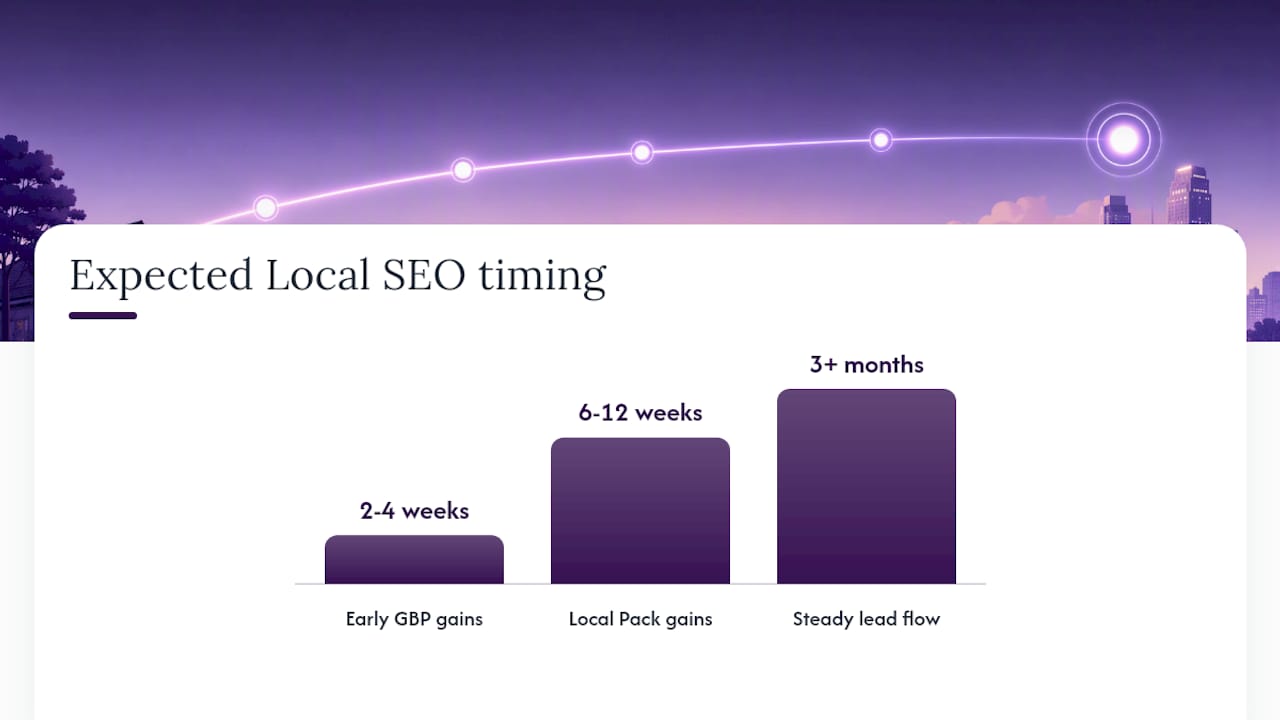
What to expect: Early GBP improvements, like appearing in more map searches and getting more profile calls, typically show within 2–4 weeks of a complete, verified profile. Meaningful Local Pack movement for competitive search terms usually takes 6–12 weeks. Steady lead flow from suburb-level service pages builds from month three onwards.
Key takeaways
Getting found in local search comes down to three compounding assets: a complete, verified GBP, problem-focused service pages for each suburb you serve, and a consistent weekly review habit.
| Point | Details |
|---|---|
| GBP is your first priority | Claim, verify, and fully complete your Google Business Profile before anything else. |
| Service pages beat generic sites | Build separate pages for each service and suburb to match real search intent and convert better. |
| Reviews need a weekly cadence | Ask every customer within 24 hours; respond to every review to build trust and local ranking signals. |
| Retainers cost $1,000–$2,500/month | Quality local SEO for Australian tradies sits in this range; measure success by cost per booked job. |
| Ask Hayley closes the loop | A one-page site with local SEO plus voice-first call answering stops leads from going unanswered. |
Table of Contents
- Why local SEO matters more than paid leads for tradies
- 1. The core local SEO checklist every tradie needs
- 2. How to set up and maintain your Google Business Profile
- 3. How to build service and suburb pages that actually rank
- 4. Collecting and using reviews to rank and convert
- 5. Citations and Australian directories — where to list and how to stay consistent
- 6. Local link-building tactics that work for tradies
- 7. How to target suburbs safely without risking suspension
- 8. Timeline, costs, and what to realistically expect
- 9. Short action plans for busy tradies: 1 week, 1 month, 3 months
- 10. How Ask Hayley turns your SEO traffic into booked jobs
- What actually separates the tradies who win at local SEO
- Your local SEO results start with the right foundation
- Sources
Why local SEO matters more than paid leads for tradies
Most Australians searching for a tradie start on Google. Research from Studio Slate notes that a high share of local searches convert quickly, with Local Pack results capturing the majority of clicks before a searcher ever scrolls to the organic listings below. That means if you are not showing in the map pack for your core services and suburbs, you are invisible to the customers most likely to call today.
The business case is straightforward. Paid lead platforms charge you per enquiry, whether the job books or not. Local SEO, once built, delivers enquiries at a fraction of that ongoing cost. A well-maintained GBP and a handful of strong suburb pages can generate calls for years without a per-lead fee.
According to BrightLocal’s Local Consumer Review Survey, consumers check multiple review platforms before choosing a local business, and businesses that respond to reviews are trusted significantly more than those that don’t. For tradies, that trust gap translates directly into phone calls.
Three factors determine your Local Pack ranking:
- Relevance: Does your GBP and website clearly describe the service the customer searched for?
- Distance: How close is your listed business location (or service area) to the searcher?
- Prominence: How many quality reviews, citations, and links point to your business?
GBP drives map-pack visibility. Your website captures enquiries, builds authority, and ranks for suburb-level searches that the GBP alone cannot cover. Together, they create a compounding asset. Per-lead platforms do not.
1. The core local SEO checklist every tradie needs
This is the ordered playbook. Work through it in sequence, because each step builds on the last.
Step 1: Claim and verify your Google Business Profile
Set it up as a service-area business (SAB). Hide your residential address. Add your service areas as individual suburbs or postcodes, not a radius. GBP is the single most important digital asset for contractors, and getting the setup right from the start prevents suspension headaches later.
Step 2: Build problem-focused service and suburb pages
Separate pages for each high-value service (e.g. “hot water repairs”, “blocked drains”) outperform a single generic trade page because they match what customers actually search. Pair each service with the suburbs you serve most.
Step 3: Fix technical basics
- Mobile speed: test with Google PageSpeed Insights and aim for a score above 70
- Click-to-call: your phone number must be a tappable link on mobile
- Add LocalBusiness and Service schema to your pages (more on this below)
Step 4: Audit and fix your citations
Check that your trading name, phone number, and address (or service-area description) match exactly across every directory. Using your legal Pty Ltd name instead of your trading name is one of the most common NAP errors Australian tradies make.
Step 5: Build a review collection habit
Ask every customer for a Google review within 24 hours of job completion. Respond to every review, positive or negative. Set a weekly cadence and stick to it.

Step 6: Earn local links
Sponsor a local footy club. Get listed on your local council’s contractor page. Write a short case study for a community group. These links carry more weight than generic directory submissions.
Step 7: Track what matters
Record profile views, calls from GBP, website enquiries, and booked jobs each month. Calculate your cost per booked job so you can judge whether SEO is delivering value.
Pro Tip: Set up a free Google Search Console account and link it to your GBP. This unlocks instant verification in some cases and gives you keyword data showing exactly which searches are driving traffic to your site.
2. How to set up and maintain your Google Business Profile
Your GBP is your most powerful local ranking tool. Set it up correctly once and maintain it weekly.
Choose the right business type
Select “service-area business” during setup. This hides your home address from the public listing while still allowing Google to understand your location for proximity ranking. Never list a virtual office or a fake commercial address — Google’s systems detect this and it commonly triggers suspension.
Set your service areas correctly
Google allows a maximum of 20 service-area entries per Business Profile. Enter each as a city, suburb, or postcode. Do not use a radius. Stick to areas you genuinely serve and can reach within a reasonable drive from your base. Exceeding 20 entries or using radius settings can cause profile edits to fail silently.
Complete every field that matters
- Primary category: choose the most specific trade category available (e.g. “Electrician”, not “Contractor”)
- Services list: add every individual service you offer, with a short description for each
- Business hours: include emergency or after-hours availability if you offer it
- Photos: add at least 10 photos — branded vehicle, completed jobs, tools, team
- Attributes: tick every relevant attribute (licensed, insured, free quotes, etc.)
- Website link: point this to your homepage or a dedicated landing page
Verification options
GBP verification now includes video, phone/SMS, Search Console instant verification, and live video calls. The method offered depends on your business category. Locksmiths, plumbers, and HVAC tradies are frequently asked to complete video verification. Prepare a 60-second clip showing your branded vehicle, tools, and any relevant paperwork or licence documentation. This speeds up the process and reduces the risk of automated rejection.
Pro Tip: Link your GBP to a verified Google Search Console account before you apply for verification. When the accounts are connected, instant verification becomes available for eligible categories, saving days of waiting.
Red flags that cause suspensions
- Listing a home address that is publicly visible
- Using a virtual office or co-working address
- Inconsistent trading name across GBP and other directories
- Creating multiple listings for the same business at different addresses
3. How to build service and suburb pages that actually rank
Generic trade pages do not convert. A page titled “Plumber in Sydney” competes with every plumber in the city and tells Google nothing specific. Problem-focused pages win because they match exactly what a stressed homeowner types at 9pm.
What a strong service page looks like
Build separate pages for each distinct service — “blocked drains Penrith”, “hot water system replacement Parramatta”, “emergency electrician Blacktown”. Each page should include:
- A headline that names the problem and the suburb (e.g. “Blocked Drain Repairs in Penrith”)
- An intro paragraph describing the problem and your solution
- A list of specific services covered on that page
- Local proof: photos from jobs in that suburb, your licence number, any relevant council or permit notes
- A short FAQ answering common questions about that service
- A clear tap-to-call CTA above the fold on mobile
- LocalBusiness and Service schema in the page code
Making suburb pages genuinely unique
The biggest mistake tradies make with suburb pages is swapping only the suburb name and leaving everything else identical. Google recognises thin templated content and ranks it poorly. Make each page unique by including:
- Local details specific to that suburb (e.g. older housing stock, common pipe materials, council permit requirements)
- Photos taken in that area
- A mention of nearby landmarks or streets where relevant
- Any area-specific pricing notes or access considerations
Pro Tip: Before writing a suburb page, search “[your service] + [suburb]” in Google and read the top three results. Note what questions they answer and what they miss. Your page should answer everything they do, plus fill the gaps.
Schema: what to add and where
Add LocalBusiness schema to your homepage and Service schema to each service page. You can generate both using Google’s Structured Data Markup Helper or a plugin like Yoast SEO or RankMath if you are on WordPress. Schema does not directly boost rankings, but it helps Google understand your pages and can trigger rich results in search.
4. Collecting and using reviews to rank and convert
Reviews are not a nice-to-have. BrightLocal’s research confirms that consumers check multiple review platforms before choosing a local business, and that businesses responding to reviews earn significantly more trust. For tradies, that trust converts directly into calls.
How to ask for reviews without it feeling awkward
The best time to ask is within 24 hours of completing a job, while the customer is still pleased. A simple SMS works well:
“Hi [name], thanks for having us out today. If you’re happy with the work, a quick Google review would mean a lot to us. Here’s the link: [your GBP review link]”
In person, you can say: “We rely on word of mouth. If you’re happy, a Google review helps us out more than you’d think.”
Add your review link as a QR code on your invoice, on the back of your business card, and in your email signature.
Where to focus your review efforts
Google is the priority. After that, focus on platforms your customers actually use:
- hipages and ServiceSeeking if you use them for leads
- Facebook for community-based referrals
- Product Review for visibility in broader searches
Responding to reviews
Respond to every review within 48 hours. For positive reviews, thank the customer by name, mention the service and suburb, and invite them back. For negative reviews, stay calm, acknowledge the issue, and offer to resolve it offline. Never argue publicly.
A response that mentions the service and location naturally reinforces your local relevance signals. “Thanks for trusting us with your hot water system replacement in Campbelltown, Sarah” does more SEO work than a generic “Thanks for the review.”
Pro Tip: Set a weekly calendar reminder every Friday to send review requests to that week’s completed jobs. Consistent, recent reviews outperform a burst of old ones. Review recency is a real ranking signal.
5. Citations and Australian directories — where to list and how to stay consistent
A citation is any online mention of your business name, address, and phone number (NAP). Consistent citations across authoritative directories strengthen your local prominence signals. Inconsistent ones confuse Google and dilute your ranking power.
Key Australian directories to target
- Google Business Profile (highest priority)
- Yellow Pages (yellowpages.com.au)
- True Local (truelocal.com.au)
- hipages (if you use it for leads)
- Oneflare
- Your local council’s contractor or preferred supplier page
- Your state’s contractor licensing board directory (e.g. NSW Fair Trading, VIC Consumer Affairs)
- Your trade association’s member directory (e.g. Master Electricians, Master Plumbers, HIA)
- Local chamber of commerce listings
The NAP audit checklist
Run this audit quarterly:
- Search your business name in Google and note every listing that appears
- Check that your trading name matches exactly — use your trading name, not your Pty Ltd legal name
- Confirm your phone number is identical across every listing (same format: 04XX XXX XXX or (02) XXXX XXXX, not mixed)
- Check your address format is consistent (if you list one) or that all SAB listings hide the address
- Look for duplicate listings and request their removal
Common mistakes to fix
- Listing “Smith Plumbing Pty Ltd” in some places and “Smith Plumbing” in others
- Old phone numbers left on directories after a number change
- Inconsistent punctuation in addresses (St vs Street, Rd vs Road)
- Multiple GBP listings for the same business
Tools like BrightLocal and Whitespark can automate citation discovery and flag inconsistencies across hundreds of directories, saving hours of manual checking. Both are available to Australian businesses and support local directory networks relevant to this market.
6. Local link-building tactics that work for tradies
Links from other websites to yours are a vote of confidence in Google’s eyes. For tradies, the most valuable links come from local, relevant sources — not from generic guest posts on national blogs.
High-return tactics worth your time
- Local trade associations: most state-based associations (Master Electricians, Master Plumbers, HIA, NECA) offer member directory listings with a link back to your site
- Local council contractor pages: many councils maintain preferred supplier or approved contractor lists; contact your local council’s procurement team
- Sponsorships: sponsoring a local footy club, school fete, or community event often earns a link from the organisation’s website
- Local news: if you do emergency storm work, a community project, or something newsworthy, pitch a short story to your local paper or suburb Facebook group; a mention in a local news article carries real link value
- Supplier and manufacturer pages: if you are an authorised installer for a product brand (solar panels, heat pumps, specific appliances), ask the manufacturer to list you on their “find an installer” page
Why local beats national for tradies
A link from your local council’s website or your suburb’s community news site carries more geographic relevance than a link from a national home improvement blog. Google’s local algorithm weights proximity and local relevance heavily. One link from a genuinely local source often outperforms five from generic directories.
Writing a short “how we fixed it” case study for a local community group, a body corporate newsletter, or a builders’ association blog is a practical way to earn these links without cold outreach.
7. How to target suburbs safely without risking suspension
Expanding your service area is tempting, but doing it incorrectly can get your GBP suspended or your edits silently rejected.
The 20-area rule
Google’s official guidance limits each Business Profile to 20 service-area entries. Use city, suburb, or postcode entries. Do not use a radius. If you try to add more than 20, the additional entries may not save, and repeated failed edits can flag your profile for review.
Choose your 20 entries carefully. Prioritise the suburbs that generate the most enquiries and where you can realistically respond within a reasonable timeframe.
Safe practices for broader reach
If you serve more than 20 suburbs, handle the overflow on your website rather than in GBP:
- Build 15–25 suburb-specific service pages with genuinely localised content
- Cluster nearby suburbs onto a single page when search volume is low (e.g. “Plumber in Ryde, Meadowbank and West Ryde”)
- Prioritise unique pages for your highest-volume, highest-competition suburbs
What to avoid
- Creating separate GBP listings for different suburbs without a genuine physical presence in each
- Using a virtual office address to appear closer to a target suburb
- Publishing suburb pages that only swap the suburb name with no other unique content
Fake locations and thin pages both carry real risk. Google’s quality reviewers and automated systems flag them regularly, and a suspended GBP can take weeks to reinstate.
8. Timeline, costs, and what to realistically expect
Local SEO is not instant, but it is predictable. Here is what the evidence suggests for Australian tradies.
Typical timelines
- Weeks 2–4: GBP improvements show (more profile views, calls from map searches) after a complete, verified profile
- Weeks 6–12: Measurable Local Pack movement for competitive terms as reviews, citations, and on-page signals accumulate
- Months 3–6: Meaningful lead flow from suburb-level service pages as organic rankings build
- Months 6–12: Strong local market presence with consistent review flow and a full suburb page library
Cost ranges
Quality local SEO retainers for Australian tradies typically sit in the $1,000–$2,500 per month (ex-GST) bracket. Packages under approximately $800 per month often rely on risky automation that can harm your profile. A one-off website build reduces ongoing fees by giving you a solid technical foundation from day one.
GBP setup and optimisation is free. Your time is the cost.
Simple ROI calculation
Track these numbers monthly:
| Metric | How to measure |
|---|---|
| Profile views | GBP Insights dashboard |
| Calls from GBP | GBP Insights > Calls |
| Website enquiries | Google Analytics or contact form notifications |
| Booked jobs from SEO | Ask customers how they found you |
| Cost per booked job | Monthly SEO spend ÷ jobs booked from SEO |
If your average job is worth $800 and your SEO spend is $1,500 per month, you need just two booked jobs per month to break even. Most tradies with a well-maintained GBP and three to five strong service pages exceed that within the first three months.
Google Ads can complement SEO for new businesses or high-value jobs while organic rankings build, but measure every campaign by cost per booked job, not cost per click.
9. Short action plans for busy tradies: 1 week, 1 month, 3 months
You do not need a full day to start. Here is what to do in the time you have.
1-week plan
- Claim or log into your GBP and confirm all details are correct
- Set service areas to your top 15–20 suburbs
- Add 5 job photos to your GBP
- Test your website on mobile and confirm the phone number is tap-to-call
- Text 3 recent customers asking for a Google review
1-month plan
- Publish your top 3 service pages (one per high-value service, targeting your busiest suburb)
- Run a mobile speed test and fix critical issues
- List your business on 8–12 Australian directories with consistent NAP
- Set a weekly Friday reminder to send review requests
- Link your GBP to Google Search Console
3-month plan
- Build out 12–15 suburb and service pages with genuinely unique content
- Establish a steady review flow (aim for 2–4 new reviews per month)
- Earn 3–5 local links (association listing, council page, sponsorship)
- Record baseline KPIs: profile views, calls, booked jobs, cost per job
- Run a NAP audit across all directories and fix inconsistencies
For sole operators: focus on GBP, your top 3 service pages, and reviews first. Those three alone will move the needle. Delegate the website build and citation audit when budget allows.
For small teams: assign one person to own the review cadence and GBP updates. Even 30 minutes per week of consistent maintenance compounds significantly over six months.
10. How Ask Hayley turns your SEO traffic into booked jobs
Getting found is only half the equation. If a customer calls while you are on the tools and no one answers, that lead is gone.
Ask Hayley’s voice-first answering fits directly into your local SEO funnel:
- Captures calls from GBP and your website when you cannot answer, so no enquiry goes to voicemail
- Pre-qualifies leads by asking the right questions (job type, location, urgency) before passing the lead to you as a warm, ready-to-book enquiry
- Handles after-hours calls so a customer searching at 9pm gets a response, not silence
- Integrates with Xero and AroFlo so call data, job details, and follow-up tasks flow into your existing systems without manual entry
For GBP specifically, you can route your GBP call tracking number through Ask Hayley so every call is answered, logged, and attributed. That data feeds back into your cost-per-job calculation and shows you exactly which suburbs and services are generating calls.
Pro Tip: Add your Ask Hayley number as the primary contact on your GBP. When a customer calls from the map pack and Hayley answers within two rings, your conversion rate from profile view to booked job improves measurably. Speed of response is one of the strongest predictors of whether a lead books.
What actually separates the tradies who win at local SEO
The tradies who consistently rank well and convert that traffic into jobs share three habits. They collect reviews every single week without fail. They have a suburb page for every area they genuinely want to work in. And when a customer calls, someone answers.
The ones who struggle usually have one of three problems. Their GBP is claimed but half-empty, with no photos and a category that is too broad. Their website has one page that tries to cover every service and every suburb at once. Or they ran a burst of activity six months ago, got a few reviews, then stopped.
The pattern that delivers results is not complicated. A complete GBP, three to five strong service pages, and a steady review cadence will outperform most competitors in most Australian suburbs within three to six months. The tradies who win are not doing anything exotic. They are just doing the basics consistently, while their competitors are not.
One pattern worth noting: a tradie who fixes a slow, mobile-unfriendly site and adds tap-to-call often sees an immediate lift in GBP conversion rate, even before rankings change. The site was already getting traffic. It just was not converting it.
Your local SEO results start with the right foundation
Getting your GBP right and publishing suburb-focused service pages will generate more calls. But calls only convert into jobs when someone answers them.
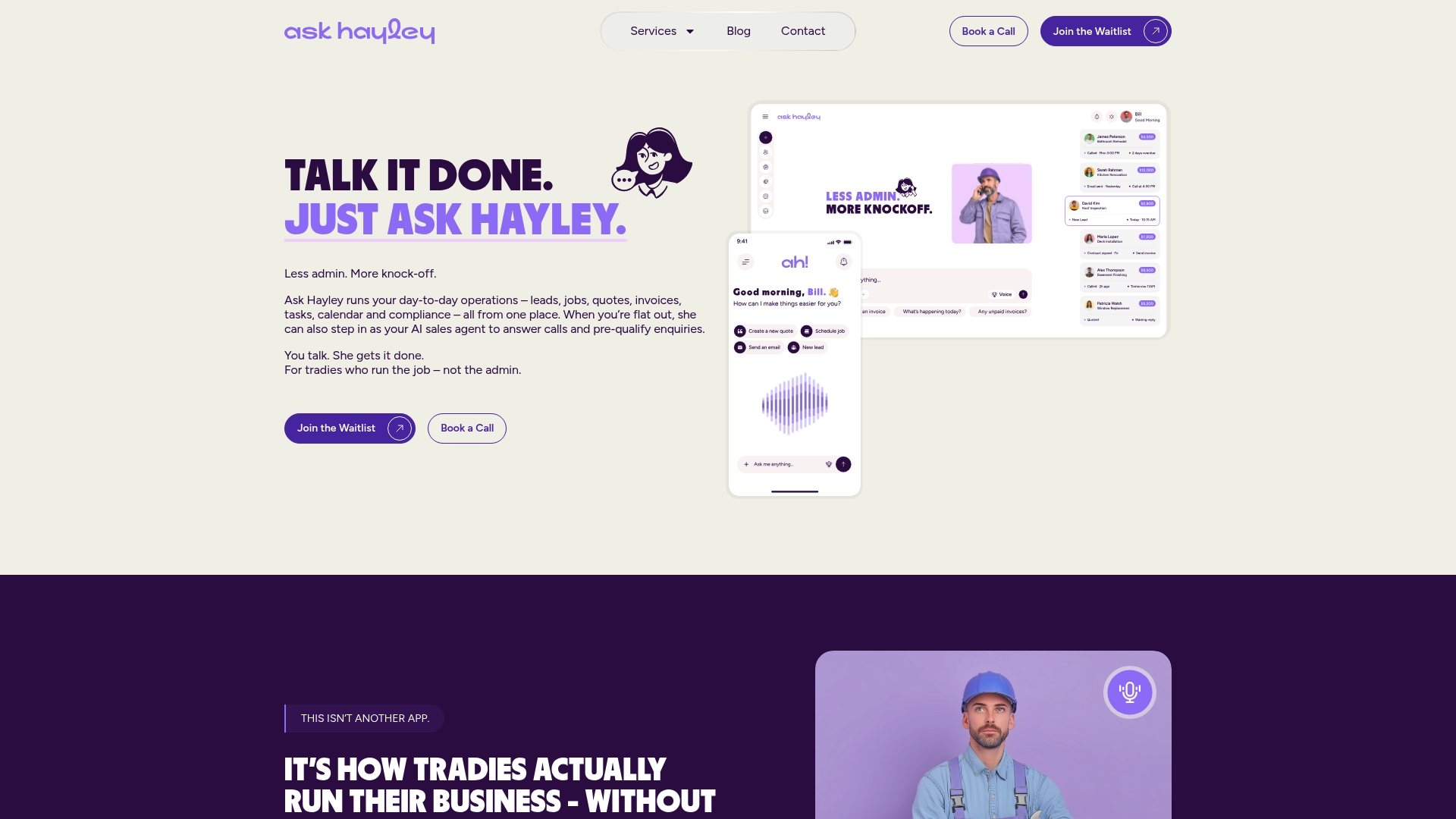
Ask Hayley’s one-page website for tradies is built specifically for local SEO, with the structure, schema, and suburb targeting already in place. Pair it with Ask Hayley’s voice-first call answering and you have a complete system: your site ranks, your GBP drives calls, and Hayley answers every one of them, pre-qualifies the lead, and passes it to you ready to book.
No missed calls. No admin backlog. No leads lost to voicemail. See what’s included and Askhayley.
Sources
Use these resources to implement the steps in this guide.
Google tools (free):
- Set or change your Business Profile service area – Google Business Profile Help
- Local Consumer Review Survey 2024 – BrightLocal
- SEO for Tradesmen: Stop Renting Leads, Own Your Pipeline – Nestcontent
- SEO for Contractors & Trades: The Complete Guide to Dominating Local Search – Marketing By Kevin
Local SEO research and review management:
Australian-specific resources:
Ask Hayley resources:


