


Use a short, site-specific WHS management plan built around six sections: project details, key personnel, risk assessment, controls, emergency planning, and SWMS management. Anchor it to Safe Work Australia guidance, your state regulator, and a firm SWMS timeline: collect subcontractor SWMS 48 hours before high-risk work starts, and a 24-hour review turnaround.
In your next 30 to 60 minutes, do this:
- Fill in project name, address, dates, and key contacts.
- List your site manager, supervisors, first aid officer, and health and safety representative.
- Attach a basic site map showing entry points and hazard zones.
- Schedule SWMS collection from every subcontractor working high-risk tasks.
That’s the skeleton. Now let’s build it out properly.
Key Takeaways
A site-specific plan with clear roles, a documented SWMS timeline, and a genuine review cycle is what separates working safety documentation from paperwork nobody reads.
| Point | Details |
|---|---|
| Start with the skeleton | Fill in project details, key personnel, site map, and hazard register before mobilisation begins. |
| Set a firm SWMS timeline | Collect subcontractor SWMS 48 hours before high-risk work, with a 24-hour internal review. |
| Keep it short | Aim for 8 to 12 pages using plain language so crews actually read and follow it. |
| Trigger reviews on real events | Update the plan regularly or immediately after an incident or scope change. |
| Get help finishing it | Ask Hayley’s safety and compliance documentation service turns your draft template into an audit-ready, maintained plan. |
Where to find official templates and examples
- Safe Work Australia: national WHS guidance and resources.
- Australian Industry Group’s project safety plan: industry example for construction projects.
- Charles Sturt University’s site safety management plan: worked example for site maps and evacuation routes.
Table of Contents
- What goes in a site safety plan template?
- How do you adapt this template to your job site?
- What are the legal obligations for a WHS management plan?
- How do you keep the safety plan actually used on site?
- Frequently asked questions
- Sources
What goes in a site safety plan template?
A working site safety plan template needs twelve sections, not forty. Auditors and workers both switch off when a document reads like a legal brief. Comcare’s WHS management plan template covers WHS arrangements, responsibilities, consultation, training, risk assessment, and emergency procedures. Treat it as your structural backbone, then adapt the language to your crew.
Purpose and scope. State what the plan covers (the project, the site, the work activities) and what it doesn’t. One paragraph is enough.
Project and site details. Project name, address, principal contractor, start and finish dates, and emergency contact numbers.
Site map and boundaries. Mark entry and exit points, hazard zones, storage areas, and amenities. A hand-drawn map is fine if it’s accurate.
Key personnel and responsibilities. Name your site manager, supervisors, first aid officers, and health and safety representative (HSR). State what each person is accountable for, not just their title.
Hazard identification and WHS risk assessment. List hazards specific to the job, not generic ones copied from another site. Work through the hierarchy of control: elimination, substitution, isolation, engineering controls, administrative controls, and PPE, in that order of preference.
Controls and procedures. Cover emergency planning, evacuation routes, muster points, PPE requirements, and permits for hot work or confined spaces. Include plant and materials registers if the job involves cranes, excavators, or hazardous substances.

Contractor management and SWMS. This is where most small builders lose control. Set a 48-hour lead time for subcontractors to submit their Safe Work Method Statements, and a 24-hour internal review window so approved work isn’t delayed at the gate.
Training and induction. Record site inductions, toolbox talk topics and dates, and any licence or ticket checks (white card, high-risk work licence, plant tickets).
Records and sign-off. Log every review, every incident, and every plan update. Set a review cycle, six months is a sensible default, and trigger an immediate review after any incident or major scope change.
Attachments. Site map, SWMS for each high-risk activity, safety data sheets (SDS), relevant permits, and licence copies.
Before work starts, run this checklist:
- Has the principal contractor signed the plan?
- Are all current licences and white cards recorded?
- Are emergency contacts correct and visible on site?
- Has every subcontractor submitted a SWMS for their scope?
- Is the site map current and does it match ground conditions?
The Australian Industry Group’s project safety plan template is a solid secondary reference if you want to compare structure before finalising your own.
How do you adapt this template to your job site?
A template only works once it stops looking like a template. Auditors spot boilerplate content within seconds, unfilled placeholders, generic hazard lists, and site maps that don’t match the actual address. The fix is straightforward: write the plan for the real job, not a hypothetical one, and update it as the project moves.
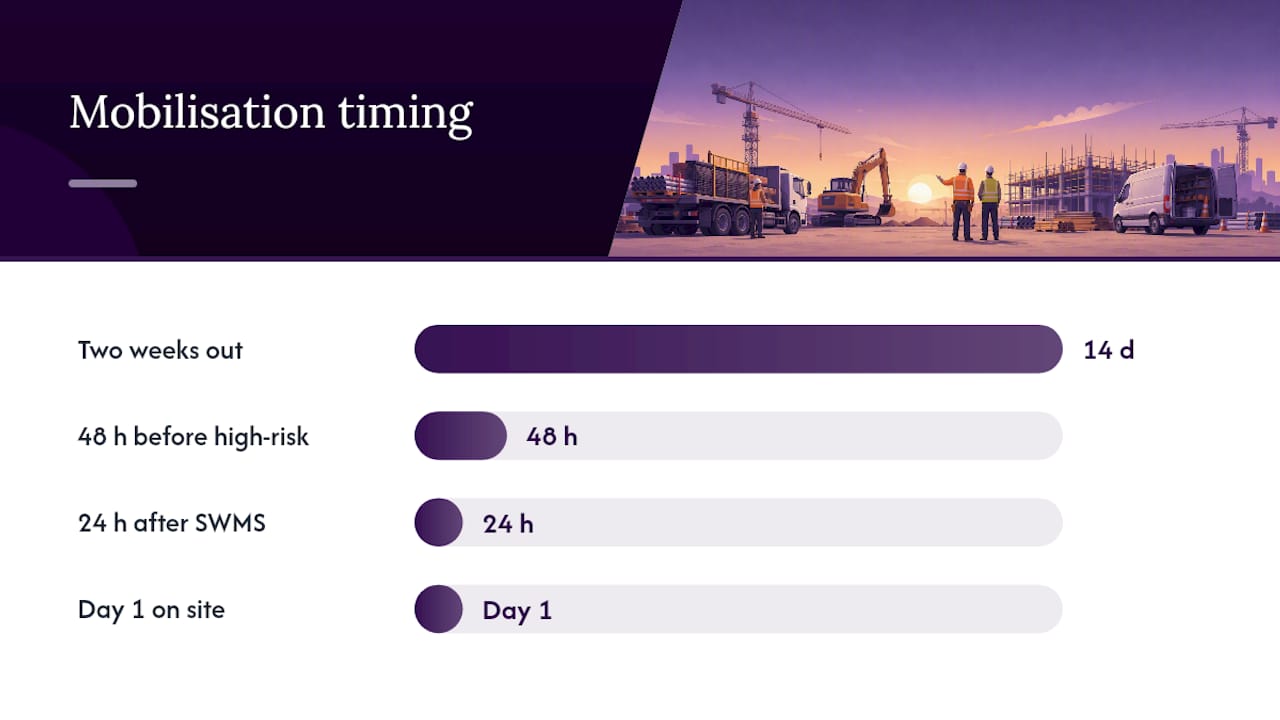
Here’s a mobilisation timeline that works for small crews:
- Two weeks out: draft the plan using the skeleton above, filling in project details and personnel.
- 48 hours before high-risk work: collect SWMS from every subcontractor undertaking that activity.
- 24 hours after receiving each SWMS: review it, request changes if needed, and file the accepted version.
- Day one on site: run the induction, walk the site map with the crew, and confirm the plan is signed off before anyone picks up a tool.
Responsibility splits naturally by role. Your project manager or supervisor owns the site map and personnel sections. Each subcontractor provides their own SWMS for their scope of work. Your WHS contact (this might be you, on a small job) tracks receipt and sign-off so nothing falls through.
Once the job’s running, the plan needs a daily rhythm: pre-start checklists each morning, toolbox talks on a set schedule (weekly is common), and a copy on site, laminated or in a folder, alongside a digital version your office can access.
For small teams, keep the whole document to 8 to 12 pages where you can. Plain language beats legal phrasing every time, and you should only attach SWMS and permits that are actually relevant to the current phase of work.
Pro Tip: Put a simple version control line on the front page, version number, date, author, and reviewer. Trigger an immediate review the moment there’s an incident or the scope changes, don’t wait for the six-month mark.
What are the legal obligations for a WHS management plan?
Your obligations sit at both national and state level, so check both before you finalise anything. Safe Work Australia sets the national guidance and model laws, but your day-to-day compliance runs through your state regulator, SafeWork NSW, WorkSafe Victoria, SafeWork SA, or Comcare if you’re working on Commonwealth land or as a Commonwealth contractor.
Every plan needs to demonstrate:
- Consultation and coordination arrangements between all persons conducting a business or undertaking (PCBUs) on site.
- Incident notification procedures, including who calls the regulator and within what timeframe.
- Evidence of induction and training, not just a policy statement saying training happens.
- Plant inspection and maintenance records for anything mechanical or load-bearing.
- SWMS retention for the life of the high-risk work, plus a reasonable period after.
Construction projects above certain size or risk thresholds typically require a formal WHS management plan as standard practice, and principal contractors are usually the ones required to prepare it. Thresholds and specific documentation expectations shift between jurisdictions, so confirm your state’s exact requirements rather than assuming national guidance covers every local rule.
Before the first worker steps on site, confirm the plan is signed by the principal contractor, every current licence and white card is recorded, and emergency contacts are correct and visible.
How do you keep the safety plan actually used on site?
Regulators are consistent on this point: a concise plan that matches your business’s actual culture and capabilities beats a long one nobody reads. Length isn’t a compliance metric. Usefulness is.
Build the plan into routines your crew already follows rather than treating it as a separate obligation. Pre-start checks, toolbox talks, and a visible site copy do more for compliance than a thick binder in a site office drawer. Keep one digital source of truth so updates reach everyone at once, instead of five different versions floating around on phones.
Small business owners feel the weight of safety paperwork more than most, and the operators who manage it best have moved from static documents to living systems that update as the job changes.
A minimal morning checklist keeps this workable:
- Is the plan version current and does it match today’s activities?
- Have all subcontractors on site today submitted their SWMS?
- Are hazard controls from yesterday still in place?
- Has anything changed on site overnight (weather, deliveries, new plant)?
Pro Tip: Pin the checklist next to the sign-in sheet. If foremen can’t find it in ten seconds, they won’t use it.
A site manager’s view on what actually works
I’ve swapped a 40-page plan nobody opened for a laminated one-page site map with a checklist stapled to it. Inductions went from twenty minutes of glazed eyes to five minutes of actual attention. The crew started pointing out hazards themselves, because they could finally see the plan as something practical, not paperwork.
Turning your template into an audit-ready plan
Building the plan is one thing. Keeping it audit-ready while you’re running a job, chasing SWMS, and answering calls from three different sites is another matter entirely. This is where a lot of small operators lose the thread, not because the template is wrong, but because nobody has the hours to maintain it properly.

Ask Hayley’s safety and compliance documentation service takes the template you’ve just built and turns it into a finished, audit-ready document, tracked, version-controlled, and matched to your actual site conditions rather than a generic download. It sits alongside Ask Hayley’s broader services, including tender support for businesses that need compliance paperwork ready for a bid, not just a job site. If you’d rather have a proper document sorted than spend another weekend formatting one yourself, get in touch through the Ask Hayley site and ask about a custom version built for your next project.
Frequently asked questions
What’s the difference between a site safety plan and a SWMS?
A site safety plan covers the whole project, personnel, emergency procedures, hazard management, while a Safe Work Method Statement (SWMS) covers one specific high-risk task, like working at height or excavation. Your site safety plan should reference and collect the relevant SWMS as attachments.
How long should a construction safety plan be?
Aim for 8 to 12 pages where the job allows it. Length isn’t what regulators check for, clarity and relevance are. A shorter plan that crews actually read beats a long one that sits unopened in a folder.
Do I need a WHS management plan for every small job?
Formal WHS management plans are typically required above certain project size or risk thresholds, and requirements vary by state. Even on smaller jobs, a basic site safety plan covering hazards, roles, and emergency procedures is good practice and often expected by principal contractors.
How often should I review my site safety plan?
Review it every six months as a baseline, and immediately after any incident, near miss, or significant change in scope or site conditions. Build the review date into your version control line on the front page.
Can I use a generic site safety plan template for every project?
No. Auditors can spot boilerplate content quickly, unfilled placeholders, generic hazards, and mismatched site details. Start from a template structure, but fill it with details specific to the actual project, address, and workforce.
Sources
- WHS Management Plan Template — Construction Safety Plan Guide
- Safe Work Australia
- Project Safety Plan
- Site Safety Management Plan (Charles Sturt University example)


