


Start with a clear, evaluation-ordered tender response template and attach a one-page capability statement. According to the Australian Government’s Selling to Government guidance, there is no single standard format — so your job is to complete every mandatory form, follow the buyer’s requested structure, and present your response in the exact order of the evaluation criteria. That makes it easy for evaluators to compare submissions side by side.
Before you open a blank document, confirm you have these ready:
- Completed response sections (in the buyer’s order)
- Pricing schedule or Bill of Quantities
- One-page capability statement
- Public liability and workers’ compensation insurance certificates
- Relevant trade licences and accreditations
- WHS/safety policy and any required safety plans
- Signed declarations and GST/tax forms
- Any addenda acknowledgement forms
Pro Tip: Never reformat the buyer’s template. Fill in the sections exactly as provided. Changing the structure — even to improve readability — can trigger disqualification.
Key takeaways
A compliant, well-structured tender response template — built around the buyer’s evaluation criteria and backed by measurable evidence — gives Australian tradies and small businesses the best chance of scoring well and winning work.
| Point | Details |
|---|---|
| Follow the buyer’s order | Structure every answer to match the evaluation criteria sequence so evaluators can score quickly. |
| Supply all mandatory returnables | Missing a signed declaration or insurance certificate is enough to exclude an otherwise strong bid. |
| Use STAR case studies | Each project example needs a measurable outcome and a named verifier to carry weight with evaluators. |
| Use official templates where specified | GC21 and DIT RFT templates set the standard for construction and government work — don’t substitute your own. |
| Ask Hayley tender support | Ask Hayley prepares compliant tender templates, capability statements and compliance documents for Australian tradies. |
Table of Contents
- How should you structure your tender response?
- What goes in a capability statement?
- What mandatory forms and returnables do you need to supply?
- How do you manage deadlines, addenda and lodgement?
- How do you present evidence that actually scores?
- Should you bid? A quick decision checklist
- Common mistakes that cost you marks
- How Ask Hayley’s tender support service works
- What I’ve learned about tendering as a tradie
- Ready to submit a stronger tender?
- Sources
How should you structure your tender response?
Evaluators score submissions against a set of weighted criteria. The faster they can find your answer to each criterion, the better your score. Business Queensland’s tendering guidance recommends structuring every answer as: Answer → Approach → Evidence → Outcome. Lead with a direct statement that addresses the criterion, then explain your method, back it with evidence, and close with a measurable result.
Where the buyer has not supplied a template, use this order:
- Executive summary (company snapshot, key differentiators, commitment to the project)
- Capability statement (company overview, key personnel, relevant experience)
- Methodology (how you will deliver the scope, key milestones, subcontractors)
- Programme / project schedule
- Pricing schedule (itemised, GST-exclusive unless stated otherwise)
- Risk management and WHS/safety plan
- Attachments (licences, insurances, references, certificates)
A few formatting rules that matter:
- Match the buyer’s specified file type (usually PDF or Word; check the RFT)
- Respect word and page limits — exceeding them signals you can’t follow instructions
- Label every attachment clearly (e.g. “Attachment A — Public Liability Certificate”)
- Use the buyer’s section headings verbatim so evaluators can navigate quickly
What goes in a capability statement?
A capability statement is your one-page pitch. Keep it tight. Evaluators read dozens of submissions, and a dense four-page company profile works against you.
One-page capability statement structure:
- Company snapshot: ABN, years in operation, number of employees, service area
- Core services: three to five bullet points, specific to the tender scope
- Key personnel: name, role, relevant qualifications and licences
- Recent relevant projects: two or three STAR snippets (see below)
- Insurances and accreditations: policy numbers, expiry dates, certifying bodies
STAR case study snippet (example for a small construction job):
| Element | Example |
|---|---|
| Situation | Stormwater drainage failure at a commercial site in Western Sydney |
| Task | Repair and reline pipe within a five-day window |
| Action | Mobilised crew quickly, used CCTV inspection to scope works, completed relining without excavation |
| Result | Works completed in four days, zero safety incidents, client confirmed full drainage function on handover |
Attach with your capability statement:
- Copies of trade licences (current)
- Insurance certificates (public liability minimum $20 million for most government tenders)
- Key personnel CVs (one page each)
- Relevant accreditations (e.g. ISO 9001, SafeWork registration)
What mandatory forms and returnables do you need to supply?
Buyers separate two things: the response template (the document you write your answers in) and returnable schedules (pre-formatted forms you complete and return). Both are mandatory. Missing a returnable is one of the most common reasons otherwise strong submissions are excluded.
Common returnable schedules and legal documents include:
- Conditions of tendering (read these first — they govern the whole process)
- Proposed conditions of contract (your acceptance is usually implied by lodgement)
- Pricing/BOQ schedule
- GST and tax declarations
- Conflict of interest declaration
- Insurance schedule
- Addenda acknowledgement
South Australia’s DIT publishes downloadable RFT templates and Conditions of Tendering that show exactly how these documents are packaged. The ACT short-form RFT is another useful reference — it shows how conditions of tendering and proposed contract terms sit together, and why the RFT conditions become part of the contract if your tender is accepted.
For construction projects, check whether the buyer specifies GC21 — the standard Australian form for complex construction contracts. If GC21 is mandated, use its standard returnables rather than drafting your own terms. For smaller jobs, a short-form RFT is typical, but always verify the document suite required. Sprintlaw’s legal guidance on Australian tender templates recommends using standard contract documents unless your situation involves unique risks that need specialist legal drafting.
Pro Tip: Treat the buyer’s template as the mandatory baseline. Innovate inside sections — your delivery model, added value, methodology — but never change the response structure itself.
| Document type | Where to find it |
|---|---|
| Federal government RFT templates | Selling to Government (finance.gov.au) |
| SA DIT RFT templates | Dit |
| ACT short-form RFT | Act |
| GC21 construction standard | buy.nsw.gov.au |
How do you manage deadlines, addenda and lodgement?
Missing a deadline or submitting the wrong file type costs you the bid before an evaluator reads a word. Build a workback schedule from the submission deadline and set internal milestones at least five days out.
- Day 1 after RFT release: Download all documents, log the deadline, assign sections to team members
- Rolling: Track all addenda — re-read mandatory attachments after each one is issued
- Five days before deadline: Complete first draft, circulate for internal review
- Two days before deadline: Final QA, check all attachments are labelled and included
- Day before deadline: Convert to required file format, confirm file size limits, test upload
Common lodgement traps to avoid:
- Exceeding the file size limit (compress images; split attachments if needed)
- Submitting a Word file when PDF is required (or vice versa)
- Missing scanned signatures on declarations
- Failing to acknowledge addenda in writing
- Uploading to the wrong portal or email address
State procurement guidance on format and supporting material details expectations for file formats, attachment labelling and how to present supporting documents so evaluators can find them quickly. For electronic lodgement, ProTenders’ guide to electronic tendering covers portal-specific considerations worth reviewing before your first online submission.
How do you present evidence that actually scores?
Generic claims lose marks. Evaluators are trained to spot unsubstantiated statements like “we have extensive experience” and score them low. Business Queensland’s guidance is clear: use STAR case studies with measurable outcomes and verifiable references.

Map your evidence directly to the evaluation criteria:
| Evaluation criterion | Supporting document | Measurable outcome | Verifier |
|---|---|---|---|
| Relevant experience | STAR case study | Completed 3 weeks ahead of programme | Project manager (name + phone) |
| WHS capability | Safety management plan | Zero LTIs across 12-month contract | Safety officer contact |
| Financial capacity | Accountant’s letter or bank reference | Turnover sufficient for contract value | Accountant (name + firm) |
| Quality assurance | ISO 9001 certificate or QA plan | Zero defect callbacks on recent jobs | Client reference contact |
Pro Tip: Include at least one measurable metric per case study — a time saving, a cost outcome, a safety record — and name a contact who can verify it. Evaluators trust numbers they can check.
- Keep each case study to 150–200 words
- Mirror the language of the evaluation criterion in your opening sentence
- Avoid photos or diagrams unless the RFT specifically requests them
Should you bid? A quick decision checklist
Time spent on a tender you can’t win is time not spent on work you can. Run through this before committing.
Dealbreaker filters (if any answer is no, don’t bid):
- Do you hold the required licences and insurances?
- Can you demonstrate relevant experience in the scope?
- Do you have the capacity to deliver within the required timeframe?
Scoring rubric (score 1–3 on each):
- Capability fit: how closely does your experience match the scope?
- Margin: is the likely contract value worth the bid cost?
- Commercial risk: are the contract terms manageable without specialist legal review?
- Compliance ease: can you supply all mandatory documents without significant effort?
- Strategic value: does winning this contract open doors to future work?
Once you decide to bid:
- Assign a lead writer and a reviewer
- Set internal milestones (see timeline section above)
- Pull your evidence folder: CVs, certificates, case studies, insurances
Common mistakes that cost you marks
Most tender losses come down to a handful of repeat errors. Here is what to fix before you submit.
Common mistakes:
- Answering in a different order to the evaluation criteria
- Over-selling without evidence (“we are the best in the industry”)
- Missing attachments or attaching outdated documents
- Inconsistent dates, client names or project values across sections
- Exceeding word counts
Formatting best practices:
- Use the buyer’s section headings verbatim
- Bold the opening sentence of each answer (your direct response to the criterion)
- Keep paragraphs to three sentences or fewer
- Number and label every attachment in a contents list at the front
Pre-submission QA checklist:
- Every mandatory form signed and dated
- All attachments labelled and listed in the contents page
- Word counts checked against the RFT
- File format and size confirmed
- Addenda acknowledged
Pro Tip: Print the evaluation criteria and tick each one off against your draft. If a criterion has no direct answer in your response, you have a gap to fill.
How Ask Hayley’s tender support service works
Preparing a compliant, competitive submission takes time most tradies don’t have mid-job. Ask Hayley’s tender support service covers the full workflow:
- Intake and requirements capture: Hayley reviews the RFT, identifies mandatory forms and maps the evaluation criteria
- Template customisation: your tender response template is structured to match the buyer’s order and formatted to the RFT’s specifications
- Evidence assembly: capability statements, STAR case studies and compliance documents are drafted or refined using your project history
- QA and lodgement support: a final check against the submission checklist before you lodge
Service benefits include:
- Compliant, editable templates you keep and reuse
- Capability statements aligned to your licences, insurances and accreditations
- Safety and compliance documentation prepared alongside your tender (WHS plans, policy documents)
- Integration with your quoting workflow so pricing schedules stay consistent
Ask Hayley has supported Australian tradies and small service businesses to prepare compliant tender submissions, from capability statements through to full response documents and compliance attachments. The service is built around the reality of trade work: you supply the project history, and Ask Hayley handles the structure, formatting and compliance checks.
What I’ve learned about tendering as a tradie
The biggest mistake I see is treating a tender like a quote. A quote answers “how much?” A tender answers “why you?” Evaluators are not just checking your price — they are assessing whether you are a safe, capable, compliant business they can defend choosing.
Lock a clean master template now, before you need it. Keep your CVs, insurance certificates and case studies in a single folder you update after every significant job. Nominate one person to review every submission before it goes out — not the person who wrote it.
Realistically, your first few tenders will take longer than you expect. That is normal. The discipline of building your evidence folder and refining your capability statement pays off on the third or fourth bid, when you can assemble a strong submission in a fraction of the time.
Use the bid/no-bid filter every time. Pursuing tenders you are unlikely to win drains margin and morale. The businesses that win consistently are the ones that are selective, prepared, and honest about where their capability actually sits.
Ready to submit a stronger tender?
Putting together a compliant, competitive tender response takes more than a good template. It takes the right structure, the right evidence, and someone checking the details before you lodge.
Ask Hayley’s tender support service gives Australian tradies and small service businesses a done-for-you option: your response structured to the buyer’s evaluation criteria, capability statements written from your project history, and compliance documents prepared alongside the submission.
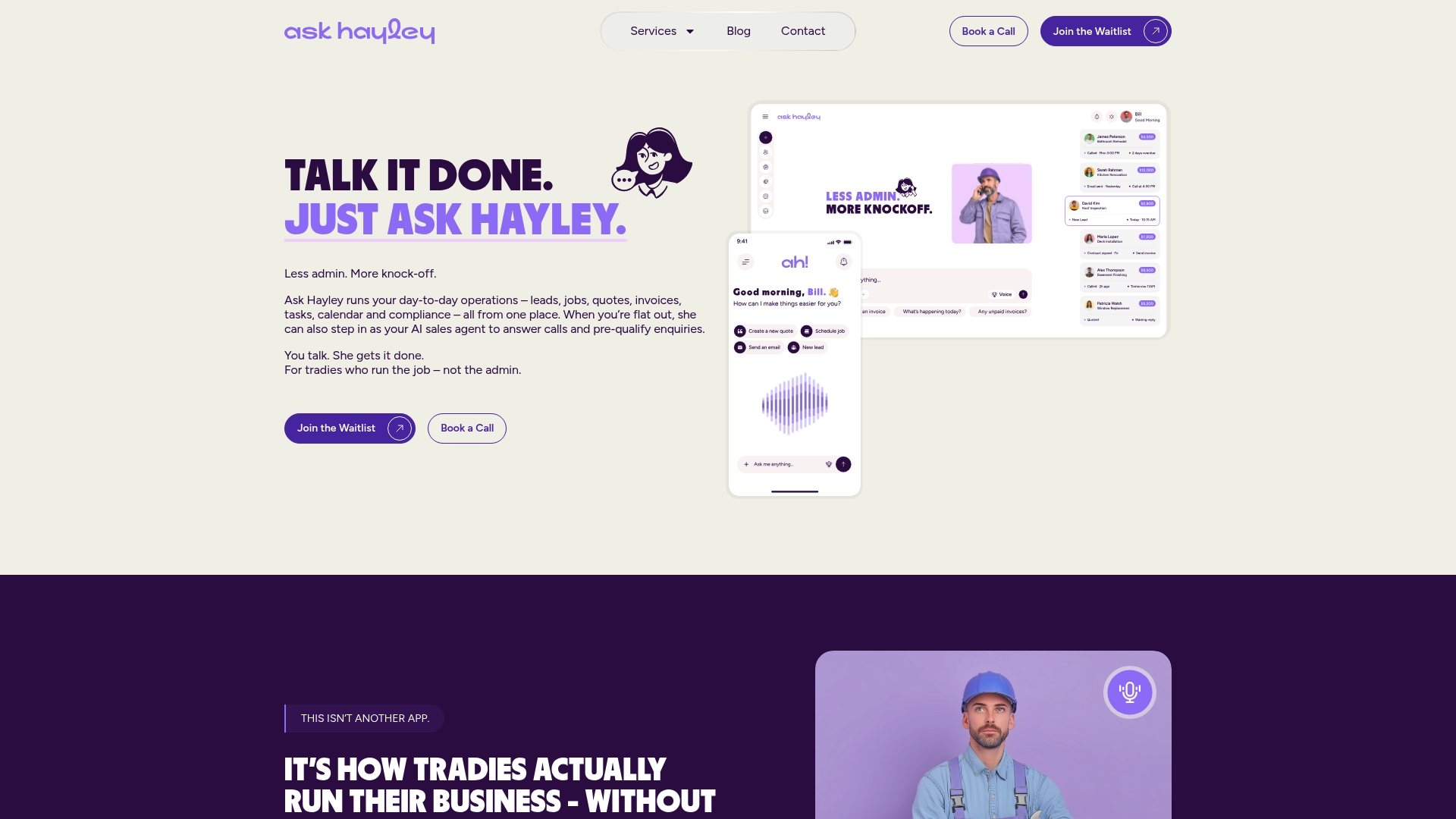
No long-term contract. No agency retainer. You get editable documents you own and reuse on every future bid. Whether you need a full submission or just a capability statement and compliance pack, Ask Hayley can help you put your best work forward.
Book a tender support session or visit Ask Hayley to see the full range of services.
Sources
Official Australian sources for tender response templates and guidance:
- Building your best response – Selling to Government
- GC21 resources
- DIT Request for Tender templates & conditions of tender
- Short form request for tender & conditions of contract (ACT)
- Tips for writing a successful tender response | Business Queensland
- Format and supporting material
- Tender Templates: Legal Essentials for Australia | Sprintlaw


