


An AI sales agent is software that runs real sales tasks (qualifying leads, chasing follow ups, booking meetings) on its own, using machine learning and natural language processing rather than a human doing every step. If you’re a tradie or small service business fielding calls while your hands are full of tools, this matters more than most tech trends. In a sample of 130,000 calls across contractor businesses, a large percentage of calls went unanswered during normal business hours. That’s a lot of jobs walking straight to the next name in the search results.
Key Takeaways
An AI sales agent works by combining autonomous decision-making with CRM, phone and calendar integrations to capture and qualify leads that would otherwise be missed.
| Point | Details |
|---|---|
| Definition matters | An AI sales agent runs sales tasks autonomously using machine learning and NLP, unlike a scripted chatbot. |
| Missed calls are the trigger | With 74% of contractor calls going unanswered in one sample, phone agents address a real, measurable gap. |
| Type follows use case | Autonomous agents suit high-volume triage; assistive agents suit consultative, high-value sales. |
| Compliance comes first | Check Privacy Act, call-recording consent and Spam Act rules before your agent talks to a single customer. |
| Ask Hayley fits tradies | Ask Hayley’s AI Sales Agent add-on combines call answering, lead qualification and Xero integration for Australian trade businesses. |
Table of Contents
- What does an AI sales agent actually do?
- What types of AI sales agents are there?
- What are the benefits for Australian small businesses?
- How do AI sales agents actually work?
- How do you actually deploy one in a small business?
- How much does an AI sales agent cost?
- What are the risks and Australian compliance considerations?
- When does an AI sales agent suit your business, and when doesn’t it?
- What we see working with Australian tradies
- How Ask Hayley helps you put this into practice
- Frequently asked questions
- Sources
What does an AI sales agent actually do?
Think of it as a tireless junior salesperson who never clocks off. According to Salesforce’s guide to AI sales agents, these tools analyse your sales and customer data to perform tasks with little or no human input, including nurturing leads, booking meetings and drafting quotes.
Day-to-day, that looks like:
- Answering inbound calls and chatting naturally, not reading a script
- Qualifying leads against your criteria before they hit your inbox
- Following up across email, SMS or messaging without you lifting a finger
- Booking appointments straight into your calendar
- Drafting quotes from job details the caller gives it
- Updating your CRM so nothing gets lost in a scribbled note
Pro Tip: Start by measuring how many calls you currently miss in a normal week. That number becomes your baseline for judging whether an agent is worth it.
It’s the gap an AI phone agent is built to close, one conversation at a time.

What types of AI sales agents are there?
Not every AI sales agent works the same way, and picking the wrong type for your business is the most common early mistake. Broadly, there are four categories worth knowing:
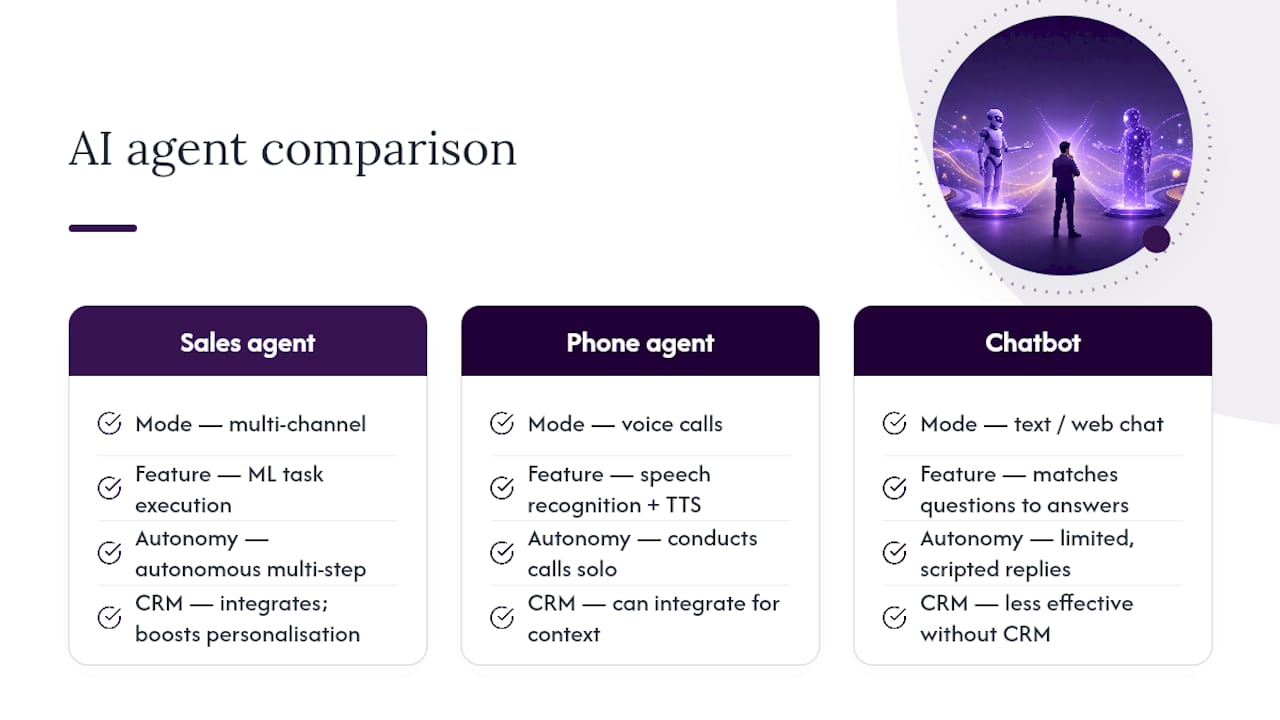
- Autonomous agents run tasks end to end with no human step in between, ideal for high-volume outbound or inbound triage.
- Assistive agents (copilots) support a human rep during consultative, relationship-heavy sales.
- AI phone or voice agents use speech recognition and voice synthesis to hold open conversations and complete tasks such as booking appointments and qualifying leads without a human on the line.
- AI SDRs focus specifically on prospecting and outbound sequences before handing warm leads to a closer.
Most teams end up running both autonomous and assistive agents, matching the type to the deal’s complexity. For a tradie, the natural starting point is almost always a phone or voice agent handling inbound calls. That’s where the missed opportunities are biggest and the risk is lowest.
What are the benefits for Australian small businesses?
The shift shows up fastest in response time. A lead who gets an answer in under a minute behaves very differently to one left on hold or sent to voicemail.
- Calls and enquiries answered instantly, day or night
- More meetings booked without you chasing people between jobs
- Admin hours freed up for actual trade work
- Consistent follow-ups that don’t fall through the cracks when you’re flat out
- Coverage outside standard business hours, when a surprising number of enquiries actually come in
Salesforce notes that reps typically spend only a small share of their working week actually selling, with the rest eaten by admin, follow-ups and scheduling. Handing those repetitive tasks to an agent is where the time savings genuinely come from, not from some abstract “AI magic”, but from integration and automation doing the boring parts consistently.
How do AI sales agents actually work?
Underneath the conversation, an AI sales agent runs on a loop: observe, plan, act, learn. ZoomInfo describes this as what separates a true agent from a simple chatbot, which just matches a question to a scripted answer. An agent reasons over context and can execute several steps in sequence without a human nudging it along.
Underneath that loop sit a large language model, a decisioning engine and some form of memory. Rather than just generating a reply, the agent decides what action to take next, using intent detection to work out what the caller actually wants.
For that to work well, it needs data. Priority integrations usually include:
- Your CRM (contact records, deal stage)
- Phone systems (for call answering and routing)
- Calendar (for booking without double-ups)
- Xero or your invoicing platform
- Quoting software
Pro Tip: Connect your CRM and calendar before you touch accounting integrations. Get the agent booking jobs cleanly first, then layer in Xero once you trust the basics.
An agent reading a unified customer profile can personalise outreach using product usage or support history. Without that, it’s limited to whatever fields sit in your CRM.
How do you actually deploy one in a small business?
Getting from “sounds good” to “live and working” doesn’t need to be complicated, provided you don’t skip the groundwork.
Before launch:
- Define what success looks like: fewer missed calls, more booked jobs, faster response times
- Map where your customer data actually lives (CRM, spreadsheets, phone logs)
- Confirm your consent and call-recording setup is compliant
- Clean up your CRM contacts and write down what an ideal customer actually looks like
Running the pilot:
- Pick one low-risk use case first, like inbound call triage or meeting booking
- Run it for four to eight weeks before judging results
- Track meetings booked, response time and how many leads turn into real opportunities
Ongoing:
- Keep a human in the loop for anything outside the agent’s guardrails
- Review call recordings and messaging tone regularly
- Update scripts and data feeds as your business changes
How much does an AI sales agent cost?
Pricing varies more than most vendors let on, and the drivers are worth understanding before you sign anything.
- Licence model: per seat versus per volume of conversations or minutes
- Voice minutes, which add up fast for phone-heavy businesses
- Integration and setup fees for connecting CRM, calendar and Xero
- Ongoing monitoring and human oversight
- Deliverability and reputation management for email and SMS outreach
Pro Tip: Budget for setup, a monthly subscription and some usage-based cost on top. Treat the first month as a pilot to validate ROI, not a locked-in commitment.
More automation generally means more setup work and more things to keep an eye on, particularly email deliverability and keeping the agent’s tone consistent with your brand.
What are the risks and Australian compliance considerations?
Before you deploy anything that talks to customers on your behalf, a few Australian-specific checks matter more than the sales pitch.
- Privacy Act obligations: know what personal information the agent collects and how it’s stored
- Call recording consent: Australian law generally requires notifying (and in some states, obtaining consent from) callers that a conversation may be recorded
- Spam Act rules: electronic marketing messages need consent, sender identification and an unsubscribe option
- State-based fair trading rules: relevant if the agent makes claims about pricing or services during a call
Operational risks matter just as much. Poor data quality leads to bad qualification decisions. Brand tone can drift if nobody reviews transcripts. Deliverability issues can quietly tank your email outreach without you noticing for weeks.
Pro Tip: Set explicit consent capture at the start of every call, build in human-in-loop escalation for anything unusual, and audit a sample of recordings and messages monthly.
When does an AI sales agent suit your business, and when doesn’t it?
Fit matters more than features here. Some businesses see results almost immediately; others are better off waiting.
Good fit:
- Tradies with high inbound call volume and limited admin capacity
- Businesses that regularly miss leads outside business hours
- Firms with clear, repeatable qualification criteria
Poor fit:
- Solo consultative sales where personal rapport closes the deal
- High-risk, heavily regulated quoting that genuinely needs human oversight at every step
Many businesses land on a hybrid: autonomous agents handling volume tasks like triage and booking, with a human or assistive copilot stepping in for the bigger, more complex jobs.
What we see working with Australian tradies
The wins we see most often are simple: fewer missed calls, more jobs actually booked, less time lost to admin at night. Start small. Get inbound call capture and booking right before adding anything more complex.
How Ask Hayley helps you put this into practice
Ask Hayley is built specifically for Australian tradies who lose jobs to missed calls, not for enterprise sales teams with dedicated ops staff. It answers your phone when you can’t, pre-qualifies leads before they hit your inbox, and updates your records through natural voice prompts instead of another app to log into.
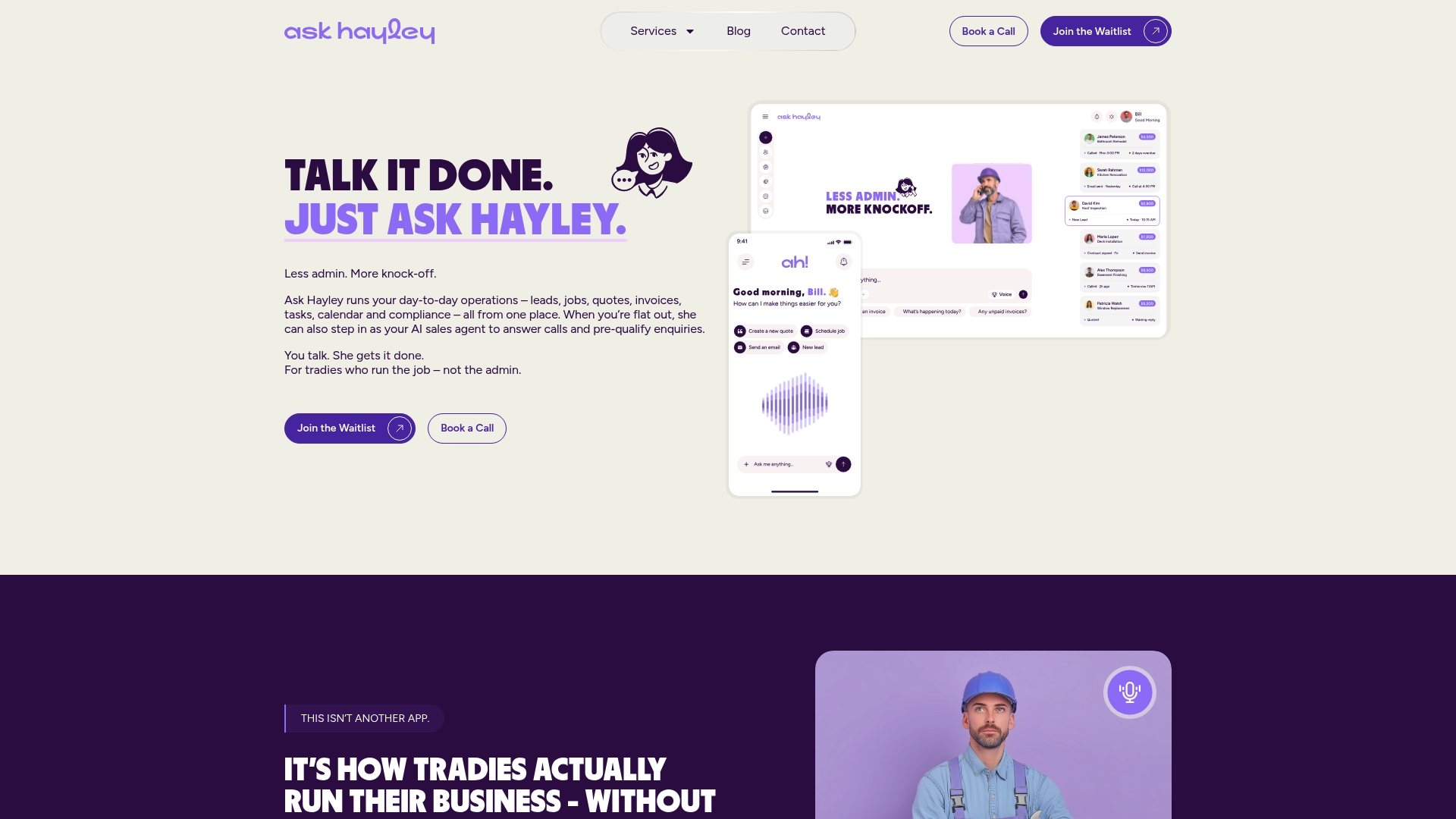
The AI Sales Agent add-on sits on top of the core Assistant and Office Manager plans, giving you multi-channel outreach and meeting booking alongside call answering, with Xero integration keeping your admin trail clean. It suits tradies and small service businesses with high inbound call volume or admin overload most, exactly the fit described above. If your website isn’t capturing leads properly either, pairing it with a simple lead-capture website closes that gap too. Head to the Ask Hayley homepage to see the plans and book a trial.
Frequently asked questions
What is an AI sales agent in simple terms?
It’s software that performs sales tasks such as lead qualification, follow-ups and meeting booking on its own, using machine learning rather than a fixed script.
What is an AI phone agent, and is it different?
An AI phone agent is a specific type of AI sales agent focused on voice calls. It uses speech recognition and voice synthesis to hold real conversations and complete tasks like booking without a human on the line.
How is an AI sales agent different from a chatbot?
A chatbot typically matches a question to a pre-written answer. An AI sales agent reasons over context and can execute multi-step tasks, like qualifying a lead, updating your CRM and booking a follow-up call, without step-by-step human direction.
Do I need a CRM before I can use an AI sales agent?
Not strictly, but it helps significantly. An agent connected to a CRM can prioritise and personalise outreach far better than one working from call transcripts alone.
Is it legal to have an AI agent answer and record customer calls in Australia?
Generally yes, provided you meet call-recording notification and consent requirements under Australian law and handle any personal information collected in line with Privacy Act obligations. Check the specific rules for your state before going live.
Sources
- Salesforce — AI sales agent guide
- ZoomInfo — AI sales agents explainer
- Murf — What is an AI phone agent?
- Cdp
- Komo — AI sales agent glossary


