


Use a short, correctly filled purchase order issued before materials ship. Get the PO number, both parties’ ABNs, GST treatment and delivery details right, and matching invoices later takes minutes, instead of a phone call to the supplier. Issue it as soon as you commit to a quote, list every line item with unit prices exclusive of GST, and quote the PO number on every delivery docket and invoice that follows.
TL;DR:
- Using a purchase order with correct details and clear GST treatment prevents delays in claiming input tax credits and protects your legal position.
- Locking unit prices and quantities on POs helps safeguard your margins on materials-heavy jobs and streamlines payment approval.
- Always quote the PO number on delivery dockets to simplify dispute resolution and improve traceability, especially at the delivery stage.
- Maintaining a consistent, full field set in your PO template—especially buyer and supplier ABNs, delivery details, and clear line items—reduces errors and legal risks.
- Employing voice-first management platforms enables real-time, hands-free logging and tracking of purchase orders, deliveries, and invoices to cut admin time and avoid costly site delays.
Table of Contents
- What is a purchase order for tradies in Australia?
- Why should tradies bother with purchase orders?
- What should a tradie purchase order include?
- How do you create and manage POs without stopping work?
- How does Ask Hayley cut the admin around purchase orders?
- Hayley’s tradie-first view: three fixes worth adopting this week
- A simpler way to run PO admin on site
- Sources
- FAQ
What is a purchase order for tradies in Australia?
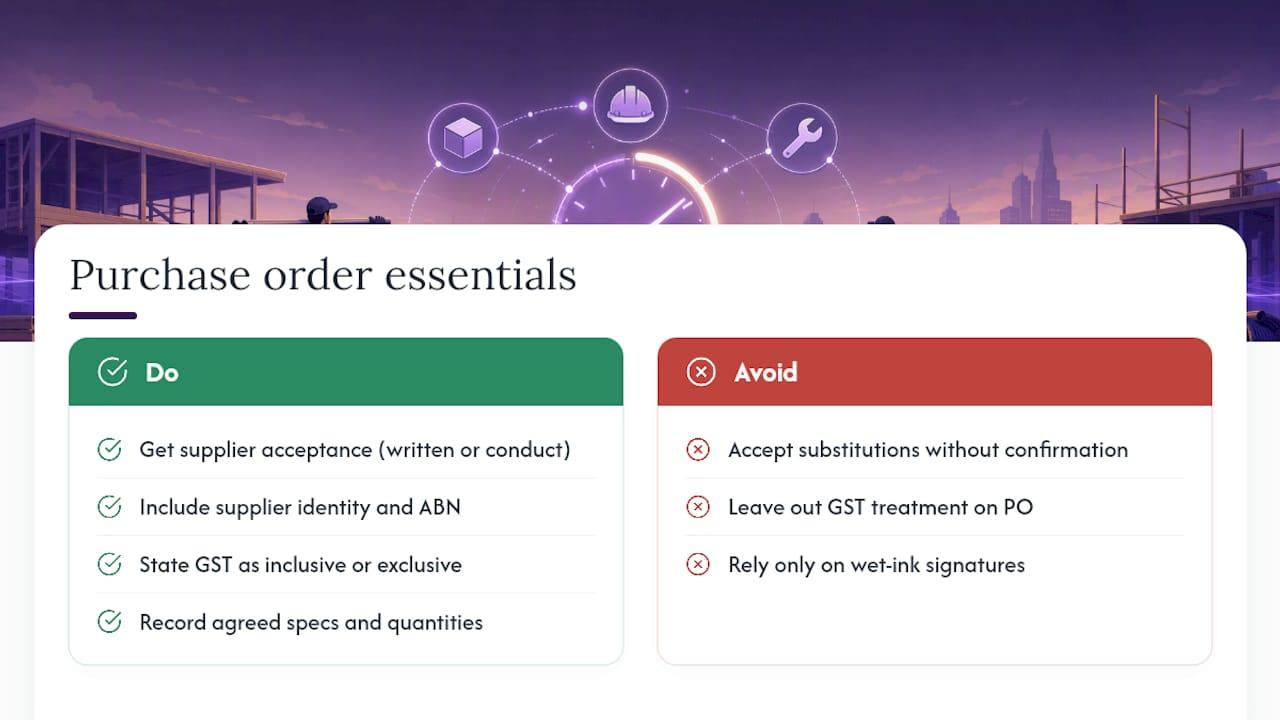
A purchase order is an offer to buy, not a finished contract. It becomes binding once your supplier accepts it, either by written confirmation or by conduct, such as loading the order onto a truck and delivering it to your site.
That acceptance matters more than most tradies realise. If a supplier substitutes materials or changes the price without confirming against your PO, you have a paper trail showing what was actually agreed. The Electronic Transactions Act generally treats an emailed PO and a scanned acknowledgement as legally effective, so there’s no need to chase a wet-ink signature before work starts.
Tax treatment is where a lot of tradies come unstuck. The Australian Taxation Office requires a valid tax invoice to show the supplier’s identity and ABN before you can claim input tax credits for GST. If your PO doesn’t state GST treatment clearly, GST inclusive or exclusive, mismatches between the PO and the tax invoice can hold up your GST claim at tax time. Consumer law also comes into play on quality and fitness for purpose when supplies don’t match what was ordered, so a clear written PO strengthens your position either way.
Why should tradies bother with purchase orders?
A PO does more than record what you ordered. It sets up a three-way match between the PO, the delivery docket and the invoice, so you’re only ever paying for what you actually asked for and received.
That match catches the errors that eat into margin without anyone noticing: a supplier billing last month’s price rise, a quantity typo, a delivery fee that was never quoted. Locking unit prices and quantities on the PO before materials ship protects your margin on jobs where materials make up a big share of the cost, which is most residential and light commercial work.
Here’s where it pays off day to day:
- Faster payment approval. Office staff or your bookkeeper can tick off an invoice against the PO in seconds instead of ringing you on site to confirm it’s right.
- Fewer site delays. A PO with the correct delivery address and required date means less standing around waiting for a truck that went to the wrong address.
- Protected margin. Committed costs show up the moment you issue the PO, well before the invoice lands, so you catch a blown budget while there’s still time to fix it.
- Cleaner disputes. When a supplier disputes a return or a shortfall, the PO is your evidence of what was agreed.
Pro Tip: Quote your PO number on the delivery docket, not just the invoice. Most disputes happen at the delivery stage, and a docket with no reference number is a nightmare to trace back a week later.
What should a tradie purchase order include?
A compliant PO doesn’t need to be complicated, but it does need to cover a specific set of fields. Miss one and you either create a GST headache or hand a supplier an excuse to bill you for the wrong thing.
Work through this checklist when you build a template or fill one in from a generator:
- Unique PO number — sequential, never reused, so it can be traced through your accounts and the supplier’s system.
- PO date — the date you issue it, not the date you expect delivery.
- Buyer name and ABN — your business’s legal name and Australian Business Number.
- Supplier name and ABN — matched exactly to what appears on their tax invoice.
- Delivery address and job-site details — the actual site, not your business address, plus a site contact name and phone number.
- Required delivery date and delivery hours — especially important on sites with access restrictions or limited unloading windows.
- Line items — full description, product code or spec, quantity, and unit price exclusive of GST for each item.
- Line totals, GST amount, and GST-inclusive grand total — shown separately so nothing gets buried in a lump sum.
- Instruction to quote the PO number on all delivery dockets and tax invoices issued against the order.
- Warranty or defects reference, where relevant to the materials ordered.
- Approval note confirming who can authorise the order and how acceptance is recorded, whether that’s an email reply or the supplier simply fulfilling it.
That’s the full field set the standard Australian PO template is built around, and it works whether you’re filling in a spreadsheet, a free generator, or a job-management app.
How do you create and manage POs without stopping work?
The workflow only needs to be as complicated as your job size demands. For most tradies, it starts the moment a quote is accepted.
Convert the accepted line items straight into a PO, because that’s the point where “estimated cost” becomes “committed cost” on your books. Some construction PO generators let you build the order with vendor details, line items, quantities and unit prices, then export it as a PDF from your phone before you’ve even left the client’s driveway.
If you’re running several suppliers on one job, batch your orders. Send one PO per supplier rather than mixing timber, fixings and electrical gear into a single order that’s hard to reconcile later. Attach a delivery window and a site contact to every batch, since on-demand delivery services built for tradies increasingly expect that level of detail before they’ll confirm a slot.
Cost-code each PO line to a job budget as you create it, not after the invoice arrives. Some construction platforms commit the PO value to the job budget the moment it’s issued, which gives you real-time visibility of committed cost against actual billed cost. Skipping this step is a common mistake, and it turns end-of-job reconciliation into hours of guesswork instead of a five-minute check.
Build a simple dispute checklist for when a delivery doesn’t match the PO:
- Photograph the delivery before the driver leaves, particularly damaged or short items.
- Keep the delivery docket with the PO number clearly visible.
- Note whether the site contact signed for the load or simply accepted it by taking delivery.
- Flag the mismatch to the supplier in writing within 24 hours, referencing the PO number.
Pro Tip: A spreadsheet or free template is genuinely enough if you’re running one or two suppliers a week. Once you’re issuing more than a handful of POs across multiple jobs, a job-management app that generates POs straight from your estimates will save more time than it costs.
How does Ask Hayley cut the admin around purchase orders?
Filling in fields on a screen between jobs is the part most tradies actually hate, not the paperwork itself. A voice-first business management platform can help you log a PO request or a delivery detail by voice while you’re still standing in the supplier yard.
Tell Hayley what you’ve ordered and when it’s due, and she logs the delivery expectation against the job. You can ask her to set an SMS reminder for the supplier or site contact ahead of a delivery window, and flag it if an invoice comes in that doesn’t match what was logged. That closes the loop between the PO, the delivery, and the invoice without you opening a laptop.
Hayley’s tradie-first view: three fixes worth adopting this week
Three mistakes show up again and again. No PO number: fix it by numbering sequentially from day one, even on your first job. Vague ship-to details: always name the actual job site, not your office. Missing ABN: check it against the supplier’s invoice before you approve anything.
One habit fixes most disputes before they start: always quote the PO number on the delivery docket, not just the invoice.
— Hayley
A simpler way to run PO admin on site
Voice-first management platforms offer a practical alternative to juggling a notebook, a spreadsheet and multiple communications to keep suppliers, deliveries and invoices lined up. Instead of typing PO details into an app between jobs, you can use voice commands on site to log orders, track expected deliveries and flag mismatched invoices.
That matters most on the days you’re flat out, when a missed delivery reminder or an unmatched invoice costs you an afternoon of phone calls. Hayley’s work order tracking feature keeps committed costs and delivery expectations visible without you opening a laptop at 6pm. If you want to see how it handles a real week of supplier orders and deliveries, visit Ask Hayley and start a trial.
Sources
- Free Purchase Order Template Australia (2026) | Forms-Legal
- EstimationPro AI — construction purchase order template
- BuildPass — Purchase orders feature
FAQ
Is a purchase order legally binding in Australia?
Yes, once the supplier accepts it, either in writing or by delivering the goods as ordered. Before acceptance, a PO is only an offer.
Do purchase orders have to be signed?
No. A PO generally doesn’t need a signature to be legally effective, and electronic acceptance or conduct is usually enough under the Electronic Transactions Act.
Can I legally cancel a purchase order?
You can cancel before the supplier accepts it, but once they’ve confirmed or started fulfilling it, cancelling may breach the agreement and expose you to costs already incurred.
Is a PO the same as an invoice?
No. A PO is your instruction to buy, issued before goods ship; a tax invoice is the supplier’s request for payment after delivery, and the two should always match under the ATO’s GST rules.
What happens if my PO and invoice don’t match?
You should query the invoice before paying, since a mismatch usually signals a price change, a quantity error, or an unauthorised substitution that needs sorting with the supplier first.


