


AI call triage means an AI answers your incoming calls, finds out what the caller needs, sorts the call by urgency and job type, and passes the right ones to you with the details already captured. For a tradie on a roof, under a house or halfway through a switchboard, it turns a missed call into a qualified lead instead of a voicemail you might never return.
This guide covers what triage does on a call, what it should ask, how to set escalation rules, and what Australian privacy and telemarketing rules mean for how you set it up.
TL;DR
- AI call triage answers, asks a few set questions, ranks the call (emergency, quote request, existing customer, spam) and routes or logs it for you.
- The value is in the rules you set: which jobs you take, which areas you cover, and which calls ring through to your phone straight away.
- Always give the caller a path to a real person for urgent, complex or confusing calls.
- Under Australian guidance you stay accountable for what your AI tools do, so tell callers AI is in use and keep personal information to what you need.
- Ask Hayley is a voice-first platform that answers calls you can’t and pre-qualifies leads before they reach your inbox.
Table of Contents
- What AI call triage means for a trade business
- How a triaged call actually runs
- What to ask: the details that qualify a trade enquiry
- Setting escalation rules that protect you and the customer
- AI triage or a human receptionist?
- Privacy, recording and telemarketing: what to check in Australia
- Getting the most out of triage
- How Ask Hayley handles it
- FAQ
- Sources
What AI call triage means for a trade business
“Triage” is borrowed from healthcare, where it means sorting people by how urgent their need is. Most of what ranks online for the term is hospital and emergency-line material. The idea carries across to trade work well, because your phone has the same problem: every call looks the same when it rings, but they are not the same.
A burst pipe, a quote for a new deck, a supplier chasing an invoice, a robocall about your car warranty and a client asking when you’re arriving all land on one number. Triage separates them before you spend two minutes on the wrong one.
In practice, a triage system does four things:
- Answers when you can’t, so the caller isn’t left with a ringing phone.
- Asks a short, consistent set of questions about the job.
- Sorts the call by urgency, job type, location and caller type.
- Routes it: ring you now, book a callback, send you a summary, or log it as a lead.
The Australian Government’s business.gov.au page on AI notes that AI can answer customer questions after hours, refer unsolved queries to a human and save time. It also makes the point that AI doesn’t replace building a real connection with customers. That is the right frame for triage: the AI handles the first minute so you can handle the relationship.
How a triaged call actually runs
Here’s the usual flow from the caller’s side.
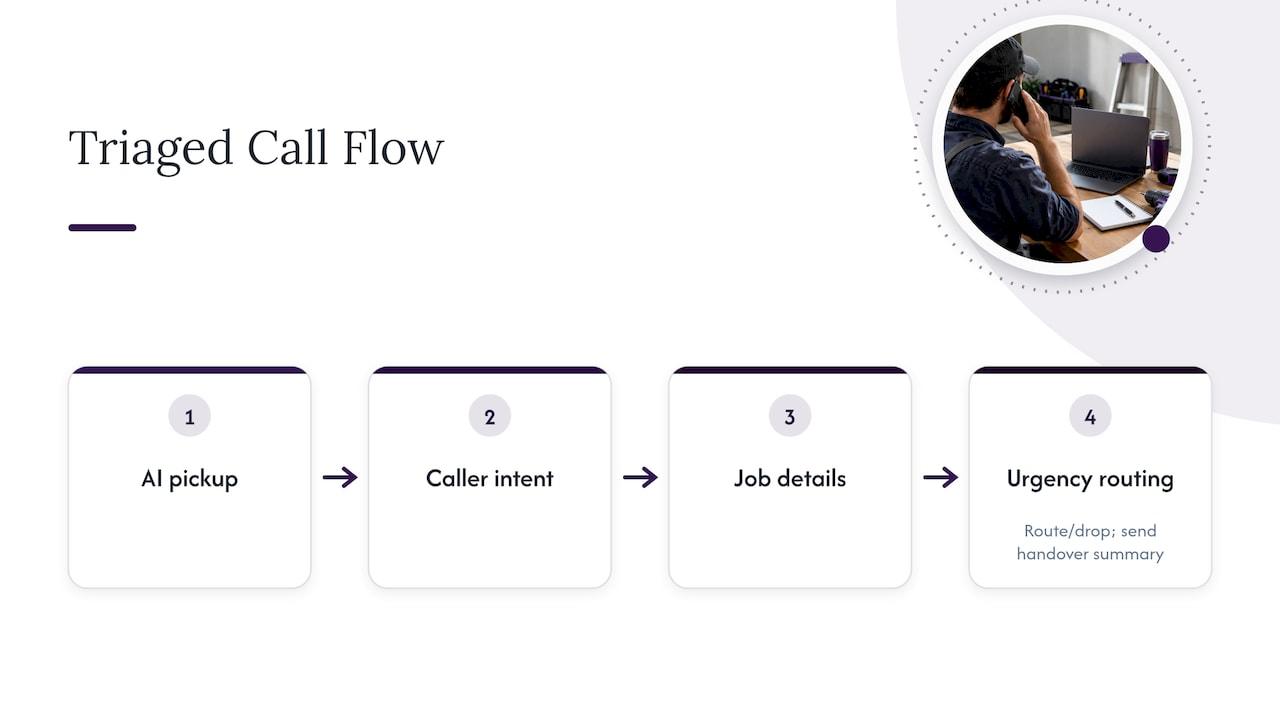
1. The pickup
The call rings out, or you divert it when you’re on the tools. The AI answers with your business name and says what it is. Telling the caller up front that they’re speaking with an automated assistant is good practice, and it lines up with the business.gov.au advice to tell customers when AI is used.
2. Understanding what the caller wants
Under the hood, reliable voice answering usually combines several technologies rather than one model: speech recognition turns the audio into text, and a language model works out the intent. You don’t need to manage any of that. What you do need to decide is the list of intents you care about, such as emergency callout, quote request, booking change, existing job query, supplier or sales call.
3. Collecting the job details
This is where triage earns its keep. A good intake gathers the basics once, in the caller’s words, so you don’t have to ring back and start from scratch. We cover the specific questions in the next section.
4. Ranking and routing
The system applies your rules. An active leak or no power to a whole house might ring your mobile immediately. A quote request for next month might become a summary in your inbox. A spam call gets dropped. If you want to go deeper on that last one, see our guide on blocking spam calls without losing real jobs.
5. The handover
You get a short summary: who called, the number, the suburb, what the job is, how urgent it is and what was promised (a callback within the hour, for example). That summary is the product. If it’s clear enough that you can decide in ten seconds, the triage worked.
What to ask: the details that qualify a trade enquiry
Not every caller is a job you want. Pre-qualification is how you find out before you drive across town for a quote that won’t convert. The questions below suit most trades, and you can add to them for your own trade.
| Detail | Why it matters | Example by trade |
|---|---|---|
| Name and best number | So you can call back without hunting | All trades |
| Suburb or postcode | Confirms the job is inside your service area | Plumber, arborist, painter |
| Type of work | Matches the job to what you actually do | Fault repair vs new install (electrician) |
| Urgency | Decides ring-through vs callback | Active leak, tree on a fence, no hot water |
| Property type | Affects scope, access and price | House, unit, commercial site |
| Owner or tenant | Tells you who approves the work | Landlord approval for a repair |
| Rough scope | Helps you decide whether to quote | Number of rooms, size of roof, length of fence |
| Timing | Flags jobs you can’t fit | “Before the end of the month” |
| How they found you | Shows which marketing works | Google, referral, van signage |
Keep it short. A caller will answer five or six questions. At fifteen they’ll hang up and ring your competitor. Our page on lead prequalification questions for tradies walks through a one-minute version.
Collect only what you need
The more you collect, the more you have to protect. The Office of the Australian Information Commissioner (OAIC) says that where the Australian Privacy Principles apply, you should collect only personal information reasonably necessary for your functions, by lawful and fair means. The same guidance says information an AI system generates or infers about a person counts as collected. So if your intake asks about someone’s health or personal circumstances, it needs a clear reason and, generally, consent.
For a trade business, that’s easy to follow. Name, number, address, job description and timing are all you need. You don’t need anything more personal to quote a bathroom reno.
Setting escalation rules that protect you and the customer
The best triage setups are defined by what happens when the AI can’t or shouldn’t carry on. One vendor’s engineering notes put it neatly: designing for the unhappy path, where intent is unclear or confidence is low, matters as much as the smooth one. For a tradie, that means deciding in advance what gets a human fast.
Calls that should reach you straight away
- Anything involving safety: gas smell, exposed wiring, sparking, flooding, a fallen tree on a house or power line.
- Existing customers with a job in progress on your site.
- Repeat callers who ring twice in a few minutes.
- Any caller who asks for a person.
- Large or commercial enquiries where a slow reply could lose the work.
For genuine emergencies, the caller should also be told to contact emergency services on 000 where life or property is in immediate danger. Your AI isn’t a substitute for that, and your greeting can say so.
Calls that can wait for a callback
- Quote requests with flexible timing.
- Booking changes and general questions.
- Follow-ups on past work.
A callback promise is only worth making if you keep it. Pair it with a simple follow-up routine. We cover that in our guide to follow-up cadence.
Calls the AI should drop or deprioritise
- Obvious robocalls and sales pitches.
- Silent calls and wrong numbers.
When the caller is confused or frustrated
If the AI misunderstands twice, it should stop trying and offer a human callback or take a message verbatim. Nobody has ever been won over by a bot that keeps repeating the same question.
AI triage or a human receptionist?
This isn’t an either-or for every business. A human receptionist is excellent when you have the volume and budget for one. But most sole traders and small crews don’t have anyone answering the phone at 7 am, on a Saturday, or while the whole team is on site.
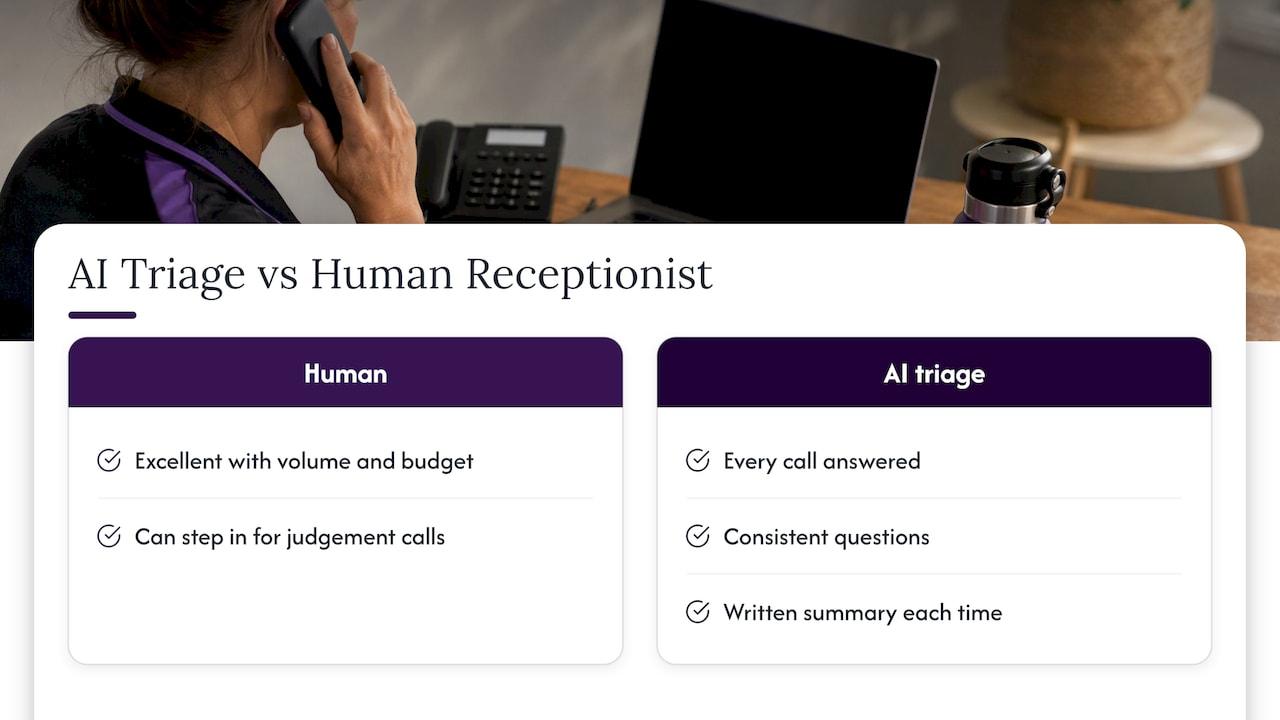
Triage covers the gap. You get every call answered, a consistent set of questions and a written summary each time. A person can still step in for the calls that need judgement. For a fuller comparison, read AI receptionist vs human: what suits an Australian tradie.
A website chatbot does a similar job for people who prefer typing. Calls and chat catch different customers, and our piece on live chat vs chatbot explains where each fits.
Our perspective
We built Ask Hayley because tradies lose work in the gaps. You’re up a ladder, your hands are full and the phone rings. By the time you ring back, the customer has called someone else.
We think triage should feel like having a calm, switched-on office manager. Hayley answers when you can’t, asks the questions you’d ask and hands you a clear summary. You talk to her the same way: no forms, no dashboard, no typing on site.
The point isn’t to replace your relationship with customers. It’s to make sure every call is caught, every lead is sorted and nothing is waiting for you at 9 pm that should have been dealt with at 10 am.
Hayley
Privacy, recording and telemarketing: what to check in Australia
This is the part many tradies skip, and it’s worth ten minutes. The following is general information. For your specific situation, check with the OAIC’s guidance or a solicitor.
You remain accountable
business.gov.au says a business stays accountable for what its AI tools do. Its suggested steps include defining what the tool is allowed to do, protecting personal data, telling customers when AI is used, testing privacy and cyber security, monitoring behaviour, checking outputs for errors and keeping a way to override or stop the system. Turn that into a short checklist:
- Write down what your AI answers and what it never does (for example, it never gives a firm price without your approval).
- Say at the start of the call that it’s an automated assistant.
- Read a handful of call summaries each week, and fix any pattern of errors.
- Know how to switch it off or divert calls back to your phone.
Recording and notification
If calls are recorded or transcribed, tell callers at the start. The OAIC says health providers must inform patients at the beginning if a telephone consultation is recorded or monitored so they can end the call or ask not to be recorded. That guidance is written for health services, but the principle of telling people early and offering a choice is sound for any business. Whether the Privacy Act applies to you depends on your size and circumstances, so confirm with the OAIC. A short line in your greeting covers the common-sense side.
Outbound calls need different rules
Answering inbound calls is one thing. If you add an AI sales agent that makes outbound calls, telemarketing rules apply. The ACMA says that if an AI system makes telemarketing calls, you need to check consent and the Do Not Call Register, and callers must identify themselves, say why they’re calling and end the call at once if asked. If you plan to run phone campaigns, it also helps to know which calls produce jobs. This guide on tying phone leads to ads with call tracking shows how to connect calls back to the marketing that generated them.
Getting the most out of triage
A few habits make the difference between a system that works and one you forget about.
- Start with your top five call types. Don’t try to model every scenario. Cover what happens most often.
- Define your service area clearly. A list of suburbs saves hours of driving to jobs you won’t take.
- Set urgency by trade. An electrician’s emergency is different from a painter’s.
- Review weekly for the first month. Listen for questions callers don’t understand, then rewrite them.
- Connect the next step. A triaged lead should flow into a quote. See how to dictate a voice quote on site.
- Confirm appointments. SMS appointment reminders cut down on no-shows once the booking is made.
How Ask Hayley handles it
Hayley is a voice-first, AI-powered business management platform built for Australian tradies and small service businesses. She answers inbound calls when you can’t, pre-qualifies leads before they land in your inbox, and handles day-to-day admin through natural voice prompts. It’s designed for the reality of trade work: hands full, on site, no time at a screen.
There are two core plans, Assistant and Office Manager, with optional add-ons: an AI Sales Agent and an AI Website Chatbot, for broader coverage across calls, leads and enquiries. Hayley also integrates with Xero and AroFlo.
If you also want your online presence to bring in the right calls, we build one-page websites, prepare tenders and write safety and compliance documentation. See what’s on offer at Ask Hayley.
We’d rather you started with a clear picture of your own calls. Count how many you missed last week, and what the average job is worth. That tells you what triage is worth to your business.
FAQ
Is AI call triage the same as an AI receptionist?
They overlap. A receptionist answers and takes a message. Triage goes further by asking set questions, ranking the call by urgency and routing it based on your rules. Most tradie setups combine both.
Can AI call triage handle emergencies?
It can recognise urgent keywords and ring your mobile straight away, based on rules you set. For any situation where someone is in danger, the caller should also be directed to 000. Your emergency rules should always end in a human, not a message.
Do I have to tell callers I’m using AI?
busness.gov.au recommends telling customers when AI is used. A short line at the start of the call does it. If calls are recorded, say so too.
What should I ask a caller before I quote?
Their name and number, suburb, type of work, urgency, property type and rough scope. Five or six questions are enough. Keep it to what you need to decide whether to quote.
Sources
- Artificial intelligence (AI) | business.gov.au
- Chapter 3: APP 3 Collection of solicited personal information | OAIC
- Chapter 2: Collecting health information | OAIC
- Telemarketing compliance alerts | ACMA
- Call Tracking Marketing: How to Tie Phone Leads to Ads | Media Click AI


