


Good tradie website copy does one job: it tells a stranger, in about five seconds on their phone, that you do the work they need, that you service their suburb, and how to get a quote. Everything else on the page is there to back that up. This guide shows you what to write, where to put it, and how to word it so it sounds like you and not like a brochure.
TL;DR
- Lead with the trade, the service and the area. Answer “do you do my job, and do you come to me?” before anything else.
- Write about the customer’s problem first, then your fix. Keep sentences short and use the words customers actually use.
- Prove it with things that can be checked: licence numbers, real job photos, genuine reviews. Never publish anything you can’t back up.
- Give every page one clear next step, and say what happens after they take it.
- Write for people first. Suburb pages and keywords work when the content is real.
Table of Contents
- Start with what a visitor needs in five seconds
- Homepage copy that earns the call
- Describe your services in the customer’s words
- Trust signals that hold up
- Calls to action that don’t make people think
- Local copy without keyword stuffing
- Write it so it sounds like you
- Perspective
- Need a hand getting it live?
- A quick edit checklist
- FAQ
- Sources
Start with what a visitor needs in five seconds
Someone with a burst pipe, a dead switchboard or a tree over the fence is not reading your “about us” story. They are on a phone, probably stressed, and likely comparing three tradies at once. They want three answers fast:
- Do you do this job?
- Do you work in my area?
- How do I get a quote or get you out here?
If your first screen answers those, you have done most of the work. If it opens with “Welcome to our website” or a paragraph about your passion for quality, the visitor is already pressing the back button.
A quick test: show your homepage to a mate for five seconds, then take it away. Ask what you do, where you work and what they’d tap next. If they can’t say, the copy needs another pass.
Homepage copy that earns the call
A tradie homepage doesn’t need to be long. It needs to be in the right order. We cover layouts in detail in our guide to three homepage layouts for Aussie tradies, but the copy follows the same logic whichever layout you pick.
The headline
Name the service, the outcome and the place. Three patterns that work:
- Service + location: “Emergency electrician in Parramatta and Western Sydney”
- Service + outcome + location: “Leaking tap fixed today, plumbing across Brisbane’s north side”
- Service + reassurance: “Licensed, insured roofing for Geelong homes”
Add availability only if it’s true. “Same-day” and “24/7” are promises. If you can’t keep them every time, leave them out.
The line under it
One sentence that says what it’s like to deal with you. Think about what makes customers hesitate: “Will they turn up? Will the price blow out? Will they leave a mess?” Answer the one you handle best.
Weak: “We pride ourselves on quality workmanship and customer satisfaction.”
Better: “We turn up in the window we give you, quote before we start, and clean up before we leave.”
The second version only works if it’s how you actually run jobs. That’s the point. Specific beats impressive.
The rest of the page, in order
| Section | What to write | Example |
|---|---|---|
| Headline and sub-line | Trade, service, area, one reassurance | “Split system installs and repairs across Perth’s southern suburbs” |
| Primary button | One action, in plain words | “Call 04XX XXX XXX” or “Get a quote” |
| Services | Short list linking to individual pages | Installs, repairs, servicing, commercial |
| Proof | Licence number, years trading, genuine reviews, real photos | “Licence No. 12345, trading since 2011” |
| How it works | Three steps, what happens after they contact you | “You call, we quote, we book a time” |
| Areas | The suburbs or regions you genuinely cover | A list of real places, not every postcode in the state |
| Final call to action | Repeat the button | “Ready when you are. Call or request a quote.” |
Make sure the phone number is tappable on mobile and visible without scrolling. Trade customers ring first and read later.
Describe your services in the customer’s words
Most service pages read like a list of capabilities. Customers don’t search for capabilities. They search for problems: “hot water system not working”, “gutters overflowing”, “fence blown down”.
A service description that works follows a simple pattern:
- The problem, in the words the customer would use.
- The outcome they want.
- How you do it, in a few short lines.
- What it depends on, such as access, size of the job or approvals.
- One next step.
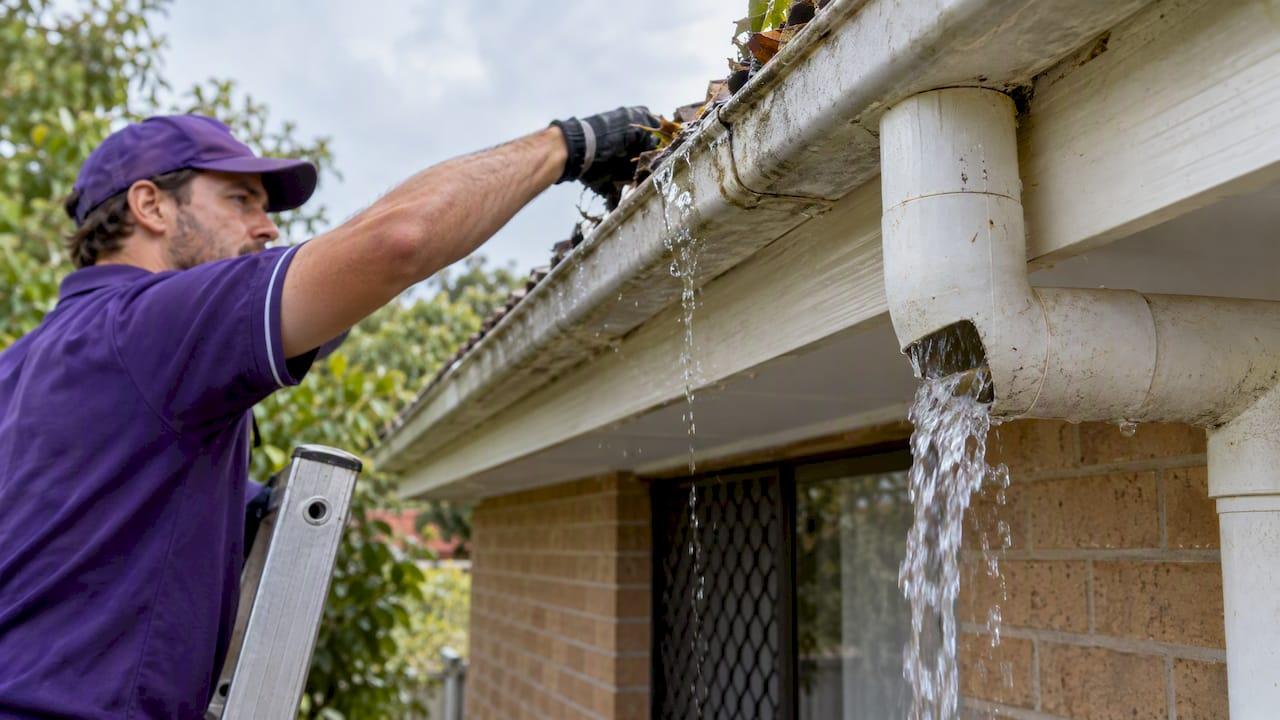
Here is a before and after for a gutter cleaning page.
Before: “We offer a comprehensive range of gutter maintenance solutions utilising industry-leading equipment.”
After: “Overflowing gutters can rot your fascia and push water back into the roof. We clear the gutters and downpipes, flush them to check the flow, and tell you straight if anything needs repair. Most single-storey homes are done in a morning. Send us a photo for a quote.”
The second version tells a homeowner what’s wrong, what happens and how long it takes. It also uses a detail a real gutter cleaner would know, which is what makes it believable.
Answer the questions they’d ask on the phone
Think about the first five questions you get on every enquiry call. Chances are they are:
- Do you cover my suburb?
- Roughly how much?
- How long will it take?
- When can you start?
- Are you licensed and insured?
Put those answers on the page. You’ll never publish an exact price for every job, but you can say what drives the price: size, access, materials, how many storeys. That alone filters out time-wasters and warms up the good leads. It also means the people who do ring you are better prepared, which is exactly what we help with on the phone side through lead prequalification questions.
Trust signals that hold up
Trust on a trade website comes from evidence, not adjectives. “Reliable” and “professional” are words every competitor uses. These are harder to fake and easier to believe:
- Your licence number, written out so people can look it up with the relevant state regulator
- Years in business, with a real start year
- A Google rating with the number of reviews behind it
- Photos of your own work, ideally with the suburb and job type
- Insurance, memberships and accreditations you actually hold
- A short, honest line about what you don’t do
Keep your claims and testimonials honest
This isn’t only good manners. Australian Consumer Law applies to your website, and the ACCC has acted on fake testimonials in the trades before. In one case, the regulator said a removalist published false testimonials, using contractors to post copied and altered reviews. The lesson for you is simple:
- Only publish testimonials from real customers, and keep the original message or email.
- Don’t edit a review to say something the customer didn’t.
- Don’t promise guaranteed results or fixed outcomes you can’t control.
- If you say “cheapest”, “fastest” or “number one”, be ready to prove it. If you can’t, say something specific you can prove instead, like “we quote in writing before work starts”.
If you’re unsure about a particular claim, such as a warranty promise or a comparative price statement, check with the ACCC’s guidance or a lawyer who knows advertising law before it goes live.
Calls to action that don’t make people think
Every page needs one main next step. Not five. A visitor who has to choose between a phone number, a form, a chat bubble, a booking link and an email address often chooses none of them.
Pick the action that suits how your customers behave:
- Urgent trades (plumbing, electrical, garage doors, locksmith work): the phone number comes first.
- Quote-driven trades (painting, fencing, roofing, landscaping, building): “Get a quote” with a short form, and photos welcome.
- Booked-in trades (cleaning, pool maintenance, air con servicing): a simple request-a-time form.
Then tell them what happens next. “Fill in the form and we’ll call you back within one business day” does far more than “Submit”. It removes the fear of sending a message into a void.
Keep forms short. Name, number, suburb and a line about the job is usually enough to start. Every extra field costs you enquiries.
What about after hours? A form submitted at 9pm that gets no reply until Thursday is a lost job. Some owners put an after-hours line on the page, such as “We reply to all messages by 8am”, and then stick to it. Others hand first contact to a call-answering tool so no enquiry waits. If you’re weighing up a website chat option, our comparison of live chat versus a chatbot will help you decide.
Local copy without keyword stuffing
You do want to be found for “electrician Newcastle” or “concreter Sunshine Coast”. The way to do it is to be useful and specific, not to repeat the phrase twelve times.
- Mention your main area naturally in the headline, the first paragraph and the contact details.
- Build a page for a suburb or region only where you really work and have something real to say: typical jobs, local housing styles, council quirks, a recent project.
- Don’t clone one page and swap the suburb name. Customers notice, and so do search engines.
- Use normal words. “Fix a blocked drain” beats “drain unblocking solutions provider”.
We go deeper on this in our guide to service area page SEO, including how to keep those pages lean and call-focused.
Balance search and readability
Writing for Google and writing for a customer feel like opposites when you start. They aren’t. The page that ranks well over time is usually the one people stay on and act on. If you want a broader view of how search-minded copy and clear writing fit together, this SEO copywriting guide covers the general principles. For a trade site, apply them with a lighter touch: one topic per page, a clear heading, short paragraphs and a next step.
Write it so it sounds like you
You don’t need to sound like a marketing agency. You need to sound like the person who turns up on the day. A few rules that help:
- Short sentences. If you run out of breath reading it aloud, split it.
- “You” and “we”. Talk to the customer directly.
- Specifics over claims. “Most bathroom retiles take five to seven working days” is better than “fast turnaround”, as long as it’s true for you.
- Cut the filler. Delete “we are a family-owned business dedicated to excellence” unless the next sentence proves it.
- Read it out loud. If you wouldn’t say it to a customer at the front door, don’t write it.
Here’s a quick way to draft: record yourself explaining your service to an imaginary customer, transcribe it, then tidy it. Tradies are usually much better talkers than writers, and the transcript often has the most believable lines on the page.
Perspective
We built Ask Hayley because tradies are best on the tools, not at a keyboard. Most owners we talk to know what they’d say to a customer. They just don’t have time to sit down and write it, and they don’t have time to answer every call while they’re on a roof.
That’s why we think about website copy and phone handling as one system. The website makes a promise: we do this job, in your area, and here’s how to reach us. The phone, the enquiry and the follow-up have to keep that promise. A beautiful homepage that sends people to a voicemail doesn’t win the job.
Our approach is voice-first. You talk, and the admin gets done. Hayley answers calls you can’t, pre-qualifies leads before they land in your inbox and helps with day-to-day business tasks through natural voice prompts. The same plain-spoken style should show up on your site. Say it the way you’d say it on the job, and make it easy to act on.
If your copy is clear and your calls get answered, you give customers every reason to choose you.
Hayley
Need a hand getting it live?
If you’d rather not write and build this yourself, we offer a One Page Website service for Australian tradies and small service businesses. It puts the essentials in one clear page: what you do, where you work, proof you’re the real deal and a simple way to get in touch.
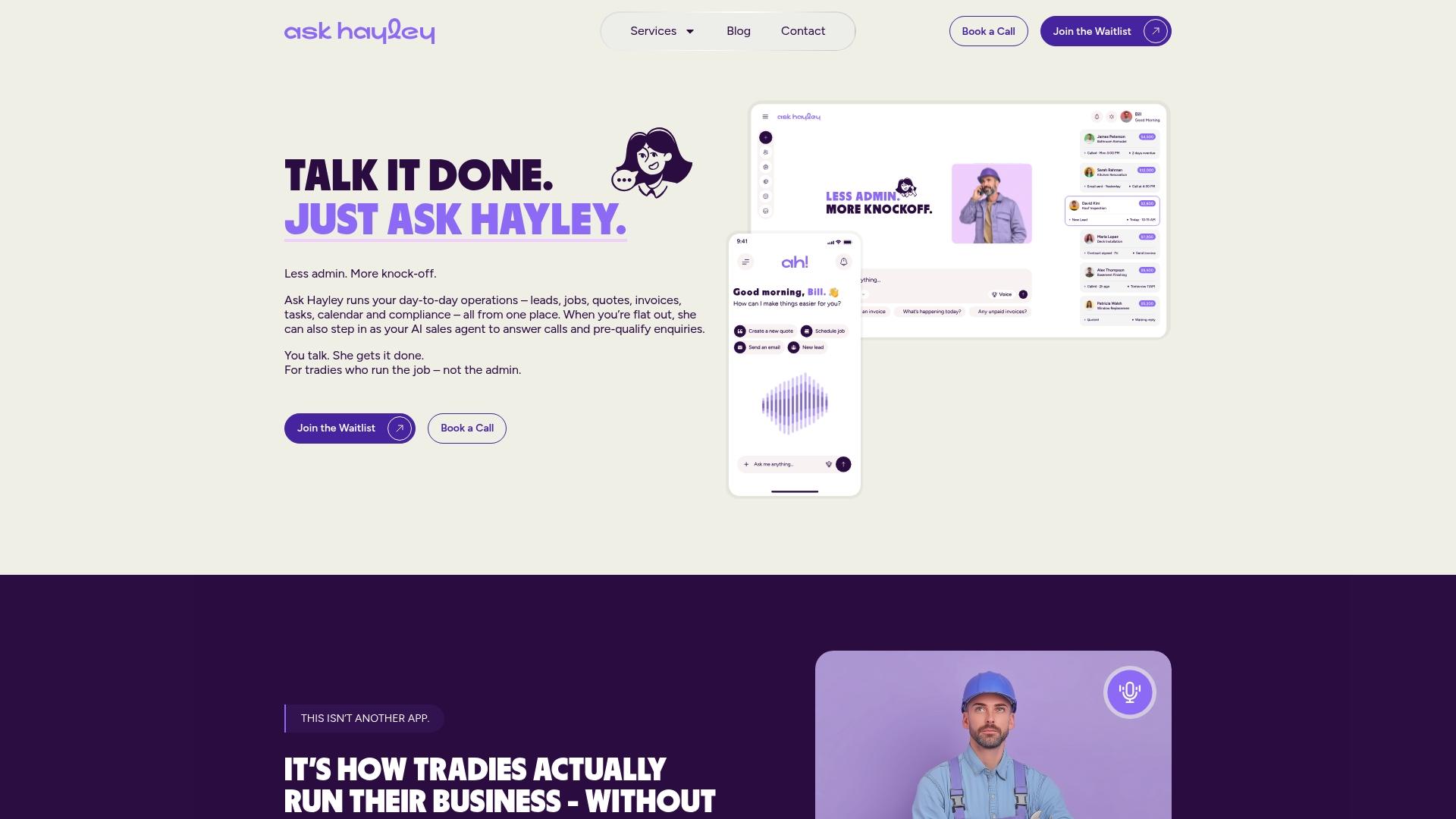
See how it works on our One Page Website page, or look at the full range of what we do on the Ask Hayley homepage. If you’re also chasing leads, our guide to owning your lead generation shows how website copy and call capture work together.
A quick edit checklist
Before you publish or rewrite, run through this list:
- Does the headline name the trade, service and area?
- Is the phone number or quote button visible without scrolling on a phone?
- Can a visitor see your licence number and a genuine proof point?
- Does each service page start with the customer’s problem?
- Does every page have one clear next step, and say what happens after?
- Have you removed any claim you can’t prove?
- Are suburb pages real, with something genuinely local on them?
- Does someone answer when people do get in touch?
If you can tick all eight, you’re ahead of most trade sites in Australia.
FAQ
How long should tradie homepage copy be?
Long enough to answer the three key questions and short enough to scan on a phone. For most trades that’s a headline, a short intro, a services list, a few proof points and a call to action. Put the detail on individual service pages rather than cramming it all onto the homepage.
Should I put prices on my website?
You don’t have to publish a full price list. It helps to explain what affects the price, such as job size, access and materials, and to say how quoting works. If you offer a standard service with a fixed price, such as a call-out or a basic clean, stating it can save you time on enquiries. Only publish figures you’re happy to honour.
Can I use customer reviews on my website?
Yes, as long as they’re genuine and you have the customer’s original message. Don’t write, edit or copy reviews to make them sound better, because Australian Consumer Law requires that testimonials aren’t misleading. If you’re unsure, check the ACCC’s guidance on testimonials and reviews.
Do I need a separate page for every suburb?
No. Create a page only for areas you actually service and where you can add something real, like typical jobs or local details. A single, honest service area list on your main pages is better than dozens of near-identical suburb pages.
What’s the biggest copywriting mistake tradies make?
Talking about themselves instead of the customer’s problem. Pages full of “we are passionate about quality” don’t tell a visitor whether you can fix their leak this week. Lead with the problem, the area and the next step.
Sources
- ACCC: Removalist admits publishing false testimonials
- SEO Copywriting Guide for Marketing Pros in 2026


