


A sales pipeline for a trade business is a short list of stages every enquiry moves through, from first call to paid job. Most tradies do well with six to eight: new enquiry, contacted, qualified, site visit or quote prep, quote sent, follow-up, won or lost, and booked. Each stage needs one clear rule for moving a lead forward. Then you can see at a glance which jobs are close, which are stalling and which need a call today.
This guide gives you the stages, the rules between them, a simple way to score leads and a follow-up rhythm that suits a working day on the tools.
TL;DR
- Use plain stage names and one exit rule for each. Six to eight stages is plenty for a sole trader or small crew.
- Score every enquiry on budget, need, timing and fit, then sort it into “chase now”, “nurture” or “pass”.
- A quote is a pipeline stage, not the finish line. Put a follow-up date and an expiry date on every one.
- Missed calls are the leakiest part of the pipeline. Fix the first stage before you polish the rest.
- Keep it in one place you can update by voice or in 30 seconds, or it will not get updated.
Table of Contents
- What a sales pipeline means for a tradie
- The 8 pipeline stages that suit most trades
- How to score leads without a spreadsheet degree
- Keep the pipeline alive in real life
- Where Ask Hayley fits in
- Our perspective
- Common pipeline mistakes to avoid
- FAQ
- Sources
What a sales pipeline means for a tradie
Corporate sales guides talk about prospecting, demos and closers. Your version is simpler. Someone rings about a leaking tap, a rewire, a fence or a roof. You call back, work out if it’s a fit, look at the job, price it, send the quote and chase it. If they say yes, you book it in.
That is a pipeline. The only difference between a messy one and a useful one is that the useful one is written down, with every lead sitting in exactly one stage at a time.
Without it, the same things happen on repeat:
- A quote goes out on Tuesday and nobody thinks about it again.
- A voicemail sits unreturned while you’re up a ladder.
- You spend a Saturday pricing a job for someone who was never going to proceed.
- You can’t answer “how much work is actually in the pipeline?” when the diary looks thin.
A pipeline also shows you where work leaks out. If lots of enquiries reach “quote sent” but few are accepted, the problem is the quote, the price or the follow-up. If few enquiries reach “contacted”, the problem is missed calls and slow replies.
The 8 pipeline stages that suit most trades
Australian service-business guidance from eHustle recommends plain stage names with clear exit criteria, and suggests six to ten stages is usually enough from first touch to booked work. The eight below sit comfortably inside that range.
| Stage | What it means | Move it forward when |
|---|---|---|
| 1. New enquiry | A call, text, web form or message has come in | You’ve logged name, number, suburb and job type |
| 2. Contacted | You or your answering system has spoken to them | You’ve had a two-way conversation |
| 3. Qualified | The job is in your area, your trade and roughly their budget | They pass your scoring check (see below) |
| 4. Site visit or quote prep | You’re measuring, inspecting or pricing | You have what you need to price it properly |
| 5. Quote sent | A written quote is with the customer | Customer replies or follow-up date arrives |
| 6. Follow-up | You’re chasing a decision | Customer accepts, declines or quote expires |
| 7. Won | They’ve accepted | Deposit or booking confirmed |
| 8. Booked or lost | Job is in the diary, or you’ve closed it out with a reason | Job scheduled, or loss reason recorded |
Not every trade needs every stage. A mobile locksmith or drain unblocker may skip the site visit and quote over the phone. A builder or landscaper may split “site visit” into two stages: first visit and detailed estimate. Rename them to match how you speak. If your crew says “booked in” rather than “won”, use that.
Stage 1 and 2: catch the enquiry and make contact
This is where most trades lose work, and it’s rarely about price. If you’re on a roof or under a house, you can’t pick up. The customer rings the next name on the list.
Two habits fix most of it:
- Log every enquiry the same way. Name, number, suburb, job type, how urgent. Five details are enough.
- Respond fast. Speed matters most on urgent work like blocked drains, power outages and storm damage, where people ring several businesses at once. Our guide to capturing calls and leads goes into the detail, and our page on lead response time covers what a realistic target looks like.
If you can’t answer live, something has to. That might be a business partner, a part-time admin, or a call-answering tool that takes the details and sends you a summary.
Stage 3: qualify before you drive anywhere
Qualifying means checking whether the job is worth quoting before you spend time on it. It protects your week. A site visit costs you fuel, travel time and a job you could have been doing.
Five quick questions work for most trades:
- What is the job, in their words?
- Where is it? Are you in range?
- When do they want it done?
- Have they got other quotes, or is it a one-quote decision?
- Do they have a rough budget or a limit in mind?
You don’t need to interrogate anyone. Two or three of these in a friendly conversation will do.
Stage 4 and 5: visit, price and send the quote
Once a lead is qualified, get the quote out quickly while the job is fresh in the customer’s mind. The Australian Government’s business.gov.au guidance on quotes says a good written quote should include your business name, ABN and contact details, the customer’s details, a clear description of the work, itemised and total costs (including GST where applicable), payment terms, start and finish dates, a quote expiry date and space for the customer to accept.
The same page notes that a written quote helps avoid mix-ups, manages expectations and protects you from disputes. It also says to quote for profit, not just to win the job. If you’re unsure your numbers cover everything, see our breakdown of the five costs to include in every quote.
A few quote habits that shorten the pipeline:
- Send it the same day as the visit where you can.
- Put an expiry date on it. A 30-day expiry policy keeps old prices from coming back to bite you after material costs move.
- Spell out deposits, variations and payment terms. Our notes on quote terms that protect price and deposits show what to cover.
- Consider automating the quoting step if you spend evenings at the kitchen table building quotes.
Stage 6: follow-up is where jobs are won
Sending the quote isn’t the end of the sale. Plenty of customers are simply busy, comparing options or waiting on a partner’s opinion. A short, polite nudge often decides who gets the job.
A simple rhythm:
- Day 1-2: A quick message confirming the quote arrived and offering to answer questions.
- Day 5-7: A check-in asking if they’ve made a decision or need anything adjusted.
- Day 14: A last friendly follow-up, mentioning the expiry date.
- After expiry: Mark it lost, record why, and move on.
We’ve written out five quote follow-up emails you can copy and adapt. The wording is short on purpose. Nobody wants a long email from a plumber.
Business.gov.au also points out that a CRM system lets you keep track of interactions, follow up prospects and record customer feedback. For a small trade business, that can be as simple as a list with a “next action” date. The tool matters less than the habit of updating it.
Stage 7 and 8: win, book and close out
When the customer says yes, lock it in. Confirm the deposit, the start date and any access needs. Then move the lead to “booked” and get it into the calendar so it doesn’t live only in your head. Our tips on hands-free job scheduling can help here.
When the answer is no, don’t just delete the lead. Record the reason: price, timing, went with someone else, or no response. After a few months, those reasons tell you what to fix.
How to score leads without a spreadsheet degree
Lead scoring sounds like a software-company idea, but for a tradie it’s simple: decide which enquiries deserve your time first.
One common approach is BANT: Budget, Authority, Need and Timeline. Streamline Projects’ qualification template for trades uses it to sort leads into three buckets: qualified, nurture and disqualified. That keeps the team focused on the most promising enquiries and frees up time by dropping poor fits early.
Here’s a version you can use in your head or on a phone note. Give each point 0 to 2:
| Factor | 0 points | 1 point | 2 points |
|---|---|---|---|
| Budget | Wants the cheapest price possible | Vague idea of cost | Has a budget or has done similar work before |
| Authority | Just asking for a friend | Needs to check with someone | Is the decision maker |
| Need | Browsing | Wants it done eventually | Has a problem now, such as a leak or a fault |
| Timeline | No date | Within a few months | Within days or weeks |
| Fit | Outside your trade or area | Borderline | Your kind of job, in your area |
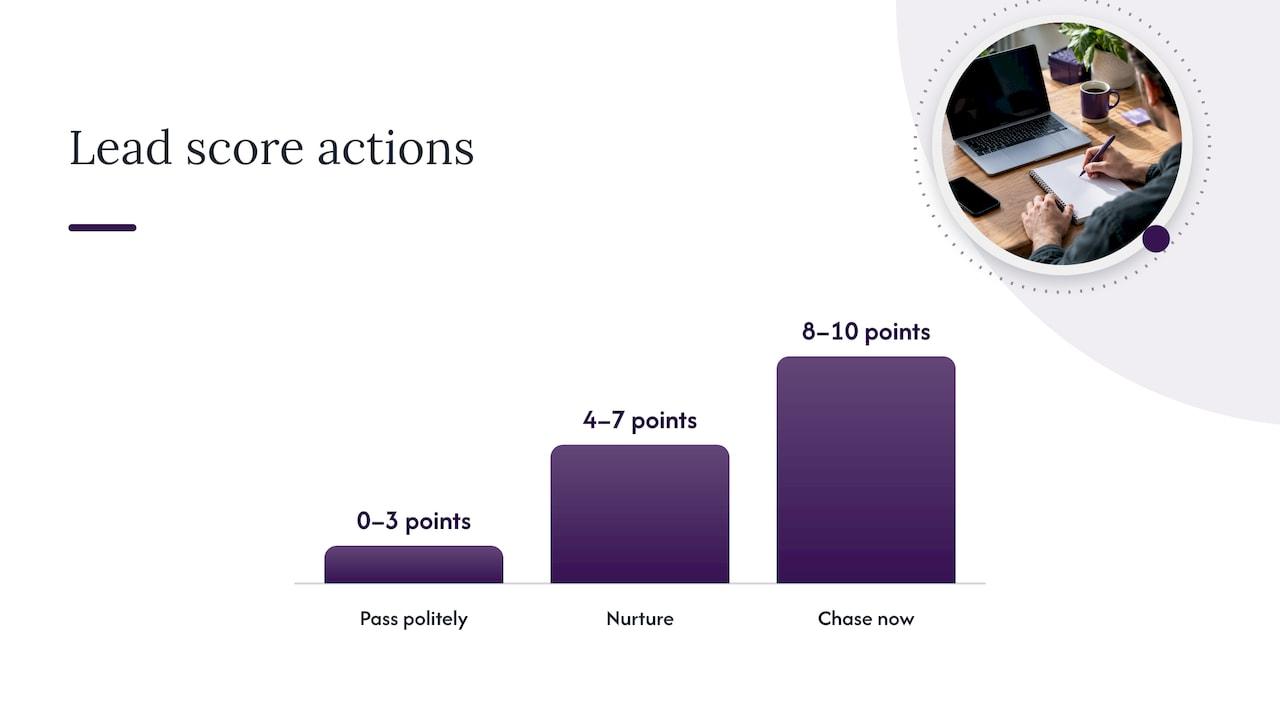
8 to 10 points: chase now. Call back first, book the visit this week.
4 to 7 points: nurture. Quote, then follow up on schedule. Keep them in the pipeline but don’t drop everything.
0 to 3 points: pass politely. Refer them on, or send a short reply explaining you’re not the right fit.
This is a rule of thumb, not a law. If you’re a roofer and a body corporate rings about a 40-unit complex, that might score lower on timeline but still deserve a priority call because of job size. Adjust the points to suit your trade and your margins.
Signals worth noting on every lead
Beyond the score, a few details change how you handle an enquiry:
- Urgency: emergency jobs jump the queue.
- Job size: a $300 repair and a $30,000 renovation need different follow-up effort.
- Source: referrals, Google and repeat customers often convert differently. Track where each lead came from.
- Repeat or commercial work: property managers and builders can send steady work, so they deserve faster responses.
Keep the pipeline alive in real life
The best pipeline is the one that gets updated. Most tradies fall down not on design, but on upkeep. You finish a job at 4:30, the phone has rung three times, and the last thing you want is another screen.
A few ways to keep it honest:
- Update at set times. Five minutes at smoko and ten at end of day beats an hour on Sunday night.
- One home for everything. If leads are in your phone, notebook, inbox and the ute’s dashboard, you’ve got four pipelines and none of them work.
- Give each lead a next action and date. “Call Sarah Thursday” beats “follow up”.
- Review weekly. Count the number of leads in each stage. If “quote sent” is bulging, spend Friday arvo on follow-ups.
- Close out dead leads. An old list full of maybes hides the real opportunities.
When the pipeline needs more hands
If you’re spending more time chasing leads and writing quotes than doing paid work, it may be time to bring someone in. That might be an estimator, an office admin or a salesperson. If you’re weighing that up, this guide to hiring sales staff for a small business in Australia explains what to look for. Whoever you hire, give them the same stage definitions so everyone speaks the same language.
Where Ask Hayley fits in
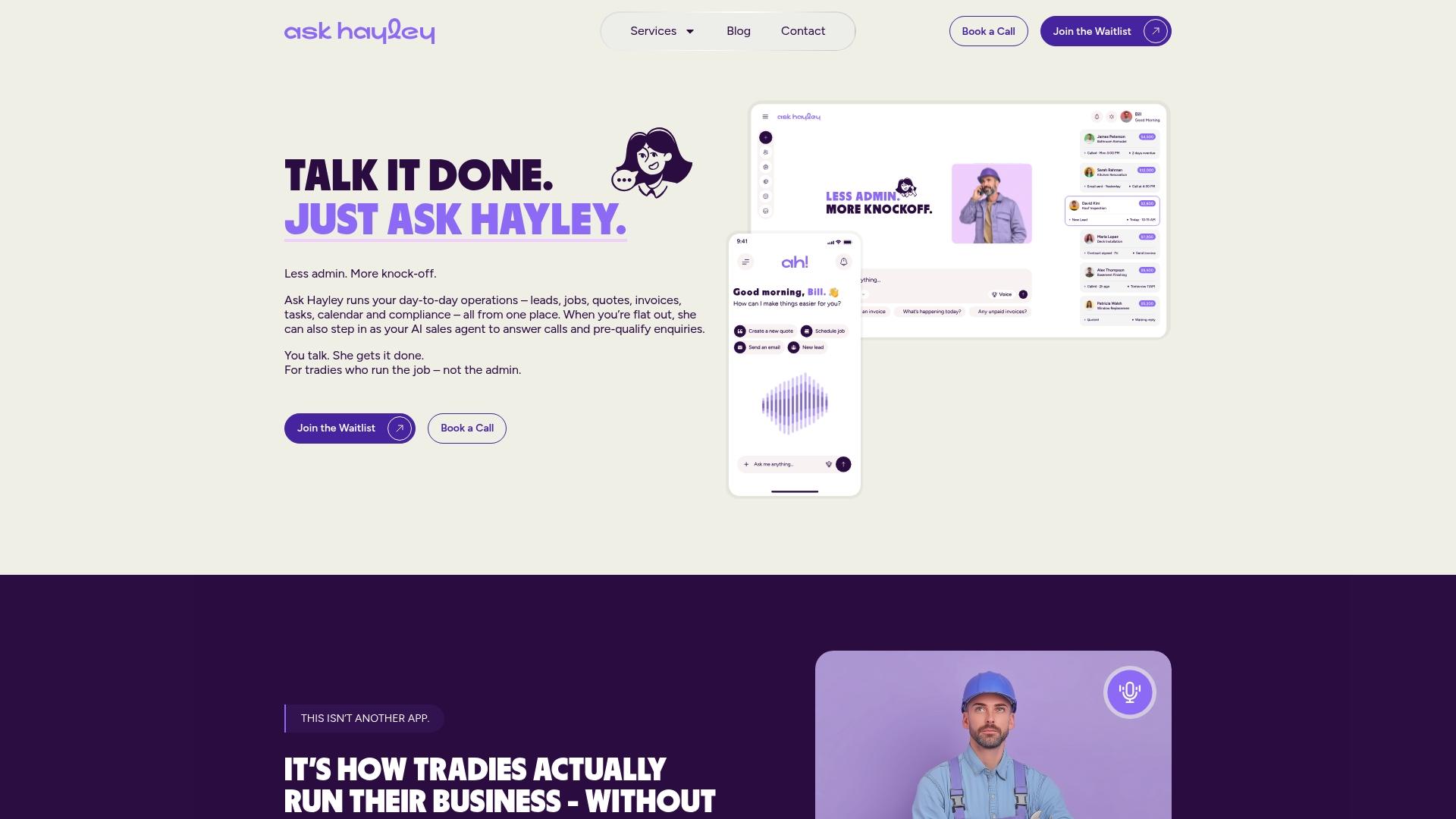
A pipeline only works if the first stage works. Ask Hayley is a voice-first business management platform built for Australian tradies. Hayley answers inbound calls when you can’t, pre-qualifies leads before they land in your inbox, and handles everyday admin through natural voice prompts. That means you talk, rather than type or navigate dashboards, while your hands are full.
The platform covers lead capture, call answering, quote generation, invoicing, task management, calendar, compliance tracking and reporting, with integrations for Xero and AroFlo. It comes in two core plans, Assistant and Office Manager, with optional add-ons like an AI Sales Agent and an AI Website Chatbot.
If you also want a clean place for customers to land, we build one page websites and help with tendering and safety and compliance documentation. See everything on the Ask Hayley homepage.
Our perspective
We built Ask Hayley around one observation: tradies don’t lose jobs because they’re bad at the work. They lose them because the phone rang while they were on a roof, or a quote sat in a ute for a week.
A pipeline sounds like office language, but it’s really just a promise to every enquiry: someone will call you back, someone will look at your job, and someone will follow up. The hard part is keeping that promise when your hands are full.
That’s why we made it voice-first. Hayley answers calls when you can’t, pre-qualifies leads before they reach your inbox, and lets you update jobs by talking. No extra app to learn, no forms to fill in at 7pm. Our aim is a pipeline that stays current because it takes seconds, not because you found an hour.
If you do one thing after reading this, make sure no enquiry goes unanswered. Everything else in the pipeline gets easier from there.
Hayley
Common pipeline mistakes to avoid
Too many stages. Twelve stages with fuzzy differences means nobody updates them. Start with eight or fewer.
Stage names nobody understands. “Opportunity engagement” means nothing on site. “Quote sent” does.
No exit rule. If a lead can sit in “contacted” forever, it will. Define what moves it on, and what happens if it doesn’t.
Treating every lead the same. A blocked drain and a bathroom reno need different timing. Score and sort.
Forgetting repeat customers. Past customers are the cheapest leads you’ll ever get. Add a “past customer” tag and check in every so often.
Never recording why you lost. Loss reasons turn a dead lead into useful data.
FAQ
How many stages should a trade business pipeline have?
Six to eight is enough for most sole traders and small crews. Australian service-business guidance suggests six to ten stages as a general range. If you can’t explain a stage in one sentence, merge it with a neighbour.
What’s the difference between a sales pipeline and a sales funnel?
A funnel describes how a customer moves from awareness to purchase. A pipeline describes the steps you take on each lead and where each one sits right now. For a tradie, the pipeline is the more practical tool because it tells you who to call today.
What should a quote include to keep a lead moving?
Business.gov.au lists your business name, ABN, customer details, a clear description of work, itemised costs including GST, payment terms, dates, an expiry date and room for acceptance. A complete quote reduces back-and-forth and makes it easier for the customer to say yes.
How often should I follow up a quote?
A reasonable rhythm is a quick check within a couple of days, another around the end of the first week, and a final nudge before the quote expires. Adjust for job size. Larger jobs often take longer to decide, so space the follow-ups out but keep them scheduled.
Do I need a CRM for a small trade business?
Not necessarily. Business.gov.au notes that a CRM helps you track interactions and follow up prospects, but a simple list with next-action dates can do the same job. Choose something you will actually update, ideally by voice or in under a minute.
Sources
- Prepare quotes | business.gov.au
- Manage customer relationships | business.gov.au
- Customer Journey: From First Click to Booked Work | eHustle
- Free Lead Qualification Template for Trades & Construction | Streamline Projects


