


A virtual receptionist in Australia usually costs a small monthly fee plus a charge for each call or each minute answered. Your real bill depends on how many calls you get, how long they run, and which extras you switch on. For a one-to-five person trade business, the useful number is not the headline price. It is the total per month at your call volume, including GST, after-hours loading and setup.
This guide shows how the pricing models work, where bills creep up, what different call volumes look like in dollars, and how a human answering service compares with an AI one. We sell a voice-first platform for tradies, so we say where we sit. We also give you the maths to check any quote yourself.
TL;DR
- Most plans combine a base monthly fee with a per-call or per-minute charge. A cheap headline price can still add up to a large bill.
- Extras drive the real cost: after-hours loading, long calls, number porting, setup fees, call transfers and minimum terms.
- Work out your own total: calls per month, times average cost per call, plus the base fee, plus GST if it isn’t included.
- An AI receptionist is usually priced as a flat plan or by minutes, so it can be more predictable than per-call billing when your phone is busy.
- Ask for the full monthly price in writing. Australian Consumer Law expects businesses to be upfront about total pricing and ongoing subscription fees.
Table of Contents
- What a virtual receptionist actually does for a tradie
- How Australian virtual receptionist services charge
- What the price usually includes
- The extra fees that push the bill up
- What different call volumes cost: worked examples
- AI receptionist vs human service: how the costs compare
- Questions to ask before you sign
- Spotting misleading pricing
- Our view: price the call, not the plan
- Where Ask Hayley fits
- Cheap ways to cover calls while you decide
- A simple way to choose
- FAQ
- Sources
What a virtual receptionist actually does for a tradie
A virtual receptionist answers your calls when you can’t. You’re up a ladder, under a sink or on a roof, and the phone rings. Instead of voicemail, someone (or something) picks up, takes the caller’s details and passes them on.
That matters because most callers who hit voicemail simply ring the next tradie on the list. We go through the maths of that in our piece on first call answer rate. The value of a receptionist is the jobs you would otherwise lose, so the cost only means something against what one booked job is worth to you.
There are two broad types:
- Human virtual receptionists. A real person, usually in a shared call centre, answers using your business name and a script you provide.
- AI receptionists. Software answers in a natural voice, asks your screening questions and sends you a summary.
Both can take messages, collect job details and book callbacks. They differ mainly in how they bill, and in how they handle odd or emotional calls.
How Australian virtual receptionist services charge
There are four common ways providers price their service. Many mix two of them.
Per-call pricing
You pay a set amount for each call answered. It is simple and suits low volume. The risk is what counts as a call. Wrong numbers, spam calls, silent calls and a caller who rings back twice can all be billed. Ask the provider exactly what triggers a charge.
Per-minute pricing
You pay for talk time. This favours short, simple calls. It punishes a chatty caller who wants to explain their whole bathroom renovation. If your trade involves long explanations (building, landscaping, solar), per-minute billing can climb quickly.
Monthly bundle with included calls
You pay a monthly fee that covers a set number of calls or minutes, then a lower or higher rate for extras. This is the most common structure for small businesses. Check what happens when you go over, and whether unused calls roll over. Usually they don’t.
Flat monthly rate
One price, with a fair-use limit or a high allowance. This is the easiest to budget for and is more common with AI services. Read the fair-use wording, because “unlimited” often has a limit buried in the terms.
What the price usually includes
Across providers, a basic plan normally covers:
- A dedicated or forwarded business phone number
- Call answering in your business name
- Message taking and delivery by email or SMS
- A basic call script
Optional or higher-tier features often include call transfers to your mobile, appointment booking, lead screening, CRM or accounting integrations, and call recordings. Each one can move you into a more expensive plan, so list what you need before you compare.
The extra fees that push the bill up
The monthly price is only part of it. These are the items to check before you sign.
- Setup fees. Some plans charge nothing. Managed services, where someone builds your scripts and call flows for you, often charge a one-off fee.
- After-hours and weekend loading. If you want cover at 6 pm on a Saturday, check whether the rate is the same. Many human services charge more outside business hours.
- Call transfers. Putting a caller through to your mobile can be billed as a separate call or extra minutes.
- Overage rates. Going past your bundle can cost more per call than the plan’s base rate.
- Phone number costs. A new local or 1300 number may be an extra monthly line item. Porting your current number may carry a fee.
- Spam and wrong-number calls. These count toward your bundle on many plans.
- GST. Business plans are often advertised ex GST. A $100 plan ex GST is $110 once GST is added.
- Minimum terms and cancellation. Month-to-month is safer when you are testing. Annual plans can lock you in.
- Currency. Some services bill in US dollars. Your Australian price then moves with the exchange rate.
What different call volumes cost: worked examples
Published prices change often, so we use round, illustrative numbers here. Swap in the figures from the quotes you receive. The method is what matters.
The formula: base monthly fee + (calls × cost per call) + extras, then GST if the quote excludes it.
Assume a plan with a $30 base fee and $3 per call, ex GST.
| Calls per month | Call charges | Plus base fee | Ex GST total | Inc GST total |
|---|---|---|---|---|
| 50 | $150 | $30 | $180 | $198 |
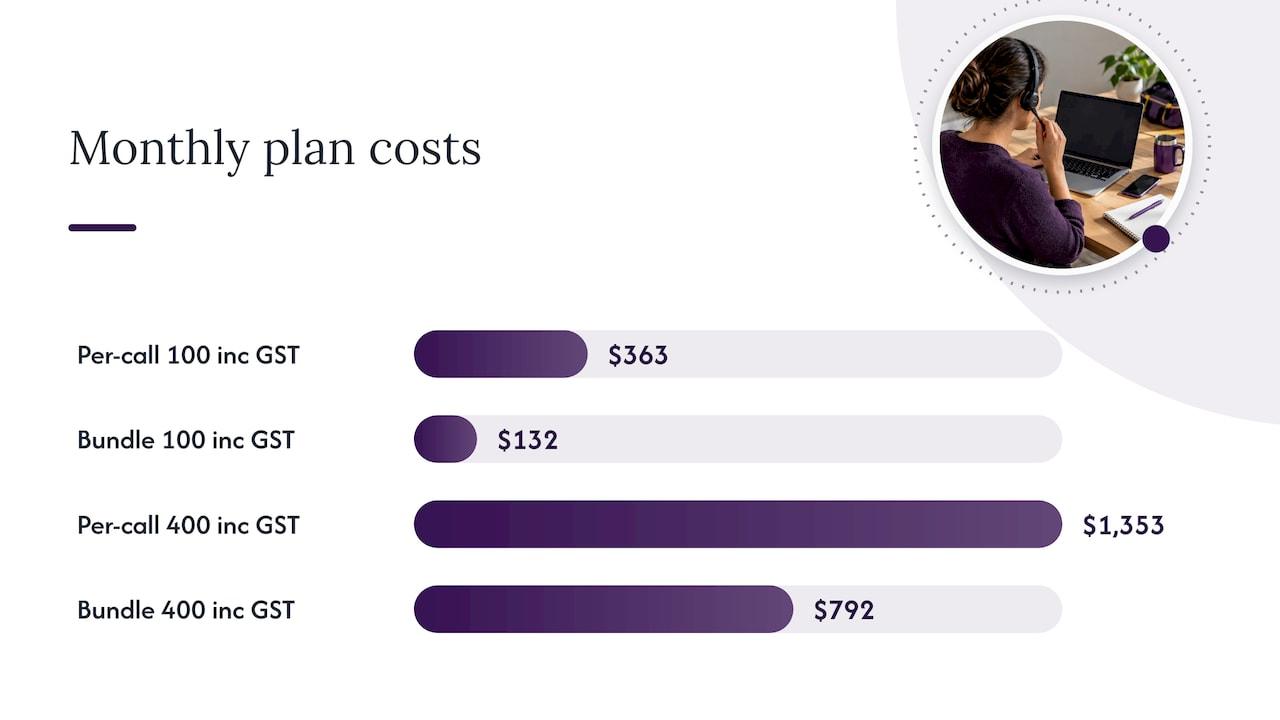
| 100 | $300 | $30 | $330 | $363 |
| 200 | $600 | $30 | $630 | $693 |
| 400 | $1,200 | $30 | $1,230 | $1,353 |
Now compare a bundled plan at $120 a month ex GST that includes 100 calls, with extra calls at $2 each.
| Calls per month | Cost ex GST | Cost inc GST |
|---|---|---|
| 50 | $120 | $132 |
| 100 | $120 | $132 |
| 200 | $320 | $352 |
| 400 | $720 | $792 |
At 50 calls, the per-call plan is cheaper before GST, at 100 calls the bundle wins, and at 400 calls the bundle is far ahead. The break-even depends entirely on your volume, so count your calls first. Your phone provider’s call log for the last three months is the quickest way to do that.
Count only the calls you would hand over
You probably don’t need a receptionist for every call. Regular customers and suppliers ring your mobile directly. The calls you want covered are new enquiries and calls you miss. Count missed and unanswered calls over a typical month. That number is often much smaller than your total, and it is the one to price.
Weigh it against one job
If the average job you win is worth $400 in margin, a service that costs $150 a month and saves one extra job pays for itself. If you never miss calls that turn into work, it won’t. Be honest about which describes you.
AI receptionist vs human service: how the costs compare
The two models behave differently on the bill.
| Human virtual receptionist | AI receptionist | |
|---|---|---|
| Typical billing | Base fee plus per call or per minute | Flat plan, bundled minutes, or per minute |
| Budget predictability | Varies with call volume | Often more predictable |
| After-hours cost | Often loaded | Often the same as daytime |
| Setup | Script handover, sometimes a fee | Call flow and question setup, sometimes a fee |
| Busy periods | Can queue when several calls arrive together | Can take several calls at once |
| Unusual or upset callers | A person can adapt and show empathy | Best with clear, repeatable questions |
| Call data | Held by the provider and its staff | Held by the provider’s software and recordings |
Here is the practical read for a tradie. If most of your calls follow a pattern (“What’s the job, what’s the suburb, how urgent is it, what’s your number?”), AI handles them well and costs less when volume spikes after a storm. If you often take sensitive calls, such as insurance claims after damage or distressed customers, a person may still serve you better, or you may want AI first and a human fallback.
Whichever you choose, the questions you ask callers matter more than who asks them. We cover a one-minute triage set in lead prequalification questions, and it works as a script for either type of service.
Questions to ask before you sign
Take this list to every provider. Get the answers in writing.
- What is the total monthly cost at my expected number of calls, including GST?
- What counts as a billable call or minute?
- Are spam, wrong-number and repeat calls billed?
- Is after-hours or weekend cover charged differently?
- How are transfers to my mobile billed?
- Is there a setup fee, and is it refundable if I cancel?
- Can I port my current number, and does it cost anything?
- Is there a minimum term, and how do I cancel?
- Are prices in Australian dollars?
- Where are calls and recordings stored, and who can access them?
On recordings, if a service records calls you are responsible for telling callers. Call recording rules differ between states and territories, so ask the provider how they handle the notification, and check with your state regulator or a lawyer if your work involves sensitive information.
Spotting misleading pricing
Subscription pricing is a regulated area. The ACCC took action against an online service over pricing claims and undisclosed subscriptions, and in 2026 the Federal Court ordered $10 million in penalties for misleading pricing representations. The takeaway for you is practical: a business should clearly show the total cost, including ongoing subscription fees, before you commit.
In plain terms, watch for:
- A “from” price that applies to a plan you can’t actually use
- A free trial that rolls into a paid plan without a clear reminder
- Per-call fees shown in small print
- Monthly prices that exclude GST without saying so
If you can’t find the full price on the provider’s site, ask for it by email. A clear answer is a good sign. A vague one is a reason to look elsewhere.
Our view: price the call, not the plan
We built Ask Hayley because tradies kept telling us the same thing. They didn’t miss calls because they were lazy. They missed them because their hands were full, and by the time they called back, the customer had booked someone else.
Here is how we think about cost, grounded in how trade work runs:
- Start with the missed call. A receptionist that answers every call, including the five that are suppliers and spam, is money spent on the wrong calls. Cover the calls that become jobs.
- Avoid another app. A receptionist that sends you messages in yet another inbox only moves the admin problem. We put call answering, lead screening, quotes and invoicing behind one voice interface, so you talk to Hayley rather than learn another dashboard.
- Screen before you ring back. A lead that arrives with the job type, suburb and urgency already captured saves you the call-back that goes nowhere.
- Ask for the whole bill. Whoever you choose, a plan should be easy to explain in one sentence: what you pay, what it includes and how to leave.
We also don’t think a receptionist replaces the rest of your front end. If callers hit a website that gives them no reason to trust you, they hang up before the receptionist matters. Calls come from somewhere, and where they come from affects what a call costs you.
— Hayley
Where Ask Hayley fits
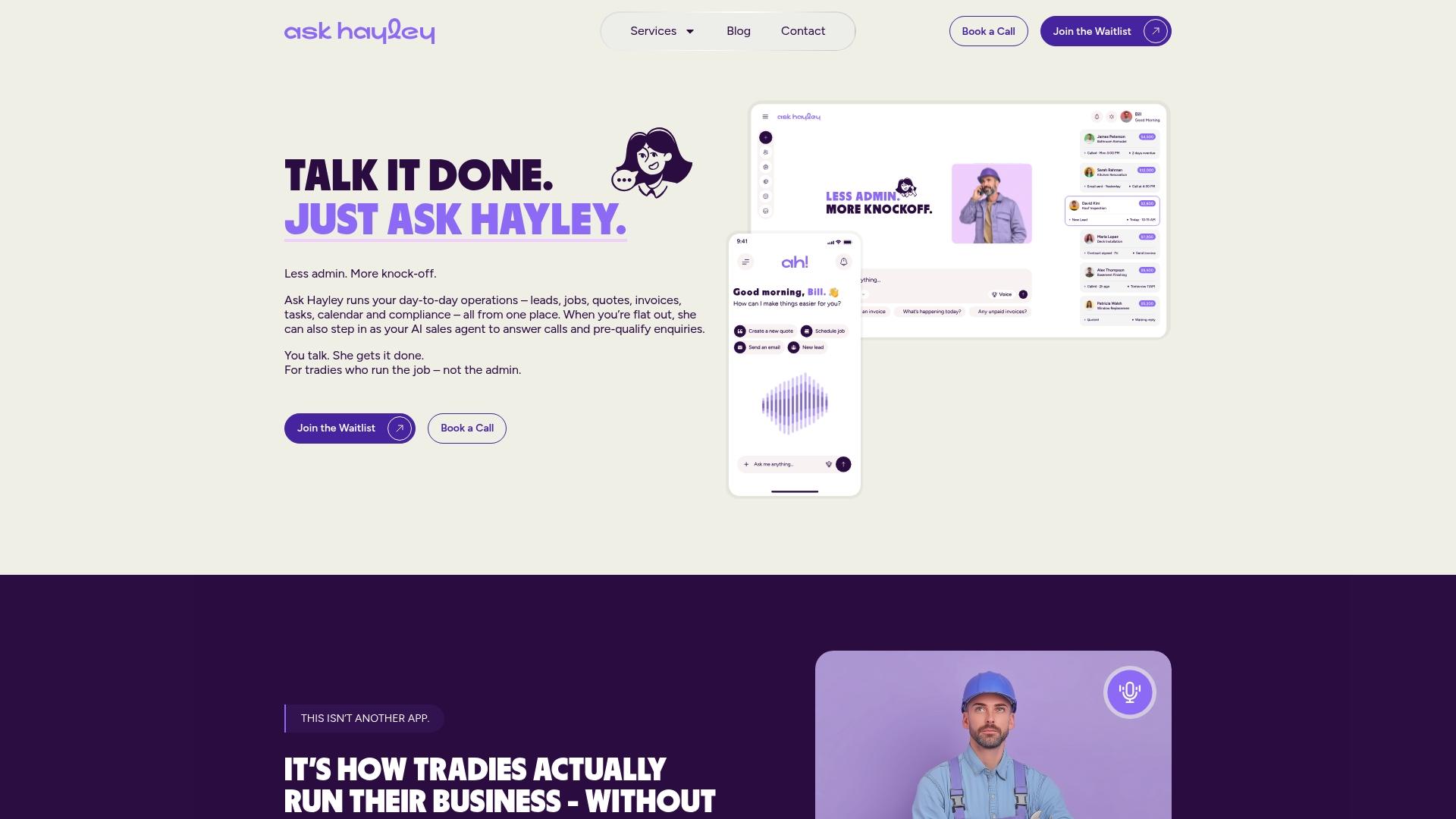
If you are comparing receptionist options, look at the whole job of handling a call, not just answering it. Ask Hayley answers inbound calls when you can’t, pre-qualifies leads before they reach your inbox and handles day-to-day admin by voice, with plans built around Assistant and Office Manager, plus optional add-ons such as an AI Sales Agent and AI Website Chatbot. You can see how it works on the Ask Hayley site.
If you also want to look professional where callers find you, we build a one page website that puts your phone number first. Pricing for the website and compliance services isn’t published, so ask us for a quote based on your trade.
Cheap ways to cover calls while you decide
You don’t need a service on day one. A tight voicemail greeting helps more than most tradies expect. It tells the caller what to do next and when you will ring back. We have written six examples in out of office voicemail scripts for Australian tradies you can copy and adapt.
Also look at how fast you respond. The gap between the missed call and your reply decides who gets the job, which we explain under lead response time. A receptionist helps most when it shortens that gap.
A simple way to choose
- Pull three months of call logs and count new-enquiry and missed calls.
- Decide your must-haves: after-hours cover, transfers, booking, screening.
- Collect two or three quotes and put each into the formula above at your volume.
- Add GST, setup and number costs to every quote.
- Pick month-to-month terms for the first trial.
- After 30 days, count the extra jobs booked against the cost.
If the numbers don’t favour the service, change the plan or cancel. A good provider will make that easy.
FAQ
How much does a virtual receptionist cost in Australia?
There is no single price. Plans typically combine a monthly fee with a per-call or per-minute charge, so the total depends on your call volume and extras. Use the formula above with real quotes, and include GST, setup and after-hours loading. Always ask for the full monthly cost in writing.
Is an AI receptionist cheaper than a human one?
Often it is, especially when call volume rises, because AI plans are commonly flat-rate or minute-based rather than charged per call. A human service can still be the better fit for sensitive or complex calls. Compare both at your own volume rather than relying on the headline price.
What extra fees should I look out for?
Check for setup fees, after-hours loading, transfer charges, overage rates, phone number costs, billing for spam calls, GST and minimum terms. Any of these can change the total noticeably. Ask which ones apply before you sign.
Do I need a virtual receptionist if I’m a sole trader?
Only if you regularly miss calls that would have become paid work. If you’re on the tools most of the day and your phone often goes to voicemail, it can pay for itself with a few extra jobs. If you rarely miss enquiries, a good voicemail greeting and quick call-backs may be enough.


