


Send a short first follow-up 2 to 3 days after your quote, a value-add message around day 7, and a polite expiry reminder before the price closes out. Use a ready-made template for each touch and finish every message with one easy way to say yes, like an accept link or a simple reply. This is the cadence Ask Hayley recommends for Australian sole traders and small service businesses chasing conversions, not just chasing up.
TL;DR:
- Follow-up sequences should include four to five timed touches, starting with a simple check-in two to three days after sending the quote.
- For urgent jobs, follow-ups should be compressed into 48 hours, while larger projects may require a three- to four-week cadence.
- Subject lines should reference the specific job and include clear, concise details to increase open rates, with emails opening by confirming receipt and scope.
- Switching to SMS or phone calls is advisable when email responses cease after two touches, especially for high-value or urgent jobs.
- Keeping records of accepted quotes with clear scope, price, and acceptance method protects your business and ensures clarity in case of disputes.
Table of Contents
- What is the right follow-up sequence for quote emails?
- When should you send each follow-up?
- What makes a quote follow-up email actually get a reply?
- When should you switch to SMS or a phone call?
- Ready-to-send follow-up email templates
- What should you keep on record once a quote is accepted?
- Why speed and follow-through matter more than perfect wording
- A simpler way to keep every quote follow-up on track
- Where to check the rules and get more examples
- Sources
- FAQ
What is the right follow-up sequence for quote emails?
Most quotes that go cold do not die because the client said no. They die because nobody followed up, or the follow-up felt like a nag. A structured sequence of quote follow up emails fixes both problems: it keeps you visible without sounding desperate, and it gives the client a natural moment to say yes.
A sensible sequence runs four or five touches, each with a distinct purpose. Skipping straight to “just checking in” every time is the fastest way to get ignored.
- Initial send — the quote itself, with a clear breakdown and one obvious next step.
- Day 2 to 3 check-in — a friendly nudge confirming they received it and asking if anything needs clarifying.
- Day 5 to 7 value-add — something useful, not pushy: a photo of similar work, a note on availability, or an answer to a question they hadn’t asked yet.
- Pre-expiry notice — a courteous reminder that the price or the booking slot is closing soon.
- Closing message — if there’s still no response, a short note releasing the quote and leaving the door open.
Each stage has one job. The check-in confirms receipt and removes friction. The value-add builds trust without selling harder. The expiry notice creates a genuine, non-manipulative reason to decide. The closing message protects your time and your tone, so you’re not still chasing a lead six weeks later that was never going anywhere.
This flow lines up with what Jotquote’s guide on following up on quotes recommends: a first follow-up 2 to 3 days after sending, a second about a week later, and a final check before the quote lapses. It’s a pattern that turns up across proposal and quoting advice because it mirrors how people actually make decisions. They need a reminder, then a reason, then a deadline.
When should you send each follow-up?
Timing is where most follow-up sequences fall apart. Send too soon and you look impatient. Wait too long and the client has already booked someone else, or simply forgotten you exist.
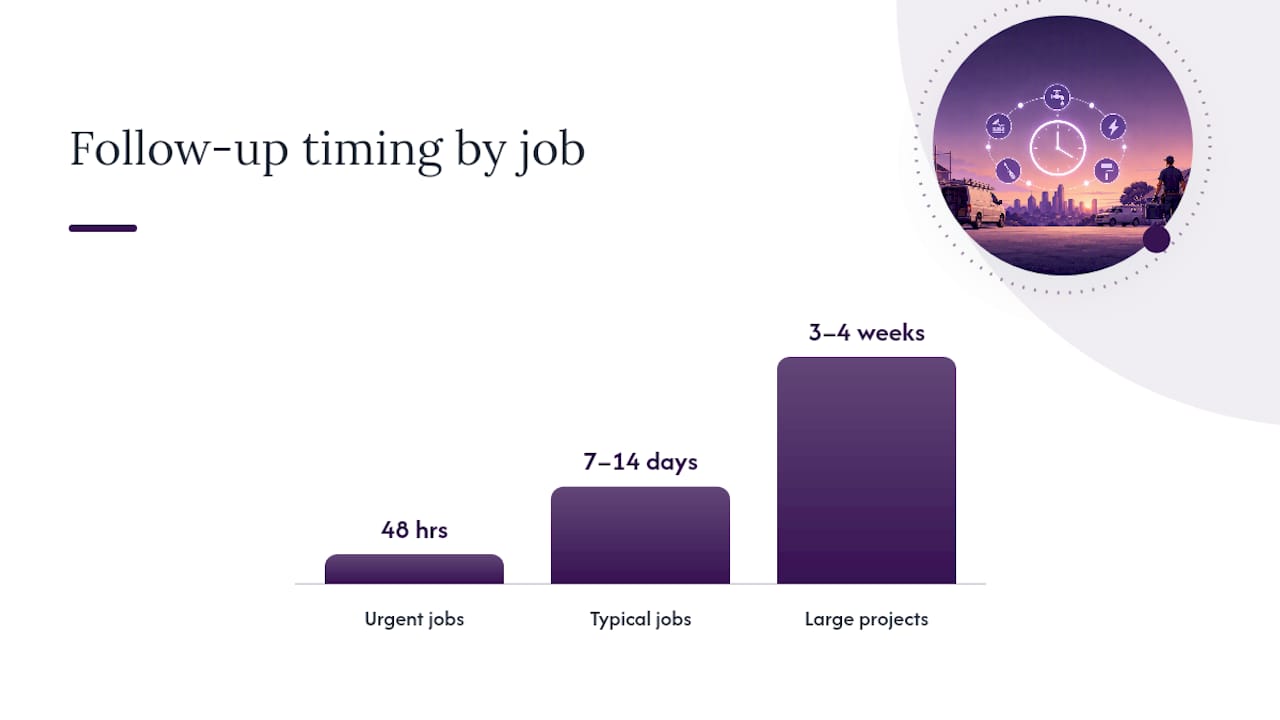
The cadence that works best for most Australian trade and service businesses is two to three touches spread across 7 to 14 days, tightening to three touches with a firm expiry date for jobs where price and availability genuinely matter. That timing lines up with the general follow-up cadence used across quoting guides, which points to a first nudge at day 2 or 3, a second around a week out, and a final check before the quote closes.
A few practical adjustments matter for Australian conditions:
- Urgent jobs (a burst pipe, an emergency call-out) compress the whole sequence into 48 hours. Follow up same-day or next morning, because the client is likely getting three other quotes right now.
- Large projects needing approvals (a renovation, a commercial fit-out) stretch the cadence to 3 to 4 weeks, since the client may need a partner, a strata committee, or a board sign-off before replying.
- Business days versus calendar days matters more than people think. A quote sent Friday afternoon effectively lands Monday. Count your “day 2” from the next business day, not the calendar date, or you’ll follow up while the client is still asleep on a Saturday.
- Public holidays and long weekends push the whole sequence out. Sending a “just checking in” email on the Tuesday after the Australia Day long weekend usually reads better than one dropped in on the holiday itself.
- Know when to stop. After three unanswered touches, send one graceful closing message and move on. Chasing a fourth or fifth time rarely converts and can damage how the client remembers you.
What makes a quote follow-up email actually get a reply?
Subject lines decide whether your email gets opened at all, and openings decide whether it gets read past the first line. Keep both short and specific.
Strong subject lines reference the job, not just the word “quote”:
- “Following up on your [service] quote”
- “Quick question about your bathroom reno quote”
- “Ready when you are, [Name]”
- “Your quote expires Friday, want to lock it in?”
Open with a single sentence that confirms receipt, restates the scope or price briefly, and offers help. Something like: “Just following up on the quote for the deck rebuild at [suburb], quoted at $[amount], to see if you had any questions.” That one line does three jobs at once, and it means the client doesn’t have to scroll back through old emails to remember what you’re talking about.
End with a call to action that removes friction rather than adding pressure. “Reply YES and I’ll lock in your slot” works better than “let me know if you’d like to proceed,” because it tells the client exactly what to type. An accept link, a booking link, or a simple “reply YES” all outperform anything that requires printing, signing, and scanning a document back.
Effective follow-ups lead with something useful rather than a sales push. That might mean addressing an objection before it’s raised, offering a small scope tweak, or referencing similar work you’ve completed nearby.
Pro Tip: Always personalise the project date, suburb, and price summary in every follow-up. A generic “just checking in” gets deleted. “Following up on your deck rebuild at Kew, quoted at $4,200” gets read.
When should you switch to SMS or a phone call?
Email works for most quote follow-up emails, but it’s not the only tool, and leaning on it exclusively for every client is a mistake.
Switch to SMS or a phone call when you’ve already spoken to the client by phone, when the job is high-value enough that a missed email is expensive, or when a client has gone quiet after two email touches. A short text, “Hi Sam, following up on your fence quote, are you still keen for the June start?”, often gets a faster reply than a third email ever will.
Simple automation prevents the whole sequence from relying on your memory. A basic setup triggers a follow-up when the quote is sent, pauses automatically the moment the client replies or accepts, and fires reminders at day 2, day 7, and just before expiry. Vendor platforms describe sequences running 5 to 7 touches across 14 to 21 days, mixing email and SMS, though most Australian sole traders need far fewer touches than that to stay on top of a quote.
- Only send SMS to clients who’ve given you their number for that purpose. Check SMS marketing laws in Australia before running any text-based sequence.
- Keep automated messages short, personal in tone, and easy to opt out of.
- Mixing channels properly tends to outperform relying on one channel alone, as long as every message stays permissioned and polite.
Voice-first workflows are designed to cut the admin load of managing this manually, since triggers and reminders run in the background instead of living in your head.
Ready-to-send follow-up email templates
These templates cover the full sequence. Adjust the bracketed details and keep the tone as your own.
-
Initial send (with the quote)
Subject: Your quote for [job type] at [suburb]
“Hi [Name], thanks for the chance to quote on your [job type]. I’ve attached the full breakdown, total comes to $[amount]. Happy to answer any questions, just reply to this email or call me on [number].” -
Day 2 to 3 friendly check-in
Subject: Following up on your [job type] quote
“Hi [Name], just checking you received the quote for [job type] okay. Let me know if anything needs adjusting or if you’ve got questions about the scope.” -
Day 5 to 7 value-add
Subject: A quick thought on your [job type]
“Hi [Name], I recently finished a similar [job type] in [suburb], happy to send a couple of photos if that’s useful. Also wanted to flag I’ve got a slot opening up in [timeframe] if you’re ready to lock things in.” -
Pre-expiry reminder
Subject: Your quote closes [date]
“Hi [Name], just a heads up that your quote for [job type] is valid until [date]. Keen to help if you’re still considering it, reply YES and I’ll get you booked in before the price changes.” -
Closing message
Subject: Keeping the door open
“Hi [Name], haven’t heard back so I’ll assume the timing isn’t right just now. If anything changes, happy to requote or chat, just reach out anytime.”
For tradies, keep the scope and price front and centre in every touch, clients comparing multiple quotes want to reconfirm numbers fast. Consultants and service-based businesses often get better replies by leading with a value-add (a resource, an insight) before mentioning price again. Photographers and creatives tend to convert well on a value-add that includes a portfolio link or a recent shoot from the same area.
Whichever version you send, the accept step matters more than the wording. A direct link the client can click to approve, or a plain “reply YES,” converts better than asking someone to print, sign, scan, and email a document back, as automation vendors consistently point out. If you run larger jobs that involve formal proposals rather than quick quotes, the same principle applies to tendering, just with a longer runway.
What should you keep on record once a quote is accepted?
Once a client says yes, whether by email reply, text, or clicking an accept link, keep that record somewhere retrievable. It’s your proof of scope and price if a dispute ever comes up.
A quote can create a binding obligation once it’s accepted, so it’s worth including the scope, the price, and the exact acceptance method directly in the quote itself, as outlined in official guidance on preparing quotes. Keep it simple:
- Save the accepted quote email or export the online acceptance confirmation.
- State clearly in the quote how a client accepts it, by reply, signature, or clicking a link.
- Note the accepted date and price in your job file, useful come tax time and for Queensland’s practical quote guidance.
This isn’t legal advice, for anything contract-specific, check the official sources above or speak with an adviser.
Why speed and follow-through matter more than perfect wording
The biggest mistake I see in Australian trade businesses isn’t bad quote wording, it’s silence. A quote sent and never followed up is a coin flip at best. Most tradies I talk to assume a client who doesn’t reply has gone elsewhere. Often they’ve just gotten busy, and the job that follows up wins.
What surprises people is how little the follow-up needs to say to work. It doesn’t need to sell harder than the original quote did. It just needs to show up on time, twice, with an easy way to say yes.
Voice-first admin tools exist because most trade business owners are on a roof or under a sink when the client finally replies, not sitting at a laptop. Some platforms are built around that reality: answering calls, qualifying leads, and triggering follow-ups without anyone having to sit down at a screen between jobs. The businesses that respond fastest and follow up consistently tend to convert more of their quotes, not because the price changes, but because they’re the ones still in the conversation when the client is ready to decide.
— Hayley
A simpler way to keep every quote follow-up on track
Some tools offer an alternative to chasing quotes manually between jobs by answering calls when you can’t, pre-qualifying leads before they hit your inbox, and triggering the follow-up sequence automatically once a quote goes out, so nothing sits forgotten in a drafts folder.
If your business also needs a clean, simple way to present quotes and past work to new clients, the One Page Website service gives you a professional landing page without the agency price tag. For larger jobs that need a formal proposal rather than a quick quote, the Tendering service handles that heavier lifting. And if compliance paperwork is the thing eating your evenings, Safety and Compliance Documentation is worth a look too.
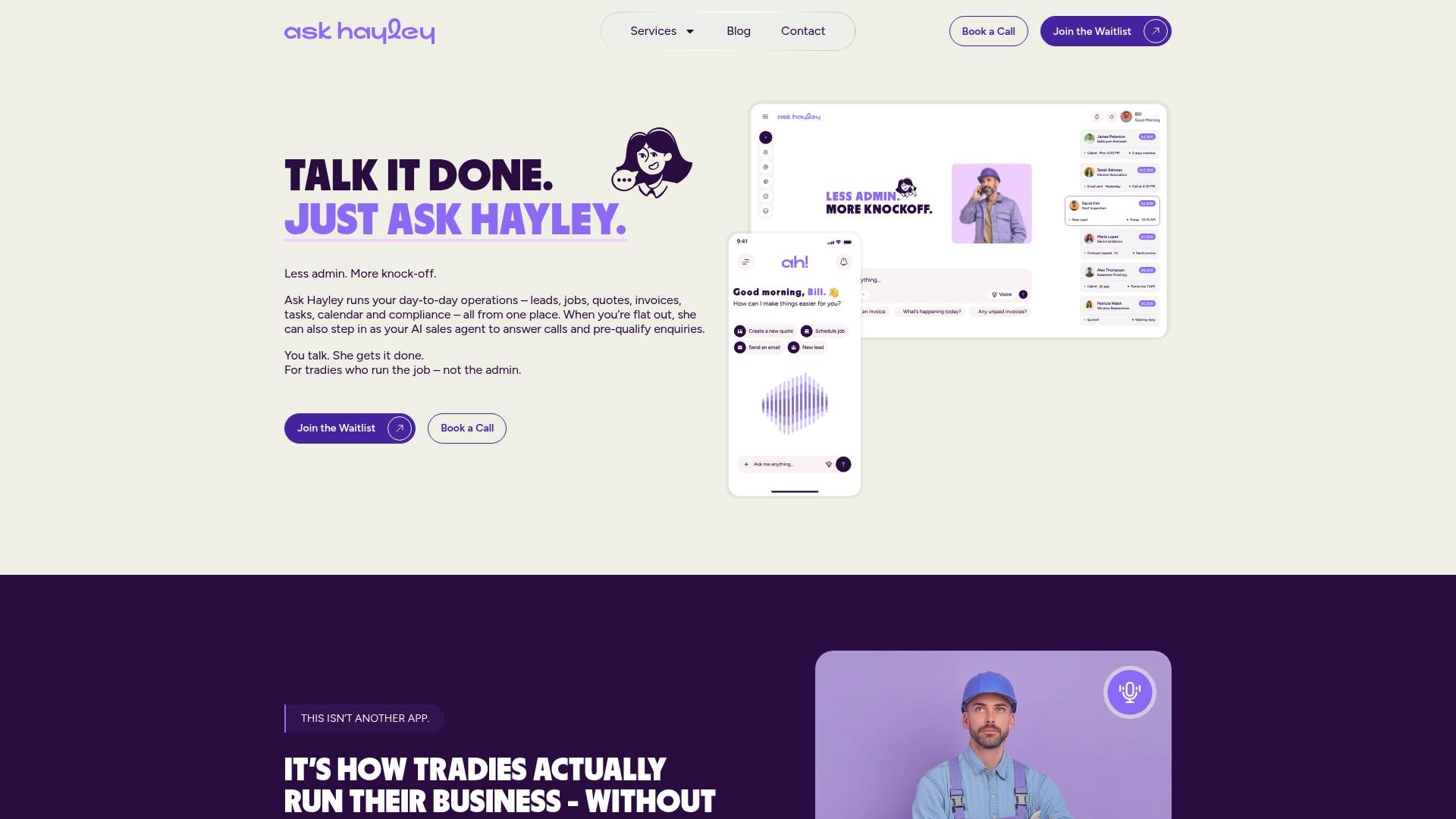
Have a look at what Ask Hayley offers on the main site and see whether voice-first admin fits how you actually work, hands full, on-site, no time to sit at a screen.
Where to check the rules and get more examples
For the official word on quotes and contracts, see business.gov.au’s guidance and business.qld.gov.au’s quote-preparation advice. For process ideas if you run a service or agency, 121 Group’s process page is a useful read.
Sources
FAQ
How do I write a follow-up email for a quote?
Confirm receipt of the quote in one sentence, restate the price or scope briefly, offer to answer questions, and end with a simple way to say yes, like a reply or an accept link.
How do I politely say “follow up” in an email?
Use phrases like “just checking in on” or “following up on” rather than “I’m chasing you,” and pair it with something useful, a photo, an availability update, or an answer to a likely question.
How soon should I follow up after sending a quote?
Send your first follow-up 2 to 3 days after the quote, a second around day 7, and a final reminder before the quote expires, a cadence backed by common quoting-industry guidance.
How do I follow up on a quotation politely without sounding pushy?
Lead with value rather than pressure, mention something helpful before asking for a decision, and always give the client an easy, low-friction way to respond, such as a “reply YES” option.
Does Ask Hayley help with quote follow-ups?
Yes, Ask Hayley can trigger follow-up reminders when a quote is sent and handle inbound calls and enquiries, reducing the admin load of chasing quotes manually. Current pricing is available on the Ask Hayley website.

