


Round robin lead distribution assigns each incoming lead to the next eligible rep in a fixed sequence, so everyone gets an even share over time. It works best when your reps have comparable capacity, comparable skills, and no strong territory or specialty divide. If that description doesn’t quite fit your team, weighted, skill-based, or capacity-driven routing will serve you better. The rest of this guide covers the models, the controls, the implementation checklist, and the Australian privacy rules you need to know before you switch it on.
TL;DR:
- Round robin works best when sales reps have similar capacity, skills, and no specialized territory or language requirements.
- Using weights, eligibility filters, schedules, caps, and overflow paths can optimize round robin, but improper setup causes routing issues.
- Most failures in small mobile teams stem from poor lead quality or inaccurate intake processes rather than configuration mistakes.
- Proper monitoring, logging, and testing are essential to prevent silent drift and ensure fair, compliant lead distribution.
- Pre-qualifying leads with voice-first capture, like Ask Hayley, improves data quality and fairness before routing rules are applied.
Table of Contents
- What is round robin lead distribution and how does it differ from load balancing?
- When does round robin suit your team (and when does it not)?
- Weights, eligibility, schedules and fallbacks: the controls that make round robin work
- Step-by-step implementation checklist for CRM administrators
- Advanced pitfalls: state, overlapping rules and manual reassignments
- Privacy and consent rules for lead routing in Australia
- Audit, monitoring and KPIs to run after launch
- Perspective: what actually breaks round robin in small mobile teams
- How Ask Hayley makes fair routing possible before a lead even reaches your CRM
- Sources
- FAQ
What is round robin lead distribution and how does it differ from load balancing?
Round robin lead distribution cycles leads through a pool of reps in strict turn order. Rep A gets lead one, Rep B gets lead two, Rep C gets lead three, then back to Rep A. It sounds simple because it is, but the mechanics split into two distinct models worth knowing before you configure anything.
- Order-based pools advance a turn pointer with every assignment. Whoever is “next” in the sequence gets the lead, regardless of how many leads they’ve already closed or how heavy their pipeline is.
- Count-based pools assign the next lead to whoever currently holds the lowest count in the active period. If Rep B has been on leave and missed three rounds, count-based routing gives them extra leads to catch up rather than rigidly following the queue.
Load balancing is a different beast entirely. Rather than rotating by turn or by count, it distributes leads based on real-time capacity, factoring in open opportunities, calendar availability, or workload score. A rep buried in follow-ups gets skipped until they free up. Round robin doesn’t look at capacity at all; it just looks at whose turn is next. Say you run a five-person inside sales team with even territories and similar close rates: order-based round robin works cleanly. If one rep works part-time and the others full-time, count-based pools or load balancing will produce a fairer split.
When does round robin suit your team (and when does it not)?
Round robin earns its reputation for simplicity when your reps are genuinely interchangeable. That means similar capacity, similar product knowledge, and no meaningful reason a given lead should go to one person over another.
- Good fit: a flat team structure where any rep can handle any inbound enquiry, similar working hours, and comparable close rates.
- Poor fit: territory-based sales where postcode determines the right rep, multilingual teams where the caller’s language dictates routing, or specialist product lines that need a technical rep rather than a generalist.
- Better alternatives exist when reps have unequal capacity (count-based pools or availability aware scheduling fix that), when leads need skill filters (best-fit assignment based on eligibility attributes), or when workload varies hour to hour (load balancing).
The honest test: if you’d be comfortable letting a coin flip decide who gets the next lead, round robin is probably fine. If your gut says “no, that lead needs Sarah because she speaks Mandarin” or “that’s a Perth job, it has to go to the WA rep,” you need lead routing by postcode, language, or skill before you even think about rotation order.
Weights, eligibility, schedules and fallbacks: the controls that make round robin work
Pure round robin without any controls is a blunt instrument. The controls layered on top are what turn it into something you can actually run a sales floor on.
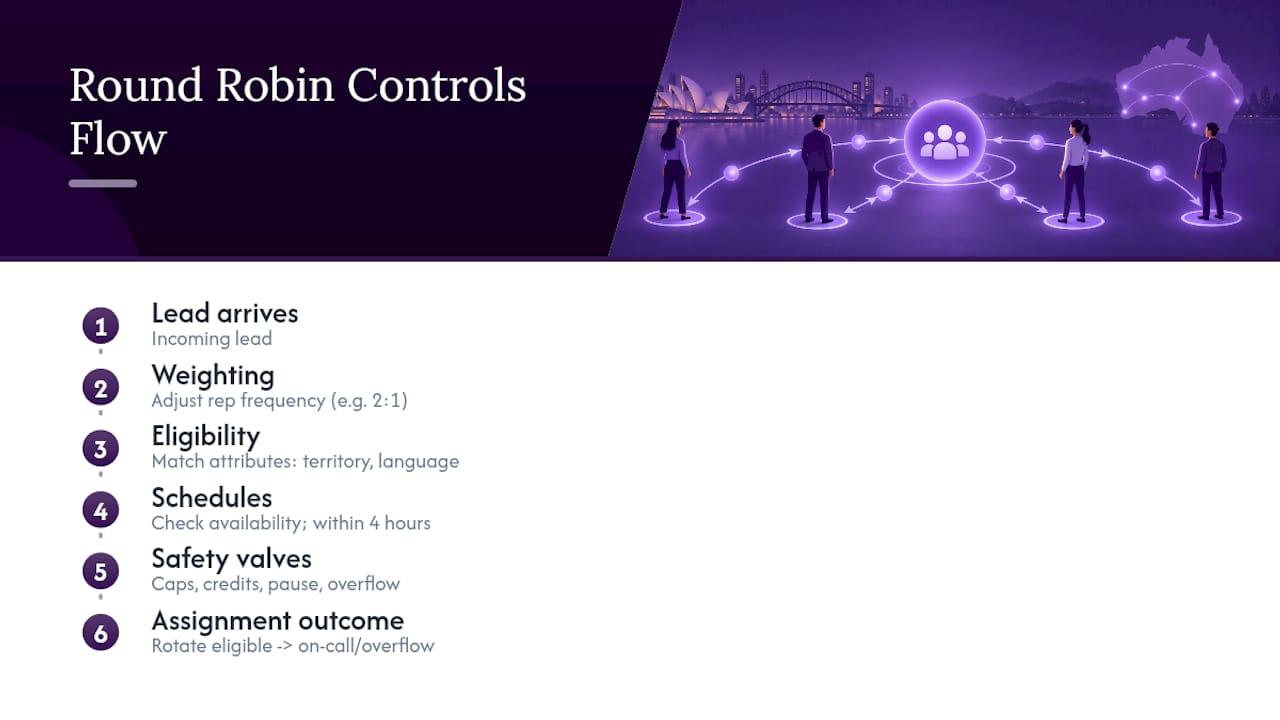
Weighting changes how often a rep appears in the rotation, without abandoning the turn-based structure. A senior rep weighted at 2 gets two leads for every one that goes to a junior rep weighted at 1, in a repeating 2:1:1 pattern rather than a strict A, B, C cycle. This suits teams where experience or product depth genuinely earns a bigger share.
Eligibility attributes filter who’s even in the pool for a given lead. Best-fit assignment combines round robin with attribute matching, so the rotation only cycles through reps who meet the criteria for that specific lead, whether that’s territory, language, or a licensed trade category, according to LeanData’s routing documentation.
Schedules and availability buckets stop leads landing with reps who are offline. A rule like “assign if available within four hours, otherwise route to the on-call backup” keeps leads moving instead of sitting in a queue overnight.
Caps, credits, pause and overflow are your safety valves. Capping limits how many leads a rep can hold at once. Credits let you manually adjust someone’s position in the rotation, useful after a period of leave. Pausing removes a rep from the pool temporarily without deleting them from the system. Overflow paths route leads to a backup queue or manager when no eligible rep is available, based on LeanData’s Round Robin node configuration.
Pro Tip: Set your overflow rule before you launch, not after the first Friday afternoon a lead comes in with nobody rostered on. An unassigned lead sitting in limbo for a weekend is the single fastest way to lose trust in a new routing system.
Step-by-step implementation checklist for CRM administrators
Configuring round robin properly is a sequencing problem as much as a technical one. Skip a step and you’ll spend weeks untangling why leads are landing in the wrong hands.
- Define objectives, SLA and success metrics first. Decide what “fair” looks like for your team before you touch the CRM, whether that’s equal lead count, equal weighted share, or equal response time.
- Map required lead fields and build mutually exclusive criteria. Postcode, product line, or lead source often decide which pool a lead enters. Overlapping criteria across two rules is the single most common cause of leads silently double-routing or skipping reps.
- Create eligible pools and choose order-based or count-based distribution. Add weights here if reps have unequal seniority or capacity.
- Set schedules, caps and fallback logic. Nominate an unassigned queue or backup team for when nobody in the pool is available.
- Test with sequential dummy leads. Run at least one full cycle through the pool to confirm the pointer or count logic behaves as expected.
- Test exclusions, duplicate updates and manual reassignment. Confirm a duplicate lead doesn’t trigger a second assignment, and check what happens to the rotation when someone manually reassigns a lead.
- Test the no-available-rep scenario deliberately. Pause every rep in a test pool and confirm the overflow path actually fires.
- Pilot on a subset of live traffic, watch the routing history closely, then expand to full volume once the pattern holds.
Oracle’s documentation on lead assignment rules recommends exactly this order: define criteria, build pools, choose the routing model, configure the rule, then test every edge case before activation. Skipping the testing stage is the single most common reason round robin setups fail in production, because the failure modes (duplicate assignment, silent counter drift, overflow paths that never trigger) rarely show up until real leads are already flowing through the system.
Advanced pitfalls: state, overlapping rules and manual reassignments
The mistakes that break round robin routing rarely show up in the initial setup. They show up three months later, when someone asks why Rep C has had four fewer leads than everyone else and nobody can explain it.
- Organisation-level vs rule-level state is the first trap. If your platform stores the rotation pointer at organisation level rather than per rule, two supposedly independent rotations (say, a Sydney pool and a Melbourne pool) can end up sharing a counter and advancing each other’s turn order without either team noticing, a risk Microsoft’s Dynamics 365 documentation flags directly.
- Overlapping rule criteria compound this. Regional or segment-specific rotations need genuinely mutually exclusive conditions, otherwise a single lead can match two rules and consume two turns.
- Manual reassignment policy needs to be decided and written down. Does a lead manually reassigned to Rep D count as Rep D’s “turn,” or does it sit outside the rotation entirely? Leave this undecided and reps will notice the inconsistency long before you do.
Pro Tip: Log the skip reason every time a rep is bypassed, not just the final assignment. Six months in, that field is the only way to prove (or disprove) a rep’s complaint that they’re being routed around.
Privacy and consent rules for lead routing in Australia
Routing a lead to the right rep says nothing about whether you’re allowed to market to that person. Consent and marketing permission are separate questions from assignment, and Australian privacy law treats them that way.
- Carry consent metadata with every routed record. Source, consent timestamp, and opt-out channel should travel with the lead through every stage of the pipeline, not just sit in a separate compliance spreadsheet.
- APP 7 governs direct marketing specifically. Under the OAIC’s guidance on Australian Privacy Principle 7, organisations must respect a person’s stated preference not to receive direct marketing, and must action opt-out requests free of charge. Being assigned to a rep doesn’t override that.
- Build suppression checks into the workflow itself. A CRM field for opt-out status, checked automatically before any automated follow-up sequence fires, stops a well-meaning rep from emailing someone who’s already opted out.
Assignment gets someone a lead in their queue. It doesn’t grant permission to market to them, and treating the two as the same thing is where a lot of routing builds quietly create compliance risk nobody notices until a complaint lands.
Audit, monitoring and KPIs to run after launch
A round robin system that isn’t monitored will drift, quietly and often invisibly, until someone raises a complaint. Build the monitoring habit into the same week you launch.
Track response time, assignment share per rep, net-count drift from the expected rotation, lead ageing in the queue, and overflow rate (how often leads are falling through to the backup path rather than being picked up normally). A rising overflow rate usually means your eligible pool has shrunk, whether from leave, turnover, or a rep quietly getting paused and forgotten. Field service reporting tools built for tradie teams can help track these numbers without manually pulling CRM exports every week.
Your routing history log should capture, at minimum:
| Field | Why it matters |
|---|---|
| Lead ID | Ties every routing decision back to a specific record for disputes |
| Pool ID | Confirms which rotation the lead entered |
| Matched eligibility attributes | Shows why the lead landed in that pool |
| Selected rep ID | The actual outcome of the routing decision |
| Skip reason | Explains why a rep in sequence was bypassed |
| Timestamp | Establishes sequence and supports SLA reporting |
| Fallback outcome | Confirms whether overflow logic fired and where the lead landed |
Run a weekly sanity check against this log. A reasonable escalation threshold is when a rep deviates noticeably from their expected share for a rolling period, a variance worth investigating before it becomes a team morale issue rather than a technical one.
Perspective: what actually breaks round robin in small mobile teams
Most round robin failures we’ve seen in small trade and service businesses aren’t configuration errors. They’re upstream problems that only show up as routing complaints. A team running three or four mobile reps, no fixed office hours, and a shared phone line doesn’t fail because the rotation logic is wrong. It fails because half the “leads” entering the rotation were never real enquiries in the first place, tyre-kickers, wrong numbers, or people calling the wrong trade entirely.

Fixing that starts before routing, not inside it. Voice-first lead capture that pre-qualifies a caller before the record ever reaches a rotation removes a chunk of the noise that makes round robin feel unfair. If Rep A keeps getting junk leads and Rep B keeps getting genuine jobs, no amount of weighting or count-based tuning solves that. The pool itself is the problem.
The other pattern worth flagging: teams over-invest in the rotation logic and under-invest in the audit trail. A system nobody can explain after the fact will always feel unfair, even when it’s mathematically correct. Log everything before you need it.
— Hayley
How Ask Hayley makes fair routing possible before a lead even reaches your CRM
Round robin only works when the leads entering the rotation are worth rotating. Ask Hayley handles the step before routing: answering calls a tradie can’t get to, asking the qualifying questions a rep would normally ask, and capturing consent metadata (source, timestamp, opt-out preference) at the point of first contact rather than reconstructing it later.
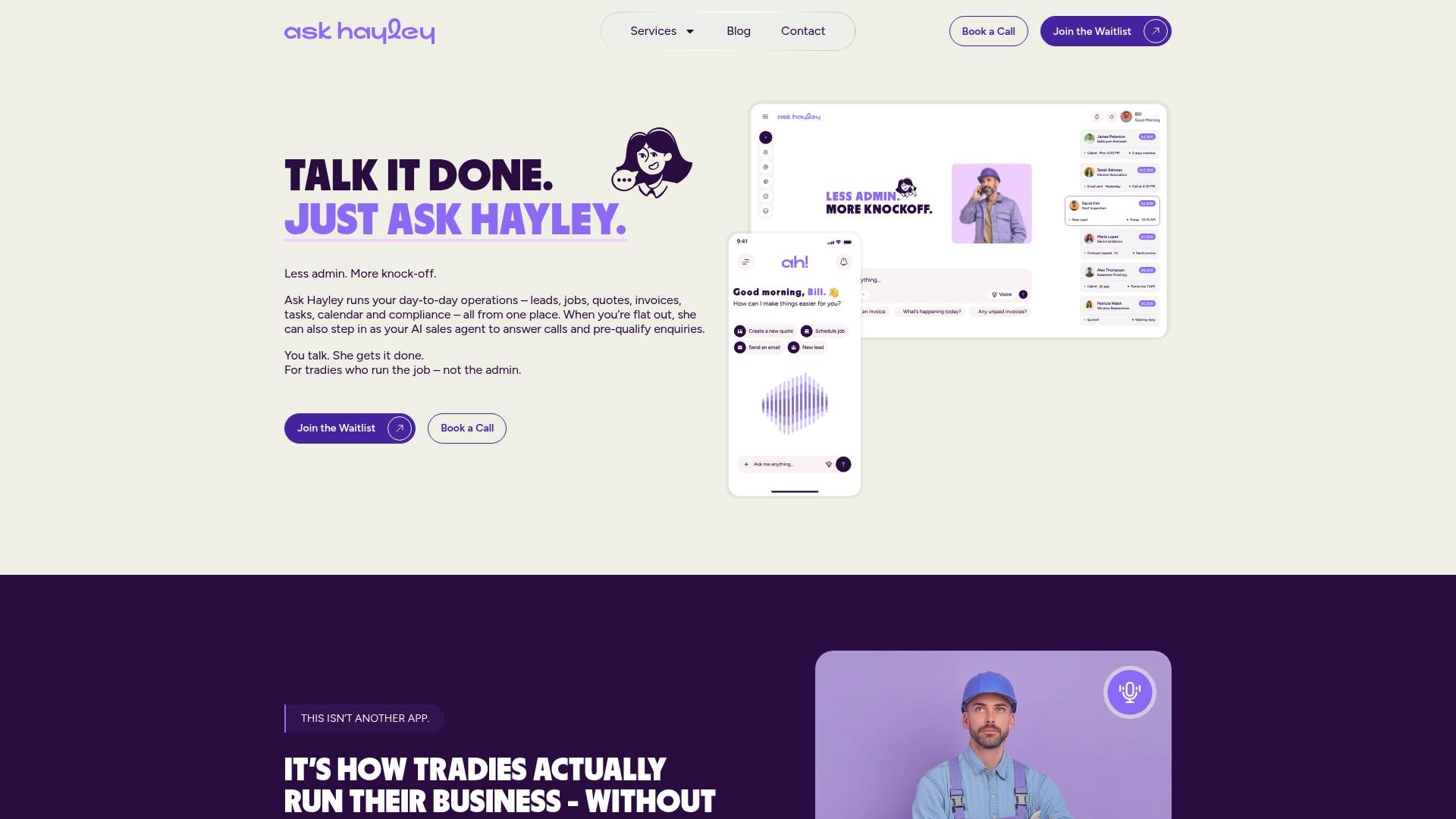
That matters because a rotation built on messy inputs, wrong-number calls, unqualified enquiries, missing consent flags, produces uneven outcomes no matter how carefully you configure weights or count-based pools. Ask Hayley’s voice-first intake means every lead entering your system already has a genuine enquiry behind it and the consent trail intact, so the routing rules you set up actually reflect fair distribution rather than compensating for noisy data. It plugs into your existing setup rather than adding another screen to check between jobs.
If you’re building or refining a routing workflow and want the intake side sorted first, have a look at what Ask Hayley covers and get a sense of how voice-first capture fits alongside your CRM.
Sources
- Oracle Cloud — lead assignment rules
- LeanData — Routing Round Robin overview
- Microsoft Dynamics 365 — create and activate assignment rule
- OAIC — APP 7: direct marketing (guidance)
FAQ
What is round robin allocation?
Round robin allocation is a method of distributing leads, calls, or tasks evenly across a group by cycling through members in a fixed sequence. Each eligible person receives the next item in turn, rather than items being assigned by availability or workload.
What is an example of round robin lead assignment?
If three reps, Anna, Ben and Chen, are in an order-based pool, lead one goes to Anna, lead two to Ben, lead three to Chen, and lead four cycles back to Anna. A count-based version instead sends each new lead to whichever of the three currently has the fewest, which matters if one rep has been away and fallen behind, per LeanData’s model.
What is round robin strategy in sales routing?
Round robin strategy assigns leads by turn order to ensure even distribution across a sales team, typically used when reps have comparable skills and capacity. Weighted or count-based variations adjust the pure turn order to reflect seniority, availability, or catch-up needs.
How does round robin lead assignment work in a CRM?
Most CRMs maintain either an order-based pointer, which advances to the next rep on each assignment, or a count-based tally, which tracks how many leads each rep has received in the current period. Some platforms, as Zoho’s implementation shows, store this rotation state in a dedicated variable so the sequence persists correctly between assignment runs.
Ask Hayley provides voice-first capture and pre-qualification before leads reach your CRM, ensuring the leads entering your routing rules are genuine and carry proper consent data.
Ask Hayley focuses on voice-first capture and pre-qualification before a lead reaches your CRM, ensuring the leads entering your routing rules are genuine and carry proper consent data. Current plan details and pricing are available on the Ask Hayley website.


