


The five pillars to check on every enquiry are service type, suburb and site access, scope or complexity, timeline urgency, and budget band. The moment a call or message comes in, grab their contact details, confirm the suburb, ask one scope question, and tell them when they’ll hear back with CRM-ready lead qualification question sets and templates that can be adapted for tradie intake processes. A voice-first tool like Ask Hayley can run this whole sequence automatically, even when you’re up a ladder.
TL;DR:
- Ask for the suburb and site access first, but defer the street address; after classifying the scope, request photos and measurements to avoid an unnecessary visit.
- Send an acknowledgment text within minutes and call back within an hour; contacting leads that quickly makes qualification roughly seven times more likely.
- Book urgent, mid to high budget enquiries within an hour; request photos before visiting when the scope is vague and the budget is low.
- Collect only information needed to respond, and identify your business in every commercial text, including messages sent after missed calls.
- Track how many enquiries answer all five questions, how many lead to quotes or visits, and where prospects drop off; revise the script monthly.
Table of Contents
- The five core qualifying pillars and the exact questions to ask
- How to ask these questions on the phone or via voice-first intake
- Turning answers into fast triage decisions
- Privacy and consent: the short Australian rules for collecting lead info
- Common objections and how to handle them during prequalification calls
- Examples of follow-up questions to deepen lead understanding
- Integrating lead prequalification questions into voice-first AI platforms like Ask Hayley
- Customising lead prequalification questions for different trade services
- Measuring and tracking the effectiveness of prequalification questions to improve lead quality
- Hayley’s perspective on why voice-first prequalification fits tradies
- Ask Hayley: automate voice-first capture and prequalification
- FAQ
- Sources
The five core qualifying pillars and the exact questions to ask
Every job enquiry, whether it’s a call, a missed-call text back, or a form fill, can be sorted using the same five questions. Ask them in order, keep them short, and you’ll know within 60 seconds whether a lead is worth your time.
Service type comes first because it routes everything else. A simple “Is this plumbing, electrical, or general maintenance?” tells you straight away whether you’re the right trade for the job, or whether you need to pass it on.
Suburb and site access matter more than most tradies realise. Ask “What suburb is the job in?” and follow with an access question like “Is it a house, unit, or something with stairs or tight parking?” Don’t ask for the exact street address yet. Trade enquiry form guidance suggests suburb and postcode are enough to decide whether to respond, and holding off on the full address avoids unnecessary friction before you know the lead is real.
Scope and complexity need a tick-style question, not an open one. Something like “Is this a repair, a replacement, or a new installation?” sorts most jobs into three buckets instantly. TradieVerify’s guide to getting quotes recommends capturing access, measurements, and material preferences early, because these details affect pricing more than almost anything else, and asking for a couple of photos at this point saves a wasted site visit.
Timeline urgency works best as a banded choice rather than a date. Try “Is this urgent, within a short timeframe, or more of a plan-ahead job?” Bands remove the pressure of committing to a date before they’ve even got a quote.
Budget band is the one tradies dread asking, but it doesn’t need to be awkward. “Are we talking a smaller, medium, or larger budget?” gives you enough to filter without demanding an exact figure.
- Service type: “Is this plumbing, electrical, or general maintenance?”
- Suburb and access: “What suburb, and is it a house, unit, or tricky access?”
- Scope: “Repair, replacement, or new installation?”
- Timeline: “Urgent, within two weeks, or planning ahead?”
- Budget: “Under $500, $500 to $2,000, or bigger?”
Pro Tip: Keep every question closed or banded. Open questions like “what’s your budget?” slow calls down and get vague answers; banded choices get a decision in seconds.
How to ask these questions on the phone or via voice-first intake
The words you use in the first 20 seconds decide whether a caller sticks around or hangs up. These scripts cover the live call, the missed-call text, and the voice-assistant version.
- Live call, straight in: “Thanks for calling [business name], this is [name]. Quick one for me, is this plumbing or electrical, and what suburb are you in?” Then: “Is it urgent, or more of a plan-ahead job?”
- Live call, caller leads with a problem: Let them explain for a few seconds, then redirect: “Got it. Just so I can point you the right way, roughly, is this under $500 or bigger than that?”
- Live call, booking pressure: “I can get someone out, but first, repair or replacement? And is it a house or unit?”
For missed calls, send a text within minutes. A two-line template works well: “Hi, sorry we missed your call! What suburb are you in and is this urgent or can it wait a couple of weeks?” That single message captures suburb and timeline in one go, and it keeps the lead warm while you finish the job you’re on.
Voice-first assistants handle this the same way a receptionist would, just without needing a desk. A prompt like “Ask the caller their suburb, then ask if the job is urgent” lets the assistant run the script and log answers straight into your CRM or job list, so nothing gets scribbled on the back of an invoice and lost in the ute.
Pro Tip: Record every answer against the caller’s name immediately. A qualifying question is only useful if the answer makes it into your system before the next call comes in.
Turning answers into fast triage decisions
Once you’ve got the five answers, the decision should take seconds, not minutes. Set rules in advance so you’re not second-guessing every call.
- Urgent plus mid-to-high budget band: book a site visit or call back within the hour.
- Plan-ahead plus clear scope: send a quote request for photos and measurements, then schedule for later in the week.
- Vague scope plus low budget band: ask for photos before committing to a visit, it often resolves the uncertainty without a drive.
- Out of service area or wrong trade: decline politely and, where you can, point them elsewhere.
- No response to the SMS acknowledgement within a day: one follow-up call, then close the lead.
Speed matters more than most tradies assume. Research on missed calls shows contacting leads within an hour makes qualification roughly seven times more likely, which is why the SMS acknowledgement needs to go out in minutes, not at the end of the day. A simple response time habit, ack fast, call back inside the agreed window, book inspections only for qualified leads, keeps your diary full of jobs worth doing.
Privacy and consent: the short Australian rules for collecting lead info
Collect only what you reasonably need to respond, and always identify your business when you ask for contact details. ACMA’s spam guidance requires this for any commercial message, including follow-up texts. Hold off on exact street addresses until the lead’s qualified, and Business backs standardising these enquiry steps so every caller gets the same fair treatment.
Common objections and how to handle them during prequalification calls
Some callers push back on being asked questions before they get a price. It’s a fair reaction if they’ve been burned before, so handle it with context, not defensiveness.
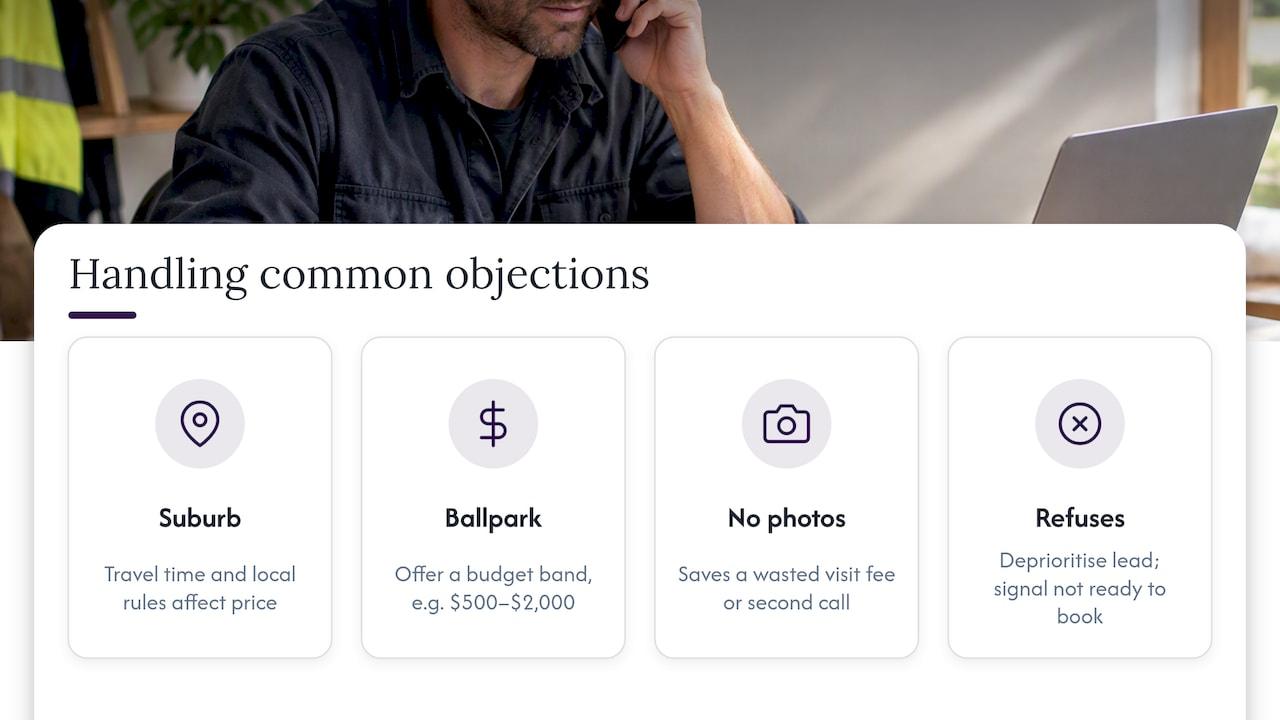
“Why do you need my suburb before quoting?” is common. Explain plainly: “Travel time and local rules affect pricing, so it helps me give you an accurate figure instead of a guess.” That reframes the question as being in their interest.
“Can’t you just give me a ballpark?” comes up when budget bands feel like stalling. Offer a band back: “Most jobs like this land between $500 and $2,000 depending on access and materials, which bracket sounds closer?” That turns the objection into a qualifying answer.
“I don’t want to send photos” is usually about effort, not privacy. Point out it saves them a wasted visit fee or a second call: “A couple of photos means I can often quote without needing to come out first.”
If someone refuses every question outright, that’s useful information too. It’s a reasonable signal to deprioritise the lead rather than chase it, since a caller unwilling to answer basic questions is often not ready to book.
Examples of follow-up questions to deepen lead understanding
Once the five pillars are answered, a couple of sharper follow-ups can tighten the quote and avoid surprises on the day.
For scope, ask “Has anyone looked at this before, and did they mention what caused it?” This often surfaces history that changes the job, like a recurring leak or an old installation that needs replacing rather than patching.
For access, “Will someone be home, and is there anywhere specific I shouldn’t park or walk through?” avoids wasted time on arrival.
For materials or finish, ServiceSeeking’s guidance for tradies recommends asking about brand or material preference early, since it can shift the price band significantly, a budget tap replacement and a designer tapware swap are different jobs entirely.
For timing, “Is there a reason it needs to happen by a certain date, like a tenant move-in or an inspection?” often reveals genuine urgency that a banded timeline question alone might miss.
These follow-ups aren’t needed on every call. Save them for leads that have already cleared the five main pillars, so you’re spending the extra minute only on enquiries worth winning.
Integrating lead prequalification questions into voice-first AI platforms like Ask Hayley
The questions in this guide work on paper, on a whiteboard, or read off a phone screen, but they work best when something else is asking them for you. That’s the gap a voice-first platform closes.
With Ask Hayley, we built the assistant to run this exact five-pillar sequence on inbound calls, so service type, suburb, scope, timeline, and budget band get captured before the enquiry ever reaches your inbox. Because it’s voice-first, there’s no dashboard to check mid-job, you talk to Hayley the same way you’d brief a receptionist, and the answers land in your system ready to action.
The scripts and SMS templates in this guide translate directly into voice prompts. “Ask the caller if the job is urgent or can wait a couple of weeks” is the kind of instruction the assistant follows in real time, which means the banding logic you’ve already decided on gets applied consistently, call after call, without you having to repeat yourself to every new caller.
Customising lead prequalification questions for different trade services
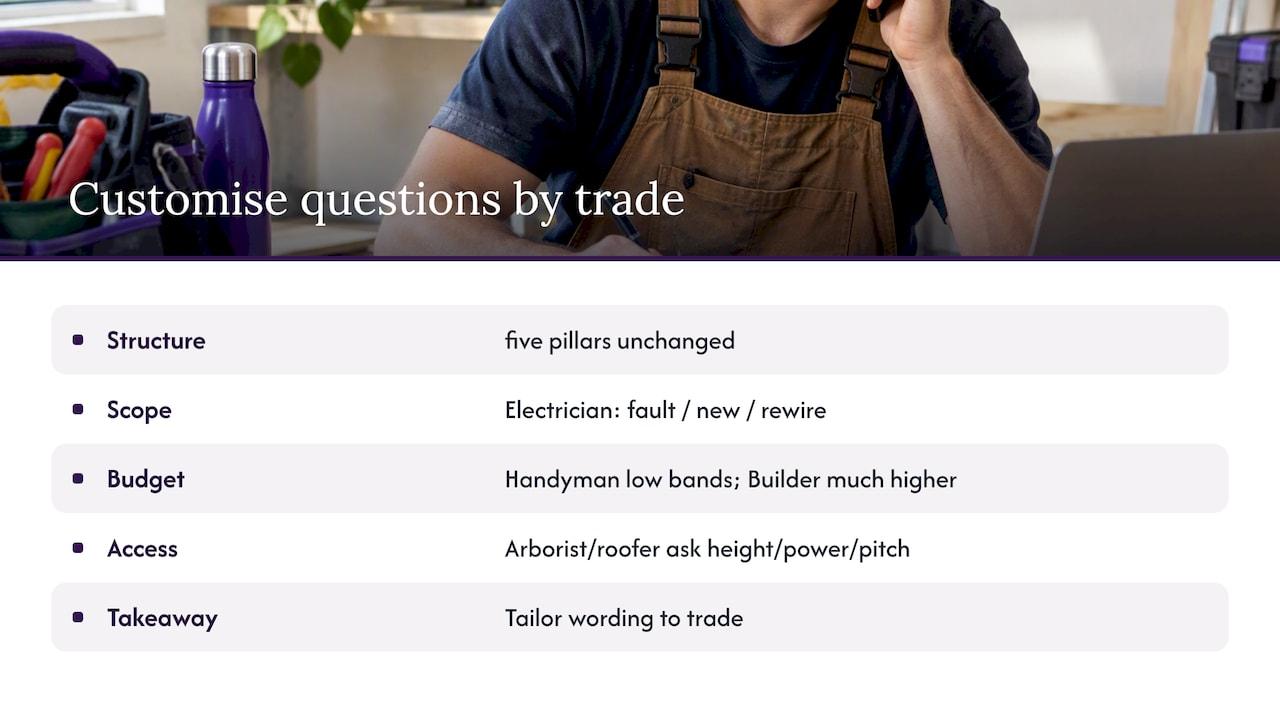
The five pillars stay the same across trades, but the wording inside each one should match the job. An electrician’s scope question might be “Is this a fault, a new circuit, or a full rewire?” while a plumber’s version is closer to “Is this a blocked drain, a leak, or a fit-out?”
Budget bands shift too. A general handyman might use “$500, $500 to $2,000, or bigger,” while a builder doing renovations needs higher bands, like “under $20,000, $20,000 to $80,000, or bigger,” to avoid every caller landing in the same bucket.
Access questions matter more for some trades than others. Arborists and roofers need to ask about tree height, power lines, or roof pitch early, since these affect whether the job is even safe to quote without a site visit. A locksmith’s access question is almost the opposite, usually just confirming whether it’s a house, unit, or commercial premises.
The underlying structure, service type, location and access, scope, timeline, budget, doesn’t change. Only the specific wording inside each pillar needs tailoring to the trade, which is why a generic script copied word for word rarely performs as well as one adjusted for your actual jobs.
Measuring and tracking the effectiveness of prequalification questions to improve lead quality
Qualifying questions are only worth asking if you can see whether they’re working. The simplest measure is conversion from enquiry to booked job, tracked against which questions were answered and which weren’t.
Keep a running count of three things: how many leads answered all five pillar questions, how many of those converted to a quote or site visit, and how many stalled or went quiet after the first contact. If a particular pillar, say the budget band, is causing people to drop off, that’s a sign the wording needs softening or reordering.
Business.gov.au’s guidance on managing customer relationships points to using simple, standardised procedures so every enquiry is handled the same way, which makes this kind of tracking far easier than ad hoc note taking. A CRM, a spreadsheet, or a voice-first capture tool that logs answers automatically all work, the key is reviewing the numbers monthly and adjusting the script, not setting it once and forgetting it.
Hayley’s perspective on why voice-first prequalification fits tradies
Most qualifying scripts get written for an office, then handed to someone whose hands are covered in grout. That mismatch is why so many good questions never get asked consistently.
Short, banded questions win because they’re fast enough to use one-handed, between jobs, without breaking concentration. If you want proof it works for your business, don’t overhaul everything at once, run the SMS acknowledgement template for a week and watch what happens to your callback rate.
— Hayley
Ask Hayley: automate voice-first capture and prequalification
We built Ask Hayley to run the exact sequence covered in this guide: answering the call, capturing suburb and scope, sending the SMS acknowledgement, and routing qualified leads straight to you.
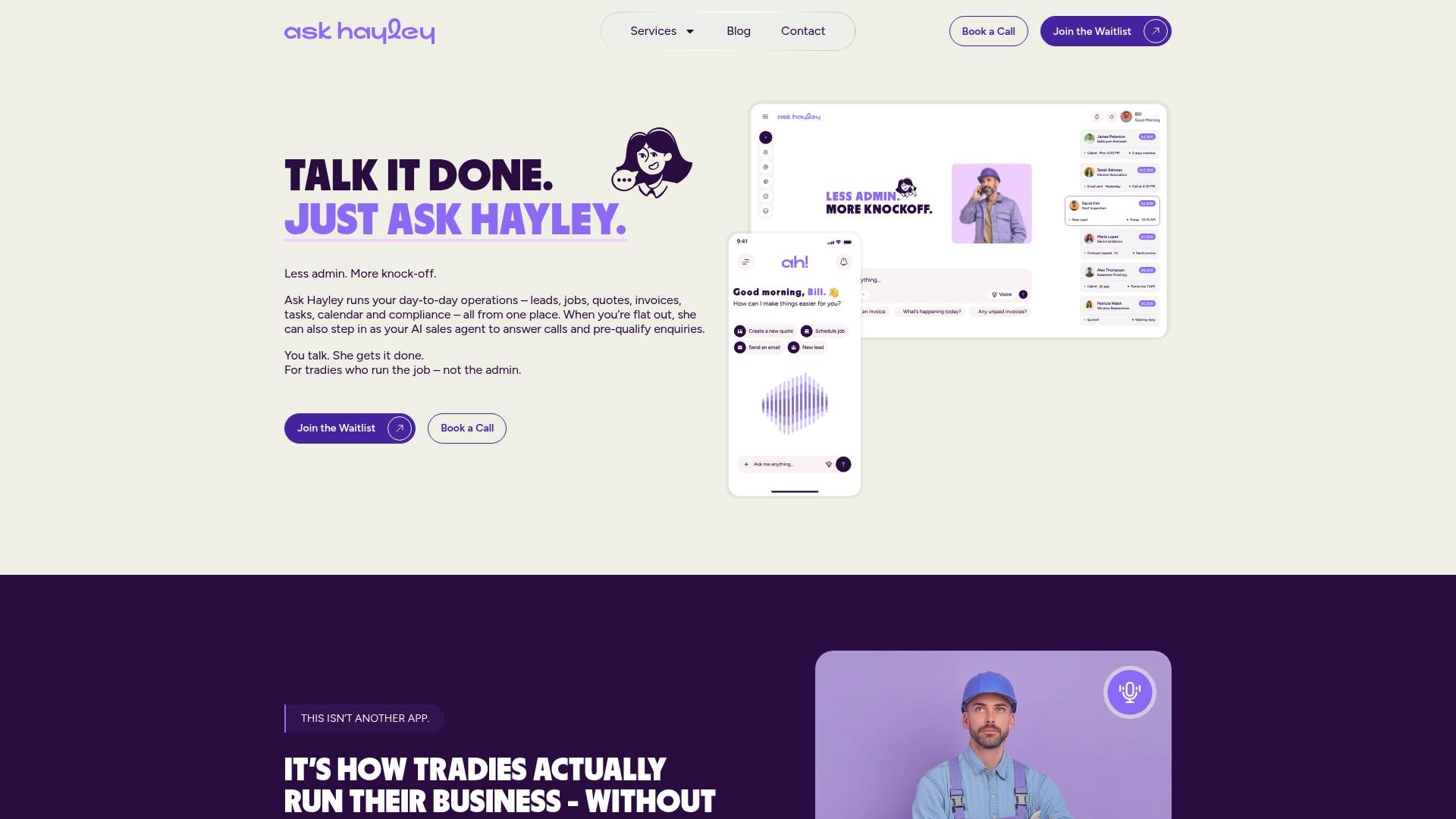
- Call answering and five-pillar capture, even when you’re on site
- Automatic SMS acknowledgement within minutes of a missed call
- Routing of qualified leads so you only follow up on jobs worth quoting
Our Assistant and Office Manager plans cover this voice-first intake, with add-ons for broader call and enquiry coverage. Try it against your next missed call and see how much of this sequence runs itself.
FAQ
What are the five lead qualification questions for tradies?
The five are service type, suburb and site access, scope or complexity, timeline urgency, and budget band. Asking them in this order lets you decide within a minute whether to quote, visit, or decline.
How fast should I respond to a missed call?
As fast as possible, ideally with an automatic SMS within minutes and a phone follow-up inside the same response window. Research on missed calls shows quick contact makes qualification roughly seven times more likely.
Can I ask for a customer’s address straight away?
You can, but it’s better to wait until the lead is qualified. Enquiry form guidance suggests suburb and postcode are enough at first contact, which also keeps you aligned with privacy expectations.
What’s the easiest way to automate these questions?
A voice-first assistant like Ask Hayley can run the five-pillar sequence automatically on inbound calls, capturing suburb, scope, and timeline without you touching a screen. It then routes qualified leads so you’re only following up on jobs worth your time.
Do budget bands actually work better than asking for an exact figure?
Banded choices tend to get a faster, more honest answer than open budget questions, since they remove the pressure of naming a number first. Most tradies find three or four bands cover the range of jobs they typically quote.


