


A variation quote is a written price and time estimate for work that changes the original job. You write it before you do the extra work, the customer agrees to it in writing, and then you start. Skip those steps and the extra work becomes the hardest money to collect on the whole job.
This guide is for Australian tradies and small contractors. It covers what counts as a variation, what a good variation quote includes, what the rules say in Queensland and Victoria, and what to do when a customer disputes the cost.
TL;DR
- A variation is any change to the work required under the contract. If the work isn’t in the agreed scope, quote it separately.
- Put the variation in writing and get the customer’s written agreement before you start. Urgent safety work is the usual exception, and the rules differ by state.
- A good variation quote describes the work, the date of the request, the price change (or the method), any delay, and when payment is due.
- Queensland and Victoria both require written agreement for domestic building variations, and Victoria has a 2% threshold for when a formal notice is needed.
- If a variation is disputed, security of payment laws give you set steps. Following the process matters as much as the paperwork.
Table of Contents
- What counts as a construction variation
- When to write a variation quote
- What a variation quote should include
- Getting the customer’s approval
- Rules differ by state and contract type
- What if the variation is disputed or unpaid
- Common mistakes to avoid
- Perspective: why we built Hayley around this problem
- Put variations into your everyday quoting
- FAQ
- Sources
What counts as a construction variation
In general terms, a variation is a change to the work required under the contract. That includes extra work, removed work, different materials, a changed sequence or a changed finish.
The NSW government’s construction procurement guide splits variations into two broad kinds:
- Client convenience variations. The customer wants something different. These generally change the scope and almost always increase cost.
- Unavoidable variations. Something unexpected happens, such as a health, safety or security problem. These may be needed to limit the effects of the event and don’t change the scope.
That NSW guide is written for government projects. The idea still applies to a private job: you need to know whether the change came from the customer or from the site.
Common examples on a trade job
- An electrician finds old wiring behind a wall that must be replaced before new circuits go in.
- A roofer opens up the roof and finds rotten battens that weren’t visible at quote stage.
- A painter is asked to add two extra rooms once the first coat is on.
- A plumber is asked to move a basin 600 mm after the rough-in is finished.
- A fencing contractor hits rock and needs different equipment to dig the post holes.
- A builder’s client swaps the tiles for a premium product after the order has gone in.
Each one changes the work, the price or the timing. Each one needs a variation quote.
Variation or part of the original job?
Ask three questions:
- Was this work described in your original quote or contract?
- Was it excluded, or covered only by a provisional allowance?
- Did the customer or the site cause the change?
If the answer to the first is no, it’s a variation. If your original quote has clear inclusions and exclusions, this gets much easier. Our guide on the quote terms that protect your price and deposit shows how to word them.
When to write a variation quote
Write one every time the work, price or timing moves from what was agreed. Don’t wait for a big change. Small “while you’re here” requests are where many disputes start, because nobody remembers later what was agreed.
In Queensland, the rule is clear. Before starting variation work, the contractor must present the variation in writing and the home owner must agree to it in writing. The exception is urgent work where producing a written copy beforehand isn’t reasonably practicable.
A good habit is to treat the exception as rare. Even on an urgent job, send the written details as soon as you can. Otherwise you’re relying on memory when the invoice goes out.
Minor changes
Some states set thresholds. In Victoria, a variation notice isn’t required when the builder reasonably believes the changes won’t need a permit change, cause delay, or add more than 2% to the original contract price. Even then, it’s sensible to record the change in writing so everyone is on the same page. Check your own state’s rules before relying on any threshold.
What a variation quote should include
Queensland gives a useful checklist. The variation document there must be readily legible and must describe the variation, state the date of the request, estimate any delay, state the change to the contract price or the method for working it out, and state when any increase is to be paid or decrease credited.
That list works well as a template for any state. Here it is as a layout you can use on the job.
| Element | What to write | Why it matters |
|---|---|---|
| Reference | Job name, address, original quote number, variation number | Links the change to the right job |
| Date of request | When the customer asked, or when you found the issue | Shows how the change arose |
| Description | Exactly what work is added, removed or changed | HIA advises that variations be expressed in terms that identify precisely what work is to be done |
| Price change | Fixed extra amount, credit, or the method (for example hourly rate plus materials) | Customer knows the cost before agreeing |
| Time impact | Estimated delay in days, or “no delay” | Protects you against delay claims |
| Payment terms | When the extra is due: with the next progress claim, on completion, or at a set date | Avoids confusion at invoice time |
| Approval | Customer’s name, signature or written reply, and date | Evidence that they agreed |
Pricing the extra work
A variation price should cover the same costs as any quote: labour, materials, equipment, overheads and margin. Many tradies price variations in a rush on site and leave something out. Our guide to the five costs to include in every quote applies just as much to the extra work.
Three practical tips:
- Price the disruption, not just the task. A 20-minute change can mean a return visit, a second delivery or a idle crew.
- Include the knock-on effect. If the change delays the next trade, say so.
- Use the same rates as the original quote unless the contract says otherwise. Customers accept consistency more readily.
A worked example
Say you’re a plumber on a bathroom renovation. Midway through, the customer asks to move the vanity to the opposite wall.
Your variation quote might read:
Variation 2, 14 March. Relocate vanity waste and water supply to the east wall as requested on site on 13 March. Includes new pipework, wall patching to rough-in stage and one extra visit. Additional cost: as per the attached price. Estimated delay: one working day. Payable with the next progress claim. Customer approval: reply “approved” by email or sign below.
It’s short. It names the work, the cause, the delay and the payment timing. That is all most customers need to say yes.
Getting the customer’s approval
HIA’s advice is simple: every variation should be agreed in writing. It also notes that written agreement helps put the client on notice of extra costs. The practical point is that a written record makes it easier to recover the cost of the extra work and cuts down arguments about what was agreed.
The Queensland timing rule
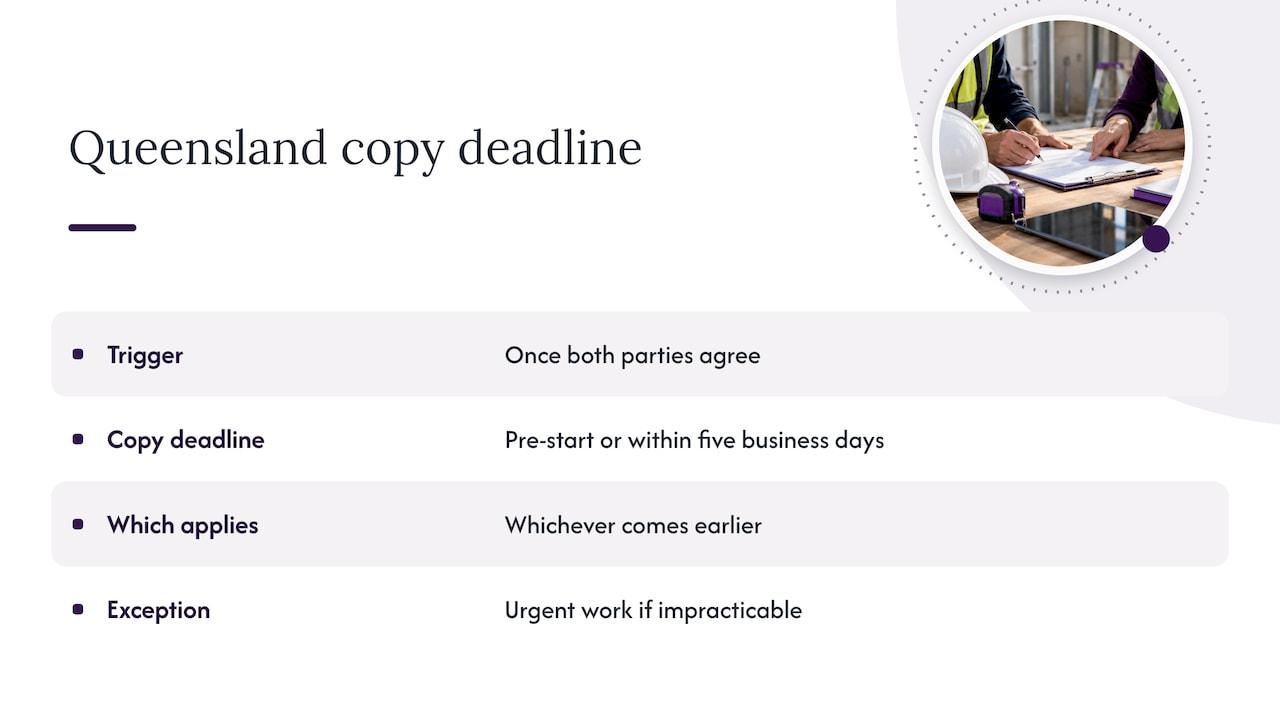
In Queensland, once both parties agree, the contractor must give the home owner a written copy before the domestic building part of the variation work starts, or within five business days of agreement, whichever is earlier. Again, urgent work where this is impracticable is the exception.
Victoria’s rule
For domestic building contracts in Victoria, the builder and client must agree in writing and put the details, including the new price and completion date, in the contract before the work is carried out.
What to keep on file
Before you start the changed work, make sure you have:
- the signed or emailed variation quote
- the customer’s written approval, with date
- photos of the site condition if the change came from something unexpected
- any messages or emails that led to the change
- an updated job schedule if timing has moved
Photos are underrated here. A photo of rotten framing taken before you cover it is hard to argue with. We cover a simple routine in our guide to managing job photos.
A step-by-step routine
- Stop and confirm the change is outside the agreed scope.
- Describe the change in plain words and take photos if relevant.
- Price the work and estimate any delay.
- Send the variation quote in writing the same day.
- Wait for written approval before you start, unless it’s urgent safety work.
- Log the variation against the job.
- Invoice or claim for it as the variation says.
For a longer version, see our nine step change order process for Australian contractors, and for contracts that use AS 4902, our guide to logging variation orders fast.
Rules differ by state and contract type
There is no single national rule for variations. A domestic building contract in Queensland, a domestic building contract in Victoria and a commercial subcontract each follow different rules. The research above shows both states require written agreement for domestic work, but with different details: Queensland sets timing for the written copy, and Victoria sets a 2% threshold and ties changes to the contract itself.
A few practical points:
- Check your licensing body. Fair Trading, the QBCC, Consumer Affairs Victoria and the equivalent body in your state publish their own guidance.
- Read your contract’s variation clause. Many contracts set the notice period, the form of the variation and who can approve it.
- Treat commercial and domestic work differently. Domestic building work usually has consumer protections that commercial subcontracts don’t.
- Get advice on big changes. If a variation is large or contested, speak to your industry association or a construction lawyer before you act.
What if the variation is disputed or unpaid
Even with good paperwork, some customers push back. Start with a conversation. HIA suggests first contacting the client to discuss non-payment. Depending on your contract, the options may include stopping work for a progress claim, taking steps to end the contract, or starting court action or alternative dispute resolution.
Security of payment
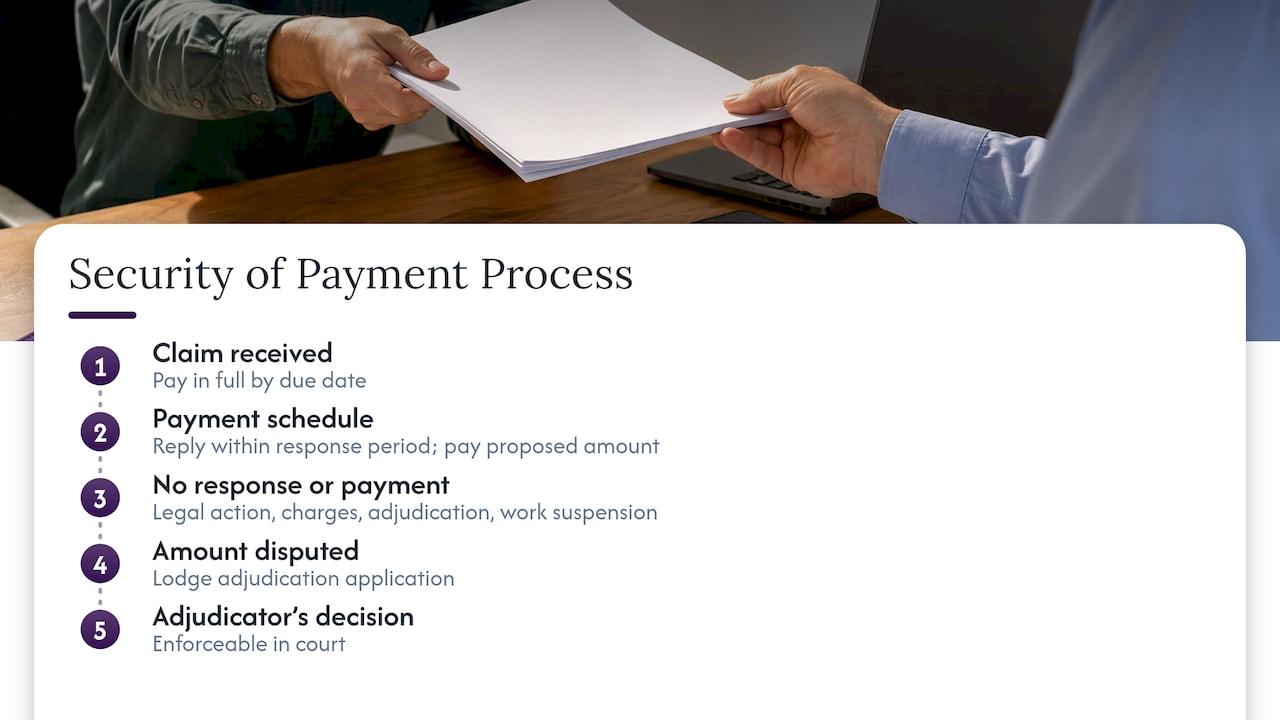
For commercial work, security of payment laws give you a faster route. In Queensland, if a payment claim is received, the respondent must pay in full by the due date, or give a payment schedule within the response period and pay the proposed amount. If they don’t, the claimant may take action, including legal proceedings, subcontractors’ charges, adjudication and suspending work.
When the parties dispute an amount, a person seeking payment can lodge an adjudication application, and the adjudicator’s decision is enforceable in court.
The lesson is that process counts. The respondent has strict duties to reply, and you have strict steps to follow. A variation that’s clearly described, priced and approved in writing makes your claim much stronger. Our guide to progress claims in Australia shows how to include approved variations in your next claim.
Protecting cash flow
Unpaid variations hurt because you’ve already paid for materials and labour. If the gap is getting tight, some tradies look at options such as an equipment business loan to smooth out purchases while they wait on payments. The better fix is to avoid the gap: agree the variation first, and set payment timing in the quote.
Common mistakes to avoid
- Agreeing on the phone and quoting later. Memories differ by the end of the job.
- Vague descriptions. “Extra electrical work” isn’t a description.
- No price method. If you can’t give a fixed number, state how you’ll work it out.
- Ignoring delay. Time is a cost. State it.
- Letting variations pile up. Invoice them at the next claim, not at the end.
- Underquoting the original job and hoping variations cover it. Customers notice, and it damages trust.
Perspective: why we built Hayley around this problem
Variations go wrong for one reason more than any other: the change happens on site, and the paperwork happens days later, if at all. You’re up a ladder or under a house. You say “yep, we can do that” and move on.
We built Ask Hayley as a voice-first platform because tradies shouldn’t have to sit at a screen to protect their margin. Our approach is designed to let you describe the change out loud, get it into a written quote, and keep it with the job, without learning another dashboard.
A clear variation quote isn’t about being difficult with customers. It’s how you keep the relationship good. Customers like knowing the price before the work starts, and you like getting paid for it.
Hayley
Put variations into your everyday quoting
If you’re already quoting by voice, adding variations is a small step. Ask Hayley is designed so you can talk through a job, produce a quote and track the work without typing. You can see how that works in our guide to dictating a voice quote on site and how it carries through to voice to invoice workflows.

We also help with the documents around the job, including tendering and safety and compliance documentation. If you want a hand with the admin that sits behind your quotes, see what Ask Hayley offers.
FAQ
Does a variation quote need to be in writing?
For domestic building work in Queensland and Victoria, yes. Queensland requires the home owner’s written agreement before the variation work starts, and Victoria requires written agreement with the details put in the contract before the work is done. Even where it’s not strictly required, writing it down is the safest way to prove what was agreed.
Can I start variation work before the customer signs?
Generally not. In Queensland the exception is urgent work where a written copy beforehand isn’t reasonably practicable. For anything else, wait for written approval, because unapproved work is much harder to recover payment for.
How much can a variation add before a formal notice is needed?
That depends on your state and contract. In Victoria, a variation notice isn’t required if the builder reasonably believes the change won’t need a permit change, cause delay or add more than 2% to the original contract price. Check the rules with your licensing body for your own state.
What if the customer refuses to pay for a variation?
Start by talking to them and pointing to the signed variation. If it stays unpaid, your contract and state law set the next steps, which may include suspending work, adjudication on commercial jobs, or dispute resolution. Get advice from your industry association or a construction lawyer on larger amounts.
Sources
- Construction procurement guide: managing variations (NSW Government)
- Contract changes and variations (QBCC)
- Changing a domestic building contract price (Consumer Affairs Victoria)
- Contract issues and getting paid (HIA)
- Industry guide to security of payment laws (QBCC)
- Commercial payment dispute (QBCC)
- Equipment business loan: how it works in Australia


