

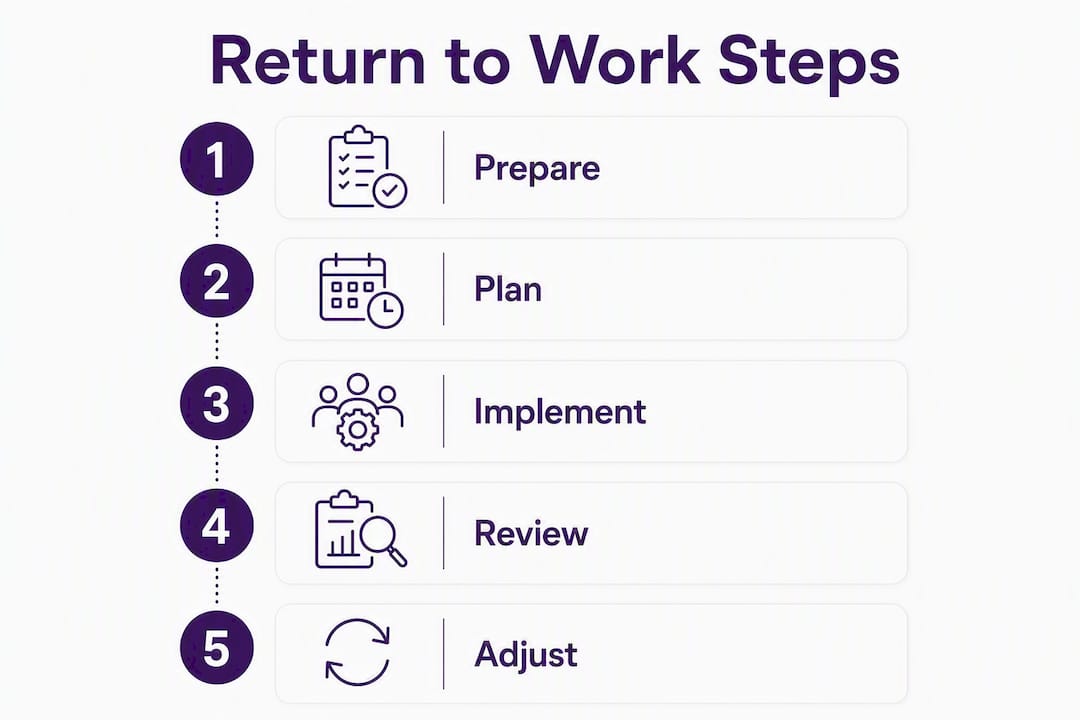
A return to work plan (RTW plan) is the employer’s primary tool for supporting a safe, timely return to productive employment after injury or illness. The goal is not to manage the injury itself, but to identify what the worker can do and adjust the workplace to match that capacity. Safe Work Australia recommends a structured three-stage model: prepare, draft the plan, and implement and review. That framework applies whether you’re running a plumbing crew of three or an HR team of thirty.
Start here: download the Safe Work Australia RTW plan guide and template and use it as your baseline. State and territory bodies such as ReturnToWorkSA, Comcare, and SIRA NSW publish their own versions, so check your jurisdiction before finalising anything.
Why act early? Early, documented workplace reintegration strategies consistently improve recovery outcomes. The longer a worker stays away without a structured plan in place, the harder the return becomes, for them and for your business.
Table of Contents
- How do you build a return to work plan step by step?
- Who is responsible for what in an RTW plan?
- What exactly goes in a return to work plan template?
- How do you run the Day 1 meeting and weekly check-ins?
- What are your legal obligations under Australian law?
- How often should you review the plan, and what timelines are realistic?
- Where can you download the official templates and resources?
- Supervisor one-page checklist: ready to print and use
- Key takeaways
- RTW plans for small businesses: what actually matters
- Ask Hayley takes the admin out of compliance documentation
- Useful sources and further reading
How do you build a return to work plan step by step?
The three stages map directly to practical tasks you can complete in one planning meeting and a series of short follow-ups.
Stage 1: Prepare
- Notify the right people. As soon as you know an employee will be absent or is ready to return, contact your insurer or workers’ compensation authority. Requirements vary by state, but early notification is a legal obligation in most jurisdictions.
- Gather functional capacity information. Request a medical certificate or functional capacity evaluation from the treating clinician. Ask only what the worker can do, not for a diagnosis.
- Identify suitable duties. Walk through your workplace and list tasks that match the worker’s current functional abilities. For a tradie, that might mean light-duty site supervision or materials ordering rather than physical labour.
- Assign a contact person. Nominate one person, typically the supervisor or HR manager, as the worker’s single point of contact throughout the plan.
Typical timeframe: 3–7 days before the planned return date.
Stage 2: Draft the plan
- Complete the template fields — Use the Safe Work Australia template or your state authority’s version. Record functional abilities, suitable duties, adjusted hours, workplace modifications, goals, milestones, and review dates.
Typical timeframe: completed at least 24 hours before the return date.
Stage 3: Implement and review
- Run the Day 1 welcome-back meeting. Keep it private, warm, and focused on the plan, not the injury. (See the meeting scripts section below.)
- Check in weekly. Short 15–30 minute check-ins during the first month let you catch problems early and adjust duties before they become barriers.
- Formal review at 4–8 weeks. Reassess workload, hours, and milestones. Extend, close, or escalate the plan based on progress.
- Final review at 60–90 days. Most plans resolve within this window. If not, involve the insurer, RTW coordinator, or an occupational rehabilitation provider.
| Stage | Key actions | Who leads |
|---|---|---|
| Prepare | Notify insurer, gather functional capacity info, identify suitable duties | Employer / HR manager |
| Draft | Collaborative meeting, complete template, get sign-off | HR / supervisor + worker |
| Implement | Day 1 meeting, weekly check-ins, duty adjustments | Supervisor + worker |
| Review (4–8 weeks) | Reassess milestones, adjust plan | HR / supervisor + insurer |
| Close or escalate (60–90 days) | Formal review, return to full duties or refer to rehab provider | HR + insurer / RTW coordinator |
Pro Tip: For small teams, keep the plan to one page. A living document you update weekly beats a polished 10-page form that nobody reads after Day 1.
Who is responsible for what in an RTW plan?
Five parties share accountability in any workplace reintegration strategy. Knowing who does what, and when, prevents things from falling through the cracks.

The employer carries the primary legal obligation: cooperate with the worker’s recovery, provide suitable duties, and maintain the plan. The worker is expected to participate actively and communicate honestly about their capacity. Neither party can make the plan work without the other.
| Role | Core responsibilities | Key documents | Typical timepoints |
|---|---|---|---|
| Employer / HR manager | Notify insurer, identify suitable duties, maintain confidential records | RTW plan, insurer notification | Days 1–3, ongoing |
| Worker | Participate in planning, attend medical appointments, communicate capacity changes | Medical certificates, signed plan | Throughout |
| Supervisor / manager | Run Day 1 meeting, weekly check-ins, adjust duties as directed | Check-in log, duty adjustment notes | Day 1, weekly |
| Insurer / RTW coordinator | Approve plan, fund rehabilitation if needed, monitor progress | Claim file, rehabilitation referrals | Notified within required timeframe; reviews at milestones |
| Treating clinician | Provide functional capacity information, update certificates | Medical certificates, capacity reports | As required by plan milestones |
When a plan stalls, the escalation path is: supervisor → HR manager → insurer or RTW coordinator → occupational rehabilitation provider. Don’t wait until 90 days to escalate; if a worker’s capacity isn’t progressing after four weeks, loop in the insurer early.
Privacy note: Record only functional limitations, not diagnoses. “No lifting above 10 kg” is appropriate. “Worker has a herniated L4/L5 disc” is not something to put in a shared document or brief to the team. Supervisors need to know what adjustments to make, not why medically.
Compliance reminder: Workers’ compensation legislation and RTW obligations vary by state and territory. Always confirm your specific obligations with your state authority (SIRA NSW, WorkSafe Victoria, ReturnToWorkSA, WorkCover Queensland, and so on) or your insurer.
What exactly goes in a return to work plan template?
The plan must focus on functional abilities and time-limited adjustments, not on medical history. Here are the fields to complete and how to phrase them.
Template fields and sample wording
| Field | What to record | Sample wording |
|---|---|---|
| Employee details | Name, position, department, contact | “Jordan Smith, Electrical Apprentice, Site B” |
| Treating clinician | Name, practice, phone | “Dr. A. Nguyen, Bayside Medical, XXXX XXXX” |
| Functional capacities | What the worker can do | “Can stand for up to 2 hours; no lifting above 5 kg; able to drive” |
| Suitable duties | Specific tasks assigned | “Materials ordering, site safety checks, tool inventory” |
| Workplace adjustments | Physical or schedule changes | “Reduced hours: 6 hrs/day, Mon–Wed–Fri for weeks 1–2” |
| Goals and milestones | Measurable progress markers | “Return to full hours by week 6; resume overhead work by week 8” |
| Review dates | Scheduled check-in dates | “Weekly check-ins; formal review in mid-March” |
| Contacts | Supervisor, HR, insurer | Names and direct numbers |
| Approvals | Signatures | Worker, supervisor, insurer (if required) |
Case example 1: Tradie with a lifting restriction
Worker: Marco, plumber, strained lower back.
Functional capacity: No lifting above 8 kg; can drive, stand, and walk on flat surfaces.
Suitable duties: Quoting visits, materials pick-up (with assistance), apprentice supervision.
Adjustments: 4-hour days for weeks 1–2, increasing to 6 hours in weeks 3–4.
Goal: Return to full field duties by week 6, subject to medical clearance.
Case example 2: Office worker returning from psychological injury
Worker: Priya, project coordinator, returning after stress-related leave.
Functional capacity: Can concentrate for up to 90 minutes; benefits from reduced interruptions; may need breaks during high-pressure tasks.
Suitable duties: Document review, low-volume email correspondence, one-on-one meetings only (no large group meetings in weeks 1–2).
Adjustments: Work-from-home two days per week; flexible start time (9:30 AM); weekly check-in with supervisor.
Goal: Gradual reintroduction to full project load by week 8, with weekly review of stress tolerance.
For psychological injuries, WorkSafeBC’s guidance organises strategies across four functional categories: time management, pace and concentration, memory, and interpersonal interaction. Adapting this framework to your plan wording makes the adjustments concrete and measurable rather than vague.
How do you run the Day 1 meeting and weekly check-ins?
A structured Day 1 meeting, followed by regular short check-ins, is one of the most reliable ways to keep an employee transition plan on track. RTW protocols consistently recommend a private welcome-back conversation on the first day, then weekly touchpoints during the first month.
Pre-return checklist (3–7 days before)
- Confirm the worker’s return date with HR and the insurer.
- Brief the supervisor on the plan and the worker’s adjusted duties (not the diagnosis).
- Prepare the worker’s workstation or site setup to match the adjustments.
- Notify the team that the worker is returning, without disclosing medical details. (“Jordan is coming back on Monday on adjusted duties for a few weeks.”)
- Print or share the signed plan with the supervisor.
Day 1 meeting script (30–45 minutes, private)
- Welcome (5 min): “Welcome back. We’re glad to have you here. How are you feeling about today?”
- Walk through the plan (15 min): “Let’s go through the plan together so we’re both clear on what the next few weeks look like.” Cover duties, hours, and adjustments.
- Practical logistics (5 min): Parking, workstation, breaks, who to contact if something isn’t working.
- Set expectations (5 min): “The plan is temporary. As your capacity increases, we’ll adjust together. There’s no pressure to rush.”
- Check for questions (5 min): “Is there anything about the plan or the workplace that you’d like to flag before we start?”
- Close (5 min): Confirm the date of the first weekly check-in and who will run it.
Weekly check-in script (15–30 minutes)
- “How has the week felt overall? Is the workload manageable?”
- “Are the adjusted duties working, or do we need to change anything?”
- “Any concerns about the workplace, the team, or the plan?”
- “What’s one thing that went well this week?”
- Document the conversation briefly: date, who attended, any changes agreed.
Pro Tip: Use a simple 1–5 scale (“How manageable was your workload this week, on a scale of 1 to 5?”) to track progress objectively. It reduces stigma, gives you a trend line, and makes it easier to justify plan adjustments to an insurer.
Privacy guidance for team briefings: Tell the team only what they need to know to work alongside the returning employee. Adjusted duties are fine to mention. Medical details are not. If a team member asks why, the answer is: “That’s between the employee and HR.”
What are your legal obligations under Australian law?
Australian employers have clear legal obligations when returning employees to work, and those obligations sit across two frameworks: work health and safety (WHS) law and workers’ compensation legislation. Requirements vary by state and territory, so the specifics below are general principles. Confirm your obligations with your state authority or insurer.
Core obligations:
- Cooperate with the worker’s recovery and the insurer’s RTW process.
- Provide suitable duties where reasonably practicable.
- Notify the insurer within the required timeframe (this varies by jurisdiction, but early notification is always safer).
- Keep confidential records of the plan, check-ins, and any adjustments.
- Not disadvantage the worker for making a workers’ compensation claim.
Insurer notification and recordkeeping checklist
| Action | Who | When |
|---|---|---|
| Notify insurer of injury | Employer / HR | As soon as practicable; check state timeframes |
| Provide functional capacity information to insurer | Employer (with worker’s consent) | At plan drafting stage |
| Keep signed RTW plan on file | HR | Duration of plan + minimum retention period per state |
| Document weekly check-ins | Supervisor | Each check-in |
| Store records securely and limit access | HR | Ongoing |
| Notify insurer of significant plan changes | Employer | As changes occur |
Recordkeeping: Keep the signed plan, check-in logs, medical certificates, and any correspondence with the insurer in a secure, access-controlled file. Only the worker, their supervisor, HR, and the insurer should have access. Most states require records to be kept for a minimum of seven years, but check your jurisdiction’s specific requirement.
State authority links: SIRA NSW and Comcare publish jurisdiction-specific guidance. Always check your state or territory authority for the rules that apply to your business.
This article provides general information only, not legal or professional advice. Confirm current obligations with your state workers’ compensation authority or a qualified workplace relations professional.
How often should you review the plan, and what timelines are realistic?
Check in weekly for the first month. Reassess formally at 4–8 weeks. Conduct a final review at 60–90 days, or earlier if the worker’s capacity changes significantly.
Milestone table
| Timepoint | Check type | Success criteria | Escalation trigger |
|---|---|---|---|
| Day 1 | Welcome-back meeting | Plan understood, duties confirmed | Worker unable to perform any suitable duties |
| Week 1–4 | Weekly check-in (15–30 min) | Workload manageable (score ≥ 3/5), no new symptoms | Score drops below 2/5 two weeks running |
| Week 4–8 | Formal plan review | Hours or duties increased as planned | No capacity improvement; worker or supervisor raising concerns |
| Week 8–12 | Milestone review | Approaching or at full duties | Capacity plateaued; refer to occupational rehabilitation |
| Day 60–90 | Final review / plan closure | Return to full pre-injury duties or agreed alternative | Ongoing restrictions; escalate to insurer and rehab provider |
Realistic timelines by injury type
- Minor musculoskeletal injury (sprain, strain): Most workers return to full duties within 4–6 weeks with a well-managed plan and suitable duties from Day 1.
- Major surgery or significant physical injury: Expect a 12–16 week reintegration window. Phased hour increases and gradual duty progression are standard. Milestones should be set in consultation with the treating clinician.
- Psychological injury: Timelines are less predictable. Capacity can fluctuate week to week, so avoid rigid performance targets in the first four weeks. Weekly reviews are non-negotiable. A phased reintegration checklist with documented success measures reduces ambiguity and gives both parties a clear reference point.
Monitoring indicators to watch: workload manageability scores, break adherence, error trends, and team climate. If a supervisor notices a pattern of missed breaks or declining work quality, that’s a signal to bring the review forward, not wait for the scheduled date.
Where can you download the official templates and resources?
The Safe Work Australia guide and template is the baseline for any Australian employer. Download it first, then check your state authority’s version for any jurisdictional additions.
| Resource | What it contains | Link |
|---|---|---|
| Safe Work Australia RTW guide and template | Three-stage model, template fields, completed example, psychological injury strategies | safeworkaustralia.gov.au |
| Safe Work Australia standalone template (PDF) | Printable template for direct use or adaptation | PDF download |
| SIRA NSW — RTW programs | NSW-specific obligations, suitable duties guidance, insurer liaison | sira.nsw.gov.au |
| Comcare — RTW for employers | Federal jurisdiction guidance, employer obligations, plan templates | comcare.gov.au |
| WorkSafeBC psychological injury strategies | Functional category strategies for psychological injury plans (adaptable for Australian use) | worksafebc.com |
| NSC RTW protocol (mental health leave) | Day 1 scripts, phased checklist, weekly check-in templates | nsc.org |
Check your state or territory authority’s page for any additional documentation requirements. Insurers often have their own preferred templates, so ask your insurer before finalising the format.
Supervisor one-page checklist: ready to print and use
The single biggest reason RTW plans fail is not a bad template. It’s a supervisor who doesn’t know what to say or do on Day 1. A one-page checklist removes that hesitation and keeps the process consistent across your team.
Pre-return (3–7 days before)
- Confirm return date with HR and insurer.
- Review the signed RTW plan and understand the adjusted duties.
- Prepare the workstation or site setup.
- Brief the team: return date and adjusted duties only, no medical details.
- Confirm who the worker’s single point of contact is.
Day 1
- Run the welcome-back meeting (use the script above).
- Walk the worker through their adjusted duties in person.
- Confirm break times and any physical adjustments.
- Document the meeting: date, attendees, key points discussed, any changes agreed.
- Set the date for the first weekly check-in.
Weeks 1–4 (weekly)
- Run the 15–30 minute check-in using the script above.
- Record the workload manageability score (1–5).
- Note any duty changes agreed.
- Flag any concerns to HR immediately, don’t wait for the next scheduled review.
Weeks 4–8 (formal review)
- Reassess hours and duties against milestones.
- Update the plan with any agreed changes.
- Confirm with HR and insurer if significant changes are needed.
- Set the date for the 60–90 day final review.
Day 60–90 (final review)
- Assess whether the worker has returned to full pre-injury duties.
- If yes: close the plan and document the closure.
- If not: escalate to insurer and consider occupational rehabilitation referral.
Check-in logging template
| Date | Attendees | Workload score (1–5) | Duties adjusted? | Next review date | Notes |
|---|---|---|---|---|---|
| Yes / No |
Sample script for sensitive topics
“I want to check in about how you’re managing the workload. There’s no right or wrong answer here. On a scale of 1 to 5, where 1 is really struggling and 5 is completely comfortable, how would you rate this week?”
If the worker scores 1 or 2: “Thanks for being honest. Let’s look at what we can adjust this week to make it more manageable. I’ll flag this with HR so we can update the plan.”
Pro Tip: Keep the check-in log in a shared folder that both the supervisor and HR can access. If a dispute arises later, documented check-ins are your clearest evidence that the plan was followed in good faith.
Key takeaways
A compliant, effective return to work plan focuses on what the worker can do, follows the Safe Work Australia three-stage model, and is reviewed weekly for the first month and formally at 60–90 days.
| Point | Details |
|---|---|
| Start with the official template | Download the Safe Work Australia guide and template before drafting anything. |
| Focus on functional abilities | Record what the worker can do, not their diagnosis, in every field of the plan. |
| Weekly check-ins are non-negotiable | Short weekly touchpoints in the first month let you catch problems before they derail the plan. |
| Privacy protects everyone | Share adjusted duties with the team; never share medical details, even informally. |
| Ask Hayley supports the admin | Ask Hayley can customise RTW templates and handle compliance documentation for small businesses without a dedicated HR team. |
RTW plans for small businesses: what actually matters
There’s a tendency in WHS circles to treat return to work planning as a large-employer problem. It’s not. A three-person electrical business has the same legal obligation to support a returning worker as a 300-person construction firm. The difference is that a small business usually has no HR department, no RTW coordinator, and a foreman who’s also the safety lead, the scheduler, and the person who answers the phone.
The conventional advice, “develop a comprehensive RTW policy and procedure,” is fine in theory. In practice, a tradie foreman doesn’t have time to read a 20-page policy document before 7 AM. What works is a one-page living plan, a single contact person, and a 10-minute check-in at the end of each day for the first week. That’s it. The Safe Work Australia template can be pre-filled with your business name, common duty categories, and standard contacts so that when you need it, you’re filling in three fields, not twenty.
Here’s what a realistic Day 1 looks like for a small trade team. The foreman pulls the returning worker aside before the crew brief, runs through the adjusted duties in plain language (“You’re on materials and supervision this week, no heavy lifting”), confirms who to call if something’s not right, and checks in again at knock-off. That conversation takes 10 minutes. It’s documented in a shared note on the phone. The insurer is happy, the worker feels supported, and the crew gets on with the job.
The fear of bureaucracy is the biggest barrier for small businesses. The plan doesn’t need to be perfect. It needs to be honest, documented, and reviewed regularly. A simple, consistent process beats an elaborate one that nobody follows.
Ask Hayley takes the admin out of compliance documentation
Compliance documentation is one of the most time-consuming parts of running a trade business, and RTW planning is no exception. If you’re a small business without a dedicated HR team, customising templates, maintaining records, and keeping up with state-specific requirements can eat hours you don’t have.

Ask Hayley’s safety and compliance documentation service turns standard templates into ready-to-use, business-specific documents. That means your RTW plan template arrives pre-filled with your business details, duty categories, and contact fields, so your supervisor is completing three fields on Day 1, not building a document from scratch under pressure. Ask Hayley also handles the broader compliance documentation load: safe work method statements, site induction forms, and workplace policies, all prepared to Australian standards.
For businesses that want broader admin support, the Ask Hayley services page covers the full range of professional services available, including documentation, tendering, and business administration. Compliance remains your responsibility as the employer, but Ask Hayley handles the paperwork so you can focus on the job.
Get in touch through the Ask Hayley website to discuss template customisation or compliance documentation support for your business.
Useful sources and further reading
The sources below are the authoritative starting points for any Australian employer building or reviewing a workplace reintegration strategy. Bookmark the Safe Work Australia page and your state authority’s page, and check them whenever your obligations or the worker’s circumstances change.
- Safe Work Australia — Developing a return to work plan: guide and template: — The primary Australian resource. Contains the three-stage model, template fields, a completed example, and specific guidance for psychological injuries. Start here.
- Safe Work Australia — RTW plan template (PDF): — The standalone printable template. Download and adapt for your state’s requirements.
- SIRA NSW — Return to work programs: — NSW-specific obligations, suitable duties guidance, and insurer liaison requirements.
- Comcare — Return to work for employers: — Federal jurisdiction guidance covering Commonwealth employees and self-insured employers.
For jurisdictional variations, go directly to your state or territory workers’ compensation authority: WorkSafe Victoria, ReturnToWorkSA, WorkCover Queensland, WorkSafe WA, NT WorkSafe, WorkSafe ACT, or WorkSafe Tasmania. Each publishes its own guidance and, in some cases, mandatory forms.