


Most Australian small businesses pay a monthly amount for call answering that can vary widely based on volume and the extent of services provided beyond answering calls. The fastest way to estimate your cost is to pull last month’s call log including total calls, average call length, and after-hours call share, then compare these against different pricing models before committing.
TL;DR:
- Call answering service costs vary based on billing models, with per-minute and per-call plans being the most common, and AI-driven plans often cheaper at high volumes.
- Businesses should consider call volume, handling complexity, after-hours coverage, and junk calls when comparing quotes, as these factors significantly affect pricing.
- Contract length discounts may seem attractive but can lead to high cancellation fees if business needs change before the term ends.
- Additional setup, customization, and training fees can add 15 to 25 percent to initial costs and should be clarified upfront.
- Focusing on the cost of missed calls and actual business impact helps choose the most effective plan rather than simply chasing the lowest sticker price.
Table of Contents
- Call answering service cost: pricing models and realistic ranges
- What changes your quote: features, hours and call behaviour
- Human answering vs virtual receptionist vs AI: which one to pick
- Estimate your monthly cost from your own call data
- Common billing traps and a contract checklist
- Impact of contract length and cancellation fees on total cost
- Additional fees such as setup, training, or customisation costs
- Hayley’s short guide: one number to check before you sign
- Get a clear cost picture with Ask Hayley
- Sources
Call answering service cost: pricing models and realistic ranges
Four billing structures dominate the Australian market, and each one rewards a different kind of caller pattern.
Per-minute plans charge for time on the phone, usually with a block of bundled minutes and a steeper rate once you go over. Per-call plans charge a flat fee per answered call regardless of length, which suits businesses with short, predictable enquiries. Monthly tier plans bundle a set number of calls or minutes into a flat fee, giving you cost certainty but less flexibility if volume spikes. Hybrid and AI SaaS models blend a base subscription with usage credits, often at a lower headline rate because software, not a rostered team, handles the bulk of the interaction.
Per-minute and per-call structures remain the most common setup across the industry, with bundled minutes typically preceding higher overage rates once you exceed the plan.
In practice, Australian pricing tends to cluster like this:
- Light usage (under 100 calls/month): generally in the lower price range, often on a per-call or entry-tier plan.
- Medium usage (100 to 400 calls/month): typically in a mid-price tier, often with monthly plans and possible add-ons for after-hours or call transfers.
- Heavy usage (400+ calls/month): $700 to $1,000+ per month for live services, though AI-driven plans commonly sit lower at this volume because the marginal cost per call drops sharply.
The trade-off is predictability versus raw cost. A flat monthly tier costs more on paper for a quiet month but protects you from a surprise invoice during a busy one. A per-minute plan looks cheaper until call volume climbs, then the overage rate does the damage. If your business has seasonal swings (renovations in spring, air conditioning callouts in summer) that volatility matters more than the sticker price.
What changes your quote: features, hours and call behaviour
Two businesses with identical call volumes can get wildly different quotes, and the gap almost always comes down to four levers.
Coverage hours. After-hours, weekend, and public holiday coverage is usually priced as an add-on rather than bundled in, and Australian providers commonly charge a premium for nights and weekends rather than folding it into a flat rate. If most of your enquiries land during business hours, paying for 24/7 coverage is dead weight on your bill.

Handling complexity. A basic message-taking call is cheap to process. Warm transfers, live booking into your calendar, CRM note-taking, and intake forms all add handling time, and handling time is what most pricing models actually charge for.

Volume and junk calls. Spam calls, wrong numbers, and hang-ups still eat into your bundled minutes on many plans. A busy week from a marketing campaign or a referral spike can blow through your allowance faster than you’d expect.
Compliance and security. Businesses handling sensitive data (health bookings, financial enquiries) sometimes face higher fees for encrypted call handling or stricter data retention, particularly where recorded transcripts sit in cloud storage governed by platform privacy policies.
Before comparing quotes, get clear on:
- How many hours per week you actually need covered, not just what’s offered.
- Whether transfers and bookings are billed as standard calls or as premium actions.
- What the provider defines as a “billable” call versus a dropped or junk call.
Pro Tip: Ask every provider for a sample itemised bill before you sign, not just a rate card. The rate card tells you the price per minute; the sample bill tells you how they actually count minutes.
Human answering vs virtual receptionist vs AI: which one to pick
The three broad approaches produce genuinely different outcomes, not just different price tags.
- Traditional human answering services take messages and do warm transfers well, but they’re the most expensive per minute because you’re paying for rostered staff time, and complex bookings often still need a callback.
- Virtual receptionist services sit in the middle: trained operators (sometimes offshore, sometimes local) handle scripted call flows, light booking, and basic CRM entry at a lower rate than a fully live in-house team.
- AI-powered answering automates qualification and booking directly, and AI options can carry meaningfully lower per-call costs while also converting more calls into confirmed bookings rather than just messages.
The right choice depends on what a call is actually worth to you, especially considering practical advice on following up leads by phone from the Quote follow-up for Australian air-con cleaning businesses. A low-volume tradie who might get 40 calls a month but each booked job is worth $2,000 should weight quality of conversion over raw cost per minute. A mid-volume clinic taking 300 calls a month cares more about consistent booking accuracy and DNA (did-not-attend) reduction. A high-volume lead-generation business processing thousands of calls needs the scale economics that only AI or a large virtual receptionist team can deliver without costs spiralling.
Price alone is the wrong lens here. A booked job is worth far more than a message sitting unread in an inbox, and the cheapest per-minute rate often produces the fewest actual bookings.
Estimate your monthly cost from your own call data
You don’t need a spreadsheet wizard to do this. Pull three numbers from your phone system or carrier portal and the arithmetic writes itself.
- Gather your data: average calls per day, average talk time per call, the share of calls landing after hours, and any peak weeks in the last quarter.
- Run it against each model. A per-minute plan multiplies total monthly minutes by the rate, plus overage on anything past the bundle. A monthly tier is simply the flat fee, unless you blow past the included call cap.
- Compare the outputs to see which model actually wins for your pattern.
Worked example one: A plumber takes 90 calls a month at an average of 3 minutes each, that’s 270 minutes. On a per-minute plan at $1.80/minute with 200 bundled minutes and $2.50 overage, the bill lands around $535. A flat monthly tier at $399 covering 300 minutes wins comfortably.
Worked example two: A busy electrical contractor takes 450 calls a month, mostly under 2 minutes, roughly 750 minutes total. A flat tier built for 400 minutes gets blown out fast, while an AI SaaS plan charging a base fee plus a lower per-call credit often ends up cheaper because most calls are short and simple.
Common billing traps and a contract checklist
The invoice rarely matches the rate card, and it’s almost never malice. It’s the fine print.
Minute rounding is the biggest culprit. Providers commonly round up in 30 or 60-second increments, which on a service handling lots of short calls can inflate your effective cost per call by 30 to 50% compared to your raw talk time. Hold time and wrap-up time sometimes get billed as part of the call even though the customer isn’t talking to anyone. Junk calls and hang-ups can still eat into your bundled minutes unless your contract explicitly excludes them, and unexplained spikes in operating expenses are often traced back to exactly this kind of billing creep.
Before signing, insist on:
- A written definition of what counts as a billable call (does a 4-second hang-up count?).
- The exact rounding policy, stated in seconds, not vague language like “billed in increments.”
- Live reporting access so you can check your own usage, not just wait for the invoice.
- A cap option or grace overage threshold before premium rates kick in.
Pro Tip: Negotiate for pooled minutes if you run more than one number or location. It smooths out the variance between quiet weeks and busy ones, and it stops one location’s overage from blindsiding the whole account.
Always ask for a short trial with your real call volume before committing. Advertised averages routinely leave out the spikes and junk-call effects that actually shape your bill.
Impact of contract length and cancellation fees on total cost
Contract length changes your effective cost more than most business owners realise. Providers often discount monthly rates by 10 to 20% for a 12-month commitment compared to a rolling month-to-month plan, but that discount only pays off if your call volume stays steady across the full term.
The risk sits in cancellation clauses. Some providers lock in early termination fees equivalent to several months of remaining service, which turns a “cheap” annual plan into an expensive one if your business changes direction, moves premises, or simply finds the service isn’t converting calls the way you’d hoped. Others require 30 or 60 days’ written notice regardless of contract length, which catches out businesses who assume they can walk away the moment a plan stops working.
Before signing anything longer than three months, ask directly: what happens if I need to downgrade mid contract, and is there a fee to switch plans within the same provider? A provider confident in its service usually offers a trial period or a shorter initial term specifically so you can validate the fit before locking in annual pricing. Treat a heavily discounted 24-month contract with real suspicion. The saving rarely offsets the flexibility you give up, especially for a small business whose call volume can shift with the seasons or a single new contract win.
Additional fees such as setup, training, or customisation costs
The headline monthly rate rarely tells the whole story. Most providers charge a one-off setup fee, typically ranging from $0 for basic plans up to a few hundred dollars for services that need custom call scripting, integrations with your booking software, or CRM syncing.
Training and onboarding costs vary depending on how much customisation your business needs. A simple message-taking setup might onboard in a day at no extra charge, while a service handling detailed booking rules, multiple service lines, or industry-specific scripts (think trade licensing questions or clinic intake forms) can take longer and sometimes carries an hourly consulting fee.
Customisation is where costs creep hardest. Custom greetings, branded scripts, integration with tools like Xero or AroFlo, and multi-language support are often quoted separately from the base plan. Ask for these costs upfront in writing, not as a verbal estimate, because “minor customisation” means different things to different providers.
Finally, watch for reactivation fees if you pause service during a slow season and want to switch it back on, and reporting fees if detailed call analytics sit behind a premium tier. None of these are dealbreakers on their own, but stacked together they can add 15 to 25% to your first-year cost beyond the advertised monthly rate. Get a full, itemised quote before you compare providers on price alone.
Hayley’s short guide: one number to check before you sign
If you take one thing from all this: work out what a missed call actually costs you in lost jobs, then pick the model that protects that number, not the one with the lowest sticker price. The most common mistake is chasing the cheapest per-minute rate and getting burned by rounding and after-hours overages within the first invoice. Fix it by asking for a sample bill upfront, and re-check your actual spend against the quote after 90 days of real usage.
— Hayley
Get a clear cost picture with Ask Hayley
Ask Hayley is built specifically for Australian tradies who need calls answered without paying for a full-time receptionist or juggling another app between jobs. Instead of per-minute overage traps or a call centre reading from a script, Hayley captures and qualifies leads by voice, handles basic booking, and folds straight into your existing admin, so the cost of a missed call stops being a guessing game.
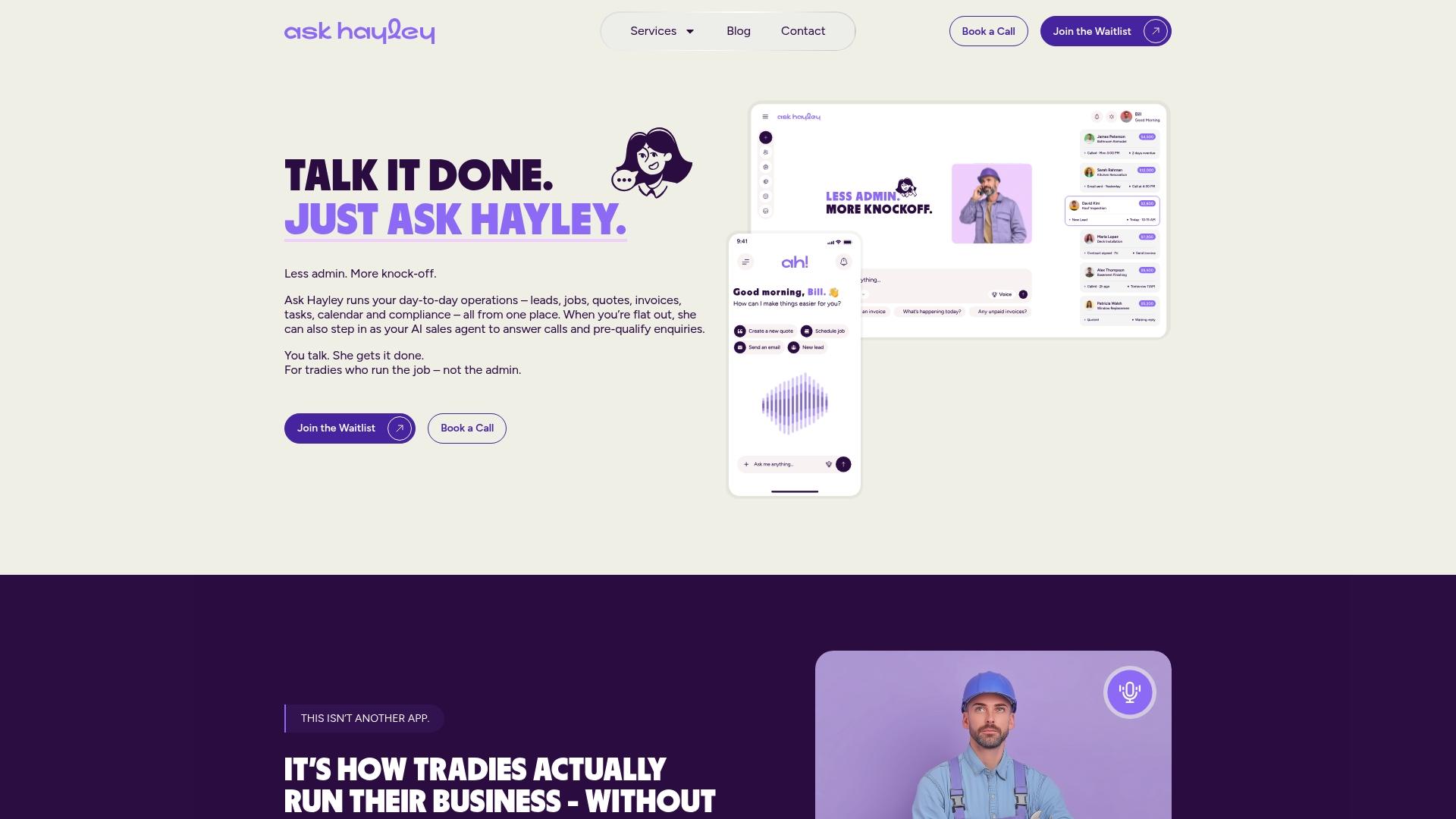
If you’ve just worked through your own call numbers using the steps above, the next move is simple. Book a free demo to see how Hayley handles a real call flow for your trade, compare the Assistant and Office Manager plans against what you’re paying now, or start a trial and measure your own answer rate over the next month. Head to Ask Hayley to get started.
Sources
- How Much Does an Answering Service Cost? (2026 Rates and the Per-Minute Traps) | SuperDupr
- Answering service cost guide | Nextiva
- Operating expenses spike across key industries | Accounting Times
- How much does a call answering service cost? | Bland AI


