


Your charge-out rate is (annual labour cost + overheads) ÷ productive hours, plus a profit margin on top. Get those numbers from your own wages, super and running costs rather than a guess, and use a realistic hour count. Start by collecting three figures this week: your true annual labour cost, your total yearly overheads, and how many hours you actually bill out. The rest of this guide, including Australian benchmarks and calculators, shows you how.
TL;DR:
- Using realistic productive hours of 1,200 to 1,500 annually prevents underpricing by 30 to 40 percent compared to assuming 2,000 hours.
- Properly including all on-costs such as superannuation, workers’ compensation, and payroll tax inside labour costs ensures accurate rate calculations and protects margins.
- Setting an hourly rate based on detailed inputs allows for flexible adjustments when quoting project types, client relationships, or adding premiums for specialized or urgent jobs.
- Transparency in rate presentation, with clear breakdowns and advance client notices for rate increases, helps avoid disputes and builds trust.
- Tracking actual billable hours through automation tools like Ask Hayley improves input accuracy, making rate setting and business performance management more reliable.
Table of Contents
- The charge-out rate formula, in words and as a working expression
- Step-by-step inputs: labour cost, overheads and productive hours
- Worked example: single-person tradie calculation
- Tools, calculators and templates you can use right now
- Turning your hourly rate into customer prices
- Australian payroll taxes, super and other on-costs to check
- Common mistakes and tips to protect margin
- How Ask Hayley helps you keep the inputs accurate
- Differences between charge-out rate and billing rate
- How to adjust charge-out rates for different types of projects or clients
- Impact of pricing strategies on charge-out rate
- How to communicate charge-out rates effectively to clients
- Legal or tax considerations influencing charge-out rate calculations
- Author perspective: simple pricing, better business
- Ask Hayley: an alternative approach to manual tracking and spreadsheet juggling
- Sources
- FAQ
The charge-out rate formula, in words and as a working expression
There are two ways to write this formula, and both land on the same number. Pick whichever one makes sense to you.
The additive version:
Charge-out rate = [(Annual labour cost + Annual overheads) ÷ Productive hours] + Profit per hour
The multiplicative version:
Charge-out rate = [(Annual labour cost + Annual overheads) ÷ Productive hours] × (1 + Profit margin %)
Both do the same job. The additive version adds a dollar figure for profit on top of your cost recovery. The multiplicative version adds a percentage. Most tradies find the percentage version easier to adjust later, because you can lift your margin from 15% to 20% without recalculating every dollar figure from scratch.
Here’s what each part of the formula actually means:
- Labour cost covers your (or your employee’s) wages, superannuation, workers’ compensation premiums, and any other cost of employing that person for the year.
- On-costs are the extras tacked onto wages: super, payroll tax where it applies, workers’ comp, leave loading. These sit inside “labour cost” but are easy to forget if you only think in terms of take-home pay.
- Overheads are everything else the business needs to run: the ute, tools, insurance, phone, software subscriptions, rent on a shed or office, accounting fees.
- Productive hours are the hours you can actually bill to a customer, not the hours you’re paid for or present at work. This is the number most tradies get wrong, and it’s the single biggest lever in the whole formula.
- Profit is what’s left after costs are recovered. It funds new tools, a second ute, hiring an apprentice, or simply a buffer for a slow month.
A quick placeholder example before the full worked calculation later in this guide: if your labour and overheads add up to $110,000 a year, and you can bill 1,300 hours, your cost-recovery rate is $84.60 an hour. Add a 20% profit margin and you’re charging roughly $101 an hour before GST. That’s the whole formula. Everything else in this guide is about getting the inputs right, because a formula built on wrong numbers gives you a confident, wrong answer.
Step-by-step inputs: labour cost, overheads and productive hours
Getting the formula right depends entirely on the quality of what you feed into it. Here’s how to work out each input using Australian rules of thumb.
Calculating your annual labour cost
Start with gross wages, whether that’s your own drawings or an employee’s salary. Then add superannuation, which the ATO requires employers to pay on top of ordinary earnings. Add workers’ compensation insurance, which varies by state and by trade classification. If you employ staff, factor in payroll tax if your total Australian wages bill crosses your state’s threshold, which you can check on your state revenue office’s payroll tax page.
Don’t forget leave. Annual leave, personal leave and public holidays are paid but non-billable, and Fair Work’s guidance on annual leave is the reference point for how much of the year that actually eats into.
Totalling your overheads
List every cost that keeps the business running regardless of how many jobs you do:
- Vehicle costs (finance, fuel, servicing, rego, insurance)
- Tools and equipment (purchase, maintenance, replacement)
- Business insurance (public liability, professional indemnity)
- Software and admin tools (accounting, job management, phone plans)
- Office or storage costs, if you have them
Add these up for the year and you have your annual overhead figure; a practical overview of allocating overheads per hour is available in the overhead rate calculation guide. Divide it by your productive hours later in the formula, not by total hours worked.
Estimating productive hours
This is where most rate calculations go wrong. A full-time employee works roughly 2,000 hours a year on paper (38 hours a week, 52 weeks), but that number includes travel, admin, quoting, waiting on materials, and the leave already mentioned above. A multi-step calculation approach that’s widely used across trade pricing guides puts realistic productive hours at 1,200 to 1,500 hours a year for most solo and small-team operators, once you strip out non-billable time.
Statistic callout: Using 2,000 hours instead of a realistic 1,200 to 1,500 hours can understate your required charge-out rate by 30 to 40% — the single most common reason tradies underprice their work.
Pro Tip: Track your actual billable hours for one month using whatever job diary or app you already have. Most tradies are shocked at how much lower their real utilisation is than they assumed.
If you want a shortcut, work out your utilisation rate (billable hours ÷ total hours worked) as a percentage, then apply it to your available working hours for the year. A 65% utilisation rate on a 1,900-hour working year gives you roughly 1,235 productive hours, right in the realistic range.
Worked example: single-person tradie calculation
Here’s a full calculation using sample Australian figures you can swap out for your own.
- Annual labour cost: $85,000 salary or drawings, plus 12% super ($10,200), plus workers’ comp and other on-costs (roughly $3,800). Total: $99,000.
- Annual overheads: Ute and running costs ($14,000), tools and equipment ($4,000), insurance ($3,500), software and admin ($2,500), miscellaneous ($3,000). Total: $27,000.
- Combined annual cost: $99,000 + $27,000 = $126,000.
- Productive hours: 1,300 hours (a realistic figure after leave, admin and travel).
- Cost-recovery rate: $126,000 ÷ 1,300 = $96.92 per hour.
- Add profit margin (20%): $96.92 × 1.20 = $116.30 per hour.
- Round for quoting: $115 to $120 per hour, depending on how you want to present it.
If you’re quoting a business customer, that figure sits above GST and you add 10% on the invoice as a separate line, per ATO tax invoice rules. Residential customers usually expect the GST-inclusive figure quoted upfront, so a $120 rate becomes $132 including GST if you’re registered. Either way, the underlying hourly rate doesn’t change. Only the presentation does.
Tools, calculators and templates you can use right now
You don’t need to build this from scratch. Business Queensland’s hourly rate pricing calculator converts a target annual income into an hourly figure and assumes a single-person business, which makes it a solid starting point for sole traders.
A few things to watch when using any calculator:
- Never trust the pre-filled benchmark figures. They’re averages, not your numbers.
- Check every field asks for your actual wages, overheads and hours, not industry defaults.
- Cross-check the output against the manual formula above. If the numbers don’t roughly match, you’ve entered something wrong.
- Some calculators, including sector-specific tools built for trades, ask about travel time and utilisation separately, which is worth doing even if you’re using a spreadsheet.
If you’d rather build your own spreadsheet, keep the formula transparent in separate cells for labour, overheads, hours and margin. That way, when your insurance premium goes up next year, you update one cell instead of rebuilding the whole thing.
Turning your hourly rate into customer prices
Your hourly rate is the base. Day rates, call-out fees and minimum bookings all come from it, with adjustments for the realities of turning up to a job.
- Day rate: Multiply your hourly rate by the hours in a working day, then apply a small discount (5 to 10%) to reflect reduced downtime between tasks on a single job.
- Call-out fee: Cover your travel time and the first 30 to 60 minutes on site, often set as a flat fee equal to 0.5 to 1 hour of your rate.
- Minimum booking: Set a floor, commonly 1 to 2 hours, so a 15-minute job doesn’t cost you more in travel and admin than it earns.
Decide upfront whether travel and small materials sit inside your quoted rate or get itemised separately. Itemising is more transparent and protects your margin on jobs with long drives, but it adds a line to every invoice. Bundling is simpler for customers but risks eating your margin on outlier jobs.
Pro Tip: When raising rates with an existing client, frame it around cost, not apology: “Our overheads and insurance have gone up this year, so from next month our rate is $X.” Confident and factual beats hesitant and vague every time.
Australian payroll taxes, super and other on-costs to check
Your on-costs vary depending on where you operate and how you’re structured, so treat these as checkpoints, not fixed numbers.
- Employer superannuation obligations apply to almost all employees and are set out on the ATO’s GST and tax invoice pages, alongside GST registration and invoicing rules.
- Payroll tax thresholds and rates differ by state. Revenue NSW’s payroll tax page is a useful example of how these thresholds are structured, but check your own state’s revenue office, since Victoria, Queensland, Western Australia and others each set their own figures.
- Workers’ compensation premiums vary by trade classification and state, and should be included in labour cost, not left as an afterthought.
- Public holiday penalty rates increase the cost of any job worked on those days, and Fair Work’s leave provisions explain how these entitlements factor into your total labour cost across the year.
Common mistakes and tips to protect margin
Most rate-calculation errors come down to a handful of repeat offenders.
- Using 2,000 hours instead of realistic productive hours. This single error understates the true rate more than any other mistake in the formula.
- Ignoring on-costs. Super, workers’ comp and payroll tax all belong inside labour cost, not bolted on afterwards.
- Missing hidden overheads like admin time, recruitment costs, and small tools that wear out faster than expected.
- Treating profit as leftover money instead of a deliberate line item in the formula.
Pro Tip: Review your rate quarterly, not annually. Small, regular adjustments (2 to 5%) are easier for clients to absorb than one large jump, and they keep pace with rising overheads instead of playing catch-up.
How Ask Hayley helps you keep the inputs accurate
The formula only works if the numbers behind it are true. The work order tracking captures job time as it happens, through voice rather than forms, so your productive hours figure reflects real work instead of a guess made at tax time. Its utilisation rate calculation turns that captured time into a running utilisation percentage you can plug straight back into the formula. Missed-call capture also matters here: every unanswered enquiry is a job that never got costed at all. Automating that data collection, rather than reconstructing it from memory or a paper diary, is one of the more reliable ways to reduce estimation error, as research on time-tracking automation suggests. Try it for a month, re-check your utilisation, then re-run your rate.
Differences between charge-out rate and billing rate
Charge-out rate and billing rate get used interchangeably, but there’s a useful distinction worth keeping straight. Your charge-out rate is the internal number you calculate: cost recovery plus profit, built from your own labour, overheads and hours. Your billing rate is what actually appears on the invoice or quote, and it can differ from your charge-out rate depending on how you package the job.

For example, your charge-out rate might work out to $110 an hour. But if you quote a fixed-price job, bundle travel into the price, or apply a discount for a repeat client, the effective billing rate on that invoice could land at $95 or $125 depending on how the job actually ran. The charge-out rate is your baseline. The billing rate is the negotiated, packaged, or averaged figure the customer sees.
Some tradies also run different billing rates for different service types from the same charge-out rate base, such as a higher rate for emergency call-outs and a standard rate for scheduled work. The charge-out rate calculation stays the same underneath. What changes is how you dress it up for the invoice. Keeping the two concepts separate in your head (and in your spreadsheet) stops you from accidentally discounting your real cost base every time you quote a fixed price.
How to adjust charge-out rates for different types of projects or clients
Your baseline charge-out rate doesn’t have to be the only number you quote. Adjusting it for project type and client relationship is normal practice, as long as you know your floor.
Complex or specialised jobs that require licences, certifications, or rare equipment can carry a higher rate too, since fewer competitors can do the work and your training investment deserves a return.
Repeat commercial clients with predictable, high-volume work sometimes justify a slightly lower rate in exchange for guaranteed hours and less time spent quoting and chasing new leads. That trade-off only works if the volume genuinely offsets the discount. One-off residential jobs with unpredictable scope often warrant your full standard rate, or even a premium, since there’s no ongoing relationship to smooth out the admin cost of a single quote.
The key discipline is knowing your cost-recovery number before you start discounting anything. A rate adjusted downward from a guess is just underpricing with extra steps. A rate adjusted downward from a properly calculated baseline is a deliberate business decision you can defend.
Impact of pricing strategies on charge-out rate
The formula gives you your cost-recovery floor. What you actually charge above that floor is a pricing strategy decision, and there are a few common approaches worth understanding.
Cost-plus pricing is what this whole guide has walked through: calculate your costs, add a margin, quote that number. It’s transparent and protects your margin, but it ignores what the market will actually bear.
Competitive pricing means checking what other trades in your area charge and positioning yourself relative to them. Pricing experts warn that benchmarking against competitors is a useful sanity check but a poor foundation on its own, because it says nothing about whether those competitors are actually covering their real costs. Plenty of underpriced trades are quietly going broke while setting the market rate everyone else copies.
A licensed electrician fixing a fault that’s kept a café closed for two days can reasonably charge more than the hourly formula alone suggests, because the cost of the problem to the customer is far higher than the cost of the labour.
The smartest approach usually blends all three: calculate your cost-based floor with the formula, sanity-check it against competitors, and lift it further where the value to the customer clearly justifies a premium.
How to communicate charge-out rates effectively to clients
A well-calculated rate still needs to be explained well, or you’ll spend half your time justifying numbers instead of doing the work.
Lead with clarity, not apology. State your rate plainly and explain what it includes, whether that’s travel, minimum call-out time, or GST. Customers respond better to a confident “$120 an hour, GST inclusive, with a one-hour minimum” than a hedged explanation of why your prices went up.
Break down quotes for larger jobs so clients can see labour, materials and any call-out component separately. This transparency reduces the “why is it so expensive” conversation, because the customer can see exactly what they’re paying for rather than one lump figure.
When raising rates, give existing clients advance notice, ideally 30 days, and tie the increase to a concrete reason: rising insurance costs, wage increases, or fuel prices. A short, factual message beats a long justification every time. Something like: “From 1 July, our rate is increasing to $125 an hour to reflect rising insurance and vehicle costs.” No apology needed. It’s a business update, not a favour you’re asking for.
For new enquiries, stating your rate early (on your website, in your first call, or in your quote template) filters out price-shoppers before you’ve spent time on a job that was never going to convert.
Legal or tax considerations influencing charge-out rate calculations
A few legal and tax factors shape what you can and should build into your rate, and getting them wrong either erodes your margin or creates compliance problems down the track.
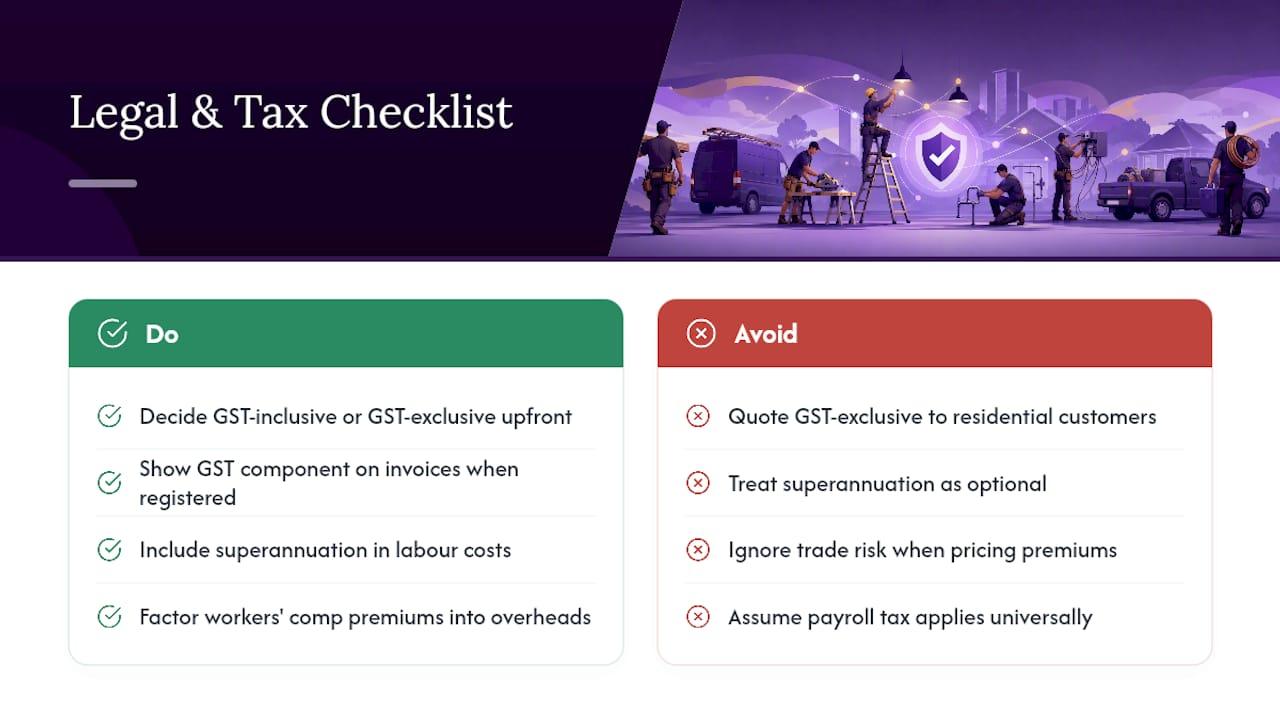
GST registration changes how you present your rate. If you’re registered for GST, your invoices need to clearly show the GST component, following the ATO’s tax invoice requirements. Quoting a GST-exclusive rate to a residential customer who expects an all-inclusive price is a common source of billing disputes, so decide upfront which way you’ll present it and stay consistent.
Payroll tax only applies once your total Australian wages bill crosses your state’s threshold, so a sole trader or small two-person operation is often well under it, while a growing team might need to factor it into labour on-costs. Check your state revenue office’s payroll tax page directly, since thresholds and rates differ across NSW, Victoria, Queensland and the other states.
Superannuation guarantee obligations are non-negotiable for employees and need to sit inside your labour cost calculation, not treated as a discretionary extra. Workers’ compensation insurance is compulsory in every state for most employing businesses, and premiums vary by trade risk classification, which affects your overhead figure directly. None of these are set-and-forget numbers. Review them alongside your rate each time you do a quarterly check.
Author perspective: simple pricing, better business
Pricing isn’t admin you tolerate. It’s the cashflow that buys your next ute, funds an apprentice’s wage, and covers you in a slow month. Small and often wins.
— Hayley
Ask Hayley: an alternative approach to manual tracking and spreadsheet juggling
Ask Hayley is the alternative to chasing job sheets and rebuilding spreadsheets every quarter. Instead of guessing your productive hours from memory, Hayley captures job time and call activity as it happens, through voice, so the numbers feeding your charge-out rate formula are the real ones.

Its utilisation rate calculation tracks how much of your available time is genuinely billable, which is the exact figure most tradies get wrong when calculating their rate by hand. Work order tracking keeps job details, time and status in one place instead of scattered across texts and notebooks, and field service KPIs give you a running view of how your business is actually performing between formal reviews. Missed calls get captured too, so leads that would otherwise vanish get followed up instead of lost.
If you’re serious about pricing your work properly, start with a trial, measure your utilisation for a month, and re-run the formula with real numbers instead of estimates. Check out the platform to see how it fits your business.
Sources
FAQ
What is a charge-out rate?
A charge-out rate is the hourly (or daily) price a tradie or service business charges a customer, calculated to cover labour costs, overheads and a profit margin, rather than just wages alone.
What does $70,000 pro rata mean?
Pro rata means a salary is calculated proportionally for the time actually worked.
How do I work out how much to charge for a service?
Add your annual labour cost and overheads, divide by realistic productive hours (commonly 1,200 to 1,500 hours for trades), then add your profit margin on top to get your hourly charge-out rate.
How do I calculate a call-out fee?
A call-out fee typically covers your travel time and the first 30 to 60 minutes on site, often set as a flat charge equal to 0.5 to 1 hour of your standard hourly rate.

