


There is no single legislated quote expiry in Australia — set a clear expiry on every quote and pick a window that matches your cost risk. A quote can become a binding contract once a client accepts it, so treat expiry dates as protection, not paperwork. For most jobs, 30 days is a sensible default, shorter periods suit volatile material costs, and longer periods should be priced with the associated risk in mind. Always state the exact date, time and time zone, whether GST is included, and how acceptance works.
TL;DR:
- Setting a clear expiry date matching your job risk ensures your quote remains valid and enforceable without leaving it open-ended.
- Using precise wording like “fixed price” and stating the exact expiry date, time, and time zone protects you from pricing disputes and misunderstandings.
- Acceptances via signed documents, specific email references, or deposit payments are the strongest methods to make a quote legally binding.
- Default expiry periods of 14 to 30 days suit most trade work, but volatile materials or limited stock require shorter windows to protect margins.
- Incorporating essential fields such as scope, price, GST, acceptance method, and variation clause in every quote minimizes disputes and streamlines follow-up.
Table of Contents
- What’s the difference between a quote, an estimate and an invoice?
- When does a quote become legally binding in Australia?
- How do you choose the right validity period?
- What should every quote include?
- How do you handle an expired quote without losing the client?
- What do these rules look like in practice?
- How do you build expiry policy into everyday operations?
- A tradie’s checklist for every quote you send
- How Ask Hayley keeps your quotes and follow-ups on track
- Where to check the official rules
- Sources
- FAQ
What’s the difference between a quote, an estimate and an invoice?
The word you put at the top of the document changes what a client can legally expect from you. Get this wrong and you can end up locked into a price you never meant to fix.
A quote is a fixed-price offer. Once a client accepts it within the stated window, you’re generally expected to honour that price, subject to the terms you wrote into it. An estimate is an approximation, useful when scope is unclear or costs are likely to shift, and it doesn’t carry the same weight as a firm offer. An invoice is a request for payment for work already agreed or completed, not an offer at all.
Confusing these three documents is one of the most common sources of pricing disputes tradies run into. A builder who sends a rough figure labelled “quote” for a bathroom reno, then discovers tile prices jumped 15%, has a much weaker position than if that same figure had been labelled “estimate” from the start.
Practical wording makes the difference between a fixed price and an indicative one:
- Fixed price language: “This quote is for $4,200 including GST, valid until 5:00 pm AEST on 12 March 2026.”
- Indicative language: “This estimate is approximate and subject to change based on final measurements and material costs at time of booking.”
- Scope protection: “This price covers labour and materials for the scope described in Section 2 only. Any additional work will be quoted separately.”
Business recommends stating price, GST treatment and a validity period on every quote you issue, regardless of trade or job size. If you’re not confident the numbers will hold, don’t call it a quote. Say estimate, and say so clearly, in the document title and in the first line of text.
When does a quote become legally binding in Australia?
A quote becomes binding the moment a client accepts it, provided the offer contains enough certainty for a court or tribunal to enforce it. This follows ordinary contract law: an offer, an acceptance, and terms specific enough to know what’s actually been agreed.
That means price, scope and timing all need to be clear enough that neither party could reasonably argue they didn’t know what they signed up for. A one-line text message saying “yep sounds good” against a vague verbal quote is a weak record. A signed document with an itemised scope, a fixed price and a clear expiry is a strong one.
Three acceptance methods hold up best in disputes:
- A signed quote (physical or digital signature) returned before the expiry date.
- A written confirmation email referencing the specific quote number and price.
- A deposit payment matched to the amount and terms stated in the quote.
Sprintlaw’s explainer on whether quotes are legally binding confirms there’s no single national expiry period set by law. Common practice across Australian industries involves setting a clear expiry window, typically ranging from around two to several weeks, with businesses expected to specify their own window clearly rather than leaving it open-ended.
Pro Tip: An unsigned verbal “yeah, go ahead” over the phone is still acceptance in the eyes of the law — it’s just much harder to prove later. Always follow up with a written confirmation, even a text, referencing the quote number.
If your client is a consumer rather than another business, the Australian Consumer Law enforced by the ACCC can also shape how a dispute plays out, particularly around misleading pricing or unfair contract terms. Quoting to consumers carries slightly more scrutiny than quoting business to business, so keep your wording plain and your terms visible, not buried in fine print.
How do you choose the right validity period?
Pick your expiry window by weighing four things: how much your input costs move, whether you’re holding stock or an allocated slot, how long the client typically takes to sign off, and how tight your margin is on that particular job.
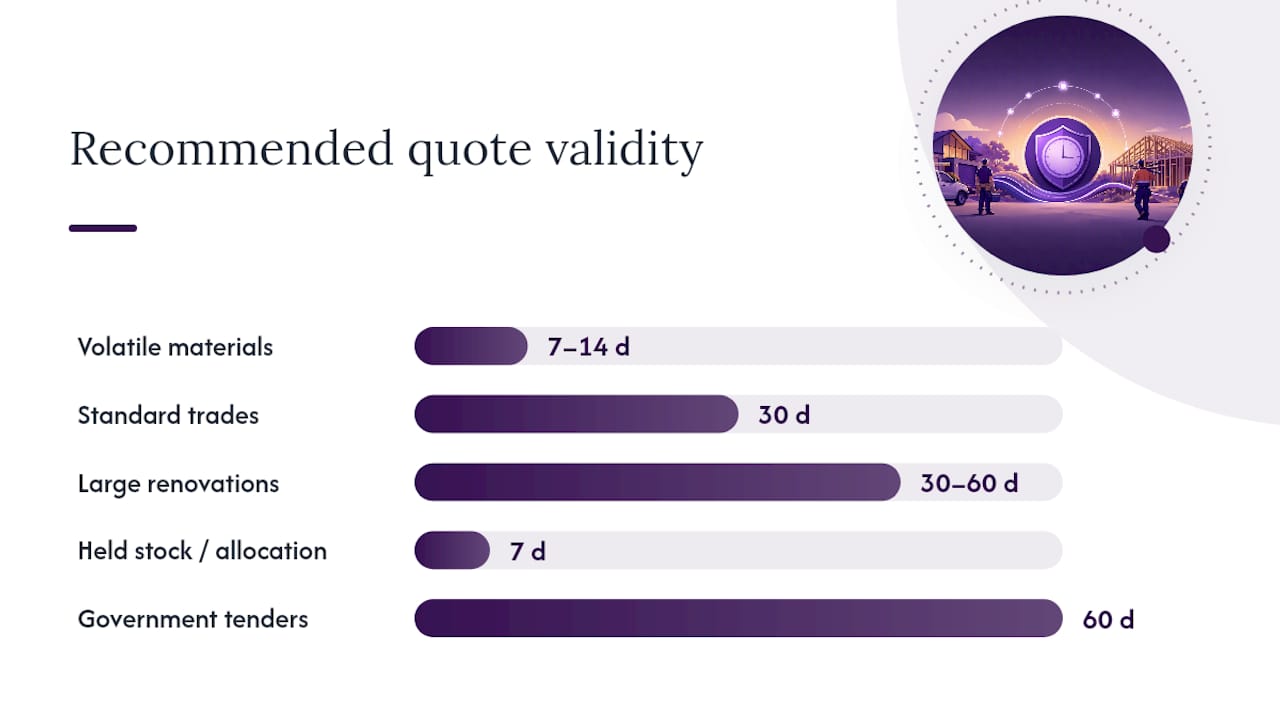
A sparky quoting a straightforward switchboard upgrade with stable material costs can comfortably offer 30 days. A landscaper quoting a job with timber or steel exposed to price swings should be looking at 7 to 14 days instead. Builders holding a trade allocation or a subcontractor booking slot often need to be even tighter, because every day the quote sits unaccepted is a day that slot could disappear.
| Job type / risk factor | Recommended validity | Why |
|---|---|---|
| Volatile materials (timber, steel, fuel-linked costs) | 7–14 days | Protects margin against price movement |
| Standard trade services (electrical, plumbing, general repairs) | 30 days | Balances customer convenience with reasonable cost certainty |
| Large renovations or multi-stage builds | 30–60 days, staged | Allows for client decision time on bigger spend |
| Bulk supply, held stock or reserved allocation | 7 days or less | Stock and allocations can’t be held indefinitely |
| Government or formal tender responses | As specified by the tender, often 60 days | Compliance requirement, not a business choice |
Vendor research on quote validity periods backs a default range of 7 to 30 days depending on volatility, with automated reminders sent 3 to 4 days before expiry as the most effective nudge point. Set that reminder cadence to match your window, with reminders sent a few days before expiry to effectively prompt decision-making.
Choosing your window comes down to a simple question: what happens to your margin if this client sits on the quote for the full period before saying yes? If the honest answer is “nothing,” 30 days is fine. If the answer is “I’d be losing money,” shorten it and say so.
What should every quote include?
A quote that protects your business has seven non-negotiable fields, and missing any one of them is where disputes usually start.
- Issue date — when the quote was written.
- Expiry date and time, with time zone — for example, “Valid until 5:00 pm AEST on 26 March 2026.”
- Full scope of work — specific enough that “extra work” is obviously separate.
- Price, with a clear GST statement — either “includes GST” or “plus GST,” never left ambiguous.
- Payment terms — deposit amount, progress payments, final payment timing.
- Acceptance method — how the client confirms they’re going ahead (signature, email reply, deposit).
- Variation clause — what happens if scope or costs change after acceptance.
Stating the exact time and time zone matters more than most tradies realise, particularly for remote or online acceptances. Guidance on Australian date and time standards recommends the format “5:00 pm AEST” rather than just a date, because a client accepting at 11:58 pm on the expiry date in a different state can otherwise create a genuine argument about whether the quote was still live.
Sample “valid until” wording that covers you both ways: “This quote is valid until 5:00 pm AEST on [date]. Quotes not accepted by this time will require re-pricing before work can proceed.” That second sentence matters. It tells the client exactly what happens next, rather than leaving them to assume the price still stands.
Pro Tip: Require a specific acceptance action, not just silence. “Reply to this email confirming you’d like to proceed” is far easier to point to later than assuming a lack of response means yes.
Sprintlaw’s quote terms and conditions template sets out the standard clauses small businesses should carry: a pricing and validity clause, GST treatment, timelines, variations, and how cancellations are handled. Borrow that structure rather than writing your terms from scratch.
How do you handle an expired quote without losing the client?
Most expired quotes fall into one of two buckets: nothing’s changed and you can simply extend it, or costs have moved and you need to re-quote. If you want to improve your sales process, working with a lead generation agency in Melbourne can help streamline client follow-ups and conversions. Knowing which bucket you’re in, quickly, keeps you from either underquoting yourself or annoying a client with an unnecessary re-price.
- Check if input costs have moved. If material prices, subcontractor rates or your own workload haven’t shifted, extend the existing quote rather than starting again.
- Set an internal rule for extensions. A simple policy such as “extend up to 3 business days without re-pricing if nothing’s changed” keeps decisions consistent across your team.
- Re-issue rather than argue if costs have moved. A short message explaining the specific cost that changed (steel price, fuel surcharge, supplier increase) lands far better than a flat “sorry, price’s gone up.”
- Send a reminder before the deadline, not after. A message 3 to 4 days out along the lines of “just checking in, your quote’s valid until Friday” prompts a decision while you can still honour the original number.
- Document every extension. A quick email noting the new expiry date protects you if the job runs into a dispute later.
Clients rarely mind a price adjustment when you explain the reason plainly and early. What damages the relationship is silence, followed by a surprise higher number at the worksite. Sprintlaw’s analysis of binding quotes also flags the value of a clear variation clause here: if your original quote already spells out that prices are subject to review after the expiry date, a re-price is expected, not a broken promise.
What do these rules look like in practice?
Three scenarios cover most of the situations tradies run into.
- Material volatility: A fencing contractor quotes a job with treated pine, sets a 7-day expiry, and the client takes 9 days to accept. Timber prices had moved in that window, so the contractor re-quotes at the new rate rather than absorbing the loss. The short expiry made that re-price expected, not awkward.
- Late acceptance, nothing changed: An electrician quotes a switchboard upgrade at 30 days. The client accepts on day 33. Nothing about labour or material costs has shifted, so the electrician honours the original price and simply notes the extension in writing.
- Estimate mistaken for a quote: A painter gives a rough verbal figure over the phone, meaning it as a ballpark, but the client later claims it as the agreed price. Because it was never written down as a formal quote with a scope and expiry, the painter has grounds to point out it was only ever an estimate, not a binding offer.
Each outcome traces back to the same root cause: whether the paperwork was clear from the start.
How do you build expiry policy into everyday operations?
Set a single default expiry for your business, then override it per job when the risk profile calls for it. A default of 30 days works for most standard trade work; jobs with volatile inputs or held stock get shortened case by case.
- Set the default once. Bake your standard expiry into every quote template so nobody’s typing it out manually and forgetting.
- Record acceptance every time. A signed quote, a confirmation email or a deposit receipt should sit against every job file, not just the disputed ones.
- Automate the reminder. Operational guidance on quotation validity periods recommends automated nudges rather than relying on memory, because a manually tracked pipeline is exactly where quotes go stale and get forgotten.
- Train staff on the extend-versus-re-quote rule. Everyone quoting on your behalf needs to apply the same threshold, not their own judgement call each time.
This is exactly where work order tracking tools earn their keep: a system that flags quotes approaching expiry stops a $6,000 job from quietly dying in someone’s inbox. Pairing that with a consistent follow up cadence means reminders go out on schedule rather than whenever someone remembers.
Pro Tip: If you’re missing calls while you’re on the tools, a missed enquiry is a quote you never even got to send. A voice-first system that answers and pre-qualifies leads while you’re up a ladder closes that gap before it costs you the job.
A tradie’s checklist for every quote you send
Run every outgoing quote past three quick questions before you hit send: Does it state a clear expiry date, time and time zone? Does it say whether the price includes GST? Does it explain exactly how the client accepts, and what happens if they miss the window?

If you can answer yes to all three, you’ve covered the fundamentals that turn a rough price into a document that actually protects your business. Most disputes I come across in trade quoting trace back to one of these three being vague or missing altogether, not to some obscure legal technicality.
Good quoting discipline pays off well beyond avoiding arguments. A clear expiry policy keeps your pipeline honest: you know which jobs are genuinely live, which have gone cold, and which need a nudge. That clarity flows straight through to cashflow, because chasing a decision on a quote that’s technically expired is far harder than following up while it’s still active.
— Hayley
How Ask Hayley keeps your quotes and follow-ups on track
Chasing expired quotes and forgetting who’s still deciding is a cashflow leak most trade businesses just accept as normal. It doesn’t have to be. A business management platform can centralise your quote templates with default expiry windows built in, so every quote goes out with a clear date, GST statement and acceptance method without retyping it each time.

Because some business management platforms answer calls and pre-qualify leads automatically, quotes can get sent faster and followed up automatically, cutting the gap where a good enquiry turns cold. Reminders fire on schedule instead of relying on memory, and every acceptance gets recorded against the job. If you’re chasing formal proposal work, the Tendering service helps you present a stronger, better-structured bid, while the Ask Hayley platform handles the day-to-day admin around quotes, calls and follow-ups. Have a look at how it fits your business, or get in touch to talk through your quoting workflow.
Where to check the official rules
For the legal basics on drafting a quote, start with business.gov.au’s quote guidance. For consumer disputes, the ACCC sets the rules on fair trading. For GST and invoicing obligations, check the ATO directly, and use Sprintlaw’s terms and conditions template as a starting clause set.
This article is general information, not a substitute for advice from a qualified lawyer. Consult a qualified legal professional about your own circumstances before acting on anything here.
Sources
- Is a quote legally binding in Australia? | Sprintlaw
- Australian Competition and Consumer Commission (ACCC)
- Australian Taxation Office (ATO)
FAQ
How long is a quote legally valid for in Australia?
There’s no fixed national expiry set by law. Common practice runs 14, 30 or 60 days, and the safest approach is to state your own expiry date and time clearly on every quote.
Are quotes legally binding in Australia?
Yes, once a client accepts a quote that contains clear price, scope and terms, it can form a binding contract under ordinary offer-and-acceptance principles.
What should the expiry date on a quotation look like?
State the exact date, time and time zone, for example “Valid until 5:00 pm AEST on 26 March 2026,” rather than just a date, to remove ambiguity for remote acceptances.
Is a quotation valid for 7 days enough?
A 7-day window suits jobs with volatile material costs or limited stock allocation, but for standard, stable-cost trade work, 30 days is a more customer-friendly default.
Can Ask Hayley help manage my quote expiry and follow-ups?
Some business platforms centralise quote templates with default expiry settings, automate reminder follow-ups, and record client acceptance, reducing the admin load of tracking quotes manually.

