


A site induction checklist documents the site-specific hazards, emergency procedures and safety rules a worker needs before they set foot on the job. It’s not optional paperwork. Before anyone does construction work on site, they need a completed induction and a signed record, and the person running the site needs to verify White Card status and task-specific competencies first. That signature, dated and filed, is your proof of compliance if anyone ever asks.
TL;DR:
- Site induction checklists must include site overview, contact details, identity and competency verification, SWMS acknowledgment, and emergency procedures clearly visible.
- Efficient inductions rely on pre-arrival onboarding, on-site walkthrough with questions, and centralized sign-off to reduce administrative delays and ensure understanding.
- Australian law mandates that inductions be site-specific and properly documented, with records kept for the project’s duration and beyond, especially for high-risk work.
- Outdated checklists, missing signatures, or language gaps are common failures and are easy to correct through careful record-keeping and timely updates.
- Effective training emphasizes comprehension through site walks, task-specific reviews, and face-to-face explanations, particularly for workers with limited English skills.
Table of Contents
- The core site induction checklist: exact items to include
- How do you run an efficient site induction?
- What does Australian law actually require for site inductions?
- Templates, sign-off examples and keeping good records
- When should you run a refresher induction?
- What training methods actually help workers retain the information?
- Author perspective: running this on small Australian sites
- Where Ask Hayley fits into your induction process
- Sources
The core site induction checklist: exact items to include
A proper site induction checklist has to work under pressure. Someone’s standing in front of you wanting to start work, and you need to move through it fast without skipping anything an inspector would flag later. WorkSafe Victoria’s sample checklist lays out the core structure that Australian sites should follow, and it’s worth building your own template around it rather than starting from scratch.
Here’s what belongs on every construction site induction checklist:
- Site overview and contact details: site address, site supervisor name, emergency contact numbers, and the principal contractor’s details.
- Identity and competency checks: full name, White Card number, and any relevant tickets or licences (dogman, EWP, high risk work licence) checked against what the task actually requires.
- SWMS confirmation: acknowledgement that the worker has read and understood the Safe Work Method Statement for any high-risk task they’ll be doing.
- PPE requirements: standard PPE for the site plus any task-specific gear (respiratory protection, harnesses, hearing protection).
- Emergency procedures: alarm signals, evacuation routes, muster point location, and where the first aid kit and first aider are.
- Active hazards and controls: what’s currently happening on site (crane lifts, excavation, live services) and how it’s being managed.
- Site rules and reporting procedures: parking, smoking areas, no-go zones, and who to report incidents or near misses to.
- Sign-on acknowledgement: a signature field confirming the worker understood everything covered.
Pro Tip: Don’t bury the emergency procedures halfway down the form. Put muster point and first aid location on the front page, because that’s the information a worker actually needs to recall under pressure, not the fine print they signed off on weeks ago.
SafeWork NSW’s guidance on safety induction makes a point worth repeating: the induction isn’t a tick-box exercise. Workers need to actually understand their rights, the hazards around them, and the safe work procedures for their task, and the completed checklist doubles as your training record if compliance is ever questioned.
How do you run an efficient site induction?
Running inductions one at a time, from scratch, for every worker who turns up is how sites lose hours a week to admin that adds no real safety value, so following a comprehensive compliance requirements checklist for Australian SMBs can streamline the process effectively. The fix is a three-step workflow that separates the boring paperwork from the parts that actually need a human standing there explaining hazards.
- Pre-arrival onboarding. Send a digital form before the worker arrives to capture their details, White Card number, and licences, and issue general site rules they can read in advance. This means you’re not doing data entry at the gate.
- On-site briefing. Walk the worker through current hazards, the site map, and welfare facilities in person. Ask two or three quick questions to check they’ve actually absorbed the safety-critical parts, not just skimmed them.
- Sign-off. Capture a signature, the induction version number, and a timestamp, then file the record centrally where it can be pulled up fast.
This structure lines up with what National Training’s guidance on WHS induction describes as leading practice, and it cuts time-to-work significantly because the admin-heavy parts happen before the worker is standing around waiting.
Pro Tip: If a worker has limited English, don’t hand them a translated PDF and call it done. Arrange an interpreter or a face-to-face walkthrough for the safety-critical sections. A translated document alone often isn’t enough to meet your duty of care.
What does Australian law actually require for site inductions?
Under Australia’s model WHS laws, a person conducting a business or undertaking (PCBU) has a duty to provide the information, training and instruction needed for workers to do their job safely. A site induction is how that duty gets discharged on a construction site, and it needs to be site-specific, not a generic slideshow reused across every job.
WorkSafe Queensland states plainly that principal contractors must ensure everyone doing construction work has either completed a site-specific induction or is accompanied by someone who has. There’s a narrower exception for some residential building sites, but it doesn’t remove the obligation to keep records of who was inducted and when.
When an auditor turns up, here’s what they’re looking for:
- A signed induction register with dates and legible names, not initials scrawled in a hurry.
- The induction version used, so you can prove the content matched current site conditions.
- Evidence that SWMS were reviewed for high-risk tasks, not just filed away.
- Competency checks against actual licences and tickets, cross-referenced to the tasks being performed.
The most common failure isn’t a missing checklist. It’s an outdated one still in circulation after site conditions changed, a signature missing from the register, or no language support offered to a worker who clearly needed it. All three are cheap to fix once you know to look for them.
Templates, sign-off examples and keeping good records
Your sign-on form only earns its keep if it captures the fields that actually matter later. At minimum: worker name, date, signature, induction version number, and a checkbox confirming SWMS review. Each field exists for a reason. Version numbers let you prove which content a worker saw if site conditions changed later; the date matters if a licence was current at induction but lapsed afterwards.
Retention should run for the life of the project at minimum, and some states expect longer for high-risk work records.
| Storage option | Best suited to | Trade-off |
|---|---|---|
| Paper register with signatures | Very small sites, short jobs | Easy to lose, slow to search |
| Spreadsheet register | Small to mid-size operators | Manual entry, no automatic backup |
| Digital induction platform / QR sign-on | Multi-site or high-turnover operations | Setup time, but audit-ready instantly |
A QR-code sign-on that writes straight to a central register gives small sites audit-ready records without adding admin overhead, according to a template guide from MapTrack. Whichever system you use, log the follow-up action if a licence has lapsed or a comprehension check failed. Ask Hayley’s safety and compliance documentation service is one option if you’d rather have templates built and stored for you than manage a spreadsheet yourself.
When should you run a refresher induction?
A one-off induction covers the site as it exists on day one. It doesn’t cover the excavation that opens up in week three, or the crane that starts operating overhead in week six. Refresher inductions exist to close that gap, and they matter more than most small operators treat them.
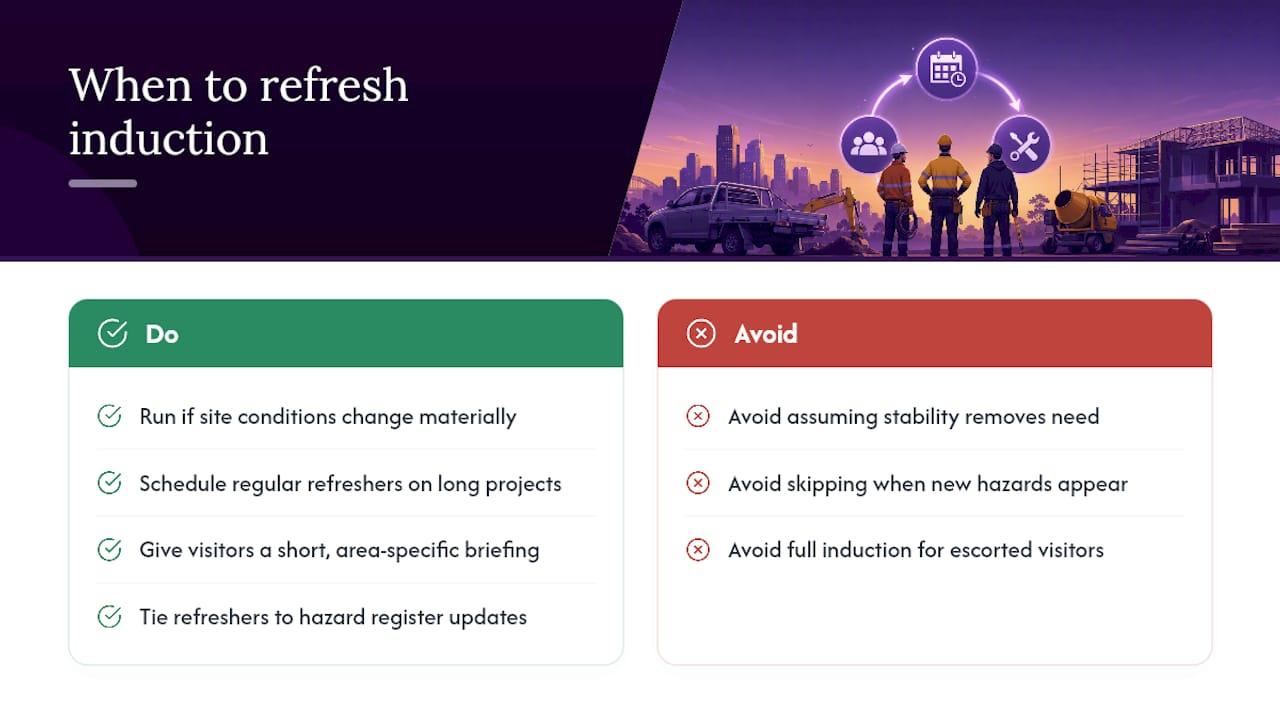
Run a refresher whenever site conditions change materially: a new hazard appears, a new area of the site opens up, or work sequencing shifts enough that yesterday’s muster point or evacuation route is no longer correct. Long-running projects should have a scheduled refresher regardless, because memory fades and new subcontractors rotate through even when the workforce looks stable on paper.
Visitors and short-term subcontractors need a different cadence to full-time workers. Someone on site for an afternoon doesn’t need the full induction a permanent crew member gets, but they still need the current hazards and emergency information relevant to where they’re working. HSE guidance on site rules and induction makes this proportionality point clearly, even though it’s UK guidance: escorted visitors get a shorter briefing, unescorted workers get the full treatment.
Practically, tie your refresher trigger to your hazard register. Every time that register changes, ask whether the induction content still matches reality. If it doesn’t, update it and note the version change in your records, because an inspector comparing an outdated induction against current site conditions is exactly the gap that turns a minor paperwork issue into a real compliance problem.
What training methods actually help workers retain the information?
Reading a PDF and signing at the bottom is the weakest form of induction training there is, and most site supervisors already suspect this even if they haven’t changed their process. Comprehension, not completion, is the real goal, and a handful of low-effort techniques improve it noticeably.
A short verbal or written comprehension check, two or three questions on the highest-risk parts of the induction, catches misunderstandings that passive reading misses almost every time, according to National Training’s induction guidance. Ask what the muster point is, ask what to do if they see an unguarded edge, and you’ll find out fast whether the information actually landed.
Walking the physical site beats a slideshow every time it’s practical. A worker who’s physically stood at the muster point and seen the first aid kit remembers both far better than someone who read the coordinates on a laminated sheet. Pair that walkthrough with the SWMS review for their specific task rather than a generic site-wide safety talk, because relevance drives retention more than repetition does.

For workers with limited English, don’t treat a translated document as equivalent to understanding. An interpreter or a face-to-face explanation of the safety-critical sections is what actually meets the standard of care expected, not a document sitting unread in a folder.
Author perspective: running this on small Australian sites
Most small operators treat induction as a formality because the paperwork feels disconnected from the actual risk. It isn’t. Pre-arrival onboarding and a central record aren’t just compliance theatre. They cut the time you spend chasing signatures and re-explaining rules to the same subcontractor twice.
The bit people skip is checking tickets against the SWMS, not just glancing at a White Card. A White Card proves general induction, not competency for the specific plant or task in front of you.
For crews with non-English speakers, budget for an interpreter. It’s cheaper than the alternative.
— Hayley
Where Ask Hayley fits into your induction process
Running inductions properly across multiple sites, or with contractors rotating through weekly, eats admin time fast, and that’s exactly where a lot of small operators quietly fall behind on record-keeping. Some platforms handle parts of your business admin that pull you away from the tools, including storing compliance documents so your induction records, SWMS references and sign-on registers sit in one place instead of scattered across emails and paper files.

If you’re juggling more than one site, dealing with high contractor turnover, or you simply don’t have spare hours to chase signatures and file paperwork, it’s worth looking at how Ask Hayley’s safety and compliance documentation service can take that load off. It sits alongside the core platform’s call handling and admin support, so induction records aren’t the only thing getting done while you’re on the tools. Have a look at Ask Hayley’s services to see what fits your business, or start with the safety and compliance documentation page directly if that’s the gap you need filled first.


