


Commercial SMS in Australia must carry consent, clear sender identification and a working unsubscribe link, full stop. From 1 July 2026, businesses using branded sender IDs also need to register on the SMS Sender ID Register or risk their texts being flagged as “Unverified”. Both duties sit under the Spam Act 2003, policed by the Australian Communications and Media Authority (ACMA).
TL;DR:
- Registration of branding sender IDs is required before July 1, 2026, to avoid texts being flagged as “Unverified” and damaging delivery rates.
- Businesses must obtain and document express consent from customers through clear opt-in methods, recording dates and channels for proof.
- Unsubscribe options must be easy, functional, and processed within five working days to prevent compliance breaches and reputation damage.
- Sending unsolicited or misleading messages risks penalties and declining trust, which can harm long-term customer relationships more than fines.
- Using a compliant platform like Ask Hayley simplifies managing consent, registration, and proof, reducing administrative burdens and avoiding accidental violations.
Table of Contents
- What the law requires: consent, identification and unsubscribe
- SMS Sender ID Register: who must register and what “Unverified” means
- How to gather and keep consent records (practical steps)
- Unsubscribe and message content rules: practical implementation
- How to register your sender ID: step-by-step
- Penalties, enforcement and why compliance matters beyond fines
- Practical compliance checklist for tradies and small services
- Author perspective: why consent and trust beat blunt blasting
- How Ask Hayley helps tradies send compliant SMS
- Sources
What the law requires: consent, identification and unsubscribe
Any SMS that offers, advertises or promotes a product or service counts as a commercial electronic message, and that single fact triggers everything else in this article. Send one without meeting the rules and you’re exposed to an ACMA investigation.
The Spam Act gives you two paths to legal consent. Express consent is the gold standard: a customer ticks a box, replies YES, or fills in a form that says clearly they’ll get marketing texts. Inferred consent relies on an existing business relationship, say a customer who booked a job with you last month, but it’s a weaker defence the moment ACMA asks you to justify it.
Every message also needs to meet baseline content rules:
- Accurate sender information, so the recipient knows who’s texting them
- No disguised or misleading subject matter
- A working, accessible unsubscribe mechanism
- Removal of opted-out numbers processed promptly
The Spam Act 2003 treats sender identification and unsubscribe as inseparable. Skip either one and the whole message is non-compliant, even if consent was solid.
SMS Sender ID Register: who must register and what “Unverified” means
If you send branded texts, from a name like “TRADIEPRO” rather than a random mobile number, you’ll need to register that sender ID on the SMS Sender ID Register before 1 July 2026. Miss the deadline and your messages don’t get blocked outright, but they do get relabelled.
Here’s what changes in practice:
- Alphanumeric branded sender IDs are the ones covered, not personal or shared numbers
- ABN holders can register directly through a participating telco; entities without an ABN go through a certified telco or partner
- Telcos carry legal obligations under the Telecommunications (SMS Sender ID Register) Industry Standard 2025 to verify use cases and over-stamp anything unregistered as “Unverified”
- Unverified messages get bundled into a generic thread on the recipient’s phone, which tanks open rates and looks like a scam text
That last point matters more than the compliance angle alone. ACMA’s own guidance flags that grouping unregistered messages this way is designed to make customers suspicious of them, which means the commercial cost of skipping registration will likely outweigh the admin cost of doing it properly.
How to gather and keep consent records (practical steps)
ACMA can ask you to prove consent existed, so vague memory of “they signed up ages ago” won’t cut it. Businesses need to show who consented, when, and through what channel, a standard drawn straight from the ALRC’s analysis of the Spam Act.
- Add a clear opt-in line to every booking form or invoice: “Reply YES to get appointment reminders and promotions by SMS.”
- Timestamp every consent event, web form, SMS reply, or verbal confirmation logged manually.
- Store the source channel alongside the date, so you can reconstruct the trail months later.
- Review inferred consent before reactivating dormant contacts. A lead who went quiet 18 months ago is a much riskier text than one from last week.
Pro Tip: Keep one master consent log, even if you’re texting from three different tools. A scattered record across apps is the fastest way to fail an audit question.
Unsubscribe and message content rules: practical implementation
A compliant opt-out in SMS is genuinely simple: the customer texts STOP, and that’s the end of it. No fee, no login, no “please call to unsubscribe.”
- The opt-out facility has to remain functional for a reasonable period after the message was sent
- Once someone opts out, you must remove them within 5 working days and be able to show when it happened
- STOP-keyword handling should be fully automated. Manual processing introduces delays that create exactly the kind of gap ACMA complaints target
- If you use a third-party SMS platform, test the opt-out flow yourself rather than assuming the provider has it sorted
Run this test monthly: text STOP from a spare number and confirm you actually get removed inside the required window.
How to register your sender ID: step-by-step
Registration runs through your telco, not directly through ACMA, so the first move is finding out who’s participating.
- Ask your telco or SMS provider whether they’re a participating provider on the register; most major carriers are rolling this in ahead of the 2026 deadline.
- Gather your proof: ABN, registered business name, and ideally a trademark or domain that matches your sender ID.
- Submit through your telco, who verifies the use case before approving the ID, as required under the Industry Standard.
- No ABN? Register via a certified telco or partner instead, since sole traders and some smaller entities fall outside standard ABN registration paths.
International senders using Australian numbers face extra scrutiny, so factor in longer lead times if that applies to you.
Penalties, enforcement and why compliance matters beyond fines
ACMA has real enforcement teeth under the Spam Act, ranging from formal warnings to infringement notices and court-imposed penalties for serious or repeated breaches. But the fine is rarely the part that hurts most.
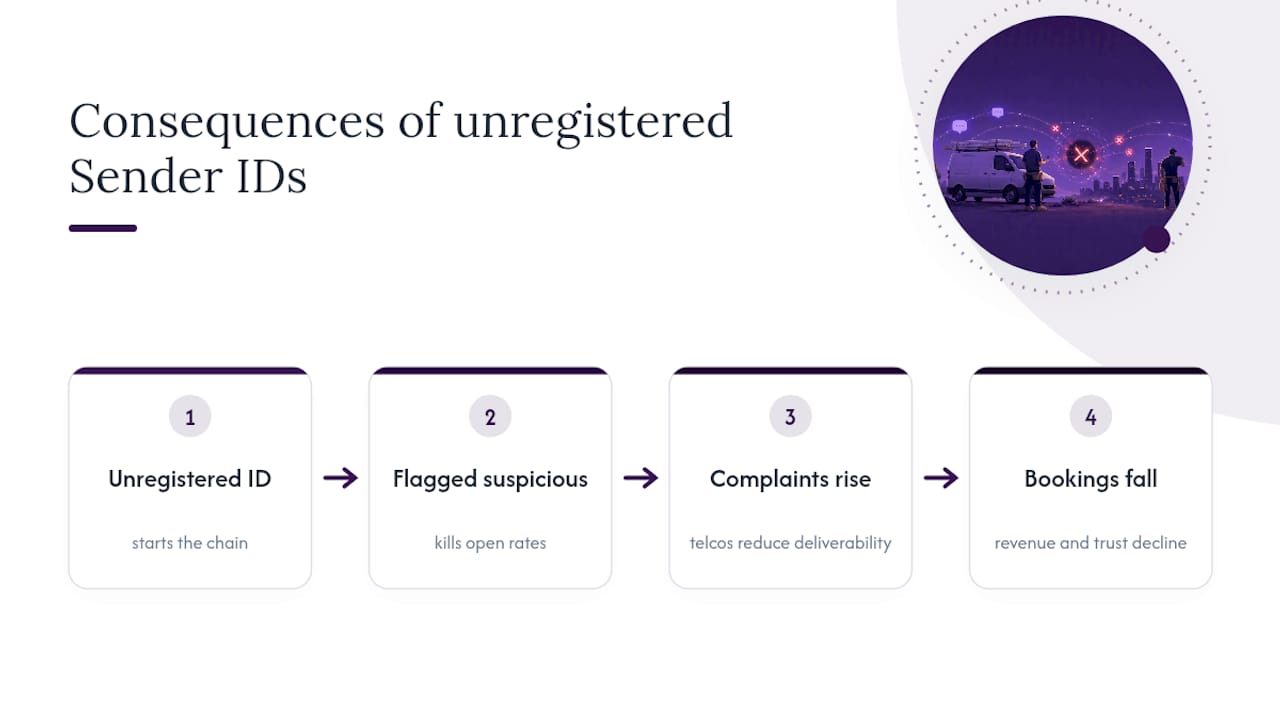
Unregistered sender IDs get grouped and flagged as suspicious, which quietly kills your open rates before ACMA even gets involved. Complaints pile up, deliverability drops with telcos, and customers stop trusting texts from your business altogether. None of that shows up on an infringement notice, but it shows up in your booking numbers.
The fix is unglamorous: document consent, respond to opt-outs fast, and register your sender ID early rather than scrambling in June 2026.
Practical compliance checklist for tradies and small services
Run through this before your next SMS campaign goes out:
- Confirm your sender ID is registered, or in progress, ahead of the 1 July 2026 deadline
- Capture express consent at booking, not as an afterthought
- Export your consent log somewhere you can retrieve in under five minutes
- Confirm STOP handling actually removes numbers within 5 working days
- Check branding on outbound messages matches your registered ID
A platform like Ask Hayley’s work order tracking can help keep job records and communication history in one place, which makes producing a consent trail far less painful. It doesn’t remove your legal responsibility for the record itself, that stays with your business under ACMA guidance on third-party platforms, but it does mean you’re not hunting through three apps when someone asks for proof.
Pro Tip: Run a monthly branding check on your outbound texts. If your sender ID shows as “Unverified” to test recipients, you’ve got a registration gap to close before customers notice it first.
Author perspective: why consent and trust beat blunt blasting
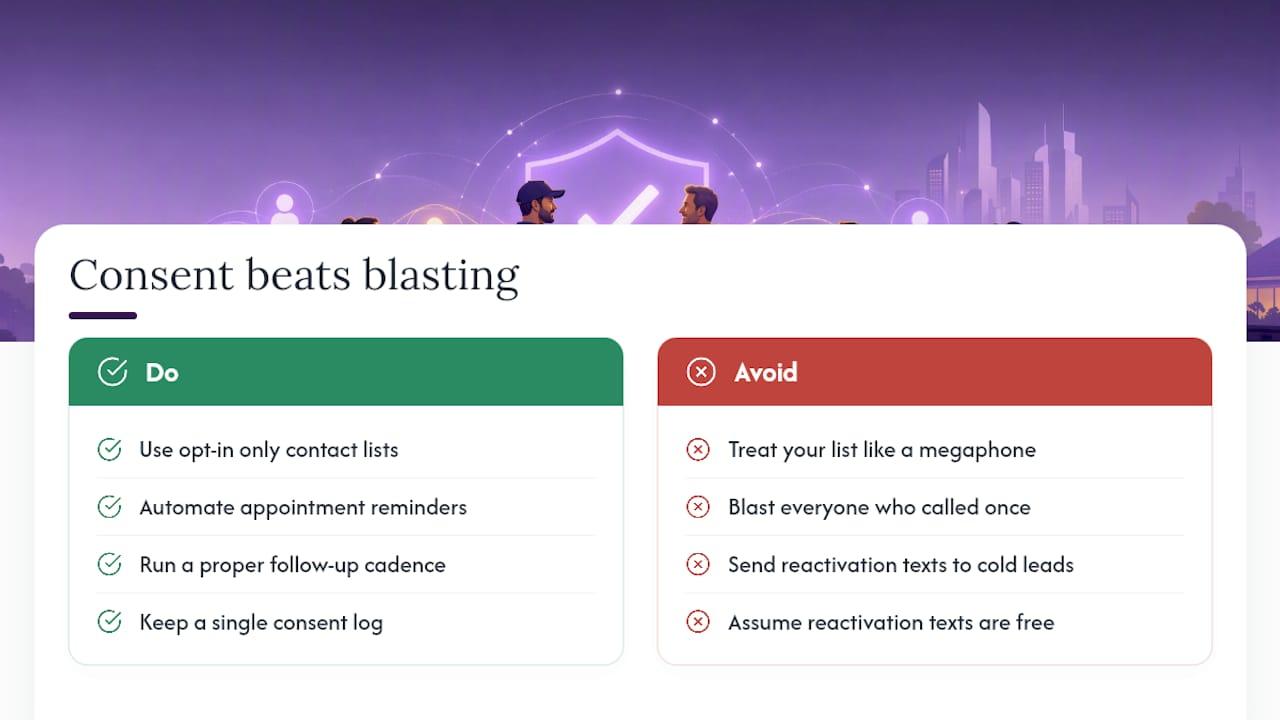
Every tradie I’ve seen get burned by SMS marketing made the same mistake: they treated their customer list like a megaphone instead of a relationship. A clean, opt-in-only list protects referral income far better than a blast to everyone who’s ever called for a quote.
The practical move is boring but effective: automate appointment reminders through a proper follow-up cadence, keep one consent log, and stop treating “reactivation” texts to cold leads as free marketing. They’re not free. They’re where most complaints start.
— Hayley
How Ask Hayley helps tradies send compliant SMS
Getting consent right, keeping sender ID registration current, and proving it all to ACMA if asked, that’s a lot of admin on top of running jobs. Ask Hayley is built for tradies who need compliant customer communication without babysitting another dashboard.
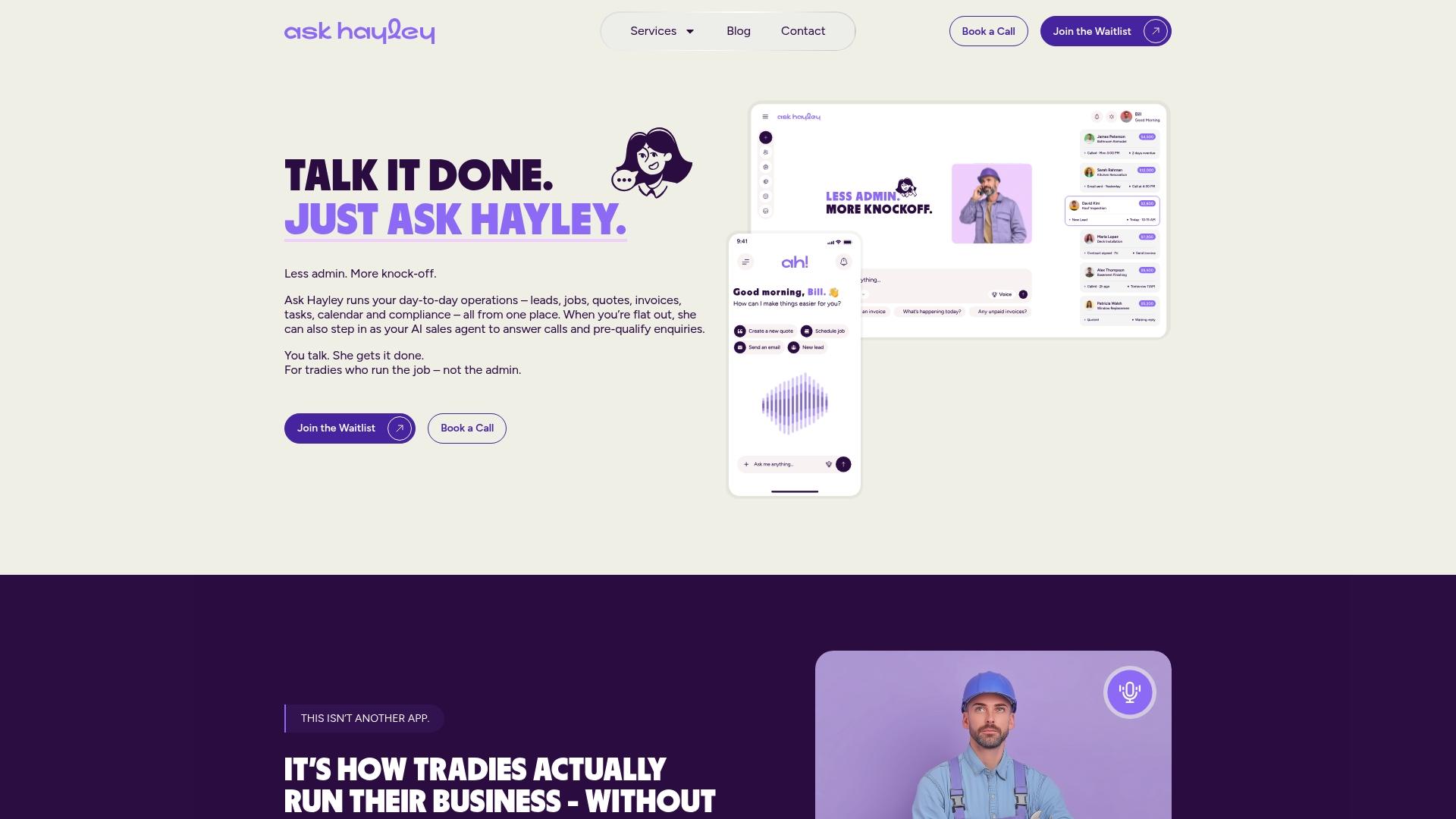
The platform’s SMS appointment reminders send booking confirmations and reminders automatically, tied to real job data rather than a separate spreadsheet you’ll forget to update. Combined with work order tracking, you get a single record of who was contacted, when, and why, which is exactly the trail ACMA expects you to produce if your consent practices are ever questioned. Ask Hayley doesn’t remove your legal duty to manage consent properly, but it does mean the record-keeping happens as a side effect of running your business, not as extra homework. Head to Ask Hayley to see how it fits your current SMS workflow.


