
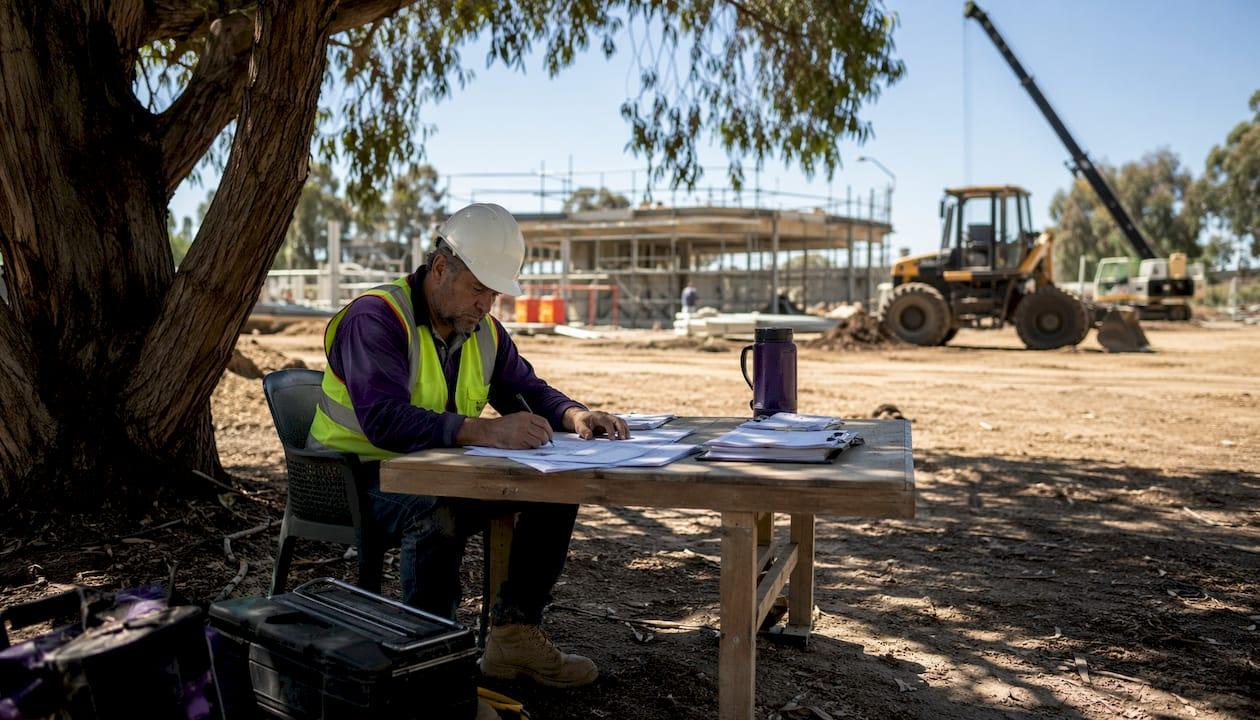
A WHS management plan is the written project playbook that sets out how you will identify, control and monitor workplace risks and meet your duties under the Model WHS Act. Your first practical step: confirm whether your construction project meets the $250,000 cost threshold that triggers the obligation to prepare a written plan before work starts, and identify who holds the principal contractor role.
A compliant plan must show:
- Consultation arrangements between all duty holders on site
- Incident management procedures and site-specific safety rules
- How SWMS will be collected, reviewed and monitored for high-risk construction work
- Named roles and responsibilities for every person with a WHS function
Table of Contents
- What your WHS management plan must contain
- How to draft and implement a plan that actually gets used on site
- What directors, officers and principal contractors must actually do
- How to manage hazards and SWMS on your project
- How often should you review and update your plan?
- What records you need to keep and how to store them
- Realistic timelines and cost drivers for small businesses
- Common mistakes tradies make and how to avoid them
- Key takeaways
- WHS belongs in your daily operations, not your filing cabinet
- Ask Hayley takes the admin out of WHS compliance
- Useful Australian sources
What your WHS management plan must contain
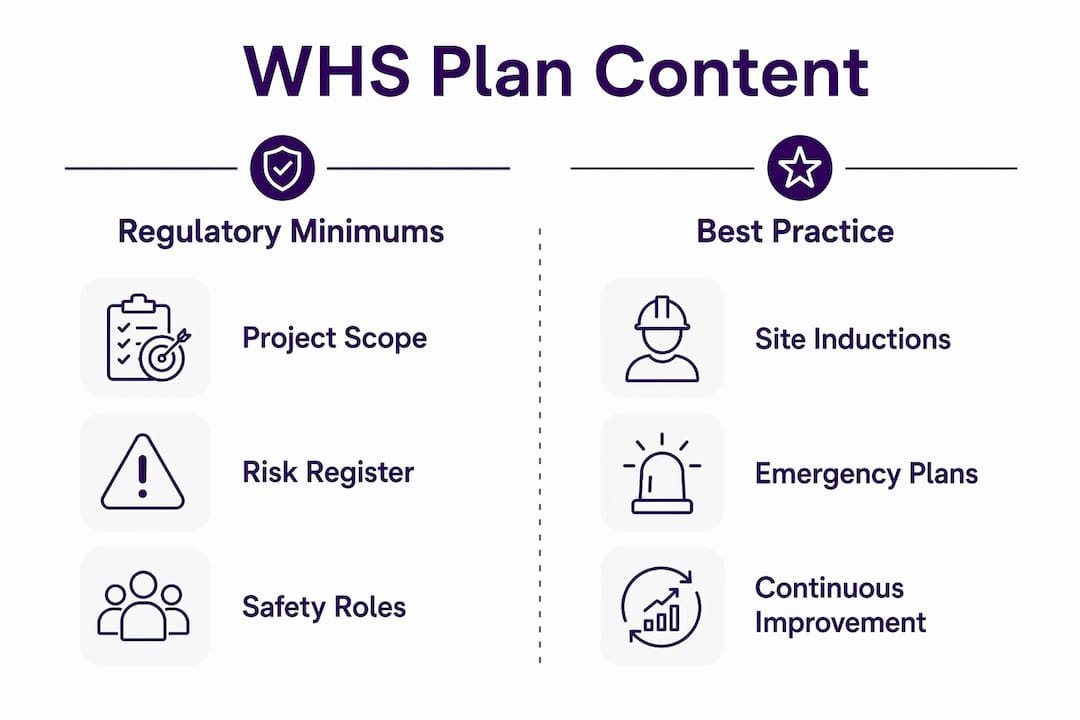
The mandatory content is non-negotiable. The table below separates regulatory minimums from best-practice additions so you can build or audit your plan quickly.
| Plan section | Status | Sample heading to use |
|---|---|---|
| Project description (address, dates, scope) | Regulatory minimum | “1. Project Overview” |
| Names, positions and WHS responsibilities | Regulatory minimum | “2. Roles and Responsibilities” |
| Consultation, cooperation and coordination arrangements | Regulatory minimum | “3. Consultation Arrangements” |
| Hazard identification, risk register and hierarchy of controls | Regulatory minimum | “4. Hazard and Risk Management” |
| SWMS collection, review and monitoring process | Regulatory minimum | “5. Safe Work Method Statements” |
| Site-specific health and safety rules | Regulatory minimum | “6. Site Safety Rules” |
| Incident management and reporting procedures | Regulatory minimum | “7. Incident Management” |
| Induction and training arrangements | Regulatory minimum | “8. Induction and Training” |
| Emergency procedures | Regulatory minimum | “9. Emergency Procedures” |
| Record-keeping and document control | Regulatory minimum | “10. Records and Document Control” |
| Subcontractor management and monitoring | Best practice | “11. Subcontractor Management” |
| Hazardous chemicals register and SDS | Best practice | “12. Hazardous Chemicals” |
| Traffic management plan | Best practice | “13. Traffic Management” |
How to draft and implement a plan that actually gets used on site
A document that sits in a folder is not a WHS management plan. It is a liability. Follow these steps to build one that works.
- Scope the project. Confirm the project cost, principal contractor, site address, anticipated start and end dates, and the types of construction work involved.
- Conduct a site-specific risk assessment. Walk the site, identify hazards for each work activity, assess the likelihood and consequence of harm, and document your control measures.
- Draft the plan. Use the mandatory sections from the table above. Keep language plain. Workers must be able to read and understand the parts relevant to their work.
- Consult with workers and subcontractors. Share the draft, hold a toolbox talk, and record who attended and what was discussed. Consultation is a legal requirement, not a courtesy.
- Get sign-off. The principal contractor or their nominated officer approves the final plan before work commences.
- Distribute and induct. Every person on site must be inducted into the site safety rules and the sections of the plan relevant to their role. Keep signed induction records.
- Collect SWMS before high-risk work starts. Review each SWMS against the plan and confirm controls are in place before the task begins.
- Run ongoing toolbox talks. Use existing job meetings to cover safety updates. This removes duplication and keeps workers engaged.
Pro Tip: Fold your safety minutes into your regular job meeting agenda rather than running a separate safety session. Integrating WHS into existing routines reduces admin time and improves worker engagement.
What directors, officers and principal contractors must actually do
Legal duty does not stop at signing the plan. Under the Model WHS Act, officers must exercise due diligence: understand site risks, allocate adequate resources for controls, and verify that safety systems are actually working. Delegation does not remove that responsibility.
In practice, that means:
- Allocating budget and time for inductions, training and SWMS review before work starts
- Conducting or commissioning regular site inspections and documenting findings
- Reviewing corrective actions after incidents or near-misses and confirming they are closed
- Signing off on plan updates when site conditions change
For property-related projects, the concept of due diligence obligations extends beyond the transaction itself into ongoing operational accountability. The same principle applies here: knowing what is happening on your site is the baseline, not the ceiling.
How to manage hazards and SWMS on your project
Many tradies confuse the WHS management plan with SWMS. They are different documents with different purposes. The WHS management plan is project-level; SWMS are task-level documents required for high-risk construction work. SWMS are triggered by the type of work, not the project cost.
The hierarchy of controls guides control selection in both documents:
- Eliminate the hazard entirely
- Substitute with something less hazardous
- Isolate the hazard from people
- Engineer controls into the work method
- Administrative controls (procedures, training, signage)
- Personal protective equipment as the last resort
For SWMS management, your plan should address:
- Which high-risk activities require a SWMS (working at heights, excavation, electrical work, confined spaces)
- Who is responsible for collecting and reviewing each SWMS before work starts
- How non-compliant SWMS are rejected and corrected
- Where SWMS are stored and how workers access them on site
How often should you review and update your plan?
A live document is what regulators look for. Filing the plan and forgetting it is one of the most common compliance failures.
| Review trigger | Recommended action |
|---|---|
| Annual minimum | Full review of all sections; update risk register |
| Post-incident or near-miss | Immediate review of relevant controls and procedures |
| New subcontractor on site | Update roles, responsibilities and SWMS register |
| Significant site change (scope, layout, hazards) | Revise affected sections before work resumes |
| Quarterly (best practice) | Check SWMS register, induction records and corrective actions |
Keep a version control log on the front page of the plan: date, version number, summary of changes, and who approved the update. Retain all superseded versions and incident records for at least the duration of the project, and longer for notifiable incidents as required by your state regulator.
What records you need to keep and how to store them
Good record-keeping is your evidence of active management. Inspectors want to see that the plan is used, not just prepared.
Your document inventory should include:
- All versions of the WHS management plan with version control log
- SWMS register (list of all SWMS collected, reviewed and approved)
- Signed induction records for every worker and visitor
- Training logs and competency records
- Toolbox talk and consultation meeting records
- Incident reports, investigation findings and corrective action logs
- Audit and inspection reports
Keep a labelled physical copy of the current plan on site at all times. Maintain an accessible electronic copy that the principal contractor and key duty holders can reach quickly. The plan must be available for inspection by a WHS regulator or inspector on request. For compliance documentation that is organised and audit-ready, a consistent filing system matters more than the format you choose.

Realistic timelines and cost drivers for small businesses
For a small-to-medium construction project, expect the following:
- Initial scoping and site assessment: 2–4 hours
- Drafting the plan: 4–8 hours for a straightforward project; longer for complex multi-trade sites
- Consultation and sign-off: 1–2 hours, including a toolbox talk
- Mobilisation (inductions, SWMS collection): 2–4 hours before work starts
The primary cost drivers are specialist time (if you engage a safety consultant), induction and training delivery, and administrative setup. You can reduce cost without losing compliance by using a site-specific template, integrating safety into existing job meetings, and assigning one person to own the SWMS register from day one.
Failing to prepare a plan where required attracts monetary penalties under state WHS legislation. The cost of getting it right upfront is a fraction of the cost of a regulator-issued notice or prosecution.
Common mistakes tradies make and how to avoid them
These are the patterns that cause plans to fail compliance checks or never get used on site.
- “Set and forget.” Preparing the plan before work starts and never touching it again. Update it after every incident, site change or new subcontractor.
- Vague responsibilities. Listing “site manager” without a name. Every role must have a named person attached.
- No SWMS register. Collecting SWMS informally with no central record. One person must own a register from day one.
- Inductions not recorded. Verbal inductions with no sign-off sheet. Unsigned inductions are invisible to inspectors.
- Generic hazard lists. Copying a template risk register without tailoring it to your actual site and work activities.
Pro Tip: Assign one person, by name, as the SWMS register owner before mobilisation. Give them a simple checklist: collect, review, approve, file. That single accountability point prevents the most common SWMS compliance failure.
Key takeaways
A compliant WHS management plan, prepared before work starts and kept live throughout the project, is the single most effective way to demonstrate active safety management to Australian regulators.
| Point | Details |
|---|---|
| Confirm the threshold | Projects that meet or exceed the cost threshold require a written plan before work commences. |
| Cover all mandatory sections | Include roles, consultation, risk register, SWMS process, incident management and inductions. |
| Keep it live | Review after every incident, site change or new subcontractor, and at least annually. |
| Document everything | Signed inductions, SWMS register, toolbox talk records and corrective actions are your evidence. |
| Ask Hayley can help | Ask Hayley prepares site-specific compliance documentation and keeps your records organised and audit-ready. |
WHS belongs in your daily operations, not your filing cabinet
Most tradies treat WHS documentation as something you do once to win a contract, then shelve. That is the wrong frame entirely. A safety plan that lives on site, gets updated after near-misses, and is referenced in every toolbox talk is not just a compliance document. It is a business tool.
Fewer stoppages, lower workers’ compensation claims, and a reputation for running a tight site all follow from treating WHS as part of how you operate, not a box to tick. Leadership visibility matters here. When the principal contractor or business owner is seen reviewing the plan, signing off on corrective actions and asking about SWMS compliance, the whole site takes safety more seriously.
The review schedule is not a formality. Quarterly check-ins and post-incident reviews are where the real risk reduction happens.
Ask Hayley takes the admin out of WHS compliance
Getting your safety and compliance documentation right is one of the most time-consuming parts of running a trade business. Ask Hayley prepares site-specific WHS management plans, SWMS templates and compliance records tailored to your project, so you are not starting from a blank page or a generic template that does not reflect your actual site.

For tradies who need to present professional, audit-ready documentation to clients or regulators, Ask Hayley handles the drafting, version control and record organisation. Your job is to run the site. Ask Hayley handles the paperwork behind it. Visit askhayley.com.au to see how the platform and professional services work together, or go straight to the services page to find the right fit for your project.
Useful Australian sources
- WorkSafe ACT Guidance Note: WHS Management Plans — The primary reference for mandatory plan content, penalties and review obligations. Start here.
- WorkSafe ACT: WHS Management Plans (web) — Plain-language overview of the $250,000 threshold and principal contractor obligations.
- Safe Work Australia: National Compliance and Enforcement Policy — Explains the risk-based regulatory approach and what inspectors look for.
- SafeWork NSW: Code of Practice — How to Manage WHS Risks — Approved code covering hazard identification, risk assessment and the hierarchy of controls.
- NSW Government: WHS Management Guidelines for Construction — Detailed guidance for construction projects including SWMS, audit checklists and template structure.
- Comcare: WHS Management Plan Template — A practical template to adapt for your own project documentation.