


If you record calls with customers, tell every caller at the very start, in plain words, and give them a real chance to say no. That one habit keeps you on the right side of the stricter state rules and the federal rules at the same time. Below you’ll find scripts you can copy for live answering, recorded announcements, voicemail and on-site calls. You’ll also see what to do when a caller refuses and how to store recordings sensibly.
TL;DR
- Say it first: tell the caller the call is recorded before anything of substance is said, and say why.
- Keep it short: two or three sentences, with a clear way to opt out (“tell me now” or “press 2”).
- Offer a real choice: if the caller says no, stop recording, call back on an unrecorded line or move to text or email.
- Be careful with state differences: most states and territories expect everyone’s consent, so a script that works in Sydney should also work in Brisbane.
- Store recordings securely and delete them when you no longer need them.
Table of Contents
- Why a script matters for a trade business
- What the law says in plain words
- What a good consent script includes
- Copy-and-paste scripts
- What to say when a caller refuses
- Common mistakes to avoid
- How to store and manage recordings
- Missed calls, lead screening and recording
- Perspective: why we think telling callers upfront is good business
- Putting it in place this week
- Get help with the paperwork side of your business
- FAQ
- Sources
Why a script matters for a trade business
You take calls from the ute, a roof, a ladder or a crawl space. A customer rings about a leaking tap, you agree on a price, and later they dispute what was said. A recording can settle that argument in thirty seconds. It can also cause real trouble if the customer never knew it was being made.
A script removes the guesswork. You say the same short thing every time, so you never have to wonder whether you told them. It also sounds professional. Customers tend to relax when a business explains itself clearly.
This is general information, not legal advice. If your business has an unusual setup, such as recording calls with government clients or across several states, talk to a lawyer who works in privacy or small business law.
What the law says in plain words
There are two layers of law to understand.
Federal law. Telephone interception is a federal offence. The Office of the Information Commissioner Queensland explains that inserting a device into a phone, or between the phone and its handset, counts as interception. Holding a recorder near the mouthpiece or using speaker is not interception. Most tradies using a phone app or a business phone system aren’t intercepting in this sense, but the rule is a good reason to keep your setup simple and above board.
State and territory law. Each state and territory has its own surveillance or listening devices law. Victoria’s LawHub says it is legal to record a private conversation if you are a party to it and you aren’t using a device installed within the phone. Queensland goes a step further: the OIC says it is generally lawful to record a private conversation you are part of without the other person’s consent, although there are limits on how you can use the recording afterwards.
So the rules aren’t identical everywhere, and customers can ring you from any state. The sensible approach is to treat every call the same and get the caller’s clear agreement up front.
Privacy law adds a second reason
Even where recording itself is allowed, privacy law cares about how you collect personal information. In a 2017 decision, the Privacy Commissioner found that recording a guest’s call without his knowledge was collection by unfair means. The decision said people on a phone call would generally expect to be told if it was being recorded.
The OAIC makes a similar point for health services, saying people must be told at the beginning of the call so they can end it or ask not to be recorded. You’re not a health service, but the logic carries over: tell people early, and let them choose.
What a good consent script includes
Whatever the situation, four things make a script work:
- What is happening. “This call is being recorded.”
- Why. “So we have an accurate record of the job details.”
- Who is doing it. Use your business name.
- A real choice. The caller can say no and still get help.
Timing matters as much as wording. Say it before any quote, address or personal detail is discussed. If you say it halfway through, the early part of the call has already been recorded without notice.
Legal practice guidance backs the same shape. Sprintlaw suggests a good disclosure is short, accurate and tells people what to do if they don’t agree.
Copy-and-paste scripts
Change the wording to sound like you. A script you can say naturally beats a perfect one you stumble over.
When you answer live
“G’day, [Business name], [Your name] speaking. Just so you know, I record my calls so I have an accurate note of the job details. Are you happy for me to record this one?”
Wait for a yes. If the caller says yes, carry on. If there’s a pause or a no, go to the section on refusals below.
A short version for busy days
“[Business name], [Your name]. Calls are recorded for job records. Tell me now if you’d rather I didn’t.”
This works for returning customers who already know the drill, but a clear “yes” is still the cleanest consent.
A recorded announcement before the call connects
If your phone system plays a message first, keep it to two or three sentences:
“Thanks for calling [Business name]. Calls are recorded so we can keep accurate records of your job. If you’d rather not be recorded, press 2 now or tell us when we answer.”
Pressing 2 should lead somewhere useful, such as a line that isn’t recorded or a call-back option. An opt-out that leads nowhere isn’t a real choice.
When you call a customer
“Hi [Name], it’s [Your name] from [Business name], returning your call about the [job]. Before we start, I record calls so I’ve got the details right. Is that okay with you?”
Outbound calls need the same notice. Don’t skip it just because you made the call.
For voicemail greetings
Voicemail is different because the caller speaks after the beep. Your greeting should tell them that their message will be stored. For example:
“You’ve reached [Business name]. We can’t take your call right now. Leave your name, number and a few details about the job, and we’ll record your message and call you back. If you’d prefer, text us on [number].”
We’ve put together six voicemail scripts for Australian tradies if you want more wording to adapt.
Using a speakerphone on site
If you’re on a job with a client standing next to you and a customer on the speaker, tell everyone in earshot. “I’m recording this call, folks, is everyone okay with that?” Keep it casual but clear.
What to say when a caller refuses
Some people just don’t want to be recorded. That’s their right, and the worst response is to push back or go quiet.
Sprintlaw advises that a business shouldn’t pressure a customer to continue on a recorded line. It suggests alternatives such as stopping the recording if your system allows it, moving to email or a web form, or arranging a call-back on a line that isn’t recorded.
A simple reply for tradies:
“No worries at all. I’ll stop the recording. Can I take the details now, or would you prefer to text me the address and what’s going on?”
Then actually stop. Don’t carry on recording “just in case”. If your phone system can’t switch off recording mid-call, offer a call back from a phone that isn’t recording, or ask them to send the details in writing.
Keep a short note after the call: date, caller and “declined recording, details taken by text”. It’s two lines, and it shows you handled it properly.
Common mistakes to avoid
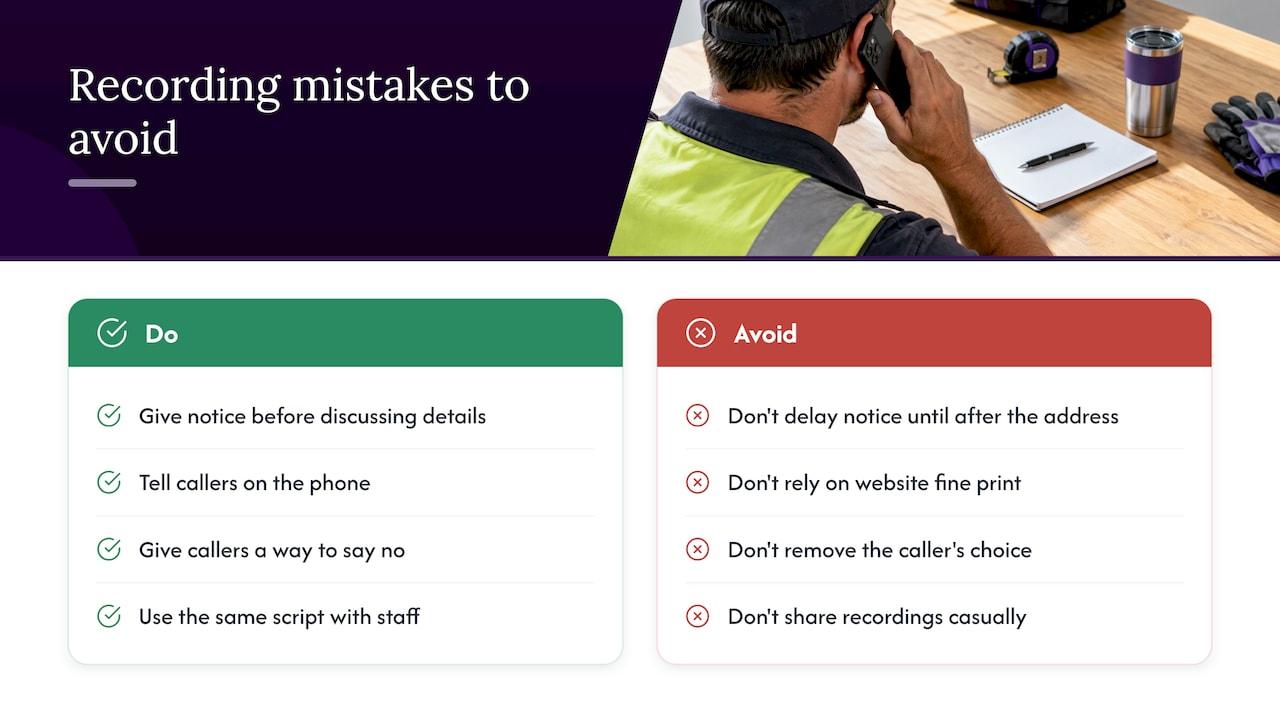
Saying it late. The notice should be the first thing the caller hears, not something you slip in after the address.
Hiding it in fine print. A line on your website saying “calls may be recorded” is a useful extra. It doesn’t replace telling the person on the phone.
Using a notice with no off-switch. If the caller can’t say no, the notice is closer to an announcement than a request for consent.
Forgetting subcontractors and staff. If your apprentice, office admin or subbie answers calls on your behalf, they need the same script. Put it on a card next to the phone or in the shared notes app.
Sharing recordings casually. Wotton Kearney points out that publishing or passing on a recording of a private conversation can carry serious penalties, including fines and imprisonment, with some exemptions such as consent and use in legal proceedings. Don’t post a call to a community Facebook group because a customer was rude. If you need a recording for a dispute, speak to your lawyer first.
How to store and manage recordings
A recording of a customer’s voice, address and job details is personal information. If the Privacy Act applies to your business, Australian Privacy Principle 11 requires you to take reasonable steps to protect personal information from misuse, interference, loss and unauthorised access. It also requires you to take reasonable steps to destroy or de-identify it when it’s no longer needed, unless the law requires you to keep it.
The OAIC’s guidance says that means active measures and thinking about whether you should still hold the information. It expects technical and organisational measures, including encryption and access security.
For a small trade business, that comes down to a few habits:
- Use a password and two-step sign-in on whatever holds recordings.
- Limit who can listen. The owner and office manager, not every crew member.
- Don’t keep them on personal phones that get lost, swapped or shared with family.
- Set a deletion rule. For example, delete routine enquiry calls after a set period and keep calls tied to a disputed job until it’s resolved. Choose the period that suits your business, and check with your accountant or lawyer if the job has warranty or legal implications.
- Know where recordings live. If a customer asks what you hold about them, you should be able to find it.
Safety and compliance paperwork can feel like another job on top of the real work. If you’d like help putting your processes in writing, we also prepare safety and compliance documentation for trade businesses.
Missed calls, lead screening and recording
Missed calls are where many tradies lose work. When you’re up a ladder you can’t answer, and most callers won’t leave a message. Whatever you use to catch those calls, apply the same principle: the caller should know what is happening at the start.
If you also want to stop wasting time on junk callers before they reach you, our guide on screening spam calls for your business covers that side of things.
Perspective: why we think telling callers upfront is good business
We built Ask Hayley around a simple idea: tradies shouldn’t have to choose between doing the job and running the business. Calls are the clearest example. You can’t answer when your hands are full, but a missed call is often a missed job.
That’s why we think the opening line of every call matters so much. Customers who hear a clear, friendly explanation of what’s happening feel looked after before you’ve said a word about price. Customers who are surprised later feel the opposite.
Our approach is designed to keep admin out of your way, so you can focus on the work. Hayley answers inbound calls when you can’t and pre-qualifies leads before they land in your inbox, all by voice, with no extra app to learn. Whatever setup you use for calls, build the consent line into it from day one, so it’s never something you have to remember on a busy Tuesday.
Write your script once, put it where everyone can see it, and make it sound like you.
Hayley
Putting it in place this week
You don’t need a big project. Here’s a simple order of work:
- Pick your opening line. Choose one of the scripts above and tweak it until it sounds natural out loud.
- Say it to a mate. Try it twice. If it feels clunky, shorten it.
- Write it where the phone is. On the dash, the office wall or the top of your notes app.
- Update your voicemail and website. Add a line to your contact page saying calls may be recorded, and what for.
- Decide where recordings live and when they go. Write the deletion rule down.
- Brief anyone who answers your phone. Ten minutes, once.
- Plan for a no. Know what you’ll say and what you’ll do.
If you want a quick check, ask yourself three things after any recorded call. Did the caller hear the notice before anything else? Could they have said no? Do I know where the recording is now? Three yeses means you’re in good shape.
Get help with the paperwork side of your business
A consent script is one small piece of running a professional trade business. We also help with the documents that win work and keep you covered. That includes a one page website, tender preparation and safety and compliance documentation, all built for Australian tradies and small service businesses. See what we offer on the Ask Hayley homepage.

If you’d rather talk than type, that’s what Hayley is for. You speak, and your admin gets handled.
FAQ
Is it legal to record phone calls in Australia?
It depends on the state or territory, and on whether you’re a party to the call. Victoria’s LawHub says a participant can generally record a private conversation if they don’t use a device installed in the phone. Queensland is generally more relaxed, but because your callers can be anywhere, telling everyone up front is the safest approach.
Do I always need to tell callers I’m recording?
Yes, as a practice. Even where a state law allows you to record without consent, privacy decisions have found that people expect to be told when a call is recorded. A short notice at the start costs you ten seconds and protects the customer relationship.
What if the caller says no?
Respect it straight away. Stop recording if you can, or offer a call back on an unrecorded line, or take the details by text or email. Don’t make the job conditional on being recorded, and note on your file that the caller declined.
Can I share a recording with someone else?
Be very careful. Sharing or publishing a private conversation is treated differently from making the recording, and penalties can be serious. If you need to use a recording in a dispute, get legal advice before you hand it to anyone.
How long should I keep call recordings?
Only as long as you need them. Privacy law expects reasonable steps to destroy or de-identify personal information once it’s no longer needed, unless the law requires you to keep it. Set a simple rule and stick to it.
Sources
- Camera surveillance, video and audio recording (OIC Queensland)
- Recording private conversations (LawHub, Victoria Legal Aid)
- ‘LP’ and The Westin Sydney (Privacy) [2017] AICmr 53
- Chapter 2: Collecting health information (OAIC)
- Business Call Recording Laws Australia: Consent Guide (Sprintlaw)
- When to hit record: the do’s and don’ts of recording private conversations (Wotton Kearney)
- Australian Privacy Principle 11 (Privacy Act 1988, Schedule 1)
- Chapter 11: APP 11 Security of personal information (OAIC)


