


For most Australian tradies, the answer is both. A phone number suits urgent, complicated or quote-based jobs, where the customer wants to talk to a real person. A booking link suits simple, fixed-scope work and the customers who enquire at 10pm. The mistake is forcing every customer down one path. The fix is a setup where the phone always gets answered, even when you’re up a ladder, and the link feeds into the same diary.
This guide explains what a booking link is, how it compares with phone enquiries, when to lead with each, and how to set both up without losing work.
TL;DR
- Phone wins for urgent jobs, big jobs and anything that needs a conversation. Booking links win for routine, fixed-scope work and after-hours enquiries.
- Most trades do best offering both, with the phone number easy to find and a booking link for people who prefer not to call.
- For quotes, let customers book a short site visit or call-back rather than the full job.
- Keep the link short: name, mobile, suburb and a one-line description of the job. Chase the detail by phone.
- A phone number only works if someone answers it. Missed calls are where tradies lose the most work.
Table of Contents
- What a booking link is, and how customers use it
- Booking link vs phone: the main differences
- What Australian customers say they want
- When a booking link is the better choice
- When the customer should be able to call
- Our view: stop treating it as a contest
- What a booking link should collect
- How to offer both without missing jobs
- A quick guide by trade
- Common mistakes to avoid
- Never miss a call or a booking
- FAQ
- Sources
What a booking link is, and how customers use it
A booking link is a web address that opens a simple page where a customer picks a time, or asks for one, and leaves their details. You put it on your website, Google Business Profile, social media, text replies, invoices and email signature.
For a tradie, there are two common styles:
- Instant booking. The customer picks an open slot and it goes straight into your calendar. This suits jobs you know well, such as a standard gutter clean, a hot water check or a pool service.
- Request-based booking. The customer picks a preferred time, and you confirm or adjust it. This suits most trade work, because the job isn’t always what the customer thinks it is. You keep control and still capture the enquiry.
The customer doesn’t need to wait for office hours, sit on hold or leave a voicemail. They also don’t get an immediate human answer, and that difference drives most of what follows.
Booking link vs phone: the main differences
| Booking link | Phone call | |
|---|---|---|
| Availability | Works 24/7, including 10pm on a Sunday | Works only if someone picks up |
| Best for | Fixed-scope, fixed-price, routine jobs | Urgent, complex or high-value jobs |
| Information captured | Consistent, written, ready for your diary | Depends on the call and who takes notes |
| Customer effort | Low for people who dislike calling | Low for people who want an answer now |
| Reassurance | Limited, no voice to build trust | High, the customer hears who they’re hiring |
| Risk | Wrong job type or slot booked | Missed calls go to a competitor |
| Your effort | Review and confirm requests | Answer, ask questions, write it down |
Neither is better in every case. They solve different problems. A link removes the barrier of waiting for a person. A call removes the barrier of explaining a messy job in a form.
What Australian customers say they want
The evidence points to customers wanting choice.
A 2025 Business Index and Consumer Report covering 2,023 consumers across Australia and New Zealand found that 42% of Australian consumers said they would likely switch providers if key digital tools such as online booking or a mobile-friendly website weren’t available. The same report found 43% expected both a mobile-friendly website and online booking. That’s a signal that a link is becoming a baseline expectation, particularly for younger customers.
The phone hasn’t gone away, though. A 2019 BrightLocal survey of 500 consumers, reported by Search Engine Land, found 60% preferred to contact a local business by phone, compared with only 4% who preferred an online form. It’s an older, US-based survey, so treat it as a pointer rather than a measure of Australian habits today. Still, it fits what most tradies see: when a pipe is leaking or the power is out, people call.
The practical reading is simple. Some customers want to ring and some want to tap a link, and either group will move on if their preferred option fails.
When a booking link is the better choice
A link tends to win when the job is predictable and the customer already knows what they need.
- Routine, fixed-duration work. Pool maintenance, gutter cleaning, regular cleaning, air con servicing, garage door tune-ups and similar jobs have a known time and a known scope.
- After-hours enquiries. Many customers research on the couch after work. A link lets them lock in a request while you’re off the tools.
- Customers who avoid calling. Plenty of people would rather not phone a stranger, especially for a small job.
- Quote visits. Letting someone book a short quote visit is low risk. It’s always a sensible length, and it moves the enquiry forward without committing either side to the full job.
- Reminders and repeat work. A link makes it easy to send existing customers a way to rebook.
The quote-visit idea is one many trades miss. Instead of letting people book “a plumber for Tuesday”, let them book “a 20-minute quote visit”. You’re not locked into a job you haven’t scoped, and the customer still gets a quick, clear next step.
When the customer should be able to call
A phone number should lead when the situation is urgent, complicated or expensive.
- Emergencies. A burst pipe, a sparking switchboard, a fallen tree or a roof leak during a storm. Nobody in this situation wants to fill in a form and wait.
- Complex jobs. Renovations, rewiring, concreting, waterproofing and fencing across uneven ground all involve details that are easier to explain out loud.
- Larger quotes. A customer spending thousands wants to hear your voice and judge whether they trust you.
- Older customers and people who want reassurance. A real conversation often closes the job.
For trades where the work is urgent, the phone should be the first option on the page, with your real hours and service area shown. If nobody can answer, there should be a clear fallback, such as a callback request. For detailed quotes, a short form that gathers scope and photos can work well as a first step, with a call kept for questions.
The phone also removes a handoff. When someone answers, takes the details and puts the job in the diary, there’s no form to read later and no chance of the enquiry sitting unseen in an inbox.
Our view: stop treating it as a contest
We hear the same story from tradies all the time. The phone rings while you’re on a roof, under a sink or halfway through a pour. You can’t answer it. By the time you call back, the customer has rung someone else.
That’s why we don’t see “booking link vs phone” as a choice. A booking link helps the customer who doesn’t want to call. A phone number helps the customer who needs an answer now. Your business needs both, and it needs both to land in the same place.
The real gap isn’t the link. It’s the missed call. We built Ask Hayley to answer inbound calls when you can’t, pre-qualify the lead before it lands in your inbox, and let you manage the admin by talking instead of typing. You don’t need another app to learn or another screen to sit at.
So offer the link, keep the phone number front and centre, and make sure every enquiry gets a prompt, professional response. That’s what turns a missed opportunity into a booked job.
Hayley
What a booking link should collect
The more fields you add, the fewer people finish. For most trades, a short first step works best:
- Name.
- Mobile number.
- Suburb or postcode, so you know quickly whether it’s inside your service area.
- A one-line description of the job, such as “leaking tap in the kitchen” or “two palm trees to remove”.
- Preferred day or time, if you’re offering a slot.
Optional extras can help on bigger jobs: a photo upload, whether the property is a house or a unit, and whether the customer owns it. Add these only where the job type needs them.
A good pattern is to keep the form light and follow up fast. A quick call or text within the same day to confirm details is enough for most work. That lets you spend site-visit time only on leads that have been qualified, instead of driving across town for a job that was never a fit.
Speed matters here. If you want to dig into it, we’ve written about how lead response time affects the jobs you win.
Enquiries that should go to the phone
Some enquiries shouldn’t sit in a form queue. Build a rule for these:
- Anything urgent or safety-related, such as gas, electrical faults and structural damage.
- Jobs outside your normal scope or service area.
- Large commercial or multi-stage work.
- Customers who say they’d prefer to talk.
A line on the booking page such as “Urgent? Call us now” does most of the work. It sends the right customers to the right door.
How to offer both without missing jobs
Here’s a practical setup you can put in place this week.
1. Show your phone number and your link together
Put the phone number at the top of the page and a clear booking button beside it. Don’t hide the number to push people into a form. Customers with complicated jobs often leave when they can’t find a way to speak to someone. The question isn’t whether to offer calls or forms. It’s which one leads on which page. An emergency callout page should lead with the phone. A routine service page can lead with the link. For more on this, see how strong calls to action shape what visitors do next.
If you’re rebuilding your homepage, our guide to homepage layouts for Aussie tradies shows where to put each option.
2. Choose request-based booking to start
For most trades, we’d suggest letting customers request a slot and confirming it yourself. You keep control of your diary and your travel time, and you still capture the 10pm enquiry. Move to instant confirmation only for job types you’re certain about, such as a standard service with a fixed price.
3. Put the link everywhere customers find you
Add it to your Google Business Profile, Facebook page, email signature, invoices, quotes and text replies. If you have a one-page site, it should be on that too. Our One Page Website service is built for tradies who want a clear, professional presence without a big project.
4. Make sure the phone gets answered
This is the step most tradies skip. A number on your website is only an advantage if someone picks up. If you can’t, an answering service or an AI call handler can take the details and pass them on. Voicemail alone loses a lot of work, because the customer has usually rung two other businesses by the time you check it.

5. Set clear expectations
Tell customers what happens next. “We’ll confirm your time within the hour” or “We’ll call you back today” removes the uncertainty a link can create. Then keep to it.
6. Track where enquiries come from
Note whether each job came from a call, a link or a message. After a month or two you’ll see which channel brings the work, and you can adjust which one leads on each page.
A quick guide by trade
| Trade or job type | Lead with | Back up with |
|---|---|---|
| Emergency plumbing or electrical | Phone | Callback request |
| Routine pool maintenance | Booking link | Phone |
| Gutter cleaning, regular cleaning | Booking link | Phone |
| Air con service or install | Link for service, phone for installs | Quote visit booking |
| Roofing, fencing, concreting | Quote visit request | Phone |
| Arborists | Phone for urgent, form with photos for quotes | Phone |
| Builders, waterproofing, solar | Enquiry then call, then a booking for the site visit | Phone |
This is a starting point. Your own mix of jobs, customers and hours should shape the final setup.
Common mistakes to avoid
- Hiding the phone number. It costs you the customers who most want to talk, often the higher-value ones.
- Asking for too much up front. Long forms get abandoned.
- Offering instant booking for jobs you can’t price. Request-based booking protects your diary.
- Letting links go cold. If a request sits unread for a day, the customer has moved on.
- Forcing urgent callers into a form. Give them a number and a fast answer.
- Forgetting the follow-up. A booking that isn’t confirmed is just an enquiry.
If you want more ways to bring jobs in, our guide to tradie lead generation covers the wider picture, and our chatbot scripts for trades show how to handle website enquiries when you’re on a job.
Never miss a call or a booking
Ask Hayley is a voice-first business management platform built for Australian tradies and small service businesses. Hayley answers inbound calls when you can’t, pre-qualifies leads before they reach your inbox, and handles day-to-day admin through natural voice prompts, with no forms or dashboards. Optional add-ons include an AI Sales Agent and an AI Website Chatbot for wider coverage across calls, leads and customer enquiries.
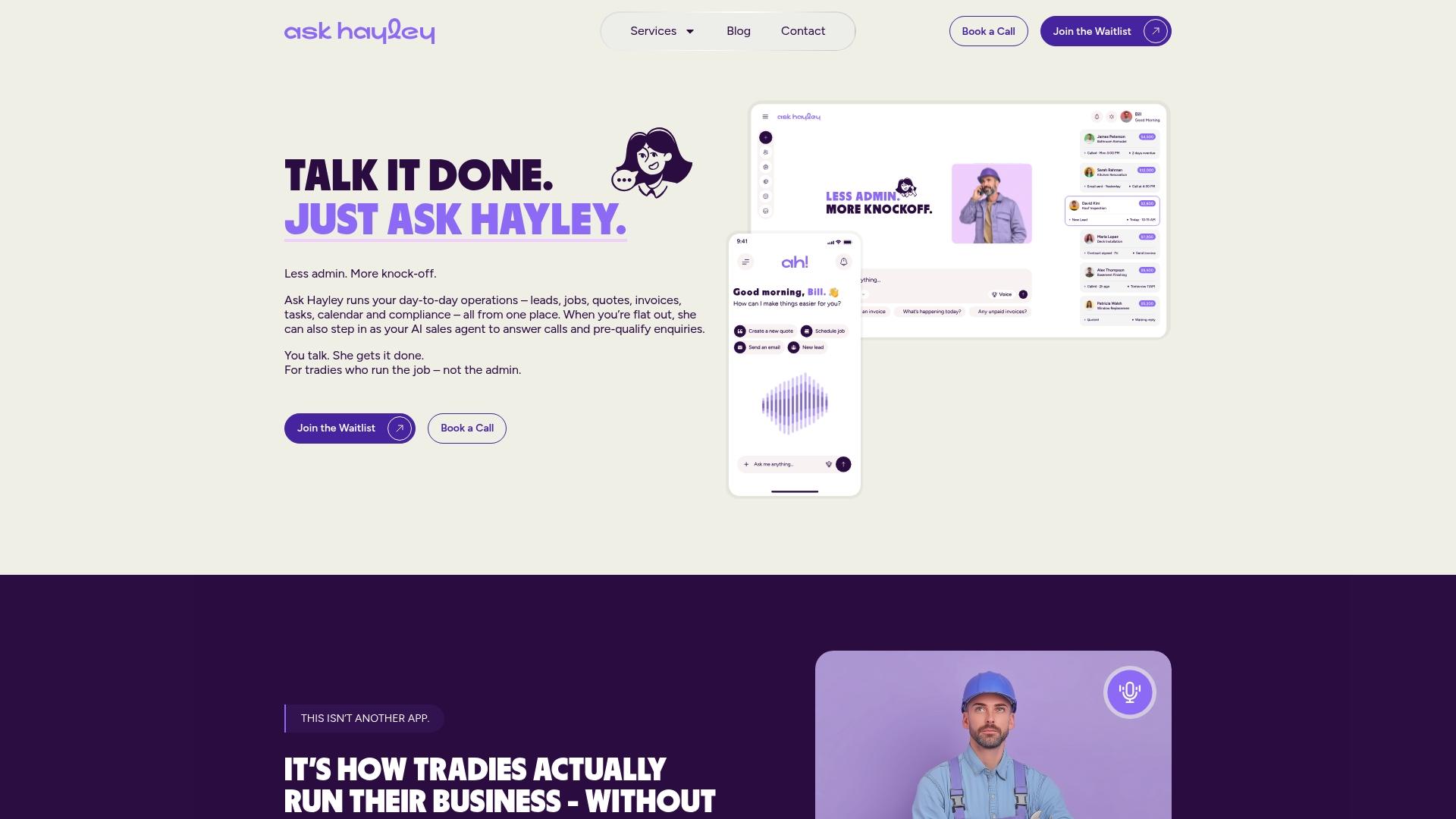
We also build one page websites for tradies, so your phone number and booking options sit in one clear place. See what we offer at Ask Hayley.
FAQ
Is a booking link better than taking calls for a trade business?
Not across the board. A booking link suits routine, fixed-scope jobs and after-hours enquiries, while phone suits urgent, complex or high-value work. Most trade businesses do best offering both and making sure each enquiry gets a fast reply.
Should I hide my phone number to get more online bookings?
No. Customers with complicated jobs often need a conversation, and hiding your number can lose them. Show the phone number clearly and give people a booking link as an extra choice, not a replacement.
What is the best thing to let customers book online as a tradie?
A short quote visit or call-back is usually the safest option. It has a predictable length, doesn’t commit you to a job you haven’t scoped, and moves the customer to the next step. Fixed-price routine jobs can use instant booking once you’re confident about them.
What should a booking link ask for?
Keep it to name, mobile number, suburb and a one-line description of the job, plus a preferred time if you offer slots. Add photo uploads only for job types that need them. You can gather more detail on the follow-up call.
What if I can’t answer the phone while I’m on the tools?
Use a call-answering service or an AI call handler that captures the caller’s details and the nature of the job. Ask Hayley is designed to answer inbound calls when you can’t and pre-qualify leads before they reach your inbox.
Sources
- Optimistic trans-Tasman SMEs face widening service gap (ChannelLife)
- Survey: More consumers trust accuracy of SMB websites over Google My Business (Search Engine Land)
- CTA importance: boost conversions with strong CTAs


