


If you’re registered for GST, a tax invoice is the document your customer needs to claim a GST credit, and the ATO sets exactly what it must show. For a job under $1,000 that’s seven details. At $1,000 or more you add the buyer’s identity or ABN. Miss one and your customer’s claim can be knocked back, which means a phone call to you later. We’ll go through the rules in the order you meet them on the job, with worked examples for typical trade work.
TL;DR
- You can only issue a tax invoice if you’re registered for GST. If you’re not, issue a plain invoice and don’t use the words “tax invoice”.
- If a customer asks, you must give them a tax invoice within 28 days, unless the sale is $82.50 or less including GST.
- Under $1,000, a tax invoice needs seven details. From $1,000 up, it also needs the buyer’s identity or ABN.
- GST must be shown as an amount, or as “Total price includes GST” when GST is exactly one-eleventh of the total.
- Details need to be clear on the invoice itself. A licence number alone doesn’t identify you.
Table of Contents
- Tax invoice or invoice: which one do you issue?
- When you must hand over a tax invoice
- What a tax invoice must show
- Showing GST correctly
- Tax receipt, progress payments and other edge cases
- A tax invoice checklist for the ute
- Where tradies slip up
- Doing it without the evening admin
- Our view
- FAQ
- Sources
Tax invoice or invoice: which one do you issue?
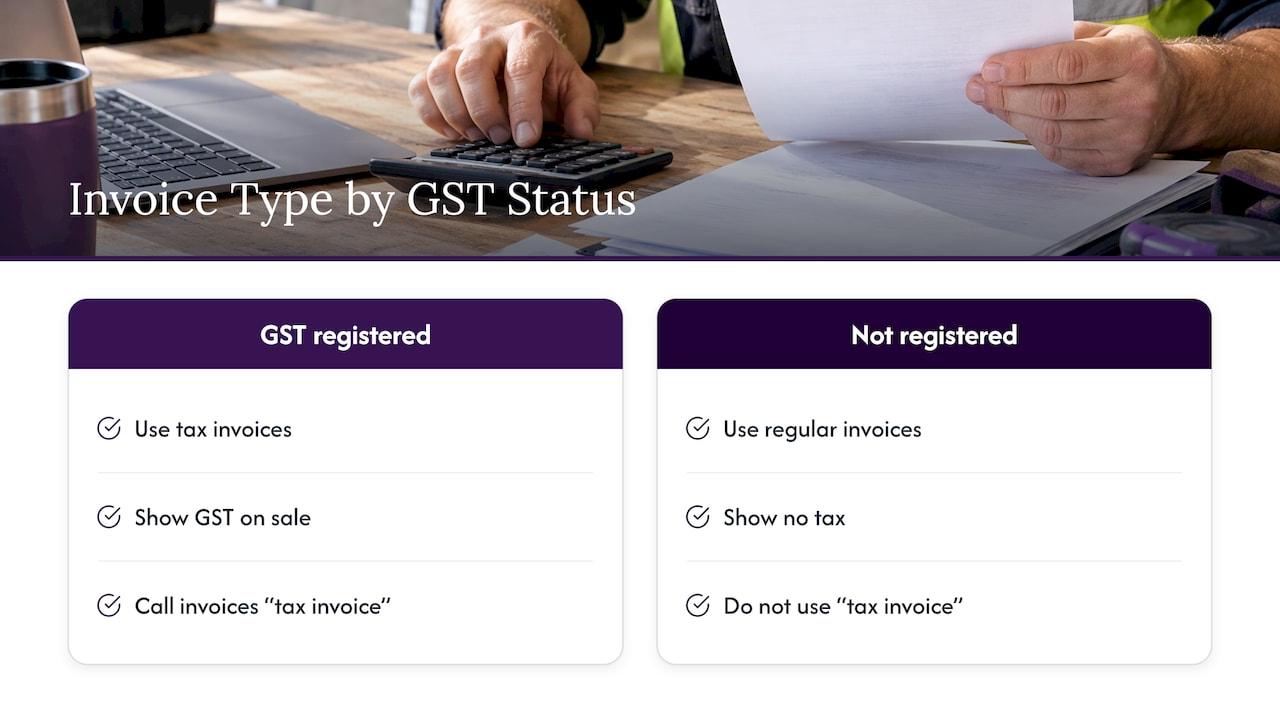
It comes down to one question: are you registered for GST?
According to business.gov.au, GST-registered businesses use tax invoices, which show the GST on what was sold. Businesses that aren’t registered use regular invoices that show no tax. The ATO’s invoice setup guidance says the same from the other direction: if you’re registered, your invoices should be called tax invoices, whether you print them, produce them in software or send them through eInvoicing.
The ATO also says that if you’re not registered, your invoices should not include the words “tax invoice”. A sole-trader sparky just starting out, or a handyman earning well under the threshold, needs to get this right from the first job.
When you have to be registered
The ATO’s GST registration page says you must register when your GST turnover is $75,000 or more. A new business must register if it expects to reach that in its first year. Registration is due within 21 days of being required. Taxi, limousine and ride-sourcing providers register regardless of turnover, and so does anyone who wants to claim fuel tax credits.
GST turnover is your business income, not your profit. The ATO tests it on both the past 12 months and the next 12 months, so a roofer who lands a big contract can cross the line before the year is out. Plenty of trades below the threshold also register voluntarily. Whatever you decide, your invoices have to match your registration status.
When you must hand over a tax invoice
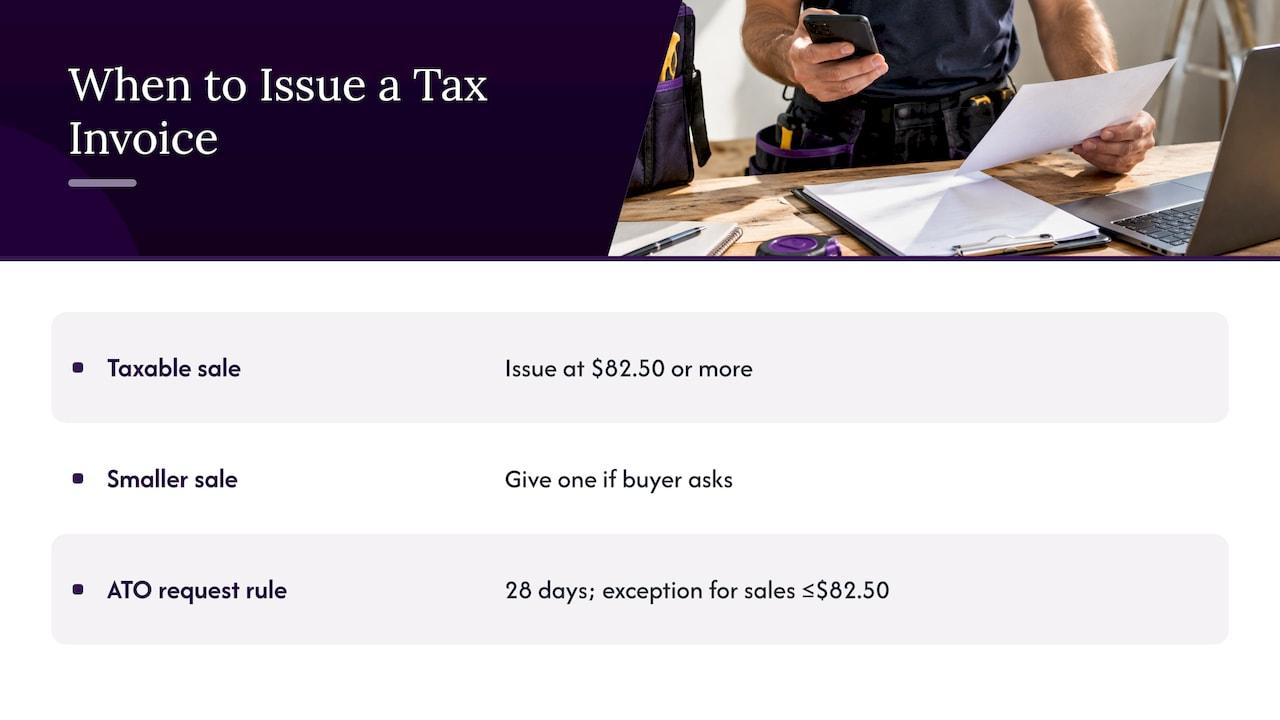
You don’t have to send a tax invoice with every sale. The ATO’s tax invoice rules say that if a customer asks for one, you must provide it within 28 days, unless the sale is $82.50 or less including GST. The ATO’s small business pages add that you should issue one for a taxable sale of $82.50 or more and give one for a smaller sale if the buyer asks.
The duty sits in section 29-70 of the GST Act, which says the supplier issues the tax invoice (the exception is a recipient-created tax invoice, where the buyer writes it by agreement). It also says the invoice must set out your ABN and the price.
In practice, trade customers (builders, strata managers, property managers, other businesses) will expect a tax invoice every time, because they claim GST credits on what you charge. Homeowners usually don’t claim anything, but they’re entitled to ask. Treating every taxable job as a tax invoice job is the simplest rule to run your business on.
Why customers chase you for it
The ATO’s GST credit page says a business needs a tax invoice to claim a GST credit on purchases costing more than $82.50 including GST. It also says an invoice with incorrect or incomplete information isn’t a valid tax invoice, unless the missing details can be found in other documents from the supplier. So an invoice that’s missing something doesn’t just look sloppy. It can cost your customer money, and they’ll ask you to reissue it.
What a tax invoice must show
There are two tiers, set by the size of the sale.
Under $1,000: seven details
The ATO says a tax invoice for a taxable sale under $1,000 must clearly show:
- That the document is intended to be a tax invoice. Putting “Tax Invoice” at the top does it.
- Your identity as the seller. Your business name works.
- Your ABN.
- The date you issued the invoice.
- A brief description of what you sold, including the quantity and price.
- The GST amount, or a “Total price includes GST” statement if the GST is exactly one-eleventh of the total.
- The extent to which each sale is taxable, so the customer can see what GST applies to.
business.gov.au’s list is worded slightly differently but lines up with this: the words “tax invoice”, your business name, your ABN, the date, a description with quantity and price, the GST payable, and the buyer’s identity or ABN on sales over $1,000. It also recommends a unique invoice number, and that’s worth doing on every invoice because it makes your records and chasing payments far easier.
$1,000 or more: add the buyer
For sales of $1,000 or more, the ATO says the same details apply, and you must also show the buyer’s identity or ABN. An invoice at this level can be used for smaller sales too, so one template with a buyer field covers every job. If there are multiple recipients, each one’s identity or ABN needs to be shown.
“Clearly” means on the page
The ATO’s tax invoice ruling, GSTR 2013/1, says the required information must be clearly ascertained from the document. It doesn’t need a particular layout. But it can’t depend on the reader looking something up elsewhere, such as on the Australian Business Register. The ruling also says a builder’s registration or licence number alone isn’t enough to identify the supplier. Put your trading name and ABN on the invoice, and your licence number as an extra if you like.
Showing GST correctly
The one-eleventh shortcut
Standard GST is 10% of the price before GST, so on a GST-inclusive total it works out to exactly one-eleventh. When that’s the case, the ATO lets you write “Total price includes GST” instead of showing the amount. If any item isn’t taxable, the GST won’t be one-eleventh of the total, so show the GST as a dollar figure.
Worked example. A plumber replaces a hot water valve and charges $600 plus GST.
| Line | Amount |
|---|---|
| Labour and parts, GST exclusive | $600.00 |
| GST | $60.00 |
| Total payable | $660.00 |
The total is under $1,000, so the seven details are enough. A buyer line is optional here, but it’s good practice.
Second example. An electrician quotes a switchboard upgrade at $1,400 plus GST, which is $1,540 in total. That’s over $1,000, so the invoice also needs the customer’s name or ABN. A common slip is leaving the customer blank because the quote was verbal.
Mixed jobs
When an invoice combines taxable and non-taxable items (non-taxable meaning GST-free or input-taxed), the ATO says it must clearly show which items are taxable, the GST to be paid and the total to be paid. Most trade work is fully taxable, so this mainly matters if you also sell something that attracts no GST. Itemise it so the taxable and non-taxable lines can’t be confused.
Rounding
For a single taxable sale, the ATO says to round the GST to the nearest cent, with half a cent rounding up. For several taxable items, you can either total first and then round, or round each item’s GST and then total. You and your customer don’t have to use the same method. Pick one and stay consistent so your reports line up with your invoices.
Tax receipt, progress payments and other edge cases
Receipts. A receipt is different from an invoice. business.gov.au says there’s no law setting out what a regular invoice must contain, but you must give a receipt if the goods or services were over $75 or the customer asks. A tax invoice shows what is owed and the GST on it. A receipt confirms payment.
Staged jobs. If you bill in stages, each invoice that is a taxable sale needs the same details, with a clear description of what that stage covers. Our guides on progress invoicing for tradies and progress claims in Australia go through how to word them.
Defective invoices. If a supplier doesn’t give a valid tax invoice, the ATO’s practice statement PS LA 2004/11 says the Commissioner can use discretion to treat a defective document as a valid tax invoice. The same statement describes tax invoices as a key integrity measure of the GST system. For you, the lesson is simple: a customer shouldn’t have to go to the ATO because your paperwork was incomplete.
eInvoicing. Sending invoices through the Peppol eInvoicing network is optional for B2B in Australia. If a larger client asks you to use it, the ATO notes that electronic systems and eInvoicing both still produce tax invoices when they carry the required details.
A tax invoice checklist for the ute
Before you hit send, run through this:
- Does it say “Tax Invoice” and are you GST-registered?
- Is your trading name and ABN on it?
- Is the issue date there, and a unique invoice number?
- Is each item described, with quantity and price?
- Is the GST shown as an amount, or “Total price includes GST” where it’s exactly one-eleventh?
- If it’s $1,000 or more, is the buyer’s name or ABN on it?
- Is it clear which items are taxable if the job is mixed?
Keep a copy. The ATO sets record-keeping expectations for GST documents, and a tidy numbered sequence makes any later question easy to answer.
Where tradies slip up
Most errors are admin errors, not tax errors. An invoice gets written in the ute at 6pm, the ABN field is skipped, the customer’s name is missing on a $2,000 job, or “invoice” is typed instead of “tax invoice”. Each one is simple, and each one comes back as a call from a bookkeeper three weeks later. Writing invoices on the day, from the job details while they’re fresh, is the biggest fix. That’s also where the time goes: sitting down after a full day to type up the paperwork.
Doing it without the evening admin
Ask Hayley is a voice-first business management platform built for Australian tradies. Quote generation and invoicing sit in the same place as your calendar, tasks and reporting, and it integrates with Xero. You talk to Hayley instead of typing into forms or dashboards. Our walk-throughs on voice to invoice workflows for ABN and GST and the quote to invoice workflow show how that fits the job from quote through to payment.
If you also need your paperwork to look the part for bigger clients, we offer a One Page Website, Tendering support and Safety and Compliance Documentation. See what’s on offer at Ask Hayley.

Our view
Most tradies we talk about invoicing with aren’t confused by the tax. They know GST is a tenth. What gets them is that the paperwork lands at the worst time: dusk, hands dirty, phone buzzing.
That’s why we built Hayley around voice. You shouldn’t need to open a form, find the right field and remember seven details when you’ve just climbed down off a roof. You should be able to say what you did, and have the job move on.
A compliant invoice is a business-credibility tool as much as a tax one. When a builder or a property manager sees a clean tax invoice with your ABN, your numbering and the GST clearly shown, they pay faster and trust you more. We want that to be the default for every tradie, not something you scramble to fix later.
Hayley
FAQ
Is it illegal not to provide an invoice in Australia?
For a GST-registered business, it’s a requirement to provide a tax invoice within 28 days when a customer asks, unless the sale is $82.50 or less including GST. A supplier who doesn’t can face an administrative penalty from the ATO. Businesses that aren’t registered have no rules on what a regular invoice contains, but should still give a receipt if the job was over $75 or the customer asks.
Do I need to charge GST if I earn under $75,000?
Not necessarily. The ATO says you must register once your GST turnover is $75,000 or more, or you expect it to be. Taxi, limousine and ride-sourcing providers register regardless. You can still register voluntarily below the threshold, and from then on you charge GST and issue tax invoices.
What is the difference between a tax receipt and a tax invoice?
A tax invoice is issued by a GST-registered seller and shows what was sold, the price and the GST. A receipt confirms the customer has paid. business.gov.au says a receipt must be given if the goods or services were over $75 or the customer asks.
What legally has to be on an invoice?
A regular invoice from a business that isn’t registered for GST has no set contents under the law, but it must not say “tax invoice”. A tax invoice has to carry the seven details listed above, plus the buyer’s identity or ABN once the sale reaches $1,000.
Sources
- Tax invoices | Australian Taxation Office
- GST essentials: tax invoices | ATO small business
- How to invoice | business.gov.au
- Setting up your business invoices | ATO
- Registering for GST | ATO
- When you can claim a GST credit | ATO
- GSTR 2013/1 | ATO Legal database
- PS LA 2004/11 | ATO Legal database
- A New Tax System (Goods and Services Tax) Act 1999, s 29-70 | AustLII
- Alternatives to a tax invoice for certain GST credit claims | AVCA


