


Tender evaluation criteria are the published tests a buyer uses to decide who wins the work. Some are pass or fail. Others are scored and weighted by importance. If you know which is which, and write each answer to match the criterion in front of the evaluator, you stop losing points on things that have nothing to do with how good your work is. We help tradies prepare tenders at Ask Hayley, and this guide covers what the scoring sheet looks like and how to respond to it.
TL;DR
- Criteria come in three types: mandatory (pass or fail), weighted (scored by importance) and non-weighted (not scored, used to judge risk or extras).
- The panel sets the scoring method and weightings before the tender documents go out, so the weightings in your documents are what you will be marked on.
- Value for money is not the lowest price. Buyers weigh price against quality, whole-of-life costs and risk.
- Mirror the criterion’s wording, give specific evidence, and check your pricing schedule for gaps or contradictions before you submit.
- BANT and CHAMP are sales-qualification checklists. Adapted, they help you decide which tenders are worth your time.
Table of Contents
- How a tender is evaluated
- The three types of criteria
- What buyers actually score
- Value for money is not the lowest price
- How scoring scales work
- How to respond to each criterion and keep your marks
- Where tradies lose points
- Recent rule changes for Commonwealth work
- Is this tender worth bidding for? BANT and CHAMP
- Our perspective
- Get help with your next tender
- FAQ
- Sources
How a tender is evaluated
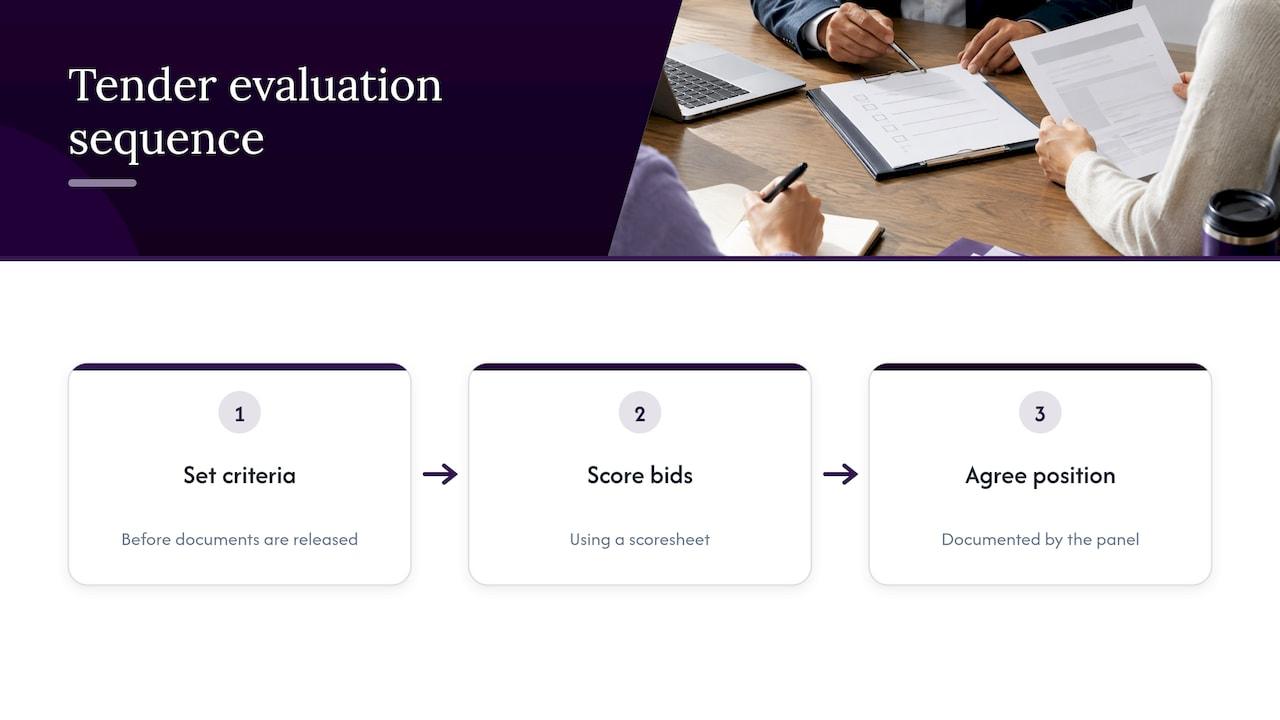
Most Australian government and council evaluations follow the same shape. An evaluation panel decides how submissions will be scored, then scores each one on a scoresheet, then meets to agree a documented position. The Tasmanian Government tendering handbook says the scoring method and the relative weighting of each criterion are set by the panel before tender documents are released. That matters for you. The weightings are not a secret, and they are not changed after the fact to suit a favourite.
The handbook also says evaluators may score each part of a multi-part criterion separately, and that failing to respond to every criterion can disqualify a tender. So a gap is not a small loss. It can be the end of your bid.
The Commonwealth works the same way in principle. The Department of Finance says officials must evaluate submissions in accordance with the Tender Evaluation Plan, seek value for money regardless of procurement size, and report contracts of $10,000 (GST inclusive) or more on AusTender. The department also notes the Commonwealth Procurement Rules changes that took effect on 17 November 2025 and says its guidance is being updated to match. If you tender for federal work, read the current rules on the Finance site rather than relying on an older guide.
The three types of criteria
South Australia’s supplier guide to how a bid is evaluated splits criteria into three types. Knowing them tells you where to put your effort.
Mandatory criteria
These are pass or fail. If your bid fails any one, it does not go any further, however good the rest is. Typical examples are a current licence, required insurances, and a signed form. They are the easiest marks to protect and the most painful to lose.
Weighted criteria
These are scored, and each carries a percentage or points value reflecting its importance. This is where tenders are won. A criterion worth 30% deserves roughly three times the attention of one worth 10%.
Non-weighted criteria
These are not scored. Buyers use them to judge risk or to note value-adds. They can still influence the panel’s confidence in you, so answer them properly.
| Type | What happens | What to do |
|---|---|---|
| Mandatory | Fail one and you are out | Check each one first, attach every document asked for |
| Weighted | Scored by importance | Spend your words where the weighting is highest |
| Non-weighted | Not scored, informs risk or extras | Answer briefly and accurately |
What buyers actually score
The South Australian guide lists the kinds of things evaluation criteria usually assess:
- Financial viability and risks
- Ability to comply with the specification and contract terms
- Capability and capacity to deliver
- Relevant experience and past performance
- Bid price or whole-of-life cost
For construction work in Victoria, Construction Guidance 3.7 requires agencies to disclose mandatory criteria in the tender documents. It also requires value for money, occupational health and safety management, industrial relations management and past performance criteria to be included. Under Direction and Instruction 3.7, OHS management is a mandatory criterion for Works over $750,000 (including GST) and Construction Services over $300,000 (including GST). So if you quote on larger Victorian jobs, your safety documents are not a nice extra. They decide whether you are scored at all.
Local councils often add their own twist. The City of Gold Coast uses a gated approach. Gate 1 filters out non-conforming submissions on mandatory criteria. Gate 2 scores capability criteria with percentage weightings, including a preference for demonstrated local benefits. Gate 3 selects on value-for-money pricing. If you are a local tradie going for council work, that local benefit scoring is worth a proper paragraph in your response.
Value for money is not the lowest price
This is the point that trips up many tradies. You price tight, you lose, and you assume the buyer only cared about cost.
The Australian Government’s Selling to Government site says value for money is the key consideration and covers price plus total costs of ownership (such as repairs, maintenance and disposal), quality and suitability for purpose, and availability in the required timeframe. The Tasmanian handbook says the same thing in plain terms: agencies weigh benefits against whole-of-life costs and do not necessarily choose the cheapest quote.
Victoria defines it as best value based on a balanced judgement of financial and non-financial factors, including whole-of-life costs, environmental, social and economic factors and procurement risk.
What this means for you:
- Do not drop your price to compensate for a weak written response. A cheap price rarely rescues a low-scoring methodology.
- Show the buyer what they avoid by choosing you: fewer callbacks, a realistic program, a safe site, clean paperwork.
- Make sure your quote is complete. Our guide to the five costs every quote must include is a good checklist before you fill in a pricing schedule.
How scoring scales work
Every panel uses its own scale, and the tender documents should tell you what it is. A common approach is a numeric scale where a top score means the response fully meets the requirement with strong evidence, a middle score means it meets the requirement with limited evidence, and a low score means it barely addresses it. The score is then multiplied by the weighting to give a weighted result, and the results are added up.
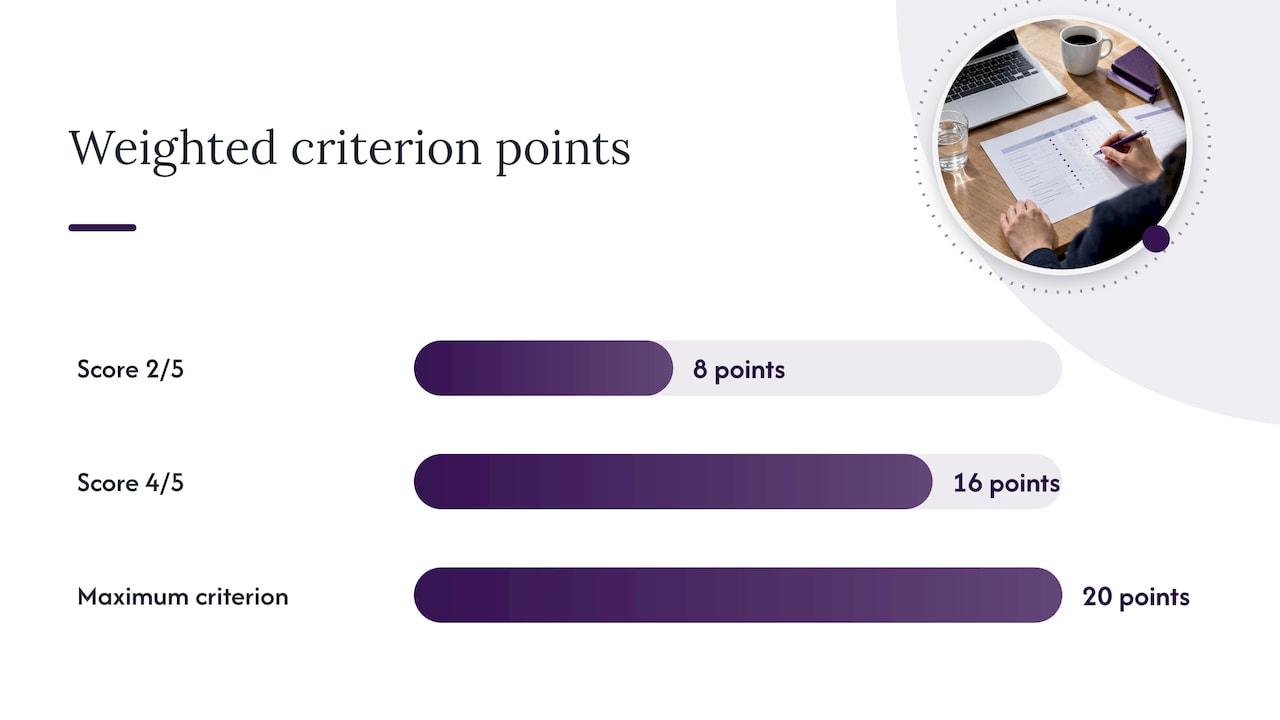
A simple worked example. Say a criterion is weighted 20% and is scored out of 5. A response scoring 4 earns 80% of that weighting, which is 16 points of the 20. A response scoring 2 earns 8. On a criterion worth 20, the difference between a good answer and a thin one is 8 points. That is often bigger than the gap between the winner and the runner-up.
Two features of the process help you. Evaluators are working from a scoresheet, so they look for the specific things the criterion asks for. And, as the Commonwealth’s evaluation guidance for one agency says, at least two people should evaluate offers using the stated scoring regime, so your response is read by more than one person. Make it easy to find the evidence.
How to respond to each criterion and keep your marks
The Tasmanian Government’s tendering tips give a method that works for any trade.
1. Break the criterion into its key points
Read the criterion and pull out each thing it asks for. List each as a heading in your response. If the criterion asks about your experience, your team and your equipment, you now have three headings. An evaluator working down a scoresheet can tick each off.
2. Use the criterion’s own words
The Tasmanian handbook says to use the language of the criterion. If the buyer asks how you will manage traffic and site access, answer with a heading that says exactly that. Do not make the evaluator translate.
3. Demonstrate, do not assert
The Tasmanian tips contrast a vague claim with a demonstrated one. Instead of saying you have the ability to do something, show it with how, when and how often you have done it, and the outcome. For a tradie that looks like:
- The job: a recent, similar scope, with the client type and the value range.
- What you did: the method, the crew size, the sequence.
- The result: finished on time, no safety incidents, no defects at handover.
- A referee who will confirm it.
If you do not have a past job that fits closely, use the nearest one and explain the link. Do not make claims you cannot back up. The handbook warns against unsubstantiated claims.
4. Show where you exceed the requirement
If the specification asks for a response within 24 hours and you attend within four, say so, and say how you do it.
5. Check your pricing schedule like a site walk
Transport for NSW’s How To Write A Strong Response handout recommends a virtual walk-through of each stage to confirm every cost is in the pricing schedule. It also says to fix errors and contradictions early, because they confuse the assessor and reduce their confidence in your ability to deliver. If your methodology says two crews and your pricing allows for one, a scorer will notice.
6. Do not skip the boring criteria
Safety, insurance, quality and environmental criteria feel like paperwork, but they are scored and sometimes mandatory. Having your documents ready before a tender lands is the difference between a calm week and a scramble. We offer safety and compliance documentation for exactly this, and our CM3 certification guide walks through one common requirement in construction.
Where tradies lose points
- Missing a mandatory item. A licence number left off a form or an out-of-date certificate can end the bid before scoring begins.
- Skipping part of a multi-part criterion. Evaluators may score each part separately, so an unanswered part is a zero.
- Generic answers. The same paragraph copied from your last tender reads as a copy.
- Contradictions between sections. Methodology, program and price must tell the same story.
- Late or unclear evidence. If the proof is buried in an appendix with no label, it may not be counted.
Two parts of a response carry a lot of weight for tradies and are easy to get wrong. The first is the methodology statement: how you will actually do the job, in what order, with what controls. Our methodology statement templates are built for scoring on that criterion. The second is the cover letter. A short, direct one page cover letter sets up the evaluator’s first impression, especially on local tenders.
If you keep getting through to the shortlist and then missing out, our piece on contractor prequalification explains why being eligible and being hired are different things.
Recent rule changes for Commonwealth work
If you bid for Australian Government work, the Commonwealth Procurement Rules were amended with effect from 17 November 2025, and the Department of Finance says it is updating its guidance to reflect them. Check the current text of the rules and the Finance procurement pages before you respond to a federal approach to market. State and council tenders follow their own frameworks, so always go by the documents attached to the specific tender.
Is this tender worth bidding for? BANT and CHAMP
This is a different question from scoring, but it saves you hours. BANT and CHAMP are two sales qualification checklists. Neither is a tender rule. They come from sales, and you can borrow them to decide which tenders deserve a response.
BANT stands for Budget, Authority, Need and Timeline. CHAMP stands for Challenges, Authority, Money and Prioritisation. The difference is the starting point. BANT begins with whether the buyer has money and a deadline. CHAMP begins with the buyer’s problem and how much it matters to them.
For a tradie reading a tender, here is how each translates.
| Question | BANT view | CHAMP view |
|---|---|---|
| Is there a budget? | Budget: is the value range in your sweet spot? | Money: does the scope justify the cost of bidding? |
| Who decides? | Authority: is the panel and process clear? | Authority: same |
| What is the job? | Need: does the scope match your trade? | Challenges: what problem is the buyer trying to fix? |
| When? | Timeline: can your crew deliver in the window? | Prioritisation: how urgent is it to the buyer? |
Use CHAMP when the tender describes a problem you can solve better than most, such as a drainage failure or an ageing roof. Use BANT when the tender is a straightforward scope and you mainly need to know if the numbers and dates work. Either way, check the weighted criteria. If the heaviest weighting is on something you cannot evidence, such as a certification you do not hold, your time may be better spent elsewhere.
Our perspective
Most tradies we talk to do not lose tenders because the work is poor. They lose them because the response does not match the scoresheet. The evaluator is working through a list, and if your evidence is hard to find, you do not get the marks.
That is why we built Ask Hayley around the reality of trade work: hands full, on site, no time to sit at a screen. Tender writing is the same problem. The admin piles up, the deadline does not move, and the safety paperwork is never ready when you need it.
Our approach is to make the structure clear: break each criterion down, answer it in the buyer’s words, back it with real jobs, and keep your compliance documents ready to go. That is practical, not fancy. It is how you build a foundation that lets you bid with confidence.
Hayley
Get help with your next tender
If you would rather spend your evenings with your family than a scoresheet, we can help. Ask Hayley offers tendering support for Australian tradies and small service businesses, along with safety and compliance documentation and a one page website that shows buyers who you are before they open your bid.

Start on the Ask Hayley site and tell us what you are bidding for.
FAQ
What are tender evaluation criteria?
They are the standards a buyer publishes and uses to assess and rank the responses it receives. Some are mandatory pass or fail tests, some are weighted and scored, and some are not scored but inform the buyer’s view of risk or extras.
How is a tender evaluated in Australia?
An evaluation panel sets the scoring method and weightings before documents are released. It then scores each response on a scoresheet and meets to agree a documented result. Bids that fail a mandatory criterion do not proceed to scoring.
Does the lowest price win a tender?
Not necessarily. Buyers assess value for money, which weighs price against quality, whole-of-life costs, suitability and risk. Tasmania’s tendering handbook says agencies may not choose the cheapest quote.
What is the difference between BANT and CHAMP?
BANT checks Budget, Authority, Need and Timeline. CHAMP checks Challenges, Authority, Money and Prioritisation, and starts with the buyer’s problem. Both are sales qualification tools, so use them to decide whether a tender is worth your time, not to understand how it will be scored.
How do I get a high score on each criterion?
Break the criterion into its parts, use its wording, and give specific evidence from past jobs with outcomes and referees. Then check that your price, program and methodology agree with each other.
Sources
- How a bid is evaluated, buying4.sa.gov.au
- A guide to tendering or quoting for Tasmanian Government
- Procurement Process Considerations, Department of Finance
- Evaluation criteria (Construction Guidance 3.7), Victoria
- Evaluation criteria (Direction and Instruction 3.7), Victoria
- Evaluation of tenders, City of Gold Coast
- Building your best response, Selling to Government
- Tips, purchasing.tas.gov.au
- How To Write A Strong Response, Transport for NSW


