


A construction risk register is a single list of everything that could go wrong on a job, how bad it would be, what you are doing about it and who owns the action. For a tradie, it turns the hazards in your head and on scattered SWMS pages into one record you can show a principal contractor, an auditor or an insurer. If you can fill in a table with eight columns, you can build one in an afternoon. The harder part is keeping it alive once the job starts, and that is where most registers fail.
This guide is written for trade and small construction businesses: electricians, plumbers, roofers, builders, concretors, arborists and the rest. It covers what goes in, how to score risks, a worked example, how often to review and how a register links to your quality plan.
TL;DR
- A risk register records each risk, its likelihood and consequence, the controls in place, the owner and the review date.
- Safe Work Australia’s model code treats a register as a recommended record, not a legal requirement. The identify, assess, control and review cycle behind it is the legal part.
- Score every risk twice: before controls (inherent) and after (residual). Act first on the high scores.
- Review it at set points: weekly on site, and whenever the job, the crew or the hazards change.
- A register that is hard to open and update will not be used, so keep it short and easy to reach from the ute.
Table of Contents
- What a construction risk register is
- Is a risk register required in Australia?
- What each entry should include
- How to build a risk register, step by step
- A worked example
- How often to review a risk register
- Quality management plan and quality assurance plan
- Keeping the register usable
- Our approach to risk on the tools
- Need a risk register and compliance pack written for you?
- FAQ
- Sources
What a construction risk register is
A risk register is the working record of your risk management. You list a risk, rate it, decide what to do, name a person to do it and set a date to check it again. Queensland’s Transport and Main Roads calls the project risk register the most essential document in its risk management process, and says it should be created at project start and updated through the life of the job by adding new risks, removing obsolete ones and adjusting the ratings.
A risk register is not the same as a risk report. The register is the live list. A report is a snapshot taken from it, such as a one-page summary of the top risks for a client or a site meeting.
It also does not replace a SWMS. A Safe Work Method Statement is the step-by-step document for one high-risk task. The register sits above it and covers the whole job, including non-safety risks like cost, weather, supply and design changes.
Is a risk register required in Australia?
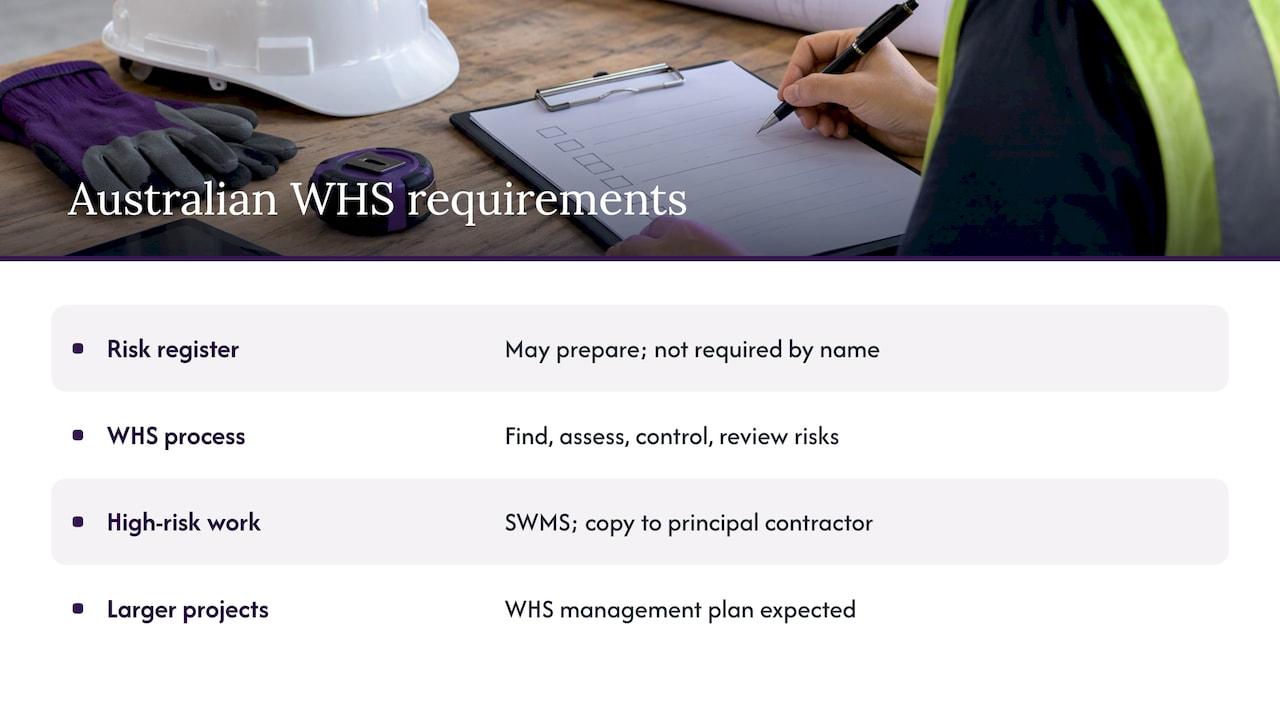
Not by name. Safe Work Australia’s model Code of Practice on managing WHS risks says you may prepare a risk register that identifies the hazards, the action needed, who is responsible and by when, and it includes an example in Appendix D. What the law does require is the process underneath: find hazards, assess the risks, control them and review the controls.
For construction, there is more. Work that is high risk needs a SWMS. Safe Work Australia’s list of high risk construction work includes work with a risk of falling more than 2 m, trenches deeper than 1.5 m, confined spaces, and work on or near energised electrical installations. Anyone doing that work must prepare a SWMS and give a copy to the principal contractor.
The Construction Work code also expects a WHS management plan on larger projects. It covers names and responsibilities, consultation, incident management, site rules and how SWMS are collected and reviewed, as set out in the Construction Work code of practice. Your register feeds straight into that plan.
WHS laws differ by state and territory. Codes of practice also get updated: the ACT, for example, approved updated versions of both the Construction work and risk management codes, taking effect on 5 November 2025. Check your own regulator’s current version.
What each entry should include
Keep the columns few. Based on the Queensland Audit Office’s advice on what to include in a risk register and the Safe Work Australia example, these fields do the job:
| Field | What to write |
|---|---|
| Risk ID and title | A short label, such as WHS-01 Working at height |
| Description | What could happen, why, and who or what it would hit |
| Likelihood (1 to 5) | How likely it is before controls |
| Consequence (1 to 5) | How bad it would be before controls |
| Inherent rating | Likelihood times consequence |
| Controls | What you do now to reduce it |
| Residual rating | The score once the controls are working |
| Owner and due date | One named person, and the date for any outstanding action |
| Review date | When you will look at it again |
The QAO also suggests recording how effective each control is and the date of the assessment. That second point matters. A rating with no date is hard to trust.
How to build a risk register, step by step
1. Identify the risks before the job starts
Walk the site, or the plans, with the people who will do the work. A short pre-start workshop beats one person filling in a form alone. One Tasmanian data centre project’s management plan describes a risk assessment workshop held before mobilisation to identify hazards, impacts and controls, and that output becomes the project’s risk register. You can run the same idea in 30 minutes on a smaller job.
Prompt yourself with these groups:
- Safety: falls, electrical contact, trenching, plant and vehicles, manual handling, dust and silica, heat.
- Site and environment: underground services, asbestos in older buildings, weather, access, neighbours.
- Commercial: material price rises, supplier delays, scope creep, slow payment.
- People: a short crew, a sick key worker, a subcontractor who is not up to the task.
- Quality: rework, poor substrate, wrong product, missed inspection points.
2. Set a simple scoring scale
business.gov.au’s guide to making a risk management plan tells you to assess each risk by looking at the likelihood of it happening and the consequence if it does, and to work out a rating system for both. A 5 by 5 grid is common and easy to use.
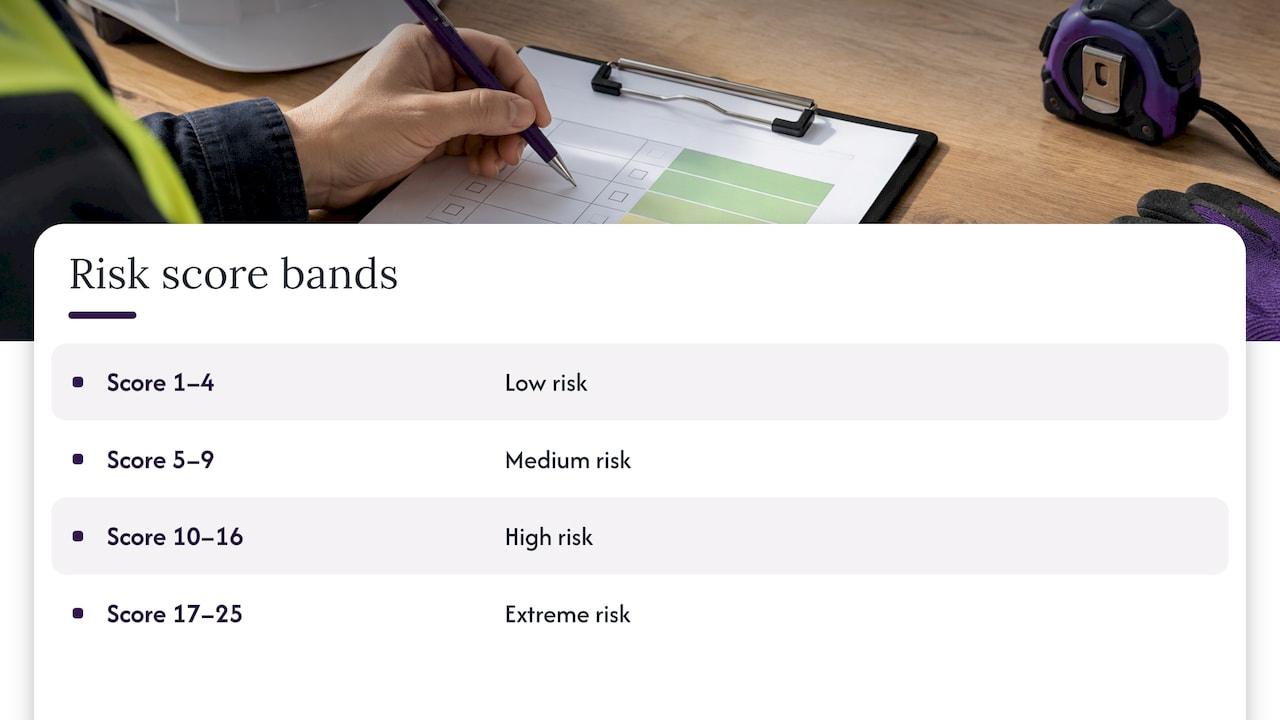
Write one line for each level so every person scores the same way. For example, consequence 5 might mean a death or permanent injury, consequence 3 a lost-time injury or a cost hit over a set amount, and consequence 1 a minor delay. Then set bands for the product of the two numbers, such as 1 to 4 low, 5 to 9 medium, 10 to 16 high and 17 to 25 extreme.
3. Score the inherent risk, then add controls
Score the risk as if nothing were in place. Then list what you do about it, starting with the strongest options. Safe Work Australia’s hierarchy of controls ranks them from removing the hazard, through substituting or isolating it and using engineering controls, down to administrative controls and PPE. Barriers beat signs, and signs beat reminders.
Only then score the residual risk. If the number barely moves, the controls are weak, and that is the useful thing the register has just told you.
4. Name an owner and a date
Every risk with a meaningful score needs one person, not a team, and a date. The Safe Work Australia example register records who is responsible for the action and by when. Without that, the register is a list of worries.
5. Set the review rhythm and stick to it
See the section on reviews below. Put the dates in your calendar when you build the register, not when you remember.
A worked example
Here is an illustrative entry for a roofing job on a two-storey home. The numbers are for demonstration only and are not from a real project.
| Field | Entry |
|---|---|
| ID | WHS-01 |
| Risk | Worker falls from the roof edge during sheet installation |
| Inherent score | Likelihood 3 x Consequence 5 = 15 (high) |
| Controls | Scaffold with edge protection, harness anchor points, SWMS signed by every worker, daily supervisor check |
| Residual score | Likelihood 1 x Consequence 5 = 5 (medium) |
| Owner | Site supervisor |
| Outstanding action | Confirm scaffold tag before day one |
| Review | Weekly, and after any near miss |
Notice the consequence stays at 5. Controls usually cut the chance of the event, not how bad it would be if it happened. That is why a fall risk never drops to nothing.
A commercial entry looks the same. Take a plumber pricing a fixed-price job with copper at an uncertain price: likelihood 4, consequence 3, inherent 12. The control might be a validity period on the quote and an allowance for price movement in the line items. Residual might fall to 6. The owner is whoever writes the quote.
How often to review a risk register
The Construction Work code says control measures must be reviewed regularly, and sets triggers: when a control is no longer effective, before a change that could create new risks, when a new hazard is found, after consultation shows a need, or when a health and safety representative asks. These are set out under Regulation 38 in the Construction Work code.
On top of the triggers, set a calendar rhythm. One NSW State Significant Construction management report says its project risk register is reviewed monthly and again after a serious incident or near miss, before project stage changes and when legislation changes, with high and extreme risks needing senior approval before work starts. Small crews can borrow the pattern:
- Weekly, five minutes: the toolbox talk. Any new hazard? Any action overdue?
- At every stage change: from demolition to framing, from rough-in to fit-off, rescore.
- After any incident or near miss: same day.
- At job close: note what you would do differently and carry it into the next job’s register.
Quality management plan and quality assurance plan
Safety is only half of the picture. The same register logic works for quality. A quality management plan sets out how you will get the job built right: the standards you work to, the inspection and hold points, who signs off and how you fix defects. A quality assurance plan is the checking side of that.
Your register supports both. Each quality risk (wrong substrate, missed waterproofing inspection, untested connection) goes in as an entry with a control. The control is then the check in your quality plan, such as an inspection point with a named person and a record. When a defect shows up, you add it to the register and ask what control would have caught it.
This matters at tender time. Principals and head contractors often ask for both documents. Our tender methodology statement guide shows how a clear method and risk approach is scored, and our guide to contractor prequalification covers what a principal looks for before putting you on a panel.
Keeping the register usable
A register fails when it lives in a spreadsheet nobody opens. Three habits fix most of this:
- Keep it short. Ten well-scored risks that people read beat 80 nobody does. Retire entries that no longer apply.
- Make it reachable. If it takes a laptop, it will not be updated on site. Photos and notes taken on the day can be logged later. Our guide to managing job photos covers a simple system for that.
- Link it to documents you already write. Variations, scope changes and handover all change risk. See how we handle variation order management and project handover documentation, and keep the register in step.
If you want to see how safety planning documents are set up in construction more broadly, there is further reading on construction project safety planning.
Our approach to risk on the tools
Most tradies we talk to do manage risk. They just do it in their heads, on the back of a SWMS or in a text thread. The problem is proving it, and keeping it current when you are on a roof with your hands full.
We built Ask Hayley around that reality. You talk to Hayley instead of typing, and the platform handles admin through voice prompts, including task management, calendar and compliance tracking. Those are the tools that keep an action with a name and a date from slipping.
A register is only as good as the habit behind it. We think the habit should cost you seconds, not an evening at the kitchen table. And when a tender or a prequalification asks for a proper risk and compliance package, you should not have to scramble to write it from scratch.
Hayley
Need a risk register and compliance pack written for you?
If you would rather have the documents built than draft them yourself, our Safety and Compliance Documentation service covers the paperwork that principals and tender panels ask for. It sits alongside our tendering support, so the documents you submit read as one consistent package. See Ask Hayley’s services to get started.

FAQ
What is a risk register in construction?
It is the live list of risks on a job, each with a likelihood and consequence score, the controls in place, an owner and a review date. It covers safety, cost, quality and programme risks. It is updated through the job, not filled in once and filed.
Is a risk register the same as a SWMS?
No. A SWMS describes how to do one high-risk task safely, and it is required for work such as working at heights over 2 m or in trenches deeper than 1.5 m. The register covers the whole project and can point to each SWMS as a control.
What risks should I put in it?
Start with the hazards of your trade, such as falls, electrical, plant, silica dust and manual handling. Then add site risks like underground services and asbestos, and commercial risks like material prices and late payment. Add quality risks that cause rework.
How many risks should a register have?
As many as you will actually review. For a small job, 10 to 20 entries is typical. Focus detail on the high and extreme scores and remove entries that no longer apply.
Sources
- Project Risk Management and Contingency Development Process Manual, Transport and Main Roads Queensland
- How to manage work health and safety risks, Safe Work Australia
- High risk construction work requiring a SWMS, Safe Work Australia
- Construction Work code of practice, Safe Work Australia
- Work Safety Group public notices, ACT Government
- What to include in a risk register, Queensland Audit Office
- Make a risk management plan, business.gov.au
- Firmus Data Centre Project HSE Management Plan
- Construction Management Report, NSW State Significant Construction
- Construction field tickets, pay apps and compliance documents


