


Good, better, best pricing means giving the customer three priced versions of the same job instead of one take-it-or-leave-it number. The customer stops asking “yes or no?” and starts asking “which one?”. For a tradie, that means a fairer comparison for the customer, a better margin on the job you’d actually recommend, and fewer quotes that go quiet. The catch is that it only works when each tier changes the real scope of the work and every price covers your costs. This guide shows how to build the tiers, price them, present them and keep them consistent across jobs. Ask Hayley is built for tradies who quote from the ute, so we’ve kept it practical.
TL;DR
- Three tiers should differ in scope (parts, warranty, extras, timing), never in how well you do the work.
- Build “Better” first. It’s the job you’d recommend. Strip it back for “Good” and add to it for “Best”.
- Price each tier from the margin you need, not from a markup. A 40% margin on a $60 cost is $100, not $84.
- Keep a price book of your common jobs so your tiers stay the same from one quote to the next.
- Watch which tier customers pick and adjust the gaps between them.
Table of Contents
- What good, better, best pricing actually is
- How to decide what goes in each tier
- Setting the price for each tier
- Presenting three options so the customer can choose
- Keeping prices consistent with a price book
- Checking which tier customers choose
- Tier examples you can adapt
- Where Ask Hayley fits
- Our view: three options are a service, not a trick
- FAQ
- Sources
What good, better, best pricing actually is
The idea is simple. You offer three versions of one job at stepped prices. The names vary (some tradies use Standard, Plus and Premium), but the structure doesn’t.
- Good: the entry option. It’s compliant, it solves the problem, and it puts a lower number on the page.
- Better: the option most customers should land on. It carries your best-value inclusions and the margin you want.
- Best: the top option, with extras that matter to fewer customers. It also makes Better look like the sensible middle.
Here’s how it plays out on a hot water replacement. Good is a like-for-like unit with a standard warranty. Better is a more efficient unit with a longer labour warranty. Best is a premium unit with a first service included and priority booking if something goes wrong.
Why does it work? People tend to avoid the extremes when they’re shown three choices, and the cheapest and dearest options make the middle one feel moderate. It also changes the conversation. With a single price, the customer’s only lever is to haggle. With three options, they choose a level of service.
That applies to most trades: electricians, plumbers, HVAC and air con installers, roofers, painters, solar installers, fencing contractors and cleaners. Anywhere you can vary materials, warranty, finish or speed, you can tier.
How to decide what goes in each tier
Start in the middle. Write up the job you’d genuinely recommend to a mate. That’s your Better.
Build Good by removing, not by compromising
Take things out of Better until you reach the leanest version that still does the job properly and meets code. Good should be something you’d stand behind. A classic mistake is building a Good option you secretly hope nobody picks. Customers can tell, and it undermines the whole quote.
Build Best by adding what some customers value
Add things that matter to a smaller group: a longer warranty, higher-grade components, a maintenance visit, priority scheduling, or a faster completion time. Best isn’t there to be sold every time. Its job is to frame the other two and to be a genuine option for the customer who wants it.
Change scope and speed, not quality
Three rules keep the tiers honest:
- Change no more than three things between levels. More than that and the customer can’t compare them.
- Name the difference in one sentence. If you can’t say what separates Good from Better in a sentence, you’ve built a price increase, not a tier.
- Name the tiers for the customer. “Bronze, Silver, Gold” tells them nothing. “Like-for-like replacement”, “Recommended” and “Long-life with priority service” tells them everything.
And keep to your licence and standards at every level. Even your lowest tier has to be safe and compliant. The difference is in components, warranty and extras, not in whether the work meets the rules.
Setting the price for each tier
Three prices that don’t cover your costs are just three ways to lose money. Work out the numbers first.
Get your real charge-out rate
Your tiers rest on a rate that covers wages, vehicles, insurance, tools, software and a profit for you. Count the annual costs, including your technology: phones, laptops and software all belong in the cost base, and trade IT support costs are part of that. Then divide by the hours you can realistically bill, not the hours you’re paid for. Our guide on using real job time to calculate charge-out rates walks through it, and the five costs every quote must include covers the ones people forget.
Price from margin, not markup
This one trips up plenty of businesses. Markup is added to cost. Margin is a share of the selling price. They aren’t the same.
Say your landed cost is $60 and you want a 40% gross margin. Divide the cost by (1 minus 0.40):
- $60 ÷ 0.60 = $100
If you just add 40% to cost you get $84, and $24 of profit on $84 is only a 28.6% margin. On a three-tier quote, that gap repeats on every tier.
Set the gaps
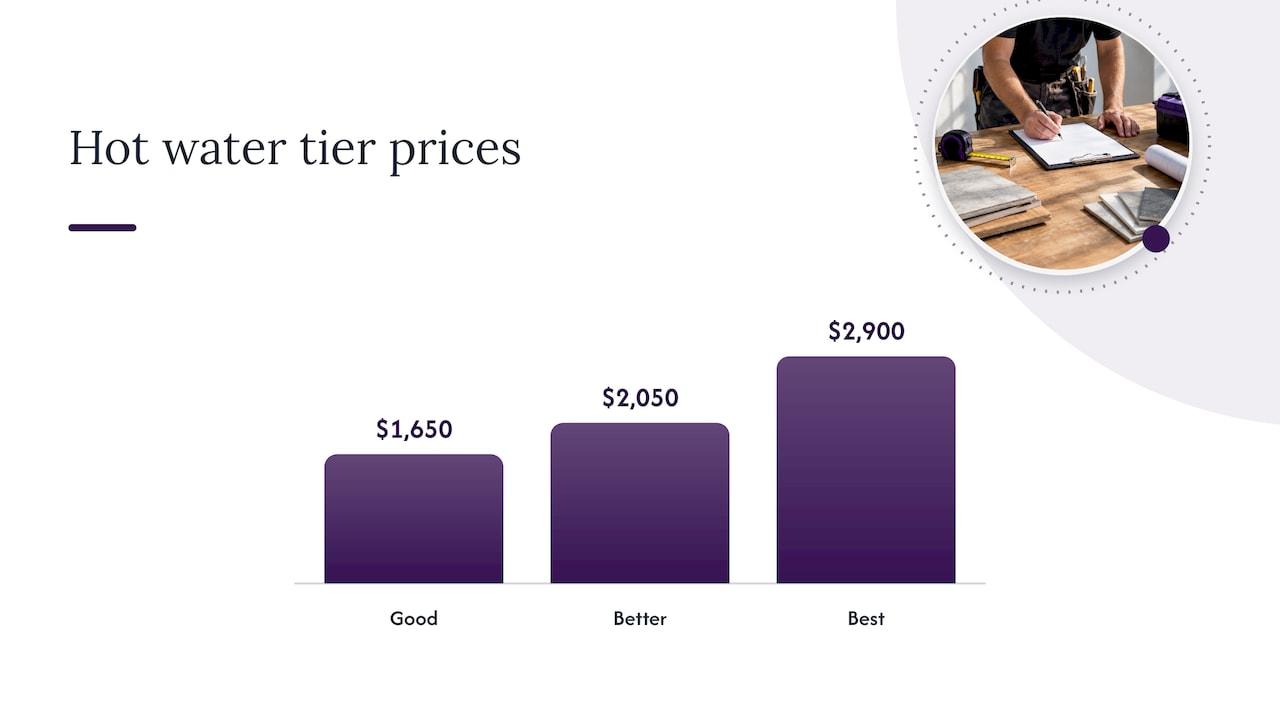
A good rule of thumb is a modest step from Good to Better and a bigger step from Better to Best. The first jump should buy a real jump in value. The second pays for extras that matter to fewer people. Here’s an example, with figures that are ours and purely illustrative, for a like-for-like hot water swap:
| Good | Better | Best | |
|---|---|---|---|
| What changes | Like-for-like unit, standard warranty | Higher-efficiency unit, 3-year labour warranty | Premium unit, 5-year labour warranty, first service, priority booking |
| Example price | $1,650 | $2,050 | $2,900 |
| Step from previous | n/a | about 24% | about 41% |
Work out your own costs for each column first, then check that every tier clears your target margin. If Good only makes sense when everything goes right, the tier is a trap.
Don’t overstate value either. Claims in a quote about performance, savings or lifespan need to be things you can stand behind, because misleading claims can breach the Australian Consumer Law.
Presenting three options so the customer can choose
A good structure is wasted if the quote is hard to read. A few habits help.
- Build the options on site. Do it during the walkthrough, while you can still see the switchboard, the roofline or the pump room, and before you talk price.
- Lead from the top. Showing Best first means the first number the customer sees is the high one. Everything after it feels like good value, and the talk becomes about taking things away rather than adding them.
- Recommend one out loud. Say which option you’d choose in their position and why, in one or two sentences.
- Say the three prices in one go, then stop talking. What the customer says next tells you their budget or their real concern.
- Explain every gap in scope terms. If a customer asks why Best costs more, point to what is physically different: the board size, the warranty length, the extra visit. If you can’t, the tiers aren’t real.
The quote document matters too. Each option should list its inclusions side by side, with the warranty and timing spelled out. Your terms should be just as clear, covering how long the price holds and what deposit applies, which is what our guide to tradie quote terms covers. A tiered quote that’s fast to send also beats one that sits on your laptop for three days, because customers often go with whoever replies first.
Keeping prices consistent with a price book
Tiering one job is easy. Tiering the fortieth is where it falls apart, because every quote gets built slightly differently. That’s what a price book fixes.
Pricing consultancy Pricing Insight describes a price book as four parts: one list price per product, a written method for how the list was set, a small number of customer tiers that turn list prices into the customer’s price, and a floor you don’t go below. In one Australian hardware distributor, rules like these cut the number of pricing decisions by 99%. A trade business is far smaller, but the principle is the same: fewer decisions mean fewer mistakes.
For a tradie, a practical price book looks like this:
- List your 10 to 20 most common jobs. Switchboard upgrade, hot water swap, split system install, gutter clean, fence panel run, whatever you quote most.
- Write the Good, Better and Best scope for each. Same wording every time.
- Cost each tier and set the price from your margin. Record the margin next to it.
- Set a floor. Decide the lowest price you’ll accept for each tier, so discounts don’t quietly erase your profit.
- Review it once a year, or whenever your supplier costs jump.
Pricing Insight also suggests keeping discount structures to three to five levels with clear entry rules. For a small business, that might simply be a standard price, a repeat-customer price and a builder or strata price. Negotiating job by job is slow and leads to inconsistent prices.
Checking which tier customers choose

After a month or two of tiered quotes, look at what people actually pick. A healthy pattern has most customers choosing Better, a decent share choosing Good and a smaller group choosing Best. One commonly quoted target is roughly 30% Good, 50% Better and 20% Best, but treat it as a guide for your own trade, not a rule.
Then adjust:
- Nearly everyone picks Good? The step to Better is probably too big, or the extra value isn’t clear. Name the difference more plainly.
- Nobody picks Best? That’s usually fine, because it’s doing its framing job. If you’d like some to take it, add something customers actually want, such as a faster start.
- Everyone picks Best? You may be underpriced. Raise the top tier.
Expect some lost quotes when you lift prices. A review of an electrical contractor’s pricing by a business coach found that staged increases improved profitability and cash flow immediately, even though the conversion rate dropped as lower-value prospects were priced off. Winning every job isn’t the goal. Winning the right ones at the right margin is. The way to see this on your own jobs is to compare quotes sent, jobs won and profit per job, which is what our job profitability analysis covers.
Tier examples you can adapt
Use these as shapes, not price lists. Your costs, region and licence class set your actual numbers.
- Switchboard upgrade: Good is a standard board with code-minimum safety switches and a 1-year warranty. Better adds a larger board and safety switches on more circuits. Best adds surge protection, a longer warranty and a pre-wired circuit for an EV charger.
- Hot water: Good is like-for-like. Better is a higher-efficiency unit with a longer labour warranty. Best is a heat pump or premium unit, with a first annual service and priority booking.
- Kitchen rewire: Good uses standard fittings. Better adds extra points and lighting. Best adds designer switches, smart lighting and a priority completion window.
- Air con install: Good is a basic system. Better is a higher-efficiency model with a longer labour warranty. Best adds a first-year service visit and a faster install date.
- Gutters, fencing or painting: Tier by materials, coats or panel grade, warranty length and whether you include prep and clean-up.
The pattern is the same each time: compliant baseline, recommended middle, premium with extras.
Where Ask Hayley fits
A tiered quote only helps if you send it while the customer is still interested. Ask Hayley is a voice-first business platform for Australian tradies. Hayley answers calls you can’t take, pre-qualifies leads before they reach your inbox, and handles admin like quote generation and invoicing through natural voice prompts, with integrations for Xero. You stay on the tools, and the next job doesn’t go to whoever picked up the phone.
If you want a better first impression online as well, we also build a one page website for trade businesses. You can see everything we offer on the Ask Hayley home page.

Our view: three options are a service, not a trick
We talk to tradies who’d rather be on the tools than at the kitchen table doing quotes. That’s why quoting habits matter so much. If building three options takes an hour of typing at night, you won’t do it. If it’s quick, you will.
Here’s how we see it. Good, better, best isn’t about squeezing customers. It’s about being clear. A customer who sees three honest options with plain differences feels in control, and a tradie who prices each from real costs doesn’t dread the tough questions.
The same goes for the rest of the job. Missed calls turn into lost quotes, and slow follow-up turns into lost jobs. Ask Hayley answers your calls, pre-qualifies leads and takes admin by voice, so your pricing work has somewhere to land. Get the structure right once, then use it every time.
Hayley
FAQ
Is good, better, best pricing the same as tiered pricing?
Yes, for most purposes. It’s a form of tiered pricing with three levels, sometimes called Goldilocks pricing. Some tradies use four or five tiers for account customers, but three is easiest for a homeowner to compare.
Will customers just pick the cheapest option?
Some will, and that’s fine, as long as Good is priced to make a margin and is a job you’d stand behind. Most customers choose the middle when the value gap is clear and you recommend it. A named reason for each gap does most of the work.
How many things should differ between tiers?
No more than three. Warranty length, component grade, an included service visit or a faster completion time are typical. If the list is longer, the customer can’t compare and you’ll spend the visit explaining instead of quoting.
Do I need a price book to use this?
You can start without one, but a short price book of your common jobs saves time and keeps your prices consistent. Start with the 10 to 20 jobs you quote most, write the three scopes for each, and set a floor price so discounts don’t eat your margin.
Sources
- Pricing Insight: Standardise Quoting and Pricing Rules
- Pricing Insight: Price Architecture, Setting Customer Bands and Tiers


