


Most tradies in Australia should offer four things: card or tap-to-pay on site, PayID or bank transfer for bigger jobs, a digital invoice with a clear due date, and a deposit up front on larger work. Cash can stay as a backup, but it shouldn’t be your main method. Since 1 October 2026 you also can’t add a surcharge to card payments, so your card costs now have to live inside your price.
This guide walks through each option, what it costs you, where it falls over on a job site and how to put a simple setup together.
TL;DR
- Offer a mix: tap-to-pay for small jobs, PayID or bank transfer for big invoices, and a deposit before you order materials.
- From 1 October 2026, card surcharges are banned on Visa, Mastercard, American Express and eftpos cards. Build the cost into your quote.
- Cash is still legal, but you must keep proper records, and relying on it alone can make you look less professional.
- Short payment terms and a same-day invoice do more for your cash flow than any app.
- Connect payments to your accounting so every payment is matched without end-of-quarter scrambling.
Table of Contents
- Why your payment options matter more than they used to
- The main payment options, compared
- The surcharge ban: what changed on 1 October 2026
- Deposits and progress claims: get paid before you carry the cost
- Payment terms: shorter is usually better
- Match payments to your accounting
- A sensible payment setup, by trade type
- Our view: payments shouldn’t mean more admin
- Where Ask Hayley can help
- FAQ
- Sources
Why your payment options matter more than they used to
Customers have moved on. The 2025 State of Small Business Report found cash is now just 24% of transactions, with 76% made by card, contactless or other digital methods. The RBA’s May 2026 bulletin on consumer payments shows online payments are now around 20% of all consumer payments, up from 4% in 2007.
Your customer has likely paid for their coffee, groceries and petrol with a phone this week. When you hand them a number to deposit into by hand, or ask for cash, the job feels less polished, even if your work is excellent.
There’s a cash flow side too. A job isn’t finished when you pack the ute. It’s finished when the money is in your account. Every day between the last tool and the payment is a day you’re funding the customer’s project from your own pocket.
The main payment options, compared
No one method suits every trade or every job. Business.gov.au makes the same point: match your methods to your business model and your customers. Here’s how the common options stack up for a tradie.
| Option | Best for | Main upside | Main watch-out |
|---|---|---|---|
| Tap and card (phone or terminal) | Call-outs, small repairs, residential | Customers expect it, paid on the spot | Processing fees, patchy coverage |
| PayID or bank transfer | Deposits, larger invoices, commercial clients | No card fees, funds arrive fast | Customer must act, so needs a clear invoice |
| Invoice with payment link | Anything quoted, progress work | Professional, trackable, easy to chase | Slower if terms are loose |
| Cash | Occasional small jobs | Instant | Records, safety, and customer perception |
| Deposit or progress payments | Renovations, installs, multi-day work | Covers materials, filters out tyre-kickers | Needs a written policy |
Tap and card payments on site
For residential call-outs this is the default. NAB explains how EFTPOS works: it lets customers pay with a debit card, credit card or mobile wallet from their phone or a wearable. You can take these payments with a standalone terminal or a tap-to-pay app on your phone, depending on your provider.
The catch is connectivity. Plenty of tradie work happens in basements, new builds, rural properties and roof cavities where reception drops out. Business.gov.au notes that a terminal with an offline mode, which stores transactions and processes them once you’re back in range, is worth looking for. Before you buy, ask your provider how offline payments work and what the risks are if a card is declined later.
PayID and bank transfer
PayID lets your customer pay to a mobile number, email or ABN instead of typing a BSB and account number. Payment providers describe it as account-to-account on the New Payments Platform, close to real time and with no card fee attached. Check with your own bank what they charge, if anything, and how to set it up.
It suits the bigger tickets. On a $12,000 bathroom renovation, even a small percentage in card fees adds up. A PayID or bank transfer request keeps that margin.
Invoices with a payment link
A digital invoice with a link or a PayID reference is the workhorse of getting paid. The customer taps, pays and gets a receipt. You see it land.
The real gain is speed. Send it before you leave the driveway, not on Friday night. If you’re quoting and invoicing by voice or on your phone, the gap between finishing and invoicing shrinks to minutes. We cover that process in our hands-free quote to invoice workflow.
Cash
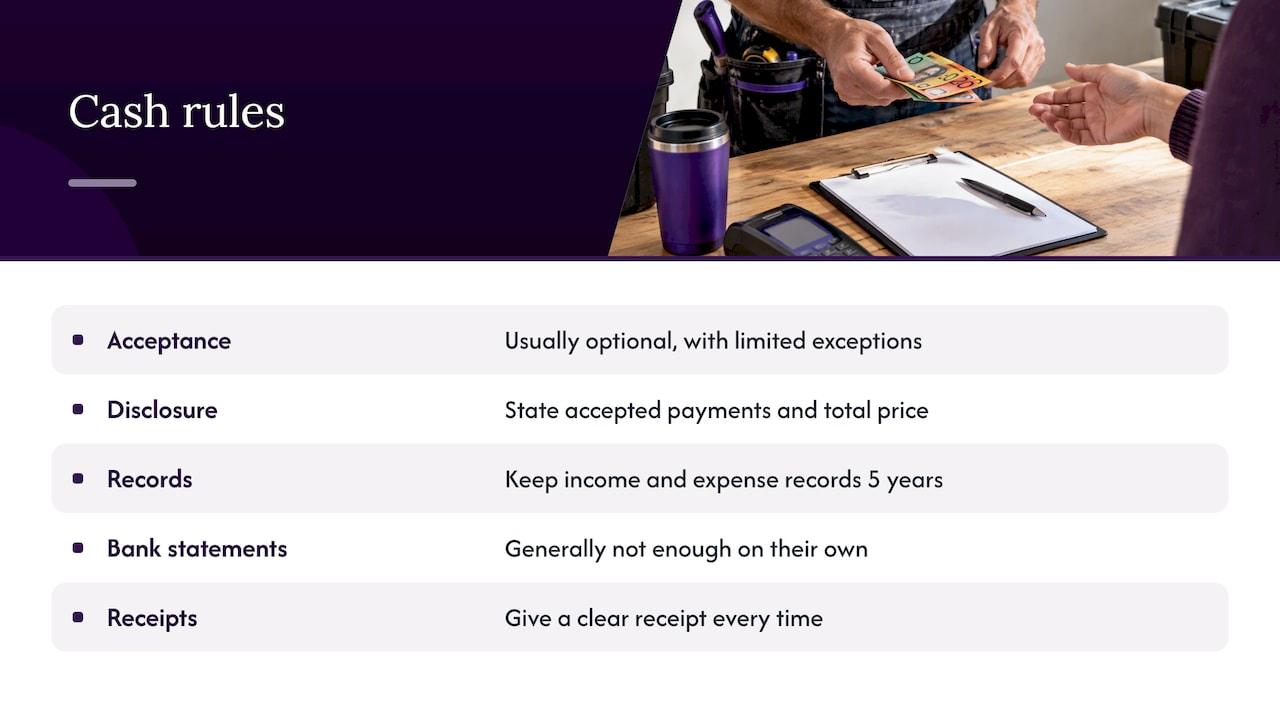
Cash isn’t illegal and most businesses can choose what they accept. The ACCC says most businesses don’t have to accept cash, though some supermarkets and fuel retailers do under limited criteria. The flip side is that you also have to be clear with customers about which payments you accept and the total price.
If you do take cash, the record-keeping rules still apply. The ATO says you must keep records of income and expenses, cash included, for at least five years, and bank statements alone generally aren’t enough. If you pay subcontractors in cash, you may also need to lodge a Taxable Payments Annual Report. Talk to your accountant or the ATO about how that applies to your situation.
Cash discounts are a separate issue. Offering them to customers can raise questions about whether the income is recorded properly and leaves the customer without a paper trail for warranty. Giving a clear receipt every time protects both of you.
The surcharge ban: what changed on 1 October 2026
For years many tradies added 1% or 2% for card payments. That has now ended. Under the ACCC’s guidance, businesses can no longer charge a surcharge on Visa, Mastercard, American Express or eftpos credit, debit or prepaid cards from 1 October 2026. Other fees that aren’t based on how the customer pays are still allowed.
What does that mean in practice?
- Price it in. Work your average card cost into your hourly rate or call-out fee rather than adding a line at the end.
- Steer big payments to PayID or transfer. No card fee, no problem.
- Update your terms and quotes. Remove any old surcharge wording from your templates, invoices and website.
- Check with your provider. The ACCC says businesses should check the card network rules or ask their payment service provider if unsure.
The ACCC also covers whether businesses can raise prices when surcharges go away, so read its page before you restructure your rates.
Deposits and progress claims: get paid before you carry the cost
Payment options aren’t only about how the customer pays. They’re about when.
If a job needs materials, a deposit means you aren’t financing them. If a job runs for weeks, progress claims keep money coming in as each stage is complete, instead of one big invoice at the end that sits unpaid.
A few habits that help:
- Put the deposit amount and due date on the quote, so the customer agrees to it when they accept.
- Tie progress payments to clear milestones, like rough-in complete or waterproofing signed off.
- Write down what happens if the customer cancels. Our guide to setting a job cancellation policy shows how.
For specifics on how much to ask for, see our guide to a deposit policy for Aussie tradies. If your work runs in stages, our page on progress claims in Australia is a good next read.
A quick example. You quote a $6,000 fence. You ask for a deposit to order the materials, then the balance on completion by PayID, with an invoice sent from the driveway. You’ve covered your outlay, given the customer a simple way to pay and avoided card fees on the largest part.
Payment terms: shorter is usually better
One of the top-ranking guides for this topic argues that short terms such as 7 or 14 days work best for most tradie businesses because money flows back faster. We can’t vouch for a universal rule, but the logic holds. The longer the term, the longer you wait and the more likely a reminder is needed.
A simple setup:
- Residential: payment on completion, same day.
- Small commercial: 7 or 14 days, stated on the quote and the invoice.
- Larger work: deposit, then staged payments.
Then follow up. Most late payers aren’t dodging you, they just forgot. A polite reminder on a set schedule works. Our piece on follow-up cadence sets out a rhythm you can copy.
Match payments to your accounting
The payment is only half the job. You then have to record it.
The ATO suggests recording income and cash payments daily where it applies to your business, and reconciling your daily sales. Its pages on when to do record-keeping tasks and debtor and creditor records are worth bookmarking.
The easiest way to meet that is to cut out double entry:
- Connect your bank feed to your accounting software.
- Issue every job through an invoice, even for tap-and-go payments, so each payment has something to match against.
- Check matched and unmatched items weekly, not at the end of the quarter.
If you use a payment platform that doesn’t link to your accounting software, you’re retyping data that should be automatic. That’s where errors, and late-night BAS sessions, come from.
A sensible payment setup, by trade type
There’s no single answer, but these starting points work for most businesses.
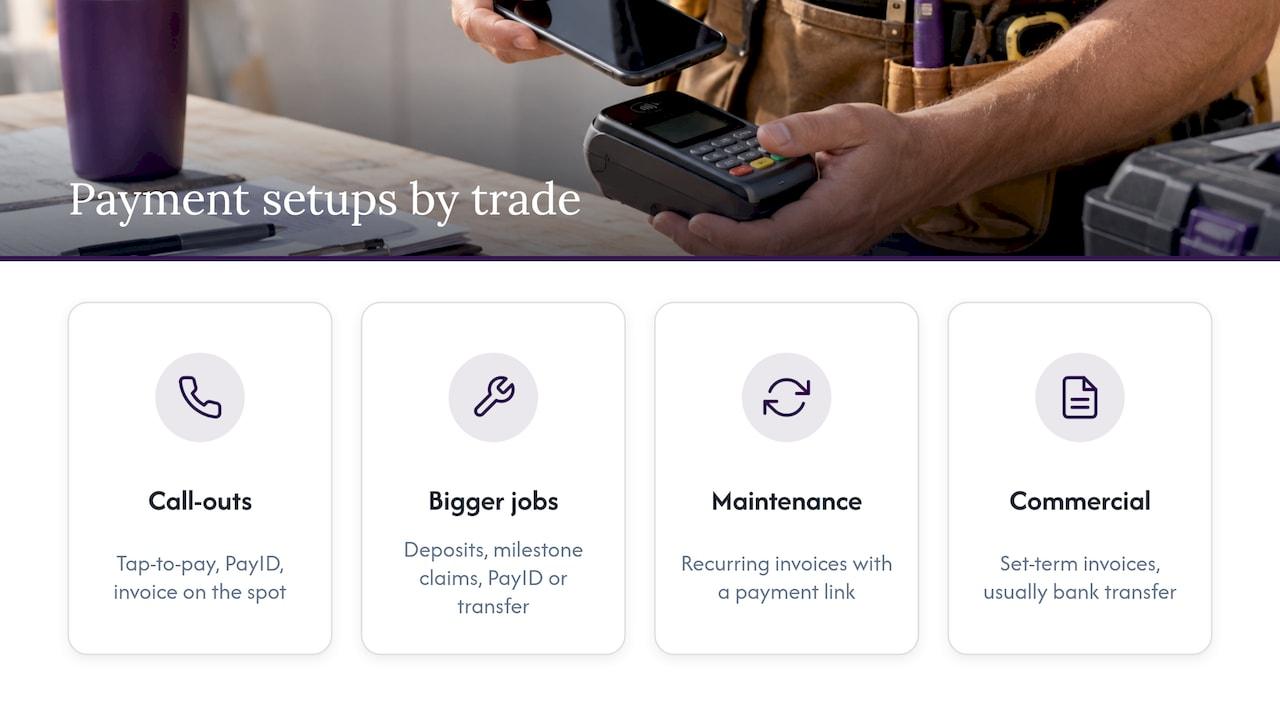
Solo sparky or plumber doing call-outs. Tap-to-pay on your phone, plus a PayID option. Invoice on the spot.
Builder, carpenter or concretor on bigger jobs. Deposit on acceptance, progress claims at milestones, PayID or transfer for each invoice. Cards for variations and small extras.
Arborist, cleaner, gutter or pool maintenance. Recurring customers suit invoices with a payment link, with terms stated up front. Cards for one-off jobs.
Commercial and strata work. Invoices with set terms, usually bank transfer. Make sure your invoice has everything the client’s accounts team needs, to avoid delays.
Whatever you choose, keep a fallback. Many tradies find a hybrid works best on site: a terminal with offline mode or a bank transfer option when coverage is bad, and cash only as a last resort with a written receipt.
Our view: payments shouldn’t mean more admin
We built Ask Hayley for tradies whose hands are full and whose time is short. Here’s what we see again and again. The problem is rarely that a tradie lacks a way to take payment. It’s that sending the invoice, chasing it and matching it all depend on sitting down at night with a laptop.
So our advice is simple. Pick two or three payment methods, not seven. Make sure each is quick for the customer. Then fix the admin around them: quote, invoice, reminder and record, ideally in one place and without typing.
That’s the idea behind Ask Hayley. You talk, and the business admin gets done. We also answer calls you can’t, so the lead who wants a quote doesn’t ring the next tradie. When enquiries, quotes and invoices flow into one system, getting paid becomes the end of a smooth process instead of a chore you put off.
— Hayley
Where Ask Hayley can help
If you’re tightening up how you present and run your business, we also build One Page Websites for tradies, and offer tender support and safety and compliance documentation. A clear website that states how you take payment, and what deposit you need, saves time on every quote. You can see everything we do on the Ask Hayley home page.
FAQ
Can tradies still ask for cash?
Yes. Most businesses can choose which payment methods they accept, according to the ACCC. If you take cash, keep written records and give a receipt. The ATO expects cash income and expenses to be recorded and kept for at least five years.
Can I still charge a surcharge for card payments?
Not on Visa, Mastercard, American Express or eftpos cards. The ban started on 1 October 2026, per the ACCC. Other fees not based on how the customer pays can still apply, so build card costs into your pricing and check with your payment provider.
What’s the cheapest way for a tradie to get paid?
Often PayID or a bank transfer, because there’s no card fee attached. That’s why it suits deposits and large invoices. Compare your bank’s and provider’s fees to see the real difference for your volume.
What should I do if I have no mobile coverage on site?
Have a fallback. Look for a terminal with an offline mode, as business.gov.au suggests, or send an invoice with a PayID reference once you’re back in range. Ask your provider how offline payments are handled first.
How quickly should I invoice?
As soon as the work is done, ideally before you leave. Short terms such as 7 or 14 days are common, and a prompt reminder schedule helps with late payers.
Sources
- ACCC: Card surcharges
- ACCC: Payment methods
- business.gov.au: Choose payment methods
- COSBOA: State of Small Business Report, August 2025
- RBA: Consumer Payment Behaviour in Australia, May 2026
- ATO: Tradies, be certain about what you can claim
- ATO: When to do record-keeping and reporting tasks
- ATO: Debtor and creditor records
- NAB: What is EFTPOS
- Pebl: Card payments for tradies


