


Contractor prequalification is the administrative gate that makes you eligible to tender for government construction work in Australia. National schemes such as the National Prequalification System and the Austroads civil scheme sit alongside state registers like Victoria’s Construction Supplier Register and Queensland’s PQC system. Each one checks your finances, technical capacity and management systems. Passing can make you eligible to tender, but it does not guarantee a contract.
TL;DR:
- Thresholds vary: Queensland requires directly engaged building contractors to prequalify above $1 million, while Victoria’s works threshold is $750,000 and services threshold is $300,000.
- The national building scheme covers nonresidential projects estimated at $50 million or more; mutual recognition varies by jurisdiction, so confirm your level before bidding interstate.
- Applications require three years of financial statements, project evidence, staff credentials, insurance, and management system records; authorities recommend starting months before a tender.
- Once listed, agencies can review financial viability, technical capacity, and management systems, while poor project reports or expired certificates can trigger downgrades, suspension, or cancellation.
- Subcontractors working under a head contractor may not need their own registration, but principals can still require equivalent evidence for their supply chains.
Table of Contents
- What is contractor prequalification and how does it fit into government procurement?
- How do the national schemes work alongside state and territory systems?
- Who needs prequalification, and what are the thresholds in NSW, Victoria and Queensland?
- What do agencies actually check in a prequalification application?
- How do you apply, step by step?
- How do you maintain prequalification once you have it?
- What documents and systems should you have ready before you start?
- Where can you check registers, download forms and find the assessing agency?
- How does prequalification differ for general contractors and subcontractors?
- How does prequalification affect tendering success?
- Can digital tools and AI platforms make prequalification easier?
- Author perspective: what should tradies do in the next 90 days?
- How can we help with tender packs, compliance documents and presenting your business?
- FAQ
- Sources
What is contractor prequalification and how does it fit into government procurement?
Think of prequalification as agencies asking one question before they ask about price: can you actually deliver? Assessors check that your business has the capability and capacity for the type and size of work you want, then record the result on a register. Procurement teams use those registers to shortlist suppliers and to run selective tenders. Government pre-qualification registers are used this way across several state schemes.
A few things are worth knowing up front:
- Being prequalified lets you tender or be invited to a selective list. It does not guarantee a single contract.
- You must be assessed, registered and active on the relevant system before you can take part in a tender.
- National schemes aim to cut duplication through mutual recognition, so one assessment can carry weight in more than one jurisdiction.
- There is generally no fee to apply for government prequalification, though your own preparation time is real.
How do the national schemes work alongside state and territory systems?
Two national schemes matter most. The National Prequalification System for non-residential buildings applies to contracts with a construction cost estimate of $50 million or more. Austroads manages the companion system for civil work, covering roads and bridges, which state and territory road agencies administer locally through the National Prequalification System for Civil.
Here is how they interact with state systems:
- Assessing agencies set your financial level, and recognition conditions can differ between jurisdictions.
- For the building scheme, you usually apply in the state of your head office to be eligible for NPS recognition.
- Mutual recognition is governed by the participating agencies, so a level granted in one place may not map one-to-one elsewhere.
- The NPS guidelines describe ongoing reviews, financial checks, periodic renewals and the recognition rules among participating agencies.
Always confirm with the assessing agency before you assume your status carries across a border.
Who needs prequalification, and what are the thresholds in NSW, Victoria and Queensland?
Whether you must apply depends on the state and the contract value. These are the examples from official guidance:
- Queensland: prequalification is mandatory for building contractors directly engaged on government projects valued over $1 million, as Business Queensland explains. Once prequalified, you can tender through QTenders, per the PQC System overview.
- Victoria: the Construction Supplier Register uses thresholds from $300,000 for services and $750,000 for works, according to its eligibility criteria, which also spell out what you need to demonstrate.
- NSW: whole-of-government schemes cover several engagement fee tiers, with separate lists for consultants and larger works. The tiers run up to $250,000, from $250,000 to $1 million, and from $1 million to $9 million.
If your target jobs sit below these lines, you may not need to prequalify yet. If they sit above, start early.
What do agencies actually check in a prequalification application?
Assessors look at several aspects of your application, and each needs evidence rather than assertion:
- Financial capacity: recent financial statements, asset ratios, net tangible assets and turnover. The ACT, for example, assesses the last three years of financial statements.
- Technical capacity: relevant project experience, CVs for nominated personnel, licences and certifications.
- Management systems: quality, OHS and environmental systems, for example AS/NZS ISO 9001, ISO 45001 and ISO 14001 where required, with independent audit evidence if requested. Austroads expects these systems to be demonstrated.
- Insurances, registrations and referees: current certificates, trade registrations and referee reports. Where you miss a criterion, conditional prequalification may be offered at the agency’s discretion, sometimes with guarantors or extra undertakings.
Pro Tip: Write each project example around what you did, the contract value and the outcome. Assessors read dozens of these, and specifics stand out.
How do you apply, step by step?
Most applications follow the same path. Allow more time than you think you need, because authorities recommend starting months early given how long administrative and financial checks can run.
- Pick the scheme and category that match the work you want to tender for, and confirm the value threshold applies to you.
- Gather your company details (ACN/ABN), the last three years of financials, insurance certificates, licences, CVs and evidence of your management systems.
- Read the application guidance for your scheme so your evidence matches what assessors expect.
- Submit electronically through the agency portal. The ACT process, for instance, uses set forms, electronic lodgement, and technical and financial assessment.
- Respond to clarification requests, referee checks and any audit the assessing agency raises.
- For the NPS non-residential $50 million-plus scheme, lodge where the rules say (head office or intended bidding jurisdiction) and allow extra time for mutual recognition.
Some schemes, including ACT’s, may also ask for second or third party certification of your QA, OHS and environmental systems, so check early whether yours are certified.
How do you maintain prequalification once you have it?
Getting listed is the start. Agencies keep checking, and status can move in both directions:
- Agencies may review your financial viability, technical capacity and management systems as part of maintaining your status. Check the relevant agency’s current review requirements.
- Performance reporting on completed projects feeds your status. Poor performance reports can lead to downgrade, suspension or cancellation.
- Victoria’s register expects suppliers to keep portal records accurate and updated.
- Tell the agency about key changes such as personnel, ABN or ACN, and insurances. Letting a certificate lapse is an easy way to get suspended for something that has nothing to do with your work quality.
Put renewal dates for insurances, licences and audits in one calendar and assign someone to own it.
What documents and systems should you have ready before you start?
Having this pack assembled before you open the application portal saves weeks:
- Company documents: ACN/ABN, an ASIC extract, the last three years of financial statements and bank references.
- Insurance certificates, including public liability and professional indemnity where required, plus licences and trade registrations.
- Evidence of your quality, OHS and environmental systems, CVs for nominated personnel, project references and referee contacts. Your induction and first aid records support the OHS side, and construction first aid requirements are a good place to check what your crews need.
- Any jurisdiction-specific pre-assessment certificates, such as Fair Jobs Code where it applies.
If your safety and quality paperwork is thin, our safety and compliance documentation work is aimed at exactly that gap.
Where can you check registers, download forms and find the assessing agency?
Go to the agency portals rather than third-party summaries, because lists and forms change:
- Austroads publishes prequalified contractor lists for civil work, with updated downloads.
- State portals cover the rest: Victoria’s Construction Supplier Register, Queensland’s PQC, NSW’s schemes and ACT guidance. Tasmania’s procurement pages and South Australia’s infrastructure and transport guidance explain their own schemes and forms.
- To confirm a contractor’s financial level, use the published lists, since the assessing agency determines that level.
How does prequalification differ for general contractors and subcontractors?
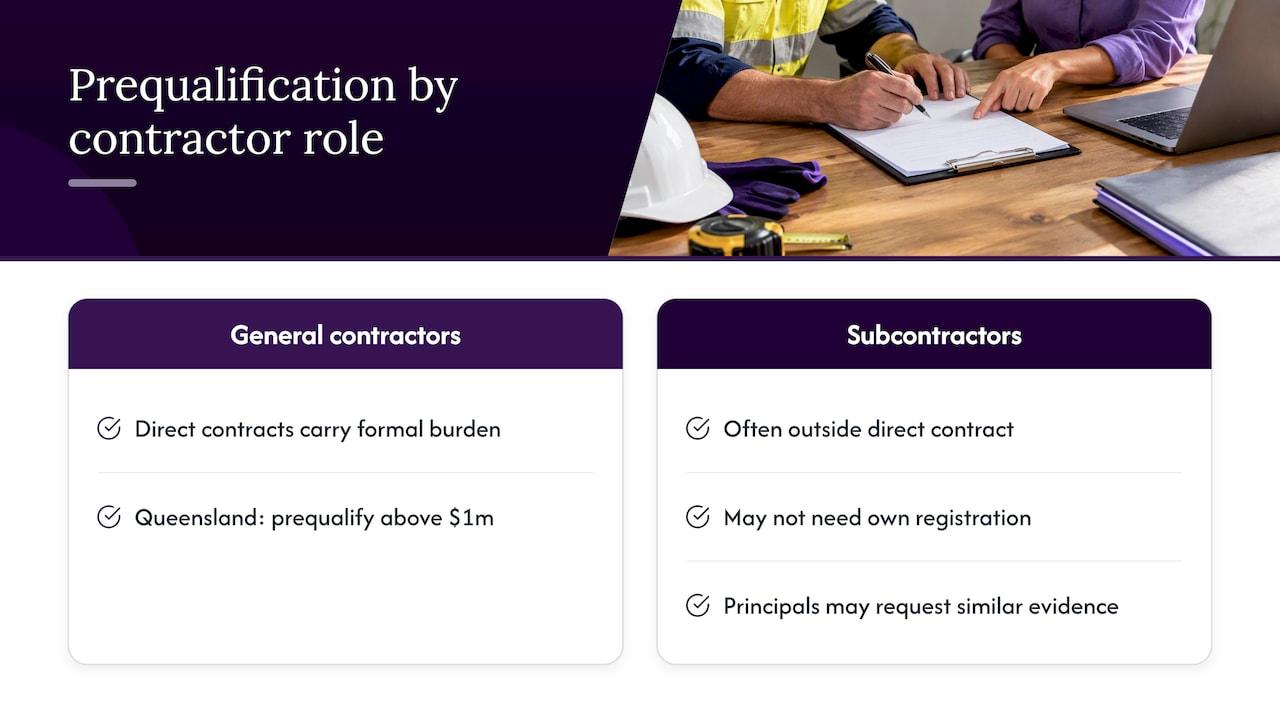
The scheme logic is the same, but the practical weight differs. General contractors are usually the ones government agencies engage directly, so they carry the formal prequalification burden. In Queensland, all building contractors directly contracted on government projects must be prequalified above the $1 million line. Subcontractors often sit below that direct relationship, so they may not need to register themselves, but principal contractors can still ask for similar evidence when building their supply chain.
Some schemes also run categories for specialist trades. Victoria’s register groups suppliers by pre-qualification category, and category assessment can require demonstrated experience on at least three similar projects. A specialist subcontractor chasing direct government work needs that track record in its own trade, not borrowed from a head contractor.
Structure matters too. Unincorporated joint ventures are usually only eligible for conditional prequalification, and related or subsidiary companies generally need to apply in their own right. So if you plan to team up with another business, sort out the legal structure before you lodge.
A practical rule: if you contract directly with government above the threshold, assume you need to prequalify. If you work under a head contractor, ask them what evidence they want, then build your pack from the same checklist anyway. It makes you easier to engage.
How does prequalification affect tendering success?
Prequalification decides whether you get into the room. It does not decide who wins. Once you are on a register, agencies can invite you to selective tenders, and you can respond to open ones that require registration. NSW agencies, for example, use their prequalified suppliers for selective tenders.
After that, the tender itself is a separate contest. Your price, methodology, program, safety approach and references get scored on their own merits. Strong prequalification evidence helps here because the same material often feeds your tender response: project examples, personnel CVs and systems documentation. Do the work once, then reuse it.
It also shapes which jobs you can chase. Your financial level and category determine the size and type of work you are eligible for, so a low level can quietly cap your pipeline. Check yours before you commit to a tender, not after.
Presentation counts as well. A tight, clear submission signals that your business is organised. Our guide to a one-page tender cover letter covers how to frame your business at the front of a bid, and our methodology statement templates cover the scored section where many small contractors lose points. If you are targeting specialist compliance routes, our CM3 certification guide walks through assessor expectations.
Can digital tools and AI platforms make prequalification easier?
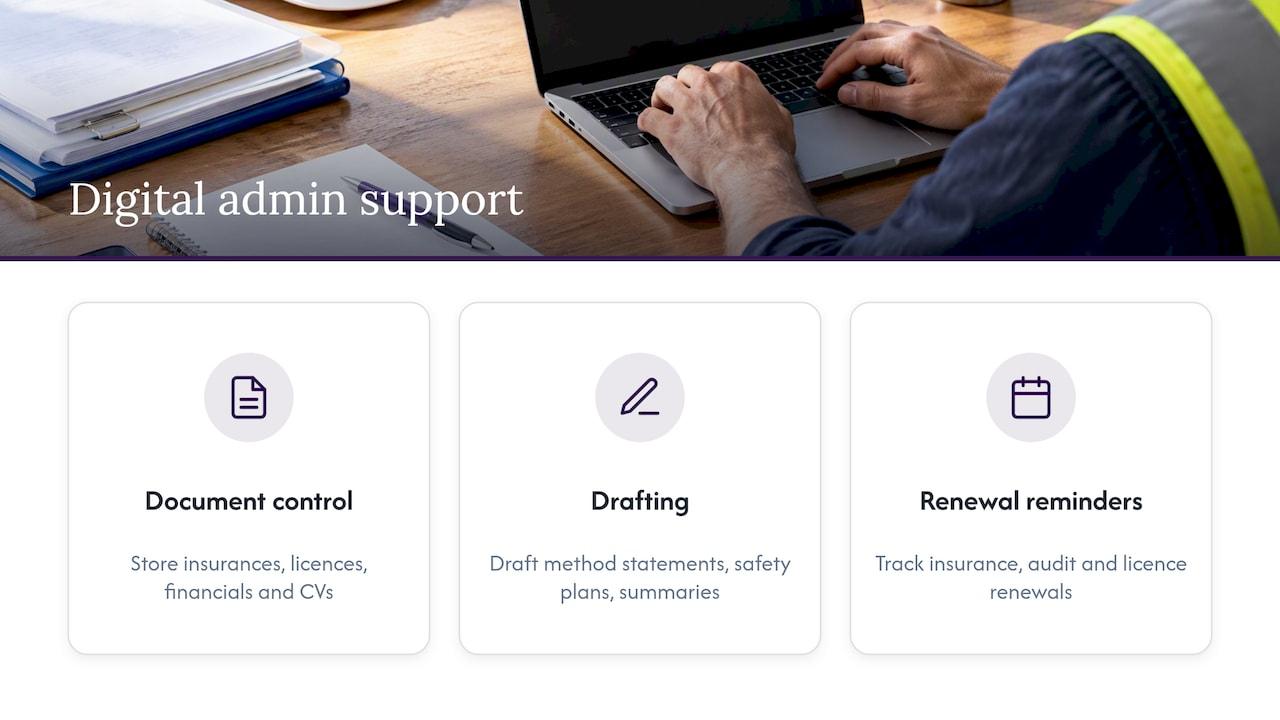
Yes, mostly by taking the repetitive admin off your plate. Prequalification and tendering both run on the same raw material: documents that must be current, consistent and easy to find. Digital tools help in three places.
First, document control. A single, organised store for insurances, licences, financials and CVs means you are not hunting through email on submission day. Portals like Victoria’s register already expect you to maintain accurate records, so keeping your own copy tidy matches how the system works.
Second, drafting. Methodology statements, safety plans and project summaries follow patterns. Templates and AI assistance get you to a solid first draft quickly, though you still need to check every claim against what your business really does. Assessors can tell when a document does not match your crews and projects.
Third, reminders. Renewal dates for insurances, audits and licences are easy to miss when you are on site all day. A voice-first assistant fits that reality: you talk, it logs the task or reminder, and nobody has to sit at a screen after hours.
We built our platform for exactly that on-site reality, with voice-driven admin for tradies. Technology does not replace the evidence assessors want. It just makes sure you have it ready, current and in one place.
Author perspective: what should tradies do in the next 90 days?
Start with the slow stuff. Financial checks and audits take time, so pull your financials together and write up CVs for the people you will nominate now, not when a tender drops. Use templates for methodology and safety documents so you never scramble for the missing page. And if you are bidding above the threshold limits, get professional help with the tender pack. A weak submission costs more than the help does.
— Hayley
How can we help with tender packs, compliance documents and presenting your business?
If your prequalification evidence or tender pack is the bottleneck, we can take that load. Our team offers tendering support, safety and compliance documentation, and a one page website so your business looks as capable online as you are on site. We offer safety and compliance documentation to support applications.

Get in touch through our tendering page and we will scope a tender pack or documentation job around your next bid.
FAQ
How can a contractor become prequalified with TfNSW?
Apply to the relevant NSW prequalification scheme for your category and work size, then submit your evidence electronically. NSW civil schemes publish scheme descriptions and templates that show what assessors expect. Check the current scheme pages for your category before you start.
What is a pre-qualified contractor?
A pre-qualified contractor is a business an agency has assessed for financial, technical and management capability and recorded on a register. That status makes you eligible to tender, but it does not give immediate tender rights or guarantee work.
What are the requirements for becoming a contractor in Australia?
Requirements vary by state and trade, but government work usually adds prequalification on top of licensing and insurance. Typical evidence covers financial capacity, technical expertise, management systems and past performance. Check your state licensing body for trade licences.
Who are tier 1 contractors in Australia?
There is no official tier 1 list in the schemes we have covered. The registers instead classify contractors by category and financial level, and the published prequalified contractor lists show where each one sits.
Sources
- Business
- Applying for building contractor prequalification | Business Queensland
- NPS — APCC
- NPS Non-Residential Building $50m Guidelines version 10 updated February 2025


