


CM3 is an Australian contractor prequalification system that verifies your WHS systems, licences and insurance so clients can hire you with confidence. A compliant status on the platform means you’ve already proven your paperwork stacks up, which cuts out repeat questionnaires and makes it far easier to get shortlisted for tenders and ongoing supplier panels.
TL;DR:
- Making sure your Business Risk Profile accurately reflects all your work activities reduces delays and reassessment cycles significantly.
- Uploading specific, project-based evidence that matches declared risks prevents assessor queries and speed up certification.
- Responding promptly to assessor requests and submitting complete evidence in one batch shortens the overall approval time.
- Staying current with platform updates and annual profile reviews ensures compliance standards remain aligned with evolving WHS requirements.
- Displaying a genuine, site-specific safety record rather than generic templates enhances your chances of rapid certification and marketplace visibility.
Table of Contents
- What is CM3 certification and how does the marketplace work?
- How do you get prequalified on CM3? Step by step
- What documents do you need for CM3 prequalification?
- What does CM3 certification cost and how long does it take?
- How do CM3 assessors evaluate submissions?
- How Ask Hayley helps you prepare CM3 evidence
- What is CM3 Induct and how does it help after certification?
- What are the common challenges in getting CM3 certified?
- How does CM3 compare to other prequalification schemes?
- Who benefits from CM3 certification and how?
- How do CM3 standards change and how do you stay informed?
- Real evidence beats polished templates
- Get your compliance evidence sorted before you submit
- Where to check official CM3 and WHS guidance
- Sources
- FAQ
What is CM3 certification and how does the marketplace work?
Cm3 is a web-based prequalification and compliance management system used across Australian construction, facilities management, mining and government supply chains. It exists to solve one headache every principal contractor has: how do you know a supplier will actually turn up with the right insurance, the right licences, and safety systems that work, not just paperwork that looks good?
Clients use Cm3 two ways. Some invite specific contractors they already deal with to join and get verified. Others browse the Cm3 Marketplace to search for compliant suppliers in a given trade or region, which means your profile can generate work you didn’t chase.
Getting compliant status pays off in several practical ways:
- One profile serves every client connected to Cm3, instead of filling out a fresh prequalification form for each new job.
- Compliant contractors appear in Marketplace searches, giving you visibility with buyers you’ve never spoken to.
- You can download your certification and display the Cm3 badge on your website, tender documents and marketing material.
- A single central profile reduces duplicated admin if you’re already working across multiple client accounts.
For a small trade business juggling five or six client relationships, that last point alone can save hours a month; learn how to streamline your operations more effectively on the Installer.
How do you get prequalified on CM3? Step by step
The process follows a fixed sequence, and skipping steps or rushing the Business Risk Profile is the fastest way to end up in a review loop. Here’s the order it actually runs in.
- Get invited or register. Most contractors join because a client invites them, but voluntary registration is also possible if you want to get ahead of a tender requirement.
- Create your account. Set up your business profile with basic company details, ABN and contact information.
- Complete your Business Risk Profile (BRP). This is where you select every activity your business actually performs, from working at heights to using powered tools to entering confined spaces.
- Gather and upload evidence. Licences, insurance certificates of currency, SWMS, training records and past project examples all get attached against the relevant BRP categories.
- Submit for assessment. A Cm3 assessor reviews what you’ve lodged against the risks you’ve declared.
- Respond to requests. If the assessor needs clarification or a missing document, you’ll get a specific request rather than a blanket rejection.
- Receive compliant status. Once everything checks out, your profile moves to compliant and becomes visible to connected clients and the Marketplace.
- Download and use it. Attach your certification to tenders, quotes and your own marketing.
This five to eight step flow mirrors the official Cm3 prequalification process, which groups it into five core stages: invitation, registration, BRP completion, evidence submission, and resolving client-specific requirements.
Pro Tip: Do your BRP before you touch the evidence upload screen. Selecting activities first tells you exactly which documents you’ll be asked for, so you’re not guessing what to attach.
What documents do you need for CM3 prequalification?
Your evidence has to match what you declared in the BRP, activity for activity. Assemble the wrong mix and you’ll be sent back for revision, which is the single biggest cause of delay in the whole process.
Typical documents contractors need on hand:
- Certificate of Currency for Public Liability insurance
- Certificate of Currency for Professional Indemnity insurance (where relevant to your trade)
- Trade licences and individual qualifications for licensed work
- Safe Work Method Statements (SWMS) for high-risk construction activities
- WHS, environmental and quality policies
- Training records for staff (white cards, first aid, plant tickets)
- Past project examples showing the work was actually carried out safely
The trap most contractors fall into is uploading generic SWMS templates that don’t reflect the specific risks in their BRP. If you’ve selected “working at heights” but your SWMS only covers general site hazards, an assessor will flag the mismatch. Many contractors mistakenly build BRPs that omit high-risk activities or tick boxes for work they don’t actually do, and assessors routinely bounce assessments back when the SWMS and BRP don’t line up. Fix it by working backwards from your BRP selections and checking every document names the specific activity, equipment and site conditions it covers.
What does CM3 certification cost and how long does it take?
Cm3 runs on a tiered annual subscription for contractors, with the tier set by the complexity of your Business Risk Profile. A sole trader doing low-risk maintenance work sits in a different pricing band to a multi-crew contractor working at heights and in confined spaces. The subscription covers assessor review and gives you unlimited client connections, so you’re not paying per client once you’re set up.
Timeframes vary depending on how complete your first submission is. A clean application with accurate BRP selections and matching evidence moves through faster than one that needs multiple rounds of clarification.
Steps that reliably shorten the wait:
- Get your BRP right the first time rather than adjusting it mid-assessment.
- Upload complete evidence in one go instead of trickling documents through as requested.
- Use the built-in help tools before you submit, not after an assessor flags a gap.
- Respond to assessor queries the same day where possible, since a stalled thread is the most common reason files sit open for weeks.
How do CM3 assessors evaluate submissions?
Cm3 assessors check that your safety systems are implemented in practice, not just documented on paper. They’re looking for real evidence: actual licences, actual qualifications, actual project history, not a template downloaded the night before submission.
Assessors also function as coaches rather than pure auditors. Because many contractors submitting evidence are operational staff rather than dedicated safety officers, assessors provide feedback and guidance to help you meet requirements rather than simply knocking back an application.
A few habits speed things up on your end. Use the question mark guidance icons and ‘Need Help’ widgets built into the assessment screens. They point to the exact evidence test being applied, which cuts down back and forth. Name your files clearly with dates and project references so an assessor isn’t guessing what a document relates to. And if you’re stuck on a specific requirement, request an assessor callback rather than submitting a half-finished answer.
Pro Tip: Before you hit submit, reread your BRP against your own SWMS as if you were the assessor. If a risk you selected isn’t covered in the documents you’ve attached, fix it before submission rather than waiting for the request.

How Ask Hayley helps you prepare CM3 evidence
Putting together SWMS, policies and project records from scratch eats a weekend most tradies don’t have. Ask Hayley’s safety and compliance documentation packs and NCC-ready handover templates are built to line up with the kind of evidence Cm3 assessors expect: real project detail, not boilerplate. When you buy a compliance pack, expect it tailored to your trade and activities, with version control so you’re not submitting outdated policies, and documents structured to slot straight against your BRP categories rather than needing rework before upload.
What is CM3 Induct and how does it help after certification?
Once your organisation reaches compliant status, Cm3 Induct becomes relevant. It’s the platform’s online induction and training solution, and it changes how you onboard workers onto client sites.
Instead of turning up to a new site and sitting through a generic paper induction, compliant contractors can have site-specific or general inductions distributed automatically, often carrying the client’s own branding. For a contractor running crews across several sites for several clients, this removes a genuine bottleneck: no more chasing induction paperwork by email or waiting on-site for a supervisor to run through the same safety briefing you’ve heard a dozen times.
Your Cm3 Induct code sits inside your contractor dashboard once your organisation is set up on the platform and connected to a client using the Induct module. It’s not something separate you apply for. If you can’t locate it, the fastest fix is checking your dashboard notifications or contacting Cm3 support directly, since it’s generated automatically against your compliant profile rather than issued manually.
There’s a Marketplace angle here too. A compliant profile with induction records already in place signals to prospective clients browsing Cm3 that you’re not just paper compliant, you’re operationally ready to be on-site fast. That’s a meaningful edge when a client is choosing between two similarly qualified contractors and one can start inducting crew the same week.
What are the common challenges in getting CM3 certified?
The single biggest challenge isn’t gathering documents. It’s making sure the documents you gather actually match the risks you’ve declared. Contractors regularly select activities in their BRP that don’t reflect their real work, either overstating scope to look more capable or understating it and leaving gaps assessors then have to query.
A second common trap is treating the submission as a one-off form-filling exercise rather than an accurate snapshot of how the business runs. Generic SWMS pulled from a template site rarely survive scrutiny, because assessors are trained to spot boilerplate that hasn’t been adapted to your actual trade, equipment or site conditions.
Time pressure causes a third problem. Contractors under deadline to win a tender rush the BRP, skip evidence categories, and end up in a longer review cycle than if they’d taken an extra day upfront.
Practical fixes that consistently work:
- Treat the BRP as the foundation. Get it accurate before touching anything else.
- Use real project examples with dates, locations and outcomes rather than vague descriptions.
- Keep insurance certificates current and diarised for renewal well before expiry.
- Lean on the support tools available rather than guessing at what’s required.
- Build your evidence pack once and reuse it, updating only what changes year to year.
None of this is complicated once you’ve been through it once. Most of the friction comes from treating the first assessment like a hurdle to clear rather than a genuine record of how your business operates.
How does CM3 compare to other prequalification schemes?
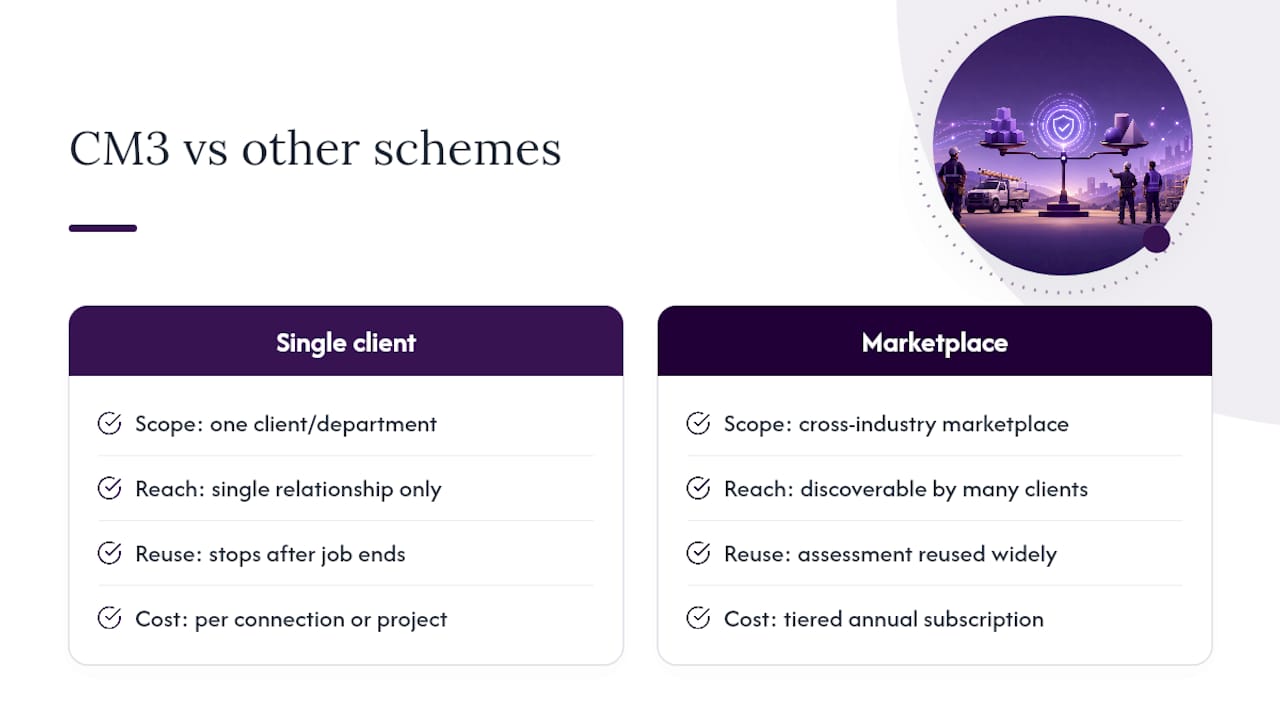
Most industry prequalification schemes in Australia work on a similar principle: verify licences, insurance and safety systems once, then let multiple clients rely on that verification instead of running their own checks. Where schemes differ is in scope, industry focus and how the marketplace side works.
Some schemes are built around a single large client or government department and only serve that one relationship. Others, like Cm3, operate as a genuine marketplace where a single compliant profile can be discovered and used by many unrelated clients across construction, facilities management and government supply chains.
The practical difference for a small contractor comes down to reuse. A scheme tied to one client saves you nothing once that job ends. A marketplace model means the assessment work you’ve already done keeps generating value with every new client that connects to your profile, without resubmitting the same evidence from scratch.
Cost structures vary too. Some prequalification systems charge per client connection or per project, which punishes contractors for growing their client base. A tiered annual subscription model, by contrast, means the cost stays predictable regardless of how many clients you connect with in a given year.
If you’re weighing up which scheme to prioritise, the honest answer is that it depends on who your clients already use. Check what your biggest current or prospective clients require before assuming one platform covers everything, since many principal contractors mandate a specific system for their supply chain.
Who benefits from CM3 certification and how?
Certification pays off differently depending on where you sit in the supply chain, and it’s worth understanding all three angles even if you’re only reading this as a contractor.
Contractors get the clearest win: less repeated admin, since one profile serves every connected client, plus Marketplace visibility that can generate leads you’d never have chased otherwise. A compliant badge also does quiet work in tender responses, signalling you’ve already cleared an independent check rather than asking the client to take your word for it.
Clients (the principal contractors and asset owners using Cm3 to find suppliers) get a faster, more consistent way to build a supply chain without running individual due diligence on every contractor. That matters most in industries where a safety failure by a subcontractor creates real liability for the head contractor, which is exactly why WHS verification sits at the centre of what Cm3 assesses.
Suppliers and larger contracting businesses managing their own subcontractor panels get a similar benefit to clients: they can require Cm3 compliance from the trades they engage rather than building their own vetting process, saving internal admin time while still meeting their own work health and safety obligations under Australian regulation.
The common thread across all three is reduced duplication. Every party avoids re-verifying the same information multiple times, which is the entire reason prequalification platforms exist in the first place.
How do CM3 standards change and how do you stay informed?
Prequalification requirements aren’t static. Regulatory changes to work health and safety obligations, updates to industry codes of practice, and evolving client expectations all feed into what Cm3 assesses over time. A BRP category that covered your risk profile adequately two years ago might need updating if new activities or equipment have entered your scope of work.
The most reliable way to stay current is treating your Cm3 profile as a living document rather than a one-time submission. Review your BRP annually, even outside the renewal cycle, and update it whenever your business takes on new types of work.
Cm3 also communicates changes directly through the platform, so checking your dashboard notifications and any communications from your assessor is worth building into a routine rather than only logging in when a client chases you. Support channels including the knowledge base, live chat and phone support exist specifically to help contractors understand what’s changed and why, so use them rather than guessing at whether a requirement has shifted.
Keeping insurance certificates, licences and training records current as a matter of course, rather than scrambling before renewal, is the single easiest way to stay ahead of any standards update without extra effort.
Real evidence beats polished templates
Assessors aren’t grading your paperwork’s presentation. They’re checking whether what you’ve written matches what actually happens on your sites, and a generic template with no project specifics is easier to spot than most contractors think. The businesses that get through fastest are the ones who treat their BRP as an honest map of their real work, not an aspirational one. Get that right and compliant status stops being a hurdle and starts being genuine leverage in every tender you submit.
— Hayley
Get your compliance evidence sorted before you submit
Ask Hayley is the practical alternative to piecing together SWMS, policies and project records yourself at 9pm before a tender deadline. Rather than starting from a blank template and hoping it matches what an assessor expects, you get safety and compliance documentation built around your actual trade and activities, plus NCC-ready project handover packs that double as the kind of project evidence Cm3 assessors want to see.

If you’re also chasing tender work once you’re compliant, Ask Hayley’s tendering support helps you put your certification to work in actual submissions rather than letting it sit unused on your profile. Head to the Ask Hayley services page to see what’s available, or get in touch to talk through a tailored compliance pack for your business before your next Cm3 submission is due.
Where to check official CM3 and WHS guidance
For the process itself, start with Cm3’s contractor prequalification page. For your underlying WHS obligations, business.gov.au’s work health and safety guidance covers the regulatory basics every submission draws on.
Sources
FAQ
How do you become CM3 certified?
You register or accept a client invitation, complete a Business Risk Profile covering every activity you perform, then upload matching evidence such as licences, insurances, SWMS and project examples for assessment. Once an assessor confirms everything checks out, your profile moves to compliant status and you can download your certification.
How much does CM3 certification cost?
Cm3 uses a tiered annual subscription for contractors, with the tier based on the complexity of your Business Risk Profile, and the subscription covers unlimited client connections. Exact current pricing isn’t published for every tier, so check Cm3’s own contractor pages for the figure that applies to your risk profile.
What does it mean for a contractor to be CM3 certified?
It means an independent assessor has verified your WHS systems, licences and insurance against the real risks in your business, rather than you simply self-declaring compliance. Certified contractors can display the Cm3 badge and appear in Marketplace searches, making it easier for clients to shortlist them without running their own checks.
Where do you find your CM3 Induct induction code?
Your Cm3 Induct access sits inside your contractor dashboard once your organisation is compliant and connected to a client using the Induct module. It’s generated automatically rather than issued separately, so check your dashboard notifications first or contact Cm3 support if you can’t locate it.


