


Price jobs by adding direct costs (materials, labour, plant), recovering your overheads, applying a profit margin, then including GST. The Business backs this approach, and our platform includes quote generation to help you prepare quotes.
TL;DR:
- Calculate charge out rates from full employment costs and realistic billable hours; quoting time, travel, training, and weather delays must be covered too.
- Choose hourly pricing for uncertain scope with a stop loss agreement, fixed rates for repeatable jobs, and cost plus pricing for variable projects.
- Margin measures profit as a share of the sale price; calculate your target price from that figure rather than adding the same percentage to costs.
- Show the price and GST status, document scope and variation terms, disclose after hours fees before attendance, and change prices mid job only by agreement.
Table of Contents
- What goes into every job price?
- How do you calculate labour: charge-out rate, true hourly cost and utilisation?
- How do you recover overheads and set your margin?
- Which pricing model suits which job?
- Worked example: how do you build a job price step by step?
- How do you turn the price into a professional quote?
- How should you adjust prices for market demand and competition?
- How do you price jobs for repeat clients or long-term contracts?
- What should you consider when pricing urgent or after-hours work?
- How often should you review and update your prices?
- Why this method suits Australian tradies
- How we help you price and quote jobs faster
- FAQ
- Sources
What goes into every job price?
Underquoting rarely comes from bad maths on the big items. It comes from the small stuff you forgot to count. Before you touch a margin, list every direct cost the job will generate, because business.gov.au tells businesses to include all relevant costs such as materials, labour, overheads and taxes when setting a price.
Here is the checklist we run through on every job:
- Materials: estimate quantities, then add wastage and delivery. Allow for supplier price movement if the job starts weeks from now.
- Labour: estimated hours, plus a realistic buffer for delays, access problems and the second trip to the supplier.
- Plant and hired equipment: scissor lifts, bins, trenchers and scaffolding priced per day or per job, including pick-up and return.
- Travel and call-out: fuel, tolls, parking and travel time to remote or awkward sites.
- Small items: fasteners, sealants, disposal and tip fees, testing, permits and certificates.
Notice what sits at the bottom of that list. Disposal, testing and permits are the items that quietly eat a margin, because nobody thinks of them as “the job” until the invoice from the tip arrives.
Material costs are the easiest place to be caught out, since a supplier price rise lands between your quote and your purchase. If a quote stays open for an agreed period, say so in your terms and tie the materials line to the supplier price on the day you order.
Pro Tip: After each job, compare your quoted direct costs to the actual receipts and timesheet. Note which line was furthest out and fix that line first next time.
How do you calculate labour: charge-out rate, true hourly cost and utilisation?
Your charge-out rate is not what you pay yourself or a worker per hour. It is the rate that covers their full cost, your overheads, and the hours nobody pays you for. business.gov.au says hourly pricing should include wages, super, leave and taxes, which is where most tradies start undercounting.
Work through it in this order:
- Add up annual employee cost: base pay, superannuation, leave entitlements and loading, workers compensation, and payroll tax where it applies.
- Work out realistic available hours: start with the standard working year, then take out public holidays, annual leave, sick days and training.
- Divide cost by available hours to get the true hourly cost of that person.
- Apply your utilisation rate: the share of available hours you can actually bill, such as the proportion of available hours billed.
- Add overhead recovery and margin to reach the charge-out rate.
Utilisation is the step people skip, and it moves the answer more than anything else. Say a worker’s true hourly cost is known and they bill only part of their available hours. Every billable hour then has to carry the cost of the unbilled ones, so the cost per billable hour is higher than the true hourly cost, before overheads or profit. If they bill a smaller share, that cost rises further. The same wage, the same person, a different price.
What counts as non-billable time?
- Driving to the supplier and between jobs
- Quoting, invoicing and chasing payment
- Toolbox talks, training and site inductions
- Wet-weather days and gaps between jobs
For the full calculation, see our guide to using real job time to calculate charge-out rates, and our walkthrough of the utilisation rate calculation if you want to check your own number.
How do you recover overheads and set your margin?
Overheads are the costs you carry whether or not you have a job on. If you do not build them into your prices, you pay them out of your own pocket.
Typical overhead items for a small trade business:
- Vehicle running costs, registration and servicing
- Insurance, including public liability and tools
- Phone, software and subscriptions
- Accounting, bookkeeping and licence renewals
- Marketing, uniforms and small tools
To turn these into something you can use, add them up for the year, then divide by one of two bases. Divide by your annual direct costs to get a percentage you apply to every job. Or divide by your annual billable hours to get a flat add-on per hour. For example, compare your annual overheads with your annual direct costs to calculate the overhead recovery percentage. Pick one method and stay with it, so every quote is built the same way.
Now the part that trips people up: margin and markup are not the same. Markup is the percentage you add on top of cost. Margin is the percentage of the sell price that is profit. A markup adds a percentage to cost, while margin is the share of the selling price that is profit. To target a particular margin, calculate the selling price using that margin rather than adding the same percentage to cost. Mixing the two up is one of the most common ways tradies end up earning less than they planned.
The business.gov.au cost-plus guidance works the same way: total the cost of supplying the service, then add your markup or margin. Review the percentages regularly, or whenever your costs change.
Pro Tip: Set your margin target first, then work backwards. Decide what profit you want per year, and check your job prices add up to it.
Which pricing model suits which job?
No single model wins every time. business.gov.au lists cost-plus, charge-per-hour, going-rate and value pricing among the common strategies, and each fits a different type of work.
- Hourly or charge-out: best for open-ended work where the scope is unclear, such as fault-finding or renovation surprises. Give a time estimate, and agree a stop-loss rule: if the job is going to exceed the estimate, you call the client before carrying on.
- Fixed or flat-rate: best for repeatable jobs like a hot water swap or a standard bathroom rough-in. Build the price from direct cost, overhead recovery and margin, then check it against previous similar jobs. You carry the risk, so the price must carry a buffer.
- Cost-plus: best for large or variable jobs where the client wants transparency. Document costs as you go and agree the margin up front, so the final figure is no surprise.
- Value pricing: best where the result or the urgency matters more than the hours, such as a burst pipe or a shop fit-out that must open Friday. Test it by quoting slightly higher on a handful of jobs and watching whether the work still converts.
Most trade businesses end up mixing these by job type. Flat-rate your repeat work, charge hourly for the unknown, and use cost-plus for the big builds. Change prices in small steps so you can see what the market tolerates.
Worked example: how do you build a job price step by step?
Here is an illustrative job. These are made-up figures to show the method, not market rates. Say you are quoting a bathroom refit tap and fixture replacement.
- Materials: $800, including wastage and delivery.
- Labour: 12 hours at a charge-out rate of $95 per hour (already covering on-costs and utilisation), which is $1,140.
- Plant and disposal: $110.
- Direct cost total: add the materials, labour, plant and disposal costs.
- Overhead recovery: apply your overhead recovery to the direct cost total and add it to the total.
- Profit margin: calculate the selling price using your target margin, before GST.
- Add 10% GST: $2,946.88 × 1.10 = $3,241.57, the price the client sees.
Now test sensitivity. If you lower the margin, the pre-GST price falls. Over a year of similar jobs, that gap decides whether you take home a good income or just a busy one. If utilisation falls, the labour rate needs to recover costs across fewer billable hours.
Put your own numbers into a spreadsheet or job-cost calculator and test a few variations before you send any quote.
How do you turn the price into a professional quote?
A good number can still lose the job if the quote looks sloppy or breaks the rules. business.gov.au and the ACCC say displayed prices must show the total price clearly and accurately, and if a part price appears, the total must be just as noticeable.
What a solid quote includes:
- The total price, in plain sight, with a clear statement of whether GST is included or excluded
- Scope of work, with inclusions and exclusions spelled out
- Deposit and progress payments: a deposit before you order materials, then staged payments tied to milestones. Our guide to progress claims in Australia shows how to structure them.
- Validity period and variation terms, so a price rise or a scope change has a clear process
- Payment methods: if you accept cards, factor payment-provider fees into your price, and revisit it if surcharge rules change
For wording that protects your deposit and your price, see our tradie quote terms template.
How should you adjust prices for market demand and competition?
Your cost-built price is the floor. What the market will bear sets the ceiling, and business.gov.au advises using market research and competitor insight when choosing a pricing strategy.
Start by finding out what comparable local businesses charge. Ring two or three for a quote, check their websites, and ask suppliers what you are up against. If you are well below the going rate and booked out, you are leaving money on the table. If you are above it and idle, ask whether your quote conveys the value: licence, insurance, warranty and reliability.
Demand moves too. After a storm, in the lead-up to summer, or when a competitor closes, your phone rings more. That is a signal to lift prices on new quotes, not to work longer hours for the same money. In quiet weeks, resist cutting your rate. Offer a bundled scope or a faster start instead, so you keep your margin intact.
Be careful with how changes look. Dynamic pricing is legal in Australia if prices are clear, fair and not misleading, so tell clients the price before work starts and never shift it mid-job without agreement.
How do you price jobs for repeat clients or long-term contracts?
Repeat work is valuable because it cuts your selling costs and your risk. You do not need to chase the lead, the scope is known, and payment is usually reliable. That justifies a different price, but not a cheaper one by default.
Start with what actually falls for a repeat client. You spend less time quoting, less time travelling if jobs are batched, and less money on marketing. Pass part of that saving on, such as a small discount on labour or a waived call-out fee, and keep the margin on materials.
For long-term contracts, protect yourself against cost drift. Include a price review clause tied to regular intervals, and allow for material and award wage changes. Spell out the scope, response times and exclusions. A fixed price over a long period with no review clause turns a good contract into a slow loss.
Check the client’s payment history before you offer a discount. A slow payer is not a loyal client. Shorten payment terms or ask for a deposit on larger work. If a contract is big enough to depend on, that is where tender documentation starts to matter.
What should you consider when pricing urgent or after-hours work?
Urgent work costs you more to deliver, so it should cost the client more. You are pulling a worker off other work, paying penalty rates or giving up your own evening, and often buying materials at retail on short notice.
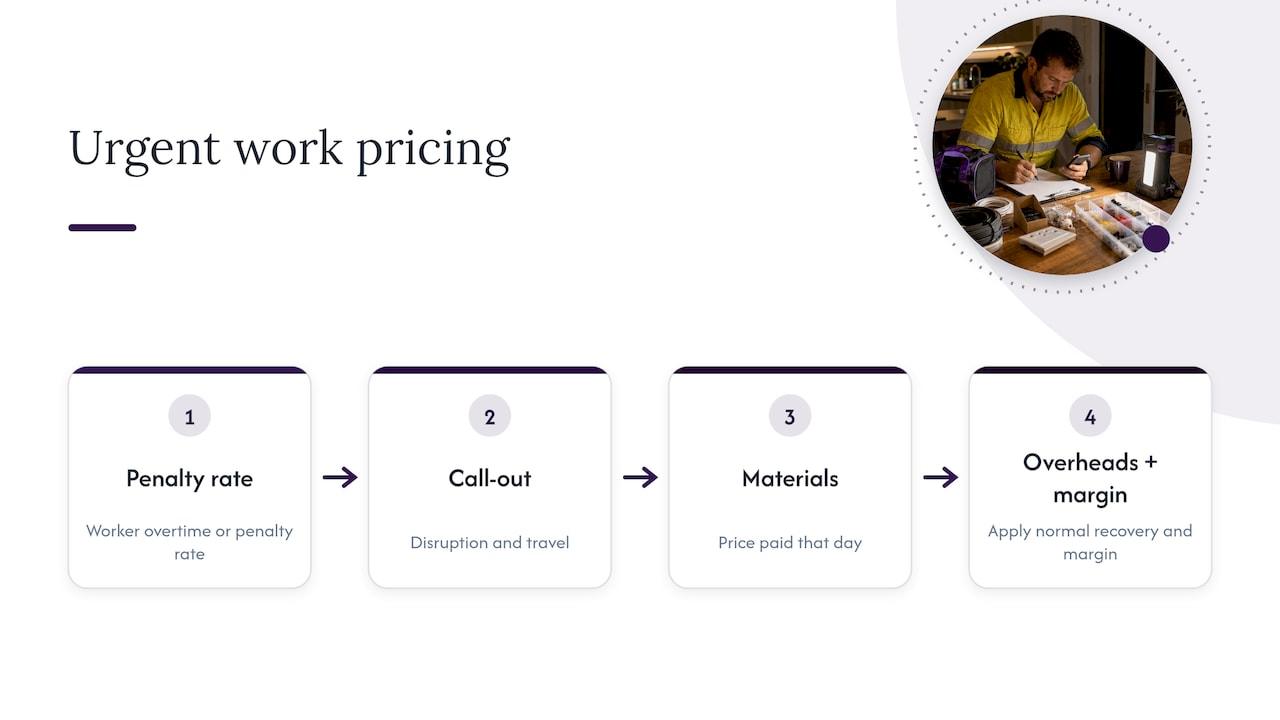
Build the premium from real costs. Start with the penalty or overtime rate that applies to the worker, then add a call-out fee that covers the disruption and travel. Price materials at what you actually pay on the day, not your usual trade rate. Then apply your normal overhead recovery and margin on top.
Be upfront. Tell the client the after-hours rate on the phone before you attend, and put it in writing. A client who agrees to a known premium is far easier to deal with than one surprised by an invoice. Under the ACCC display-price rules, the total price must be clear, so state the call-out fee and the hourly rate together rather than burying one of them.
Decide your emergency policy in advance too. Which hours do you cover, what is the minimum charge, and when do you refuse? Having these answers ready stops you from underpricing at 10pm because you are tired and the client is stressed.
How often should you review and update your prices?
Set a review date and stick to it. business.gov.au recommends reviewing prices regularly or when costs change, and that is a sensible minimum for any trade business.
A simple process works well:
- Pull your actuals: compare quoted hours and materials against what the jobs really took.
- Recalculate your charge-out rate with current wages, super, insurance, fuel and software costs.
- Re-check utilisation, since a quiet year lifts the rate you need.
- Compare against the market with a few quotes and supplier chats.
- Update templates and communicate the change to existing clients with proper notice.
Between annual reviews, watch for triggers: a big supplier increase, an award wage change, a new insurance premium, or a run of jobs that lose money. Any of these deserves a quick recalculation rather than waiting for the calendar.
Small, regular increases are easier for clients to accept than one large jump after a long period. Track your win rate as you go. If you win every quote, you are probably too cheap.
Why this method suits Australian tradies
Most pricing advice assumes you sit at a desk. Tradies quote from a ute, between jobs, with dirty hands and a phone that will not stop ringing. That is the reality we built around. The maths in this article is not hard, but it only protects your margin if you do it every single time, and that is where admin time wins or loses the day.
When quoting is slow, people shortcut it, and shortcuts are how a good business ends up working hard for thin returns. Standardising the formula, so materials, labour, overhead recovery, margin and GST are all handled the same way on every quote, is the single biggest protection against that. Voice-first tools help because you can capture details on site by talking, without typing.
— Hayley
How we help you price and quote jobs faster
Spend less evenings on quotes and more of your day on the tools. Talk to Hayley on site and we capture the job details by voice, then help turn them into a clean quote. Our team also supports tendering, safety and compliance documentation, and a One Page Website, so your pricing arrives looking as professional as your work.

See how it fits your workflow at Askhayley.
FAQ
How much do tradies charge per hour in Australia?
Rates vary widely by trade, location and experience, so there is no single figure that applies to everyone. The right rate is the one that covers your wages, super, leave, overheads and profit across the hours you can actually bill. business.gov.au says hourly pricing should include wages, super, leave and taxes.
How do you estimate the cost of a job?
List every direct cost first: materials with wastage, labour hours, plant, travel and small items like disposal and permits. Then add overhead recovery, a profit margin and GST. Compare the result with your last few similar jobs before sending it.
Is an hourly rate good in Australia?
It depends what the rate has to cover. As a wage it is a different thing from a charge-out rate, because a charge-out rate also has to recover super, leave, overheads and unbilled time. For a trade business, charging at the wage level usually means losing money.
What is the difference between margin and markup?
Markup is a percentage added to your cost. Margin is the percentage of the selling price that is profit, so a given markup always produces a smaller margin. Decide which one you are targeting, and use the matching calculation.


