


Yes, service area pages are worth building, but only if each one earns its place: the single rule that decides whether they help or hurt your rankings is genuine, location-specific usefulness rather than a city name swapped into a template. Get that right and you’ll see more of the right calls coming in. Here’s how to structure, verify and measure them properly.
TL;DR:
- Publish a suburb page only when you can add local proof, such as a completed job, customer testimonial, area specific FAQ, or access detail.
- If you cannot support separate suburb pages with distinct local details, combine nearby areas into one regional page rather than publish thin, near identical pages.
- Put a click to call button near the top, keep pages fast on phones, and use conversational local FAQs to match urgent voice searches.
- Hide your address on Google Business Profile when customers do not visit, list up to 20 service areas, and link listings directly to relevant pages.
- Set up Search Console and GA4 before publishing, then track suburb queries, calls, forms, and bookings; assess each page only after at least 90 days.
Table of Contents
- What is a service area page and when should you use one?
- Why service area pages matter for Australian service businesses
- How to structure a high-quality service area page
- How to avoid doorway pages and duplicate content traps
- Technical checklist: indexation, sitemaps, schema and page speed
- Google Business Profile and listing tips for service area businesses
- Measure and iterate: what to track and how to test SAP performance
- Keyword research specific to service area pages
- Mobile optimisation and voice search for service area pages
- Local competitor analysis and benchmarking
- Content update frequency and maintenance for SAPs
- Quality over quantity for busy tradies
- Ask Hayley: build pages and capture calls without extra admin
- FAQ
- Sources
What is a service area page and when should you use one?
A service area page highlights the work you do in a particular suburb or region, rather than showcasing a shopfront customers can walk into. BrightLocal describes a service area page as a mini local landing page built around a defined geographic area, designed to capture searches like “electrician in Parramatta” when you don’t have, or don’t want to advertise, a physical address.
They suit mobile trades, delivery-based services and hybrid businesses that split time between a workshop and jobs on the road. If you’re an electrician, plumber, arborist or similar who travels to customers across several suburbs, a service area page gives each one its own front door in search results.
The practical rule: only publish a page when you can add something real to it, a completed job, a short testimonial, a note about access or council rules specific to that area. If you can’t, skip it for now.
Why service area pages matter for Australian service businesses
Service area pages capture the exact phrasing people search when there’s no storefront to find: “plumber in Blacktown,” “tree removal near me,” “electrician open now.” Without a dedicated page for each area you cover, those searches often go to competitors with one.
They also help offset a reality of running a mobile trade: when your address is hidden on your Google Business Profile, your visibility in the local map pack can suffer. A well-built service area page gives you another way to pursue visibility in organic results for that suburb. BrightLocal notes that SAPs help businesses appear for “near me” and “[service] in [city]” searches precisely when customers don’t need to visit a physical premises.
What makes the difference between a page that ranks and one that doesn’t is local trust. A short case study from a recent job in that suburb, a photo from the site, and a testimonial from a customer in that area all signal to both readers and search engines that the page is real, not a placeholder.
How to structure a high-quality service area page
Structure matters more than word count. A well-built page gets straight to the point: what you do, where you do it, and how fast someone can reach you.
- URL and title: use natural phrasing like “electrician-penrith” rather than keyword strings, and keep every page title unique so Google doesn’t see duplicate signals.
- H1 and headers: lead with a clear H1 combining service and location (for example, “Emergency Plumbing in Penrith”), then use scannable H2s that address problems locals actually search for, like burst pipes or blocked drains.
- Contact-first layout: put a click-to-call button, SMS option or booking link near the top, along with your hours and how quickly you typically respond.
- Local proof: include a short testimonial, a photo from a job in that suburb, or a mention of a nearby landmark or neighbourhood that shows you actually work there.
- Natural location use: mention the suburb a handful of times in the body copy where it reads naturally, never stuffed into every sentence.
Search Engine Land’s guidance on service area pages stresses that these pages should be built with the human visitor in mind first, since that’s also what Google’s helpful content standards reward.
Pro Tip: Put your phone number and a “call now” button near the top of every service area page, so visitors can contact you easily.
How to avoid doorway pages and duplicate content traps
Swapping a suburb name into an otherwise identical template is the fastest way to create what Google treats as doorway content, pages that exist for search engines rather than readers. Search Engine Land warns that pages built this way struggle to earn organic rankings because they don’t meet the bar for genuinely helpful content.
Three practical fixes keep each page unique:
- Add a local job case: describe one recent job in that suburb, what the problem was and how you fixed it.
- Add an area-specific FAQ: answer a question only relevant to that location, like council permit rules or common housing styles in the area.
- Note local availability or pricing factors: mention call-out times or travel considerations specific to that suburb.
When you don’t have enough local detail to fill several small pages, group nearby suburbs into one broader regional page instead of spreading thin content across many URLs. An HTML sitemap listing every service area page helps both visitors and search engines find them all from one place.
Technical checklist: indexation, sitemaps, schema and page speed
Even a well-written page won’t rank if search engines can’t find or read it properly. A few technical basics make the difference between a page that gets crawled and one that sits invisible.
- List every page in an HTML sitemap and submit an XML sitemap through Search Console so new service area pages get discovered quickly.
- Add LocalBusiness or Service schema with your business name, phone number and service area, using Schema markup so search engines understand what the page represents.
- Keep pages fast and mobile-first, since most local searches happen on a phone while someone’s standing in a driveway or kitchen.
- Use canonical tags where content genuinely overlaps between pages, so you’re not competing against yourself for the same keywords.
- Avoid locking pages behind a store-locator widget that requires a search or click to reveal content, since that can block crawlers from indexing the page at all.
Google Business Profile and listing tips for service area businesses
Your Google Business Profile settings need to match how you actually operate. If you don’t see customers at a physical address, Google’s guidance on service-area businesses explains you should set your service areas by city or postal code, up to 20 areas per profile, and hide your address.
- Choose the fewest, most accurate categories that describe your core service, since a cluttered category list dilutes relevance rather than broadening it.
- Keep your name, address and phone number (NAP) consistent across your website, GBP and any directory listings.
- Link your GBP and other listings to the specific service area page, not your homepage, so someone searching “plumber Liverpool” lands exactly where that question is answered.
Measure and iterate: what to track and how to test SAP performance
A service area page is only doing its job if it’s bringing in calls, not just impressions. Set up tracking before you publish, not after.
- Check Search Console for queries containing suburb names, watching impressions, clicks, average position and click-through rate for each page.
- Use GA4 to track form submissions, click-to-call events and any booking button clicks as conversions.
- Run each page for at least 90 days before judging it, then adjust copy, local proof or calls-to-action based on how many visits turn into actual contact.
Keyword research specific to service area pages
Generic keyword tools will hand you volume data for “plumber Sydney,” but the real value sits one layer down, in the combinations your actual customers type when they’re ready to act. Think about intent first: someone searching “emergency plumber Liverpool open now” is closer to booking than someone searching “plumbing services.”
Start with your own service list crossed against every suburb you genuinely cover, not an aspirational list of areas you’d like to work in one day. For each combination, check what’s already ranking: if established competitors with years of local reviews dominate the top results for a particular suburb, a broader regional page might be a better investment of your time than a standalone page destined to sit on page three.
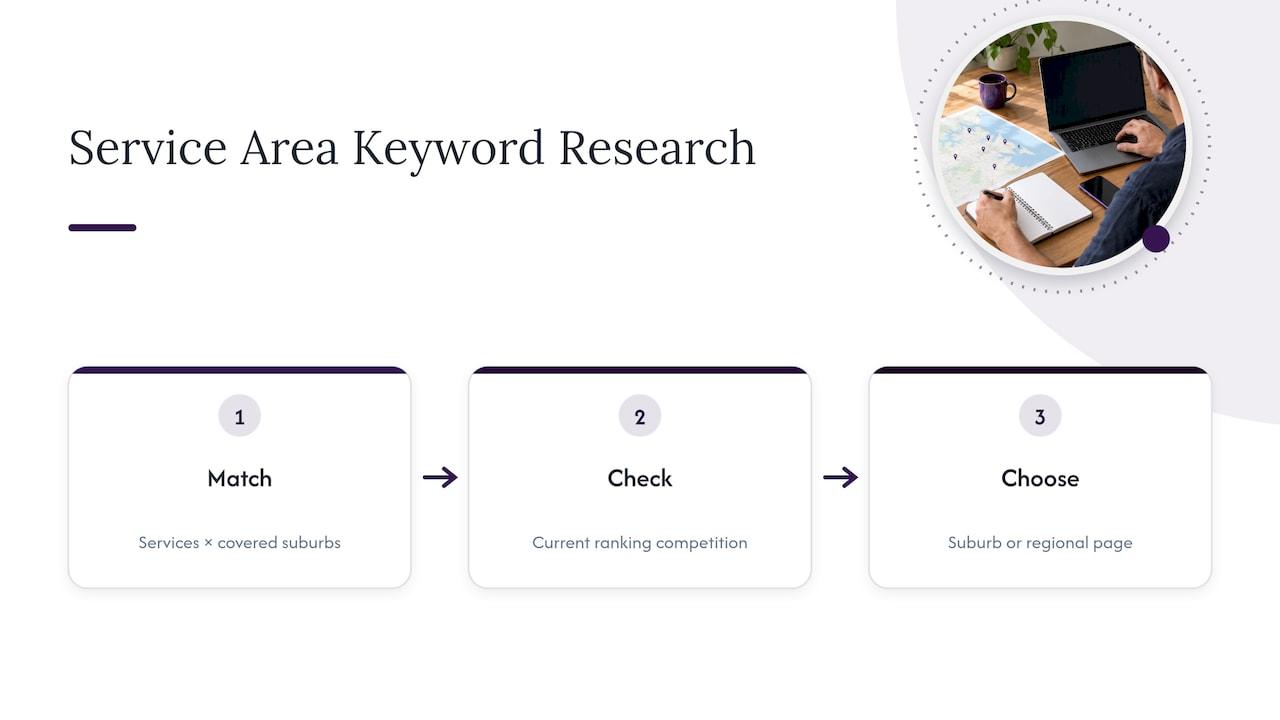
Look for modifiers that match local behaviour, “near me,” “same day,” “after hours,” “cost,” and work them naturally into headers and body copy rather than cramming them into a single sentence. Local SEO guidance for Australian businesses points to this kind of location-specific landing page content as one of the central tactics for improving local visibility, alongside Google Business Profile optimisation and consistent NAP details.
Don’t ignore service-specific long-tail phrases either. “Blocked drain Penrith” and “hot water system repair Penrith” deserve separate attention within the same page rather than one vague “plumbing Penrith” heading trying to cover everything at once.
Mobile optimisation and voice search for service area pages
Most searches for trade services happen on a phone, often while someone’s dealing with an actual problem right now, a leaking tap, a tripped switchboard, a blocked gutter before rain. That urgency changes what a page needs to deliver.
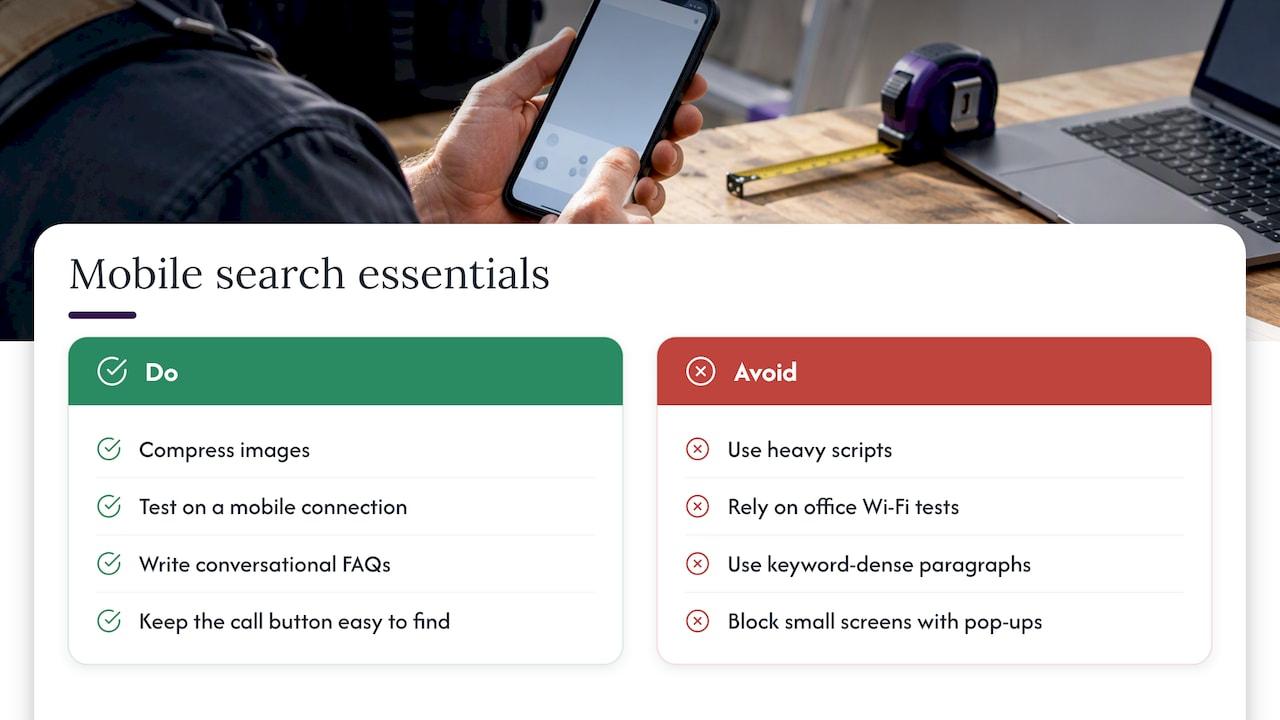
Page speed matters more here than almost anywhere else in your site. A slow-loading service area page loses visitors before they even see your phone number, so compress images, avoid heavy scripts, and test load times on an actual mobile connection rather than office wifi.
Voice search changes the phrasing people use without changing what they want. Instead of typing “electrician Parramatta,” someone might ask a voice assistant “who’s the nearest electrician open now in Parramatta.” Writing a short FAQ section in plain, conversational language, phrased as a real question and answer, gives you a better shot at matching that kind of query than keyword-dense paragraphs ever will.
Keep tap targets large enough for someone operating a phone one-handed, keep your click-to-call button fixed or easy to find without scrolling, and avoid pop-ups that block the page on a small screen. None of this is complicated, but skipping it costs you the exact visitors who were ready to call.
Local competitor analysis and benchmarking
Before you build a page, see what’s already ranking for that suburb and service combination. Open an incognito browser, search the exact phrase a customer would use, and look at what the top few results actually contain.
Note whether competitors have dedicated pages for that suburb or whether they’re relying on a single generic services page. If nobody ranking well has bothered to add local proof, a testimonial, a job photo, specific suburb mentions, that’s your opening. If every top result already has strong local content and years of reviews, weigh whether your time is better spent on a less contested suburb nearby.
Pay attention to the categories and services competitors list on their Google Business Profiles too, as this can offer ideas for how to describe your own business. Google’s category system is extensive and region-specific, so checking which categories well-ranking competitors use can reveal gaps in how you’ve set up your own profile.
This isn’t about copying anyone’s content. It’s about understanding the bar you need to clear in each suburb, then building something genuinely more useful, a clearer answer, a faster contact option, or local detail nobody else bothered to include.
Content update frequency and maintenance for SAPs
A service area page isn’t a set-and-forget asset. Suburbs change, competitors improve their own pages, and content that was accurate a year ago can quietly go stale.
Revisit each page every few months and check the basics: is the phone number still correct, are the hours still accurate, does the testimonial still feel current. Add a new job case or photo when you complete work in that area, since fresh, specific proof keeps the page feeling lived-in rather than static.
Watch your Search Console data for pages that have dropped in position or impressions over time, since that’s often a sign the content needs refreshing or a competitor has published something stronger. A regular review across all your service area pages, updating a few at a time rather than all at once, is a realistic maintenance rhythm for a business without a dedicated marketing person on staff.
Quality over quantity for busy tradies
If you’re short on time, build a small number of service area pages properly rather than creating many thin ones. A handful of pages with real local proof can be more useful than a long list of near-identical ones, and calls from a strong page may lead to more serious enquiries than clicks on a vague one. Pick your best suburbs and do them well.
— Hayley
Ask Hayley: build pages and capture calls without extra admin
If you’d rather spend your time on the tools than in a website builder, we put together one-page websites. Hayley answers calls when you can’t, pre-qualifies the enquiry, and gets the details to you without you touching a dashboard.
For tradies weighing up homepage layouts, or wanting a clearer picture of what a missed call actually costs, our full range of services covers website builds, tendering support and compliance documentation in one place. Have a look and see what fits your business.
FAQ
What makes a service area page different from a location page?
A service area page describes the suburbs or regions you travel to for work, while a location page describes a physical address customers can visit. Service area pages suit mobile trades and hybrid businesses that don’t rely on foot traffic to a storefront.
How many service areas can I list on Google Business Profile?
Google allows service-area businesses to list up to 20 service areas by city or postal code on a single profile. If you cover more than that, group nearby suburbs into broader regions rather than trying to list every one individually.
What should I check before choosing an SEO agency for local pages?
Ask how they handle duplicate content across location pages, since swapped templates are treated as low-value by search engines. Check whether they build in local proof like testimonials and job photos, and confirm they’ll set up Search Console and GA4 tracking so you can see actual results from your pages.
What is the 80/20 rule in SEO?
Applied to service area pages, it means focusing most of your effort on the suburbs and services that drive the bulk of your enquiries, rather than spreading thin content across every area you could theoretically serve. A handful of well-built pages for your highest-value suburbs will usually outperform a long list of generic ones.
What are effective local SEO strategies for a small trade business?
Core tactics include optimising your Google Business Profile with accurate categories and service areas, keeping your name, address and phone number consistent everywhere you’re listed, and building service area pages with genuine local detail rather than templated copy. Australian local SEO guidance also points to earning reviews and local links as part of a solid foundation.
Sources
- Manage your service areas for service-area & hybrid businesses – Google Business Profile Help
- Service Area Pages: Boost Local SEO Across Locations
- How to Do Service Area Page SEO for Local Search Visibility – BrightLocal
- Local SEO for Australian Businesses: The Complete 2025 …


