


A progress claim is a formal request for payment for work completed on a construction project, and in most Australian states it carries statutory force under Security of Payment (SOPA) laws. That means a valid claim can trigger strict payment deadlines and a fast adjudication process if the respondent doesn’t pay or dispute it properly. Before you claim, gather your contract reference, a schedule-of-values, and dated evidence, then serve the claim in writing.
TL;DR:
- Including the correct statutory endorsement wording ensures the progress claim maintains its legal status under your state’s SOPA laws.
- Using official templates like QBCC Form 2 or WA’s endorsement template helps meet specific jurisdiction requirements and speeds up claim processing.
- Serving claims via email to the nominated address with proof of delivery and keeping detailed, labeled records is crucial for enforceability.
- Accurate claim timing depends on referencing the contract’s specific claim date and meeting the state’s response deadlines, or the claim may become payable automatically.
- Properly documented variations, signed before work begins, and attaching all proof with each claim reduce rejection risks and simplify adjudication.
Table of Contents
- What is a progress claim in Australia?
- Checklist: what to include in a compliant progress claim
- How do Security of Payment Acts affect your claim?
- When can you legally submit a progress claim?
- How to prepare and serve a claim that will stand up to assessment
- How do you claim variations, provisional sums, and adjustments?
- What happens if your progress claim is disputed?
- Final claims and releasing retention
- What tools and templates make claims faster and more accurate?
- Hayley’s perspective: why systemising claims protects your cashflow
- A faster way to gather evidence and manage claim paperwork
- Sources
What is a progress claim in Australia?
A progress claim is a written demand for payment tied to work completed at a specific point in a construction contract, not a generic tax invoice. The difference matters: an invoice is a commercial request for money, but a progress claim made under a state Security of Payment Act carries legal weight the moment it’s served correctly. Get the format wrong and you can lose that statutory protection entirely, even if the work was done and the money is owed.
Builders sometimes use “progress claim” and “invoice” interchangeably on-site, but under law they’re separate instruments. A tax invoice satisfies GST and record-keeping requirements. A progress claim, when made under your state’s SOPA legislation, activates response deadlines, adjudication rights, and enforcement options an ordinary invoice never triggers.
Checklist: what to include in a compliant progress claim
Every state template asks for broadly the same core details, even though the exact wording differs. Before you serve anything, confirm your claim includes:
- Exact legal names of both parties and a clear reference to the construction contract.
- Claim number, claim date, and the relevant claim period or reference date.
- Stage or cumulative values, with GST shown separately and retention amounts calculated.
- Approved variations backed by signed evidence, delivery dockets, inspection certificates, and dated photos.
- The correct statutory endorsement wording if you’re making the claim under your state’s SOPA.
Missing that last point trips up more contractors than any other. Under the WA Building Commissioner’s payment claim guidance, a claim made under the Building and Construction Industry (Security of Payment) Act 2021 (WA) must carry specific endorsement wording, and skipping it can mean the claim never gets treated as a statutory claim at all, no matter how accurate the numbers are.
Pro Tip: Keep a claim skeleton in a Word or PDF template with your legal entity name, ABN, and standard contract clauses pre-filled. You’ll cut preparation time on every claim that follows.
How do Security of Payment Acts affect your claim?
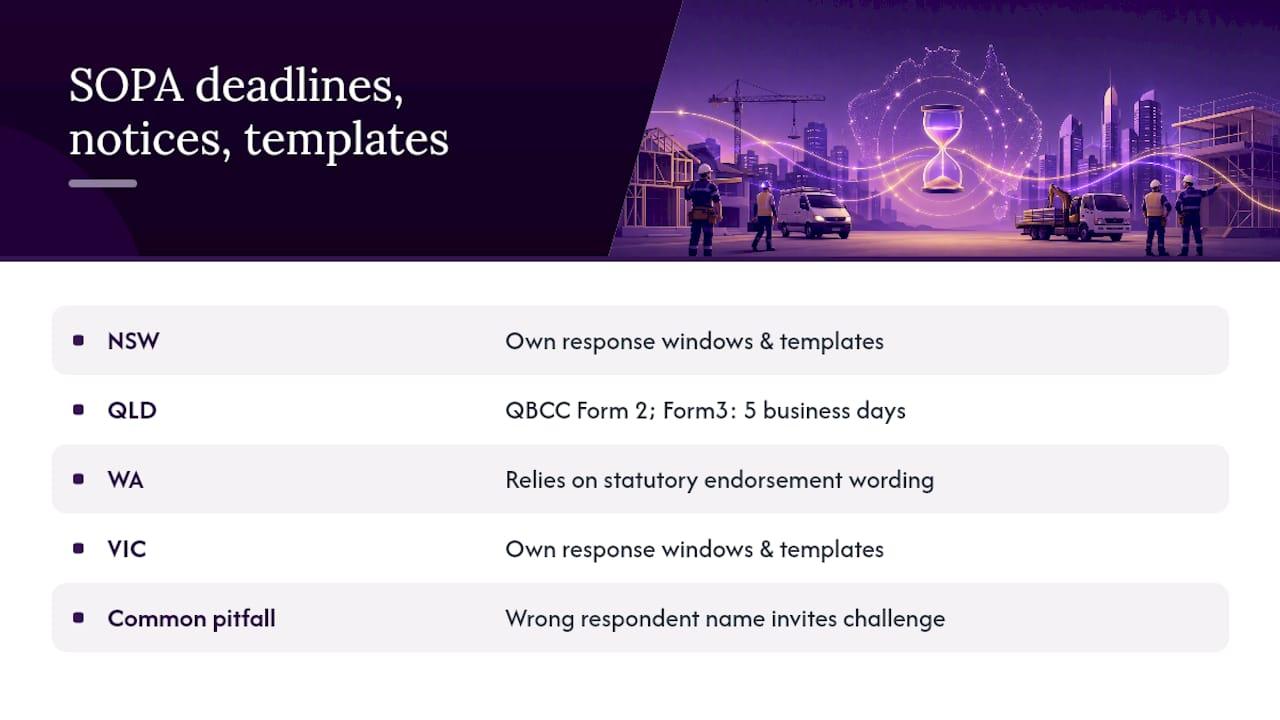
Every state and territory runs its own SOPA legislation, and while the underlying principle (get paid for work done, on time) is consistent, the mechanics differ enough to trip up contractors moving between jobs in different states.
New South Wales, Queensland, Western Australia, and Victoria all set their own response windows, notice requirements, and preferred templates. Queensland’s QBCC Form 2 is built specifically for Level 1 renovation and repair work, and it spells out that for non-final stages, the owner must pay or issue a Form 3 Notice of Dispute within five business days. Western Australia’s process, by contrast, hinges on that statutory endorsement wording mentioned above. Getting the respondent’s correct legal name wrong, or naming the wrong entity entirely, is one of the fastest ways to have a claim challenged before it even gets to the merits.
A claim that doesn’t clearly identify the claimant, the respondent, and the specific contract it relates to give a respondent an easy technical objection, regardless of whether the underlying work was actually done.
Trust official sources over generic templates you find online. Queensland contractors should work from QBCC’s guidance, WA contractors from the Building Commissioner’s template, and anyone chasing broader payment and invoicing basics should check Business.
When can you legally submit a progress claim?
Timing trips up more claims than bad maths does. A “reference date” is the date your contract (or the relevant SOPA) says you’re entitled to make a claim, and it determines whether you’re claiming monthly, at a milestone, or on some other schedule set out in the contract.
- Check your contract first for the reference date clause. Most residential and commercial contracts specify monthly claims unless stated otherwise.
- Confirm your state’s statutory limits. Many jurisdictions allow one claim per reference date unless the contract says differently, and some set outer limits, like a six-month window to serve certain claims, so check the current position in your state rather than assume.
- Know the response clock starts the moment you serve the claim. Respondents typically have a fixed number of business days to issue a payment schedule, and missing that window in many cases means the claim becomes payable in full.
- Prove service. Courier receipts, a directed email address named in the contract, or a site sign-off sheet all count as solid proof.
Pro Tip: Email your claim to the contract-nominated address and CC yourself, then screenshot the sent confirmation. That single habit has saved more contractors in adjudication than any clause in the contract itself.
How to prepare and serve a claim that will stand up to assessment
Getting the maths right is only half the job. A claim that survives scrutiny needs a clean paper trail behind every dollar.
- Calculate the claim amount from your schedule-of-values or percentage-complete assessment, then reconcile it against everything already certified and paid.
- Attach evidence mapped to each individual line item, not a general folder of photos. Delivery dockets, inspection certificates, and signed variation forms should each point to a specific claimed amount.
- Endorse the claim correctly if you’re relying on your state’s SOPA. Copy the wording from the official template rather than paraphrasing it.
- File with version control. Something as simple as naming files claim_v1.pdf and claim_v1.1.pdf, and keeping proof of when and how you sent each one, gives you a defensible record if the claim is disputed later.
A few habits separate claims that get paid on time from ones that end up in dispute:
- Reconcile against the last certified amount before you submit, not after a query comes back.
- Keep a running variations register with dates and signed approvals rather than relying on memory or a messy email thread.
- Never bundle unapproved variations into a certified claim; keep them separate and clearly labelled.
How do you claim variations, provisional sums, and adjustments?
An approved variation is work outside the original scope that both parties have agreed to in writing, whether that’s a signed variation form, an email confirmation, or a formal contract amendment. Without that signed evidence, a respondent can reject the variation outright, no matter how obviously necessary the work was.
- Present provisional sum and prime cost adjustments as separate, clearly labelled line items, not folded into the base contract value.
- Attach the original approval document to each variation claimed, not just a description of the work.
- The most common rejection reason is a variation claimed without dated, signed proof it was approved before the work started.
Keeping a single, current variations register, as the Mastt guide to Australian progress claims points out, is often the difference between a smooth claim and one that drags into adjudication.
What happens if your progress claim is disputed?
A payment schedule is the respondent’s formal response, and it must state the amount they propose to pay and, critically, their reasons for withholding any part of the claim. Read it carefully. If the reasons given don’t match what was actually raised during the job, that gap can work in your favour at adjudication.
- If no payment schedule arrives within the required window, in many cases you can treat the claim as due and move toward adjudication or direct enforcement.
- Adjudication is generally fast, often resolved within weeks rather than months, but the process still demands a tight, well-evidenced submission.
- Preserve everything: keep original documents, proof of service, and consider a notice of intention to suspend work where your state’s Act allows it.
Pro Tip: If a dispute involves a genuinely contested variation or a large sum, bring in a contract lawyer early rather than after adjudication starts. Framing your submission correctly from day one matters more than most contractors expect.
Final claims and releasing retention
Submit your final claim once practical completion is reached, and check your contract for the exact timing window, since most set a specific number of days. The defects-liability period usually runs for months afterwards and directly affects when retention gets released, so document any defects and their rectification carefully.

When requesting retention release, attach the practical completion certificate, a defects list with sign-off, and dated photos showing completed rectification work. Retention disputes usually come down to whichever party has the better paper trail.
What tools and templates make claims faster and more accurate?
Start with the official templates. QBCC Form 2 is purpose-built for Queensland Level 1 renovation and repair claims, and the WA payment-claim template covers the required endorsement wording for WA claims. Both save you from reinventing the wheel.
Beyond templates, a job-management system that holds your schedule-of-values and pushes approved claims straight into Xero cuts a surprising amount of admin time, since it removes the double handling between spreadsheets and accounting software.
- Capture dated photos at every claim milestone, not just at the end of a stage.
- Keep delivery dockets and inspection certificates filed against the specific line item they support.
- Get variation forms signed on-site before work starts, not retrospectively.
Hayley’s perspective: why systemising claims protects your cashflow
The pattern I see most often isn’t builders doing bad work. It’s good work getting under-claimed because a variation was never written down, or a claim went out a week late because someone was flat out on-site. Fewer missed variations and faster invoicing come from treating claims as a system, not a scramble at the end of each month.
— Hayley
A faster way to gather evidence and manage claim paperwork
There are other routes to tightening your claims process, from spreadsheet templates to hiring an office admin. Ask Hayley takes a different approach: it’s a voice-first platform built specifically for tradies, so instead of typing up variation notes after a long day on-site, you talk to Hayley and she organises it.

Ask Hayley captures inbound calls, collects site details through natural voice prompts, and helps organise the documents that back a claim, delivery dockets, signed variations, and site photos, so they’re ready when it’s time to claim rather than scattered across three apps and a glovebox. For tradies who also prepare tenders, the tendering support service keeps contract references and document control consistent from quote through to final claim. If defect documentation and compliance paperwork are eating your evenings too, the safety and compliance documentation service handles that groundwork as well. Head to the Ask Hayley homepage to see how it fits around your existing job-management setup.


