
A risk assessment matrix is a visual grid that plots the likelihood of a hazard occurring against the severity of its consequences, giving you a clear, colour-coded picture of which risks need immediate action and which can be monitored. Under Australian WHS legislation, documented risk assessments are not optional. WorkSafe WA mandates that employers identify hazards, assess risks using tools like the matrix, and implement controls, with regular reviews to confirm those controls remain effective.
The most widely used format is the 5×5 matrix, where numerical scoring runs from 1 to 25 and risks fall into Low, Medium, High, or Extreme zones. The zone a risk lands in drives the urgency of your response. That simplicity is exactly what makes the matrix so useful across construction sites, trade businesses, and office environments alike.
Key entities connected to matrix use in Australia:
- WorkSafe WA — sets employer obligations for documented hazard identification and control
- AS/NZS 4360:2004 — the Australian Standard providing a generic risk management framework applicable across industries
- ISO 31000:2018 — the international standard recommending risk assessment as an iterative, integrated process
Table of Contents
- How to use a risk assessment matrix step by step
- Australian WHS compliance requirements and standards
- Common pitfalls and how to avoid them
- How Australian workplaces apply risk matrices in practice
- Key takeaways
- Askhayley helps you stay on top of compliance without the paperwork
How to use a risk assessment matrix step by step
Getting the process right from the start saves you from invalid scores and compliance gaps later. Follow these steps consistently.
- Identify hazards. Walk the worksite, review incident reports, and consult workers. Log every hazard in a risk register before scoring anything.
- Define your rating scales. Set clear, written definitions for each likelihood and consequence level before the team starts scoring. Vague definitions produce inconsistent results.
- Assign likelihood ratings. Rate how probable it is that the hazard causes harm, from Rare (less than 10% chance) through to Almost Certain (over 75% chance).
- Assign consequence ratings. Rate the severity of harm if the hazard is realised, from Negligible through to Catastrophic.
- Calculate the risk score. Multiply the likelihood rating by the consequence rating. A score of 1–4 is Low, 5–9 is Medium, 10–16 is High, and 17–25 is Critical.
- Plot each risk on the grid. Place every hazard in the corresponding cell. The colour coding makes priorities visible at a glance.
- Prioritise controls. Address Extreme and High risks first. High risks require a named owner, a mitigation plan, and a review date before work continues, with a control response established within one week of identification.
- Assign owners and review dates. Every risk above Low needs a responsible person and a scheduled review. Without this, the matrix becomes a decoration.
- Implement and monitor controls. Apply the hierarchy of controls, then re-score the residual risk after controls are in place to confirm they are sufficient.
Pro Tip: Have each team member score risks independently before the group discussion. This surfaces hidden assumptions and reduces the pull of groupthink, giving you a more accurate picture of actual risk levels.
Australian WHS compliance requirements and standards
Australian workplaces operate within a clear regulatory framework, and the risk assessment matrix sits at the centre of it.
- WorkSafe WA requires employers to document risk assessments, implement controls, and review them regularly. Controls must be updated if they prove ineffective.
- AS/NZS 4360:2004 provides a generic guide for risk management applicable across all Australian industries. Its principles remain foundational for WHS officers, even as ISO 31000:2018 gains currency for iterative, integrated risk management.
- ISO 31000:2018 frames risk assessment as a continuous cycle, not a one-off task. Embedding your matrix in a digital system with scheduled review reminders aligns directly with this standard.
- Training and competency requirements apply to anyone using risk assessment tools. Staff need to understand how to define scales, score consistently, and interpret results.
Common matrix types used across Australian industries:
| Matrix type | Best suited for | Key feature |
|---|---|---|
| 3×3 matrix | Small teams, early-stage scoping | Simple, fast, low calibration effort |
| 5×5 matrix | Construction, trade, regulated industries | Finer distinctions, scores 1–25 |
| Qualitative matrix | Executive overviews, rapid workshops | Descriptive labels, no multiplication |
| Quantitative table | Regulated industries, formal audits | Financial impact column, weighted scores |

Common pitfalls and how to avoid them

Even well-intentioned risk matrices fail when the process around them is weak.
The most common problem is unclear scale definitions. Without precise, organisation-wide definitions for each likelihood and consequence level, two people scoring the same hazard will produce different results. The matrix output is only as reliable as the definitions feeding it.
Optimism bias is a subtler trap. People naturally underestimate the probability of bad outcomes, particularly for familiar tasks. Having team members score independently before any group discussion reduces this bias and produces more defensible scores.
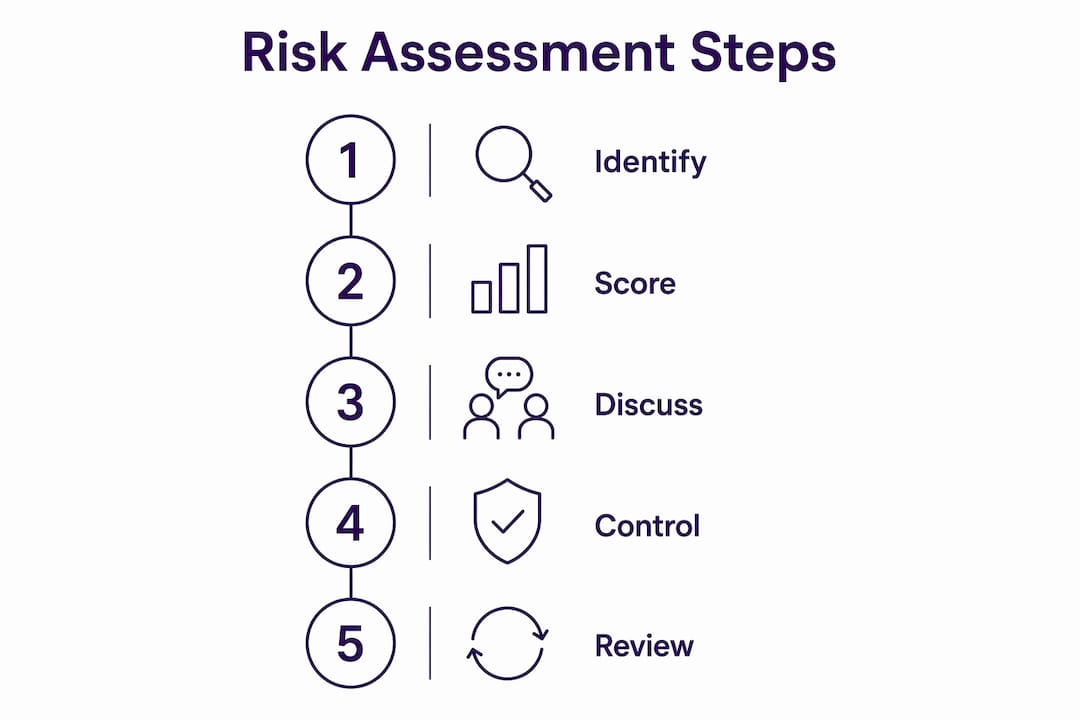
Treating the matrix as a one-off document is the third failure mode. Many organisations complete a risk assessment once, file it, and never revisit it. That approach fails both compliance obligations and practical safety. ISO 31000:2018 is explicit: risk assessment is iterative, and embedding the matrix in a digital system with automated review reminders is the most reliable way to keep it current.
Best practice summary: Define scales with concrete examples anchored to your workplace. Score independently before discussing as a group. Assign every High or Extreme risk a named owner and a review date. Integrate the matrix into a digital workflow so reviews happen automatically, not only when someone remembers.
Finally, remember the matrix is a communication tool as much as an analysis tool. It creates a shared language across teams, turning vague concerns into ranked priorities that managers and workers can act on together.
How Australian workplaces apply risk matrices in practice
Real-world application looks different across industries, but the underlying discipline stays the same.
A commercial electrical contractor in Western Australia used a 5×5 matrix to assess risks on a large fitout project. The team identified working at height and live electrical exposure as separate hazards, scored them independently, and both landed in the High zone. Each was assigned a site supervisor as owner, with a control plan documented before work commenced. The matrix was reviewed at each weekly toolbox meeting, with scores updated as controls were verified.
A small plumbing business in Queensland took a simpler approach, using a 3×3 matrix for routine job risk assessments. The lower granularity suited their team size and the pace of day-to-day work. When a new hazard type appeared, such as confined space entry on a commercial job, they shifted to a 5×5 assessment for that specific task, recognising that the coarser tool was not adequate for a higher-stakes situation.
Both examples reflect the same principle: the matrix format should match the complexity of the work, and the process around it, including ownership, review dates, and documented controls, is what makes it compliant and genuinely useful.
Key takeaways
A risk assessment matrix is only as effective as the process and definitions behind it, and Australian WHS obligations require that process to be documented, reviewed, and maintained as a living record.
| Point | Details |
|---|---|
| Score zones drive urgency | Scores in the highest category require immediate escalation; scores in the high category require a control plan before work continues. |
| Define scales before scoring | Clear, written definitions for each likelihood and consequence level prevent subjective and inconsistent results. |
| High risks need named owners | Every High or Extreme risk must have an assigned owner, a mitigation plan, and a scheduled review date. |
| Matrix is a living document | Regular reviews and updates keep the matrix compliant with ISO 31000:2018 and WorkSafe WA obligations. |
| Askhayley supports compliance tracking | Askhayley’s compliance tracking features help Australian trade businesses keep safety documentation current without the admin burden. |
Askhayley helps you stay on top of compliance without the paperwork
Completing a risk assessment is one thing. Keeping it current, assigning owners, tracking review dates, and staying compliant across multiple jobs is where most trade businesses struggle. That is the gap Askhayley fills.

Askhayley is built for Australian tradies and small service businesses that need to manage compliance without sitting at a desk. Through voice prompts, Hayley helps you track tasks, manage documentation, and stay across your obligations, whether you are on-site or between jobs. No extra app to learn, no forms to fill in after hours.
If your risk matrix is sitting in a folder somewhere, rarely reviewed and never updated, Askhayley can help you build a practical compliance routine that actually sticks. See how it works and book a free discovery call today.