


Charge a tiered cancellation fee tied to notice given (full refund beyond 48 hours, partial fee for 24–48 hours, a higher fee or no-show charge under 24 hours), always disclosed before booking. That’s fair under Australian Consumer Law, and it’s the version customers push back on least.
TL;DR:
- Charging tiered cancellation fees based on notice period aligns with Australian law by reflecting actual losses, avoiding penalties or unfair terms.
- The most defendable cancellation policies include clear, consistent wording at every customer touchpoint, with explicit fee bands and reasons.
- Risks exist if deposits exceed 10% of the job value or if fees are undisclosed, which could reclassify payments or void charges under unfair contract protections.
- Accurate logging of cancellations, reasons, and fee applications is critical to demonstrate losses and enforce policies when disputes arise.
- Automating policy communication and record-keeping with tools like Ask Hayley can ensure staff consistency and improve legal defensibility.
Table of Contents
- What should a job cancellation policy actually say?
- When can you actually charge a cancellation fee under Australian law?
- Where do customers actually see and agree to your policy?
- When should you waive the fee, and when should you hold the line?
- How do you turn the policy into daily practice?
- Why fair, simple cancellation policies save you more than they cost you
- How Ask Hayley handles bookings, confirmations and cancellations for you
- Where to check the legal detail and grab a template
- Sources
What should a job cancellation policy actually say?
A good policy is short enough to fit in a text message and specific enough that nobody can argue with it later. Start with a one-line summary for your booking page or quote, then back it with a fuller clause in your terms.
Booking-page summary (copy this):
“Cancel or reschedule more than 48 hours before your booking, no charge. Between 24 and 48 hours, a partial fee applies. Under 24 hours or a no-show, the full callout fee applies. Full terms [here].”
Full clause (for your terms and conditions):
"[Business name] requires notice of cancellation or rescheduling as follows:
- More than 48 hours’ notice: full refund or free reschedule, no fee.
- 24 to 48 hours’ notice: a partial fee of the quoted job value, or a flat callout fee, whichever is agreed at booking.
- Less than 24 hours’ notice, or no-show: the full quoted job value or minimum callout fee.
Fees cover materials already purchased, labour reserved for your job, and travel already committed. [Business name] will always try to offer an alternative time before charging a fee."
Those bands aren’t arbitrary. Sprintlaw’s guidance on cancellation policy structure recommends tiering fees to how hard the slot is to rebook, and for most trades that’s a sliding scale: two days out, you can usually fill the gap; two hours out, you can’t.
A few drafting notes worth getting right:
- Deposits should stay modest. Consumer Affairs Victoria warns that a deposit above roughly 10% of the job value risks being treated as a prepayment rather than a genuine deposit, which changes how forfeitable it is on cancellation.
- Reschedules should default to credit, not cash refunds, unless the job’s already been cancelled outright. A credit keeps the booking on your books and avoids a payment reversal.
- Define “no-show” with a number. Fifteen minutes past the booked window with no contact is a common, defensible line. Put the exact figure in the clause.
When can you actually charge a cancellation fee under Australian law?
A cancellation fee holds up when it’s a genuine pre‑estimate of loss, not a penalty dressed up as a fee. That distinction is the whole ball game under Australian Consumer Law, and it’s simpler than most tradies expect: the amount has to roughly match what you actually lose, not what you wish you could charge.
Recoverable losses typically include:
- materials already purchased for that specific job
- labour hours reserved and not able to be reallocated
- supplier deposits you can’t get back
- travel or scheduling costs already committed
A cancellation fee that’s flat, undisclosed, or wildly out of proportion to the actual loss can be void under unfair contract term protections, even if the customer technically agreed to your terms.
There’s a second layer to understand. If your work qualifies as a “major failure”, the customer can cancel and seek a refund for services not yet delivered, regardless of what your policy says. Your cancellation clause governs customer-initiated cancellations for change of mind or scheduling. It doesn’t override consumer guarantees when the failure is on your end. Keep the two separate in your head and in your terms.
Where do customers actually see and agree to your policy?
Disputes happen when a customer says “nobody told me.” The fix is repetition: the same short line, in the same words, at every touchpoint before the job starts.
- Booking page: a checkbox next to the summary line, ticked before the booking confirms.
- Confirmation SMS or email: repeat the summary sentence, with a link to full terms.
- Quotes: a one-line footer stating the fee bands.
- Invoices: if a fee applies, state which tier it falls under and why.
Practical templates for cancellation clauses consistently point to the same lesson: the businesses that get challenged are usually the ones that buried the policy in a PDF nobody opened, not the ones that charged the fee.
Pro Tip: Write the summary line once, then paste the exact same wording everywhere it appears. Customers notice inconsistency far more than they notice the fee itself.
If you want to offer discretionary waivers, phrase them as exceptions to a real rule, not a soft version of the rule itself: “Fees may be waived at [Business name]’s discretion in cases of genuine emergency.” That keeps the clause enforceable while leaving you room to be human about it.
When should you waive the fee, and when should you hold the line?
Discretion is fine. Inconsistency is what gets you into trouble.
- Document the reason. Illness, a death in the family, or extreme weather are the common, defensible exceptions. A quick note in your booking system with the date and reason is enough.
- Credit over refund for genuine exceptions. It keeps the customer relationship intact without giving away cash you may not get back if the rebooking falls through too.
- Pass on non-refundable third-party costs regardless of the reason. If a supplier deposit is genuinely non-refundable, that portion stays chargeable even when you waive your own labour fee. Say so plainly when you explain the charge.
The line to hold: if you waive a fee for one customer, you should be able to explain why that case was different from the last one you charged.
How do you turn the policy into daily practice?
A policy is only as good as what your team actually says on the phone and what gets logged when a job falls through.
- Show the policy text at every booking touchpoint — website, quote, confirmation message, invoice footer.
- Give staff a short script: “Just so you know, cancellations under 24 hours attract a fee because we’ve already reserved that time and materials for your job.” Said calmly, most customers accept it.
- Log every cancellation the same way: time of cancellation, reason given, which fee tier applied, and whether a rebooking attempt was made.
- Keep supplier invoices matched to the cancelled job so you can point to the actual loss if a customer disputes the charge.
This is where the paperwork usually falls apart for small trade businesses, not because the policy’s wrong, but because nobody’s writing any of it down consistently. A voice-first system like Ask Hayley can capture that booking acceptance automatically and log the cancellation details the moment a customer calls to cancel, so you’re not chasing your memory three weeks later trying to reconstruct what happened.
Pro Tip: Keep this article’s policy separate from any staff rostering or shift-cancellation rules. Those sit under employment law, not customer booking terms, and mixing the two in one document is a common, avoidable mistake.
Why fair, simple cancellation policies save you more than they cost you
Most tradies avoid writing a cancellation policy because it feels like the pushy move. In practice, the opposite happens: customers respond better to a fee they saw coming than to one that surprises them, even when the fee itself is annoying.
The businesses that get the angriest reviews aren’t the ones charging cancellation fees. They’re the ones charging fees nobody explained. You’ve got materials sitting in the van and a morning that’s now empty. That’s a real cost, and naming it upfront, in plain language, is what keeps the relationship intact even when someone has to pay it.
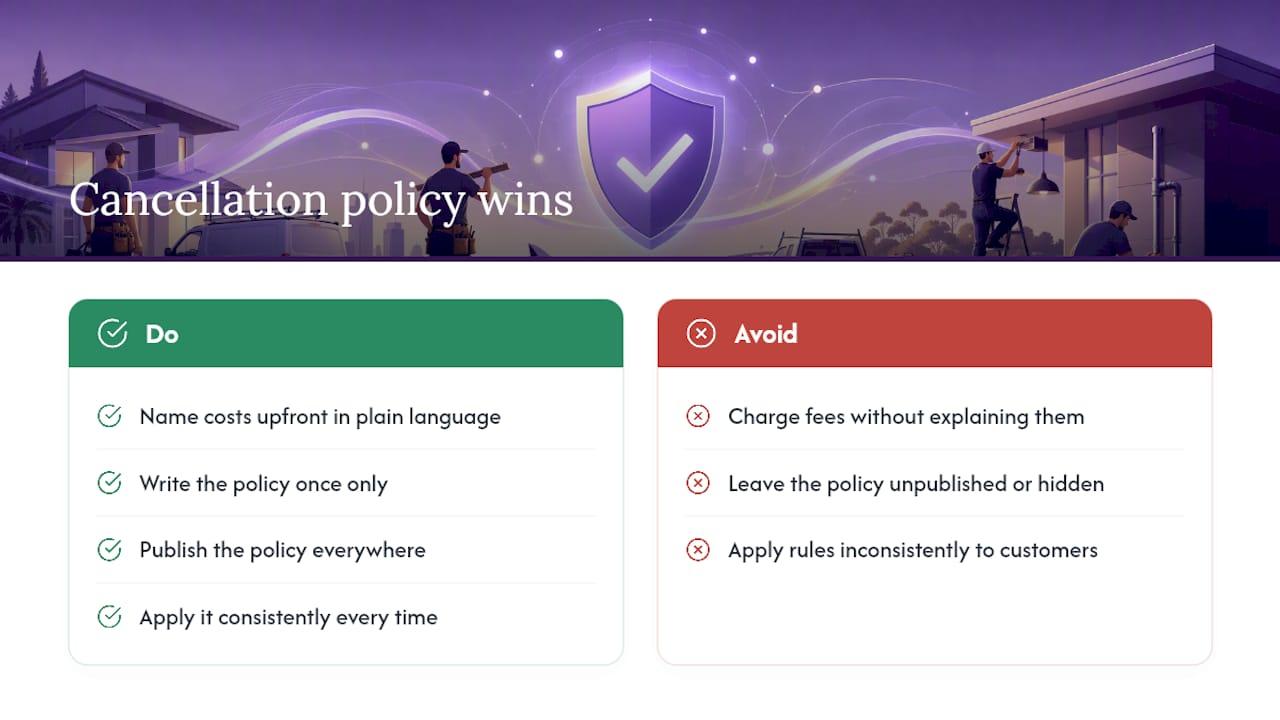
If you take one thing from this: write the policy once, put it everywhere, and apply it the same way every time. That consistency is worth more than any clever clause.
— Hayley
How Ask Hayley handles bookings, confirmations and cancellations for you
Most of the friction in a cancellation policy isn’t the wording. It’s remembering to show it, get it accepted, and write down what happened when a customer calls to cancel at 7am. Ask Hayley is built to catch exactly that gap for Australian tradies who don’t have time to sit at a screen chasing paperwork.
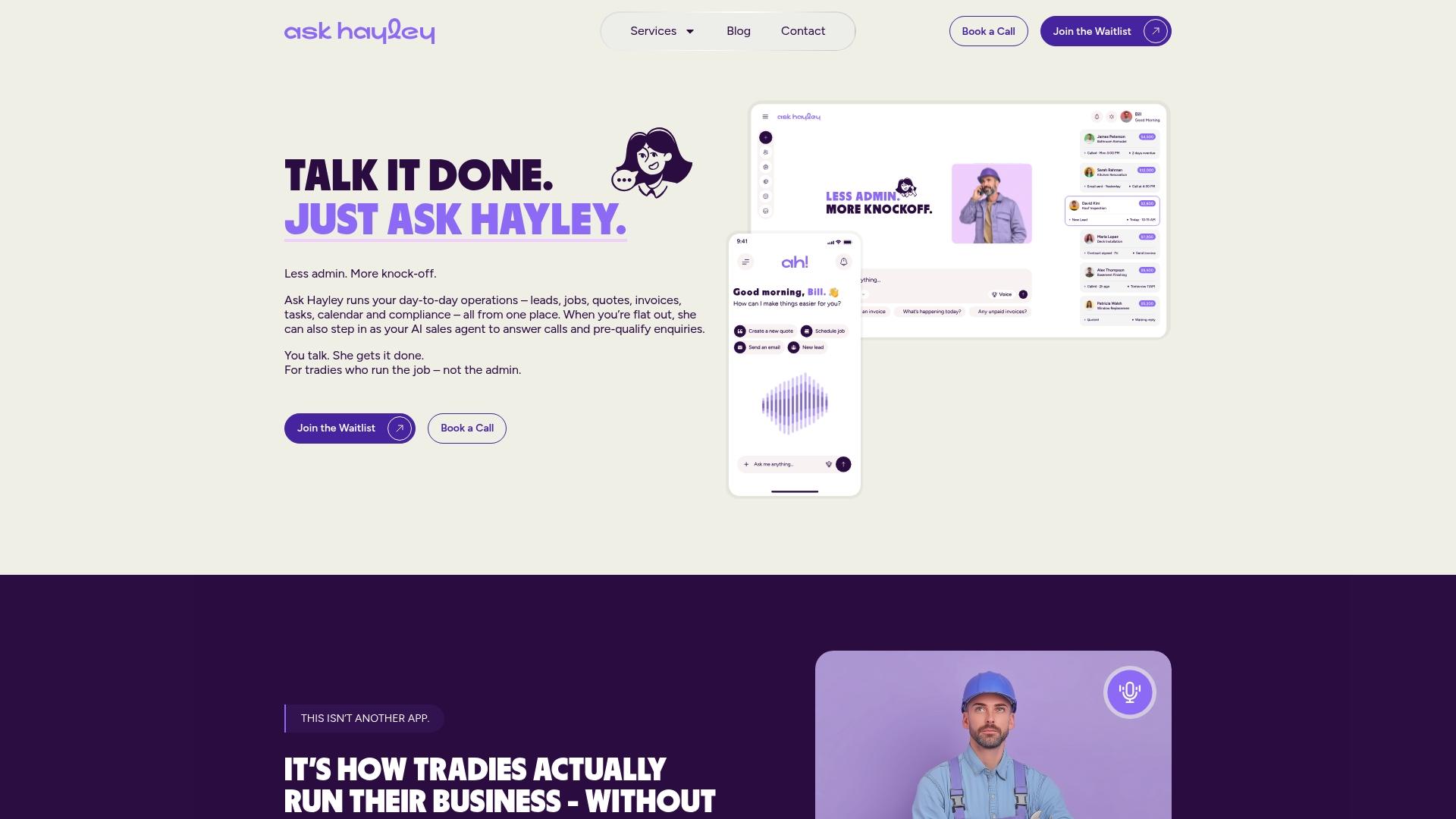
Hayley answers the call when you can’t, confirms bookings with customers, and can capture acceptance of your cancellation terms as part of that conversation, so there’s a record instead of a memory. When a job gets cancelled, the details, time, reason, and which fee tier applies, get logged automatically rather than scribbled on a whiteboard you’ll wipe next week. If you’re building this into your quotes and service agreements, Ask Hayley’s tendering support can help make sure your contract terms, including cancellation clauses, are consistent across every job you send out.
Have a look at what Ask Hayley does for bookings, calls and admin, and see whether it’s worth a trial for your business.

Where to check the legal detail and grab a template
For the legal detail behind this policy, start with the ACCC’s guidance on refunds and cancellations and Sprintlaw’s cancellation policy template. If you’re using a standard-form contract across many customers, get it reviewed by a solicitor before you rely on it, Sprintlaw’s guide to protecting revenue with cancellation clauses is a good starting point, and for the numbers behind your fee, Champion Business Coaching’s guide to margins and lost profit helps you calculate what a cancelled job actually costs you.


