


A phone answering script is a short, structured guide for how staff open, run, and close calls consistently. The fastest one to copy right now: “Good [morning/afternoon], you’re through to [Business Name], this is [Name] speaking, how can I help you today?” Every solid greeting has three parts: a time-of-day salutation, the business name, and the staff member’s name, followed by a genuine offer to help.
TL;DR:
- A clear, structured greeting that includes the business name, staff member’s name, and time-of-day salutation is essential to establish professionalism within the first 20 seconds of a call.
- Consistent use of adaptable scripts for different call scenarios, such as transfers, bookings, and verification, improves call outcomes by reducing staff hesitation and errors.
- Training staff to deliver scripts with friendly tone, proper pacing, and natural delivery enhances caller engagement and decreases missed or poorly handled calls.
- Correct formatting of international numbers, voicemail, and after-hours messaging ensures clarity and meets caller expectations from overseas and during non-business hours.
- Automation tools like Ask Hayley can effectively handle high-volume, routine calls, freeing staff to focus on complex or sensitive interactions and reducing missed opportunities.
Table of Contents
- What is a phone answering script, and why do you need one?
- Quick templates: copy-and-adapt greetings for different roles and tones
- Scripts for common call scenarios: hold, transfer, booking, payments, upset callers
- How to adapt and maintain scripts without sounding robotic
- Getting the delivery right: pacing, tone and the first 20 seconds
- Voicemail, after-hours, and Australian numbering rules
- Applying these scripts with voice-first answering
- Three things to change this week
- Let Ask Hayley run these scripts for you, 24/7
- Sources
- FAQ
What is a phone answering script, and why do you need one?
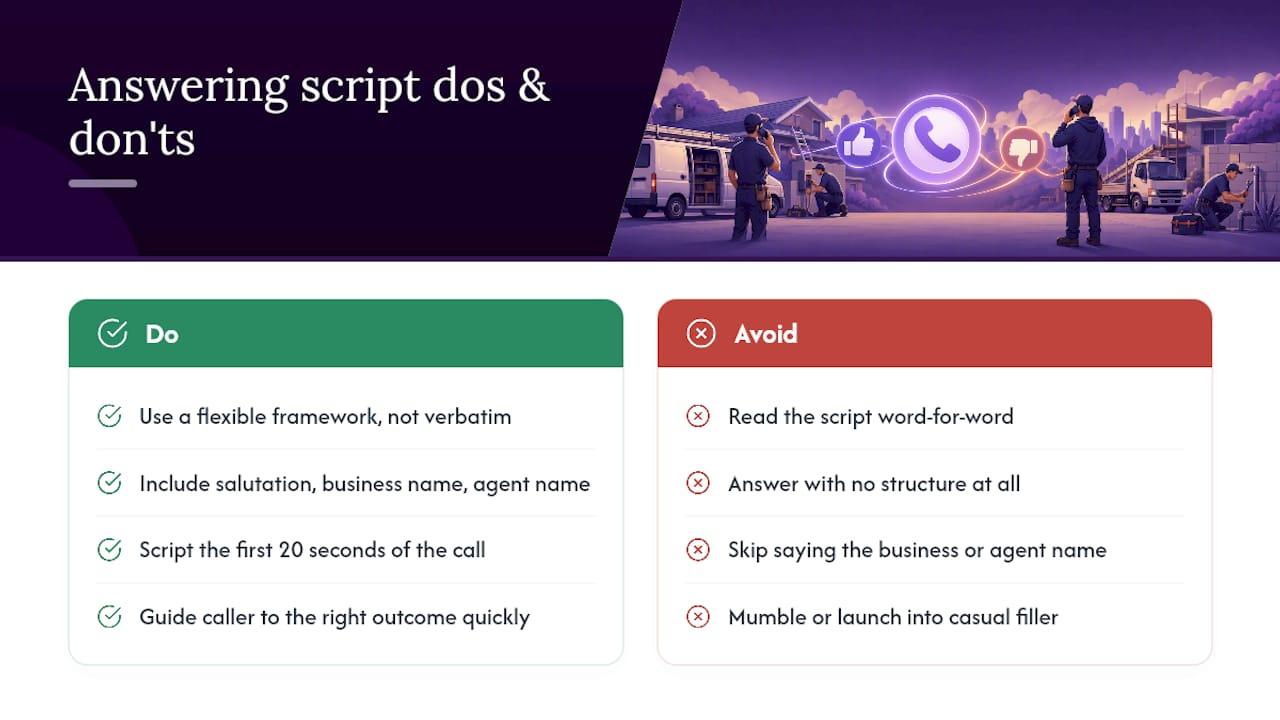
A phone answering script is not a word-for-word transcript for staff to read down the phone. It’s a framework, a set of “bones” that gives whoever picks up the right structure while leaving room for them to sound like an actual person. That distinction matters more than most business owners realise, because a script read too literally sounds stiff, and a call handled with no structure at all sounds chaotic.
The standard industry term for this is a “call handling script” or “business phone script”, and you’ll see both used interchangeably with “phone answering script” throughout this guide. Whichever term you use, the job is the same: get the caller to the right outcome without wasting their time or yours.
Template roundups across the customer service industry consistently point to three core greeting components: a time-appropriate salutation, the business name, and the agent’s name. Skip any one of these and callers notice, even if they can’t articulate why. A caller who doesn’t hear your business name within the first few seconds starts wondering if they’ve dialled the right number. One who doesn’t get a name to address feels like they’re talking to a call centre, not a business that knows them.
Here’s the part most guides miss: the script itself matters less than what happens in the first 20 seconds. That’s where callers decide whether they’re dealing with someone competent or someone who’s going to waste their time. Sales and service research consistently find the opening of a call carries an outsized share of the outcome. If you script anything, script that.
Missed or poorly handled calls cost small businesses real money. Industry commentary on call handling for small businesses links inconsistent phone answering directly to lost bookings and lost revenue, particularly for trades and service businesses where a missed call often means the job goes to a competitor who picked up. A script fixes the most common failure point: staff going blank, mumbling a greeting, or launching straight into “yeah, g’day” without identifying the business.
Quick templates: copy-and-adapt greetings for different roles and tones
Every business needs a base greeting, but the right tone shifts depending on who’s calling and what kind of business you run. Below are ready-to-use openers you can adapt in under a minute. Swap in your business name, your team member’s name, and adjust formality up or down to match your brand.
Standard professional greeting (registrations, bookings, general enquiries):
“Good morning, thanks for calling [Business Name], this is [Name]. How can I help you today?”
This works for almost any business that deals with the public directly. It’s neutral enough to suit accountants, clinics, and retail, and it hits all three required components without feeling scripted.
Warm small-business greeting (customers who value rapport over formality):
“Hey there, [Business Name], you’ve got [Name] on the phone. What can I do for you?”
Cafés, hairdressers, and local trades with a loyal customer base often do better dropping the corporate tone. The trade off is you lose a bit of the polish, so use this only where your brand voice is genuinely casual, not because it’s easier to say.
Trades/field-worker greeting (limited admin time, often answering between jobs):
“G’day, [Name] from [Business Name], sorry, bit of background noise, how can I help?”
Tradies answering on-site rarely have the luxury of a quiet office and a script on the wall. Acknowledging the noise upfront reads as honest rather than unprofessional, and it buys a couple of seconds to find a quieter spot if needed.
Receptionist opening line:
“Thanks for calling [Business Name], you’re speaking with [Name], how may I direct your call?”
If your receptionist is the first point of contact for multiple departments, this phrasing signals straight away that a transfer might be coming, which sets expectations without sounding cold.
Transfer opener (once the receptionist has identified where the call needs to go):
“I’ll put you through to [Department/Name] now, they’ll be able to help with that. One moment please.”
Time-of-day and mobile-friendly variants:
- Before midday: “Good morning, [Business Name], [Name] speaking.”
- Midday to 5pm: “Good afternoon, [Business Name], [Name] speaking.”
- After 5pm (if trading late): “Good evening, [Business Name], [Name] speaking.”
- Mobile/on-the-go, short version: “[Business Name], [Name] here, how can I help?”
That last one strips the greeting to its bare essentials, which matters if you’re a sole trader answering while driving between jobs. It still hits the three required elements, just faster.
+61 formatting note: if your script or voicemail references a callback number for interstate or international callers, format it correctly. An Australian mobile written as +61 4XX XXX XXX (dropping the leading zero from the local 04XX format) reads correctly on international caller ID and in text follow-ups. A landline follows the same rule: (02) 9XXX XXXX domestically becomes +61 2 9XXX XXXX internationally. Getting this wrong is a small thing, but it’s the sort of detail that makes a business look disorganised to anyone dialling from overseas or saving your number on their phone.
A large template pack of professional phone scripts breaks greetings into these same categories, and it’s worth browsing if you run a business with several distinct call types, like a clinic that takes both bookings and billing enquiries on the same line.
Pro Tip: Write your greeting on a sticky note stuck to the phone or monitor for the first two weeks. Staff stop needing it once the phrasing becomes automatic, but that first fortnight is where bad habits either form or get corrected.
Scripts for common call scenarios: hold, transfer, booking, payments, upset callers
The greeting gets a caller through the door. What happens next determines whether they book, buy, or hang up frustrated. Here are scripts for the five moments that most often make or break a call.
-
Putting a caller on hold. Never put someone on hold without asking first, and never guess at a time estimate you can’t back up. Try: “Would you mind holding for about a minute while I check that for you?” Wait for a yes. If it’s going to take longer than you said, come back and say so rather than leaving them hanging: “Thanks for your patience, I just need another minute or two, is that alright?” Hold etiquette across service industries agrees on the same principle: ask permission, give a realistic estimate, and offer a fallback if the wait runs long, such as a callback instead of continued holding.
-
Warm transferring a call. A cold transfer, where you just put someone through with no context, forces the caller to repeat their whole story to a second person. A warm transfer fixes that. Before connecting, give the receiving staff member a 30-second summary: “Hi Sam, I’ve got Mrs. Chen on the line, she’s after a quote for a hot water system replacement, she’s already given me her address, I’ll pop her through now.” Then to the caller: “I’m just putting you through to Sam who handles quotes, one moment.” This single habit is one of the cheapest ways to make a small business feel far more organised than it is.
-
Booking an appointment. Cold-calling and sales research consistently recommends offering two options rather than asking an open-ended “when suits you?” which forces the caller to do the mental work. Try: “I’ve got Tuesday at 10am or Thursday at 2pm free, which works better for you?” Once they pick, confirm it back clearly: “Great, that’s Thursday the 12th at 2pm, I’ll pop that in for you.” If your business sends confirmations, mention it: “You’ll get an SMS reminder closer to the date.” Confirming the date and time back out loud, every single time, catches the misheard bookings before they become missed jobs.
-
Billing and identity verification. Any call involving payment details or account changes needs a verification step that doesn’t feel like an interrogation. Keep it light but firm: “Before I pull up your account, can I just grab your name and the address on file?” Never read a card number back over the phone in full, and never ask for a CVV verbally if you can direct the caller to a secure payment link instead. If a caller sounds impatient with the verification step, a quick explanation defuses it: “This is just to keep your details safe, won’t take a second.”
-
De-escalating a frustrated or angry caller. The instinct to defend or explain immediately almost always makes things worse. Start by naming what you’re hearing: “I can hear you’re frustrated, and that’s completely fair.” Then move to action, not apology theatre: “Let me find out exactly what happened and get this sorted for you.” Avoid “calm down” in any form, it never calms anyone down. If the caller is swearing or shouting, a firm but respectful line works better than matching their energy: “I want to help you, but I need us to keep this civil so I can actually get it fixed.” That’s not about winning the exchange, it’s about getting the call back to a place where a solution is possible.
Scripts for these moments work best when they’re treated as a flexible playbook rather than a rigid script staff must recite verbatim. The exact words matter less than hitting the right beats: acknowledge, inform, act.
How to adapt and maintain scripts without sounding robotic
The templates above are starting points, not finished products. The businesses that get the most out of scripts treat them as modular, built from swappable blocks rather than one long monologue staff have to memorise.
Break every script into four blocks:
- Opener: the greeting itself, business name, staff name, offer to help.
- Discovery: the questions that work out what the caller actually needs (booking, complaint, quote, general enquiry).
- Resolution: the specific action, whether that’s booking a slot, transferring, or answering a question directly.
- Close: confirming next steps and ending the call cleanly.
Once scripts are broken into these blocks, editing becomes far easier because you’re only touching one block at a time rather than rewriting the whole thing.
Run every new or updated script through a three-step check before it goes live:
- Shrink it. If a block takes more than about 15 seconds to say out loud, cut it. Callers zone out fast, and a bloated opener buries the useful information.
- Personalise it. Swap generic phrasing for words your actual staff would say. If nobody on your team naturally says “How may I be of assistance,” don’t put it in the script.
- Role-test it. Have two staff members run through it as a caller and an answerer, out loud, not silently reading it. Scripts that look fine on paper often sound stilted the moment someone tries to say them.
Testing doesn’t need to be complicated. Record a handful of real calls (with disclosure, covered further below), or run structured roleplay sessions, and track two or three simple things: did the caller get their question answered in one call, did the staff member hit all three greeting components, and how long did the opener actually take. Compare scripts against each other the same way you’d compare two subject lines in an email campaign, keep what performs, drop what doesn’t.
Update your scripts whenever something material changes: new trading hours, a new service line, a price change, or a complaint pattern that keeps coming up. If three callers in a week ask the same question your script doesn’t address, that’s a signal the discovery block needs a new line, not a sign your staff are doing something wrong.
Pro Tip: Keep a shared document where staff can flag phrases that felt awkward on a real call. Scripts written by management in a meeting room rarely survive contact with an actual customer unchanged, and the people fielding calls every day are your best editors.
Getting the delivery right: pacing, tone and the first 20 seconds
A perfectly worded script delivered badly still sounds bad. Delivery is where most of the actual caller experience gets decided, and it costs nothing to fix beyond a bit of practice.
Smile while you talk. It sounds trivial, but the physical act of smiling changes the shape of your mouth and throat enough to noticeably warm up your voice, and callers pick up on it even though they can’t see your face. Pace matters just as much: rushing the opener because you’re juggling three other things makes the caller feel like an interruption rather than the reason you have a job. Slow down deliberately for the first sentence, then let your natural pace return.
Aim to keep the opening itself to three to six seconds, and the entire greeting, name included, under 20 seconds. Sales and service research backs this timing specifically: scripting the first 20 seconds delivers the biggest lift in call outcomes relative to the effort involved, because that’s the window where a caller decides whether to stay engaged or start looking for a way out of the call.
Train delivery the same way you’d train any other skill, with repetition and feedback, not a single briefing. Simple drills work well:
- Roleplay two or three common scenarios each week, five minutes each, rotating who plays the caller.
- Give feedback immediately after, focused on one thing at a time, tone, pace, or wording, never all three at once.
- Keep a short call-review checklist: did the greeting include all three components, was the caller’s question answered, did the call end with a clear next step.
Measure whether it’s working with a small set of numbers you already have access to: answer rate (how many calls get picked up before voicemail), how many calls convert to a booked appointment, and your missed-call rate over a week. If missed calls are climbing while answer rate stays flat, the problem probably isn’t your script, it’s staffing or timing, and worth tracking through field service KPIs rather than guessing.
Voicemail, after-hours, and Australian numbering rules
A missed call doesn’t have to be a lost caller if your voicemail actually does its job. A generic “leave a message and we’ll get back to you” prompt recovers far fewer enquiries than one that sets a specific expectation. Template research on after-hours messaging backs this up: callers respond better when given a concrete alternative, like a text option or a stated callback window, rather than an open-ended promise.
After-hours voicemail template:
“You’ve reached [Business Name]. Our team’s not available right now, but leave your name, number, and a quick note about what you need, and we’ll call you back by [specific time, e.g. 9am tomorrow]. If it’s urgent, you can also text this number.”
Emergency alternative line (for trades or services with genuine urgent call-outs):
“If this is an emergency, press 1 or call [alternative number] and someone will get back to you within the hour.”
Call-recording disclosure, if your business records calls for training or quality purposes, needs to be stated clearly and early, not buried. A simple line works: “This call may be recorded for training and quality purposes.” Say it before the caller gets into the substance of their enquiry, not after.
For numbering, always write Australian numbers the way a caller would actually read them back. A mobile is (04XX) XXX XXX domestically, or +61 4XX XXX XXX for anyone dialling from overseas or saving the contact for international use. Landlines follow area code conventions like (02), (03), (07), (08), and convert to +61 2, +61 3, +61 7, or +61 8 respectively, dropping the leading zero. Get this right on voicemail greetings, email signatures, and SMS follow-ups alike.
Applying these scripts with voice-first answering
Every script block described above, opener, discovery, resolution, close, maps directly onto how a voice-first answering system like Ask Hayley handles a call. Instead of a human running through the same discovery questions on every call, the system fills the same information slots: caller name, job type, address, preferred contact time, urgency.
For tradies specifically, that means lead qualification and booking blocks can run automatically outside business hours, capturing the details a quote actually needs (job type, location, timing) without the caller having to wait for a callback the next morning. Billing and complaint calls, on the other hand, still tend to need a human, because de-escalation and identity verification carry more nuance than a slot-filling system handles well.
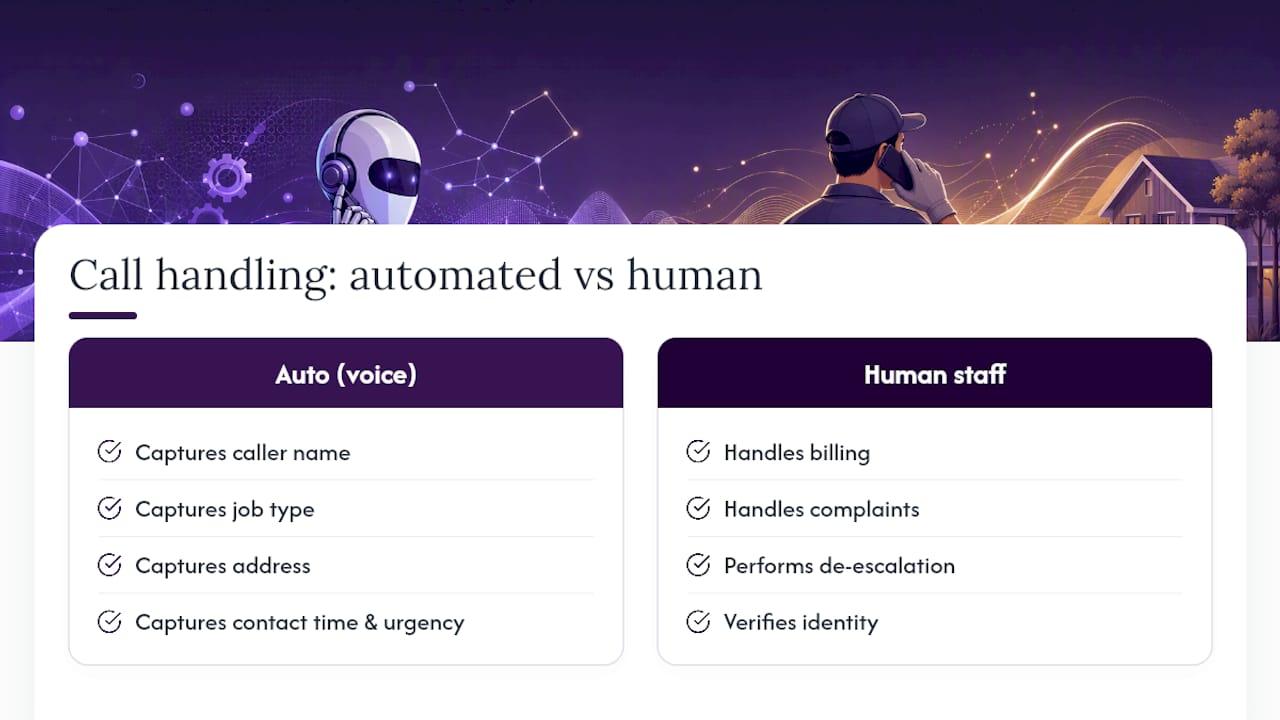
The honest answer on when automation fits: use it for high-volume, predictable calls, bookings, quote requests, general enquiries, and keep humans on anything emotionally charged or financially sensitive. Getting that split right matters more than how sophisticated the system sounds on a sales page.
Three things to change this week
Pick one greeting from this guide and put it into use today, not next month. Consistency matters more than finding the perfect wording, and you can always refine it once staff have said it a hundred times.
Run one training drill with your team this week, just one scenario, five minutes, real feedback. Trying to overhaul every script and every habit at once usually means none of it sticks. Small, repeated practice beats a single long briefing every time.
Track one metric for the next fortnight, whether that’s missed-call rate, booked appointments, or how many calls hit all three greeting components. You don’t need a dashboard full of numbers to know whether something’s improving, you need one number you actually look at.
If your call volume is growing faster than your team’s capacity to answer consistently, particularly after hours or during job site work, that’s the point to start looking at voice-first or AI-assisted answering rather than hiring another receptionist. It’s not a decision to rush, but it’s worth exploring before missed calls start costing you jobs.
— Hayley
Let Ask Hayley run these scripts for you, 24/7
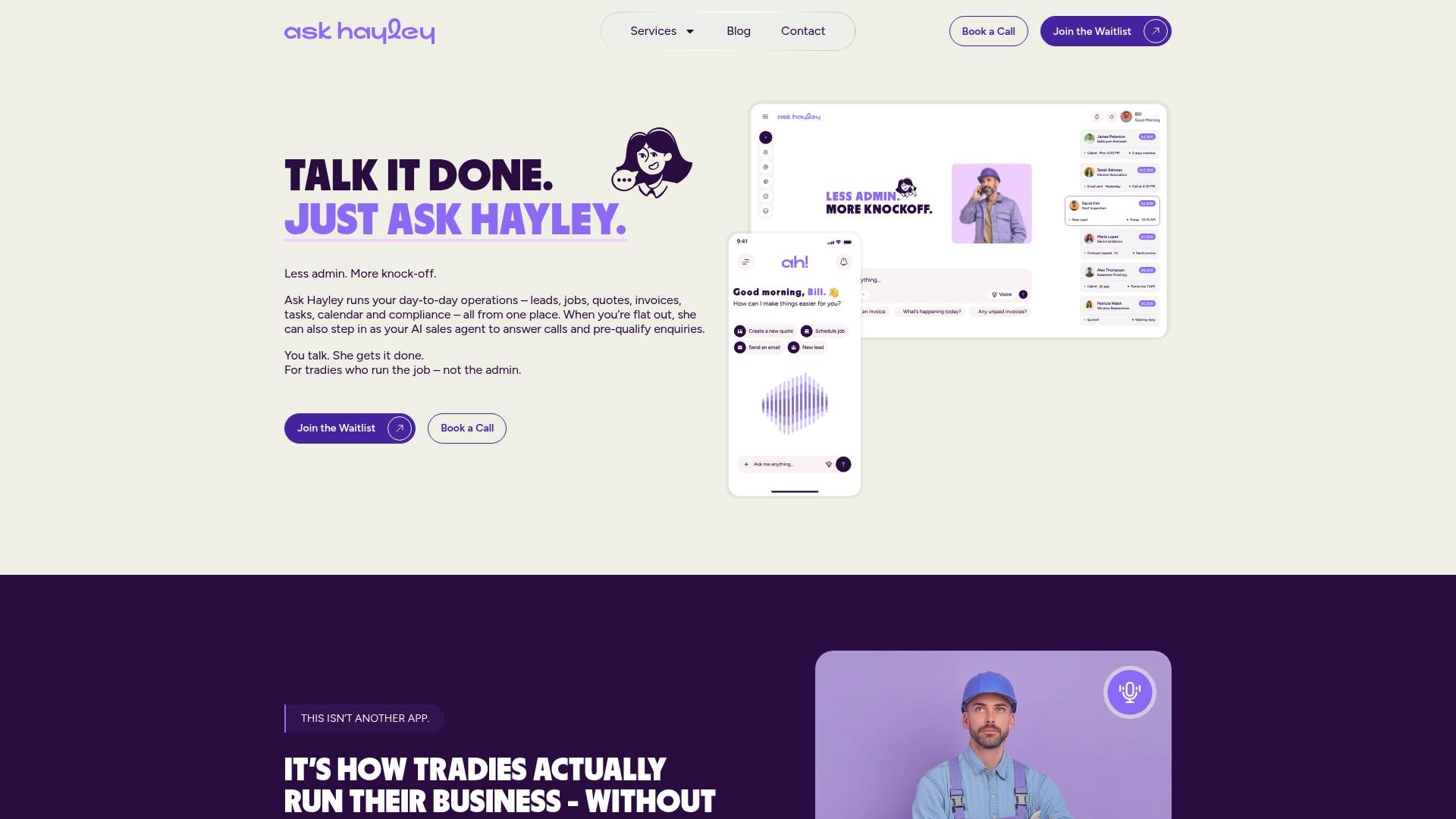
Ask Hayley is the alternative to hiring extra reception staff or hoping your team nails every script perfectly under pressure. Every block covered in this guide, the greeting, the discovery questions, the booking confirmation, maps directly onto how Ask Hayley answers inbound calls: it greets callers consistently every time, pre-qualifies leads with the same job-type and address questions a good receptionist would ask, and gets booking details into your calendar without anyone having to stop mid-job to pick up the phone.
If you’re a sole trader or small crew answering calls between jobs, training every staff member to deliver a perfect 20-second opener isn’t always realistic, and that’s exactly the gap voice-first answering fills. For businesses that want their whole customer-facing presence sorted, not just the phone, Ask Hayley’s one-page website service gives callers somewhere to confirm details or book online after a call, and its tendering and safety and compliance documentation services round out the admin side most tradies never have time for. Head to Ask Hayley to see how it fits your business, or reach out for a quote on any of the one-off services above.
Sources
- Cold calling script that actually works (from 14,000+ calls)
- How & why to use sales scripts + 14 examples and templates
- Sample script for answering phone calls: 50+ professional examples
- Cold calling scripts: 21 examples, templates, and tips
FAQ
What is a good script for answering phone calls?
A good script opens with a time-of-day greeting, the business name, and the staff member’s name, followed by a genuine offer to help, all inside about 10 to 20 seconds. Something like “Good morning, thanks for calling [Business Name], this is [Name], how can I help?” covers all three required components without sounding stiff.
What is the format of an Australian landline number?
Australian landlines use an area code in brackets followed by an eight-digit local number, such as (02) 9XXX XXXX for Sydney or (03) 9XXX XXXX for Melbourne. The area codes are (02), (03), (07), and (08) depending on the state or territory.
What should a receptionist say when answering the phone?
A receptionist should identify the business, give their own name, and offer to help or direct the call, such as “Thanks for calling [Business Name], you’re speaking with [Name], how may I direct your call?” This sets expectations clearly if a transfer is likely to follow.
How do I format a +61 number correctly?
For an Australian mobile, drop the leading zero from the local 04XX format and add +61, giving +61 4XX XXX XXX. Landlines follow the same rule, so (02) 9XXX XXXX becomes +61 2 9XXX XXXX for international callers or text follow-ups.
How much does Ask Hayley cost?
Current pricing for Ask Hayley’s plans and add-ons is available directly on the Ask Hayley website, along with details on its Assistant and Office Manager plans.


