


Voice CRM updates now let platforms act mid‑call, logging activity, matching contacts and triggering follow‑ups without a human touching a keyboard. For Australian businesses, that power only pays off if you lock down privacy disclosure, retention rules and human review first. Before you switch anything on, run vendor QA on data residency, record integrity and consent capture.
TL;DR:
- Voice CRM updates can automatically log activities, match contacts, and trigger follow-ups mid-call, but Australian data residency and privacy compliance must be confirmed first.
- Testing should include verifying data accuracy, handling ambiguous inputs, and checking system behavior during failures to prevent CRM inconsistencies.
- Australian laws require explicit disclosure of AI use, human review, and clear consent logging, with rules governing data retention and the use of voice data for training.
- Vendors must provide guarantees on data storage locations, deletion timelines, audit logs, and contact reconciliation processes before deployment.
- Reliability on basic functionalities like call answering and CRM writes should take priority over advanced reasoning features for trade businesses.
Table of Contents
- What major voice CRM updates and platform roadmaps now deliver
- How these updates change CRM workflows and what to test
- Australian compliance and privacy: OAIC expectations and ACMA telemarketing rules
- Implementation checklist and vendor questions
- Why tradies should prioritise reliability over sophistication
- How Ask Hayley helps tradies adopt voice CRM updates safely
- Sources
- FAQ
What major voice CRM updates and platform roadmaps now deliver
A real‑time voice agent is software that listens to a live call and takes action while the conversation is still happening, rather than transcribing it afterwards for someone to action later. Platform vendors call this “CRM reasoning”: the system doesn’t just write down what was said, it works out what should happen next and does it.
Microsoft’s Copilot Studio update describes voice agents that retrieve and update account data mid‑conversation, with low‑latency speech‑to‑speech responses built into Dynamics 365 Contact Center. Salesforce’s own commentary around its Koa reasoning model points the same way: the shift is from accurate transcription to auditable action inside the CRM itself.
In practice, that changes daily workflow in a few concrete ways:
- The system logs call activity automatically, without anyone typing notes afterwards.
- It matches the caller to an existing contact or flags a new one for review.
- It suggests or triggers the next step, like a quote follow‑up or a booking confirmation.
None of these vendor announcements confirm Australian availability or where your data sits once it leaves the call. Before you plan around any feature, confirm the rollout date for Australia and ask directly where voice data and transcripts are stored.
How these updates change CRM workflows and what to test
Closed‑loop automation sounds simple: call happens, CRM updates, job done. The failure modes are where it gets messy. A voice agent might match the wrong contact, create a duplicate record instead of updating an existing one, or fail partway through a write and leave your CRM in an inconsistent state.
Before you trust any of this with real customer data, run these tests:
- Put a sample call through a test CRM environment and check every field that should have updated.
- Review the activity log line by line against what was actually said on the call.
- Deliberately feed the system an ambiguous name or a bad phone number and see how it handles the mismatch.
- Switch off the CRM mid‑call to see whether the write fails safely or corrupts the record.
- Confirm there’s a clear point where a human reviews or overrides the automated action.
Pro Tip: Pilot on one small segment of calls first, watch the write success rate for a couple of weeks, and only scale once it’s holding steady.
A system that works perfectly in a demo can still create duplicate contacts the moment two customers share a surname. Testing for that now is cheaper than untangling it in your CRM six months later.
Australian compliance and privacy: OAIC expectations and ACMA telemarketing rules
Australian privacy law doesn’t treat voice AI as a grey area. The OAIC’s guidance on commercially available AI products makes clear that when an AI system infers personal information, that counts as “collection” under the Privacy Act, triggering the same accuracy, retention and disclosure obligations as if a person had typed it in. Human review of those inferences isn’t optional window dressing, it’s part of meeting your obligations.
Australians aren’t neutral on this either. The OAIC’s 2026 Community Attitudes to Privacy Survey found a majority of Australians see AI as a privacy risk, a similarly large share want human review of AI decisions and expect notification when AI is used on them. A transparency obligation, requiring disclosure of automated decision making in privacy policies is expected from December 2026.
On the outbound side, the ACMA’s Do Not Call Register rules cover personal numbers 30 days after registration, require caller identification and restrict calling windows. Outsourcing your calling to a vendor doesn’t shift that liability back off your business.
Practical actions worth taking now:
- Update your privacy policy to name the AI tools you use and what they do with voice data.
- Log consent at the point of capture, not after the fact.
- Set a clear retention window and get it in writing from your vendor.
- Confirm contractually whether your call data is ever used to train the vendor’s models.
Implementation checklist and vendor questions
Before signing anything, put these items in front of the vendor and get answers in writing from your Australian telephony and contact centre partner.
- Where exactly is voice data and CRM data stored, and is there Australian residency on offer?
- What’s the deletion SLA once a retention period expires?
- Is customer call data ever used to train the vendor’s broader models?
- Can you export full audit logs of every automated CRM write?
- How are duplicate contacts and failed writes detected and reconciled?
- What’s the escalation path and SLA when a call needs a human instead of the voice agent?
- How is consent captured and stored against each record?
Pro Tip: Set an acceptance threshold before the pilot starts, such as a minimum write success rate, so you’re judging results against a number you agreed on beforehand, not a gut feeling afterwards.
These same questions sit behind how we built follow-up cadence tracking and work order tracking for tradie businesses: every automated step needs a record a human can check.
Why tradies should prioritise reliability over sophistication
If you run a trade business, you don’t need the flashiest voice agent on the market. You need one that answers every call, books the job correctly and never loses a lead because of a dropped sync.
Advanced conversational reasoning is impressive in a demo. It matters a lot less than whether a quote follow‑up actually fires or a customer’s number gets matched to the right job history. Get the basics locked down first: reliable call capture, accurate CRM writes, then simple automation like booking confirmations and follow‑ups. Only once those are rock solid is it worth layering in more sophisticated reasoning features. Chase sophistication before reliability and you’ll spend more time fixing broken records than winning jobs.
— Hayley
How Ask Hayley helps tradies adopt voice CRM updates safely
You don’t need an enterprise rollout plan to get the benefit of voice CRM updates. Ask Hayley was built voice first for Australian tradies, so there’s no dashboard to learn and no typing between jobs.
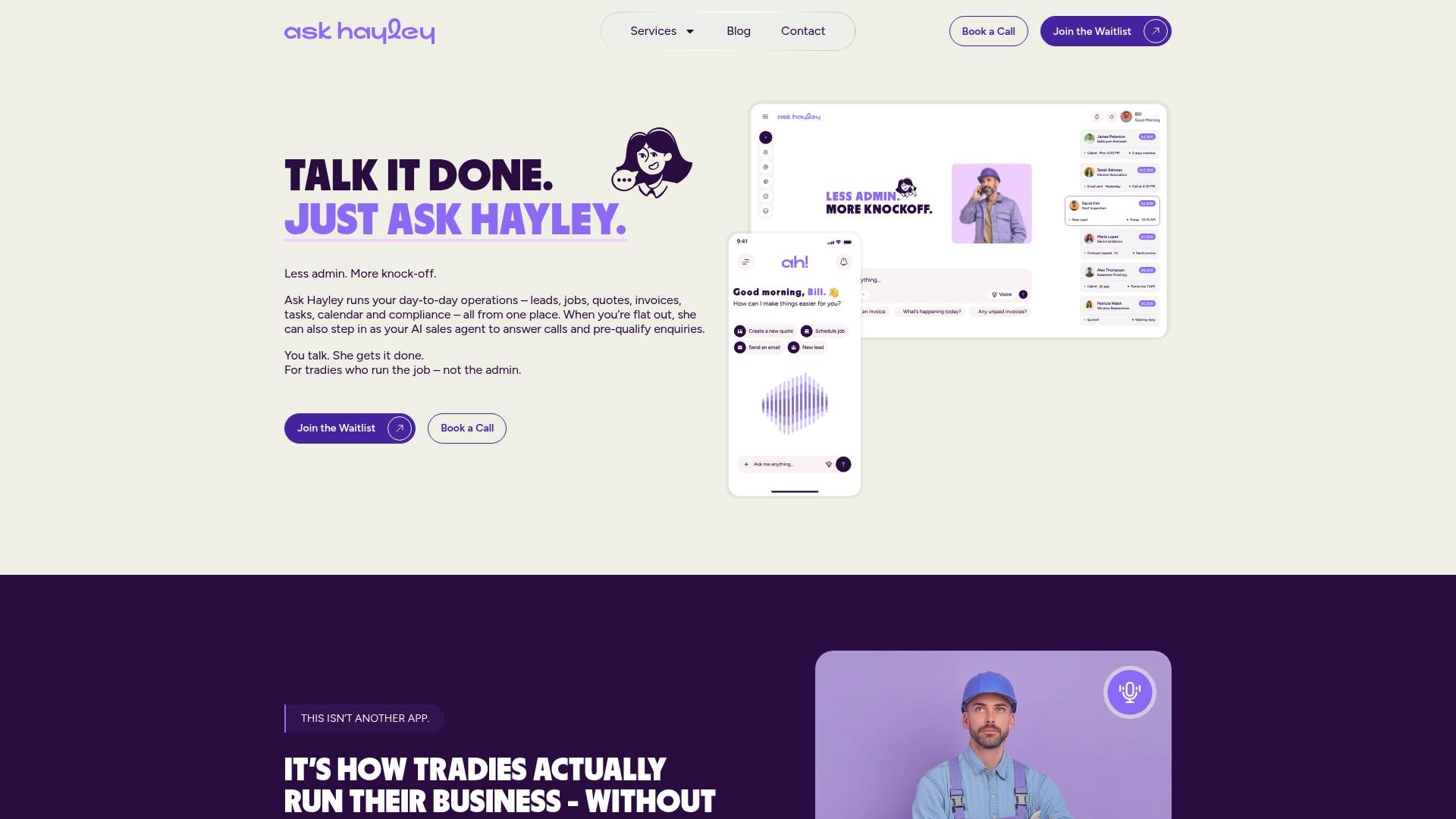
Ask Hayley’s platform supports answering inbound calls, pre‑qualifying leads, and managing follow‑ups and work orders to reduce admin. It connects with the tools you already run, including Xero and AroFlo, so records stay in sync rather than scattered.
- Inbound calls get answered and leads get pre‑qualified automatically.
- Follow‑ups and work orders are tracked so nothing falls through.
- Integrations with Xero and AroFlo keep your existing systems in the loop.
It’s the same checklist from this article, built in from day one: clear records, human escalation when it matters, and nothing you have to learn on top of running your business. See how it fits your business.
Sources
Before you commit to a vendor, read the primary sources directly rather than relying on summaries. Start with the OAIC’s AI privacy guidance and the ACMA’s Do Not Call Register rules for the compliance baseline. For technical roadmap detail, check vendor release notes directly, since features move between availability and Australian rollout on different timelines.
- OAIC — Guidance on privacy and the use of commercially available AI products
- ACMA — Do Not Call Register
- Microsoft Copilot blog — real‑time voice agents
FAQ
Do voice CRM updates meet Australian privacy requirements automatically?
No, platform features don’t come with automatic compliance. Under OAIC guidance, any AI‑generated inference counts as collected personal information, so you still need disclosure, accuracy checks and human review built around the tool.
Does outsourcing outbound voice calls to a vendor remove my liability?
No, liability stays with your business. ACMA’s Do Not Call Register rules make clear that outsourcing calling doesn’t transfer responsibility for list washing, calling windows or caller identification.
What should I test before trusting a voice agent with CRM writes?
Run a sample call through a test environment, check the activity log against what was said, and deliberately trigger a bad contact match or a failed write to see how the system handles it. A short pilot on a small segment, with a write success rate you check against, is the safest way to validate this before wider rollout.
How does Ask Hayley handle call answering and CRM updates for tradies?
Ask Hayley answers inbound calls, pre‑qualifies leads and keeps follow‑ups and work orders updated through voice, without requiring a dashboard. It integrates with Xero and AroFlo so records stay consistent across the tools tradies already use.
What’s the biggest compliance risk in 2026 voice CRM rollouts?
The biggest risk is treating AI disclosure and telemarketing rules as optional extras rather than core design requirements. OAIC survey data shows most Australians expect notification when AI is used and want human review of automated decisions, so building that in from the start avoids both compliance risk and customer pushback.


