


Aim to respond to hot inbound leads in under five minutes, with phone and chat under three and email under thirty. Faster contact wins significantly more qualified conversations than slower follow-up, and you should judge your own performance by median response time, not the average. Ask Hayley is one Australian option built to help tradies hit that window without adding another screen to stare at.
TL;DR:
- Most small businesses respond to leads too slowly, often taking days instead of minutes, which significantly reduces conversion chances.
- Immediate auto-acknowledgement within 60 to 90 seconds and automated routing can cut median response times markedly, often in less than a week.
- Response times vary greatly by lead source, with phone and chat ideally under three minutes, and email or cold leads often exceeding 30 minutes or more.
- Separately tracking processing time and rep response time reveals bottlenecks, whether in lead routing or human follow-up.
- Using voice-first assistants like Ask Hayley can automate initial contact and pre-qualification, reducing delays and increasing lead follow-through.
Table of Contents
- What is lead response time and how do you calculate it?
- Why lead response time matters: conversion and revenue impact
- Benchmarks and how to measure your baseline
- Immediate fixes: routing, automation and acknowledgement systems like those offered through CRM & automation Brisbane | Sun State Digital can implement routing, enrichment and notification integrations recommended in the article.
- First-touch playbook and multi-channel follow-up cadence
- Diagnose where your delay lives: processing vs rep response
- Short Australian audit: what audits find and how tradies should prioritise
- How Ask Hayley helps tradies hit response-time SLAs
- Three steps to run this week
- Ask Hayley: an Australian, voice-first option to improve lead response
- Sources
What is lead response time and how do you calculate it?
Lead response time is the gap between when a lead lands and when someone from your business makes first contact. The formula is simple: time of first follow-up minus time of lead creation, measured per lead and then rolled up across your pipeline, according to Geckoboard’s KPI framework.
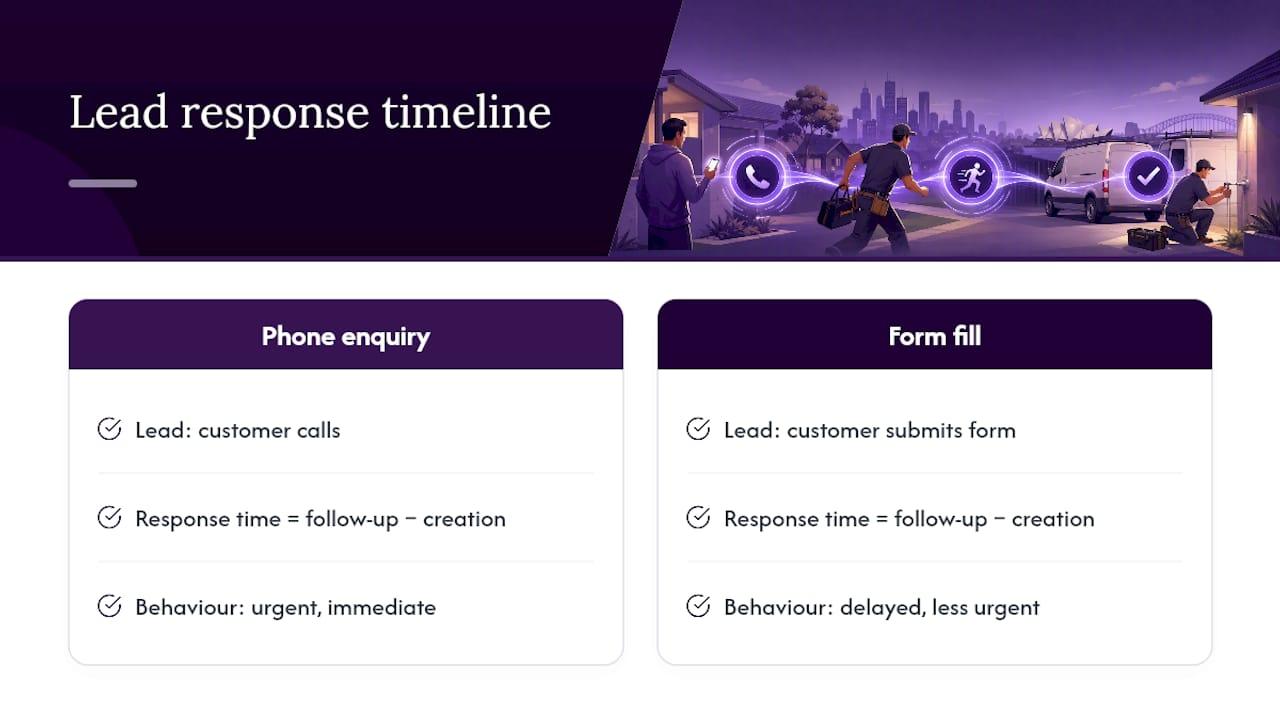
That framework also flags something most small operators miss: you need to segment the metric by lead source. A phone enquiry from someone standing in front of a burst pipe behaves nothing like a form fill from someone browsing quotes at midnight, and lumping them together hides both your best and worst results.
Response time is sometimes called speed to lead, lead follow-up time, or contact latency in different corners of the sales world. They all point at the same clock: the seconds and minutes between “a stranger wants to talk to you” and “you actually talked to them.”
Why lead response time matters: conversion and revenue impact
Harvard Business Review analysed millions of sales leads and found firms contacting a lead within an hour were far more likely to qualify it than those who waited, with the odds dropping sharply the longer the delay stretched, according to HBR’s research. The canonical “five minute” figure traces back to this same body of lead response management research, which found contact-rate multipliers that decayed fast past the first few minutes.
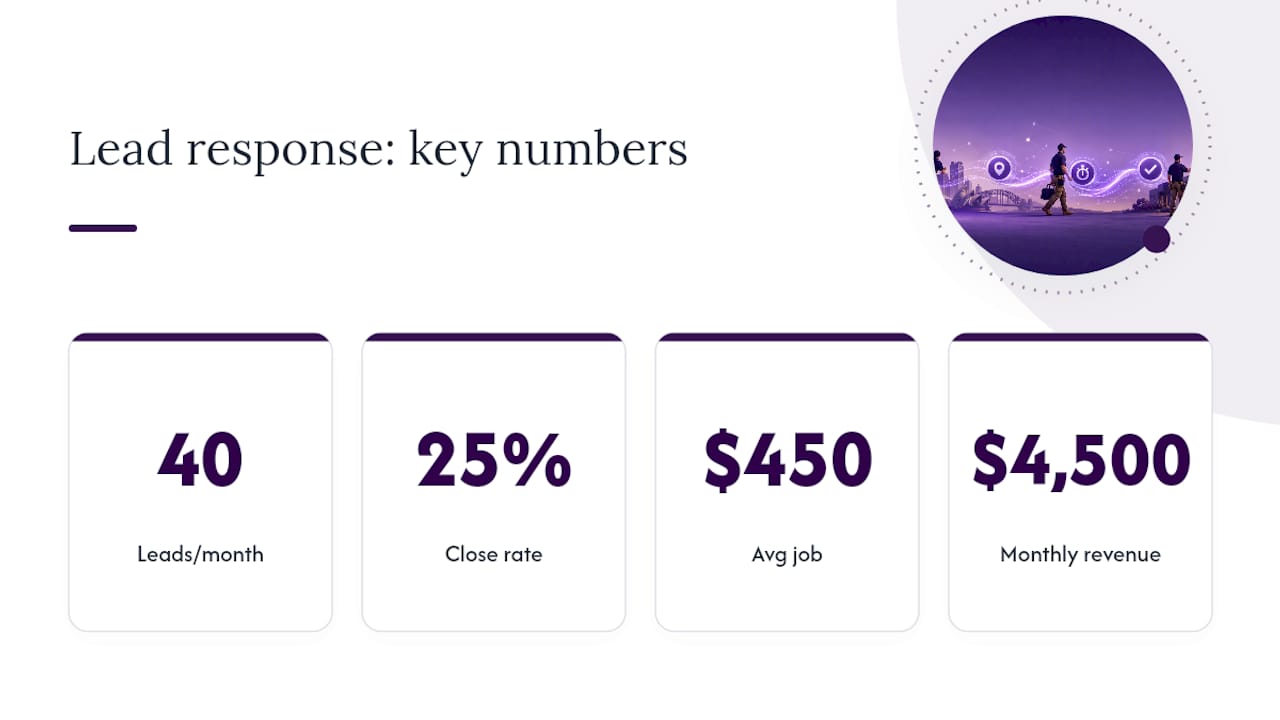
Quick math: A Brisbane electrician getting 40 leads a month at a 25% close rate and a $450 average job is worth $4,500. Slip average response from five minutes to five hours, and even a modest drop in qualification rate can cost more than one job’s revenue every single month, purely from delay.
Locally, the picture is worse than most owners assume. An Australian audit of building and trades enquiries found many businesses taking multiple days to reply to a fresh lead, not hours. That is not a training problem. It is a systems gap, and it is fixable in a week.
One measurement note matters more than it sounds: report the median, not the mean. A single lead that sat untouched over a long weekend will blow out your average and mask the fact that your typical customer is actually being handled reasonably well, or badly, depending on which way the outlier skews.
Benchmarks and how to measure your baseline
Before you can improve anything, you need a number. Pull your CRM export, calculate first follow-up minus lead creation for every lead in the last 30 days, then sort by median rather than mean, so one outlier weekend doesn’t distort your read on typical performance.
Split that median two ways:
- By channel. Phone, live chat, SMS, form, and email each carry a different customer expectation.
- By lead temperature. A hot lead (ready to book) needs a different clock to a cold one (early research).
- By source. Paid ads, referrals, and organic enquiries convert differently, and the same KPI guidance recommends tracking each separately rather than blending them into one number.
There’s also a structural split worth building into your reporting: processing time (lead creation to assignment) versus rep response time (assignment to actual contact). Blended figures hide which half of the pipeline is actually broken.
Here are sensible targets to benchmark against:
| Channel or lead type | Target response time |
|---|---|
| Phone / live chat | Under 3 minutes |
| SMS | Under 3 minutes |
| Hot inbound form lead | Under 5 minutes |
| Warm enquiry | Under 30 minutes |
| Under 30 minutes | |
| Cold or research-stage lead | Same business day |
These aren’t arbitrary. They map to the conversion decay curve HBR documented, adjusted for what’s realistic when you’re running a small crew rather than a call centre.
Immediate fixes: routing, automation and acknowledgement systems like those offered through CRM & automation Brisbane | Sun State Digital can implement routing, enrichment and notification integrations recommended in the article.
You don’t need a bigger team to fix a slow response time. You need dead time out of the process, and most of that dead time sits in the gap between a lead arriving and a human noticing it exists.
- Turn on instant auto-acknowledgement. A message within 60 to 90 seconds confirming you’ve received the enquiry and stating when a real person will follow up, exactly as recommended in modern lead-response playbooks, buys you the minutes you need without losing the lead’s trust.
- Automate routing with fallback rules. Round-robin assignment based on who’s actually available, not who’s next on a static list, cuts the manual triage step that quietly eats minutes every single time a lead comes in.
- Build in capacity-aware escalation. If the first rep doesn’t claim the lead within your SLA window, it should reassign itself, not sit in an inbox waiting to be noticed.
- Enrich the lead in real time. Pulling job history, location, or urgency signals before the call happens means the first conversation is useful, not a scramble to catch up.
- Push notifications, not email alerts. A lead sitting in an inbox is a lead nobody sees until someone opens their laptop, which for a tradie might be hours away.
- Set channel-specific SLAs, not one blanket number. Chat and phone need near-instant response; email has more breathing room.
Pro Tip: Manual lead assignment is one of the most common sources of avoidable delay in small service businesses. If a human has to eyeball an inbox and decide who gets the job, that step alone is worth automating first, before touching anything else.
First-touch playbook and multi-channel follow-up cadence
A single fast response gets you in the door. What keeps you there is a cadence that doesn’t let a lead go cold after one missed call.
The sequence recommended by current lead-response playbooks runs in layers: instant acknowledgement, then a human attempt within your channel SLA, then a timed escalation if nobody’s claimed it. Here’s how that plays out across the first 24 hours:
| Attempt | Timing | Channel |
|---|---|---|
| Acknowledgement | Immediate (under 90 seconds) | SMS or automated reply |
| First human attempt | Within 5 minutes | Phone call |
| Second attempt | 30 minutes after first | SMS or text follow-up |
| Third attempt | 3 hours after lead creation | Email with quote or booking link |
| Fourth attempt | Next business morning | Phone, if unclaimed job |
A few adjustments matter for trades specifically:
- Weekend and after-hours leads should still get an instant acknowledgement, even if the human follow-up waits until the next business window.
- Morning priority routing catches overnight leads before the day’s jobs start, which recovers a good share of enquiries that would otherwise sit for a full day.
- SMS tends to outperform email for urgent trade enquiries because it gets read within minutes, not hours, making it worth building into your follow-up cadence as a primary early-touch channel.
Diagnose where your delay lives: processing vs rep response
If your median lead response time is blowing out, the fix depends entirely on which half of the clock is broken. Instrument both processing time and rep response time separately in your CRM reports so you’re not guessing.
- Long processing time, short rep response: the bottleneck is routing or data. Automate assignment instead of relying on someone to manually allocate leads.
- Short processing time, long rep response: the lead reaches someone fast, but they’re not acting on it. That’s a behaviour or workload problem, not a systems one.
- Both are long: you likely have poor data enrichment causing hesitation, plus no escalation rule forcing action.
Track this on a simple dashboard reviewed weekly: median processing time, median rep response time, and SLA breach rate by channel. The field service KPI framework gives a useful structure for building this out without overcomplicating your reporting.
Short Australian audit: what audits find and how tradies should prioritise
Local audit data tells an uncomfortable story: many building and trades businesses across Australia are replying to fresh enquiries days after they land, not minutes, according to audit findings on the local market. For a solo operator or small crew, that’s rarely a motivation problem. It’s usually because nobody’s watching the inbox while they’re up a ladder.
Realistic SLAs for a small trades business don’t require a night shift. After-hours auto-acknowledgement combined with early-morning priority routing recovers a meaningful share of overnight leads without needing anyone awake at 2am.
Run this one-week mini-audit before changing anything:
- Pull every lead from the last seven days and timestamp first contact against lead creation.
- Calculate median response time by channel, not overall average.
- Flag every lead that took longer than your target SLA and note why.
- Check whether after-hours or weekend leads are disproportionately slow.
- Identify one quick win (usually auto-acknowledgement or routing) and switch it on this week.
How Ask Hayley helps tradies hit response-time SLAs
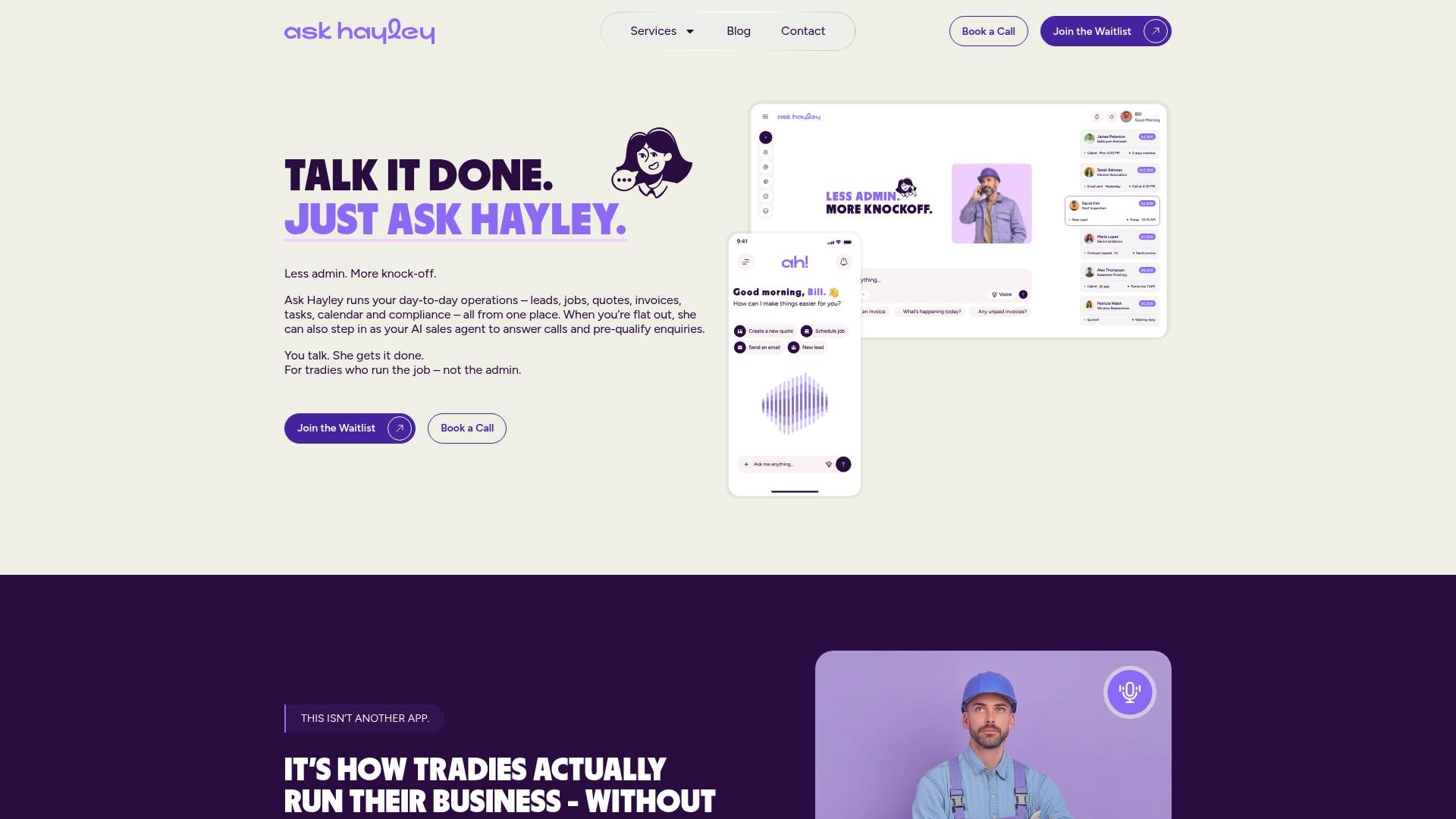
Ask Hayley is a voice-first assistant built specifically for the gap this article has been describing: the minutes between a lead landing and someone actually picking it up. When you can’t get to the phone, Hayley answers, pre-qualifies the caller before the enquiry ever reaches your inbox, and handles the admin that normally delays follow-up.
That maps directly onto the playbook above. Instant acknowledgement happens because the call gets answered, not missed. Routing happens because Hayley pre-qualifies before handing the lead over. Follow-up cadence stays intact because the admin work of logging, tracking, and prompting the next attempt runs through voice prompts instead of sitting in a notes app. For tradies running a tendering pipeline or juggling multiple active jobs, that consistency is often the difference between a lead converting and a lead going cold.
Three steps to run this week
Start with a baseline. Pull last month’s leads and calculate median response time by channel, not the average, so you know exactly where the delay sits before changing anything.
Second, switch on instant acknowledgement today, even a simple automated SMS confirming receipt and setting expectations. That single change removes the worst of the silent drop-off between a lead landing and someone noticing.
Third, run the seven-day mini-audit outlined earlier, assign one person ownership of the median LRT number, and put it somewhere visible, a whiteboard, a shared dashboard, anything that gets checked weekly. Numbers that nobody looks at don’t improve.
If you want a ready-made way to close the gap between “lead arrives” and “someone talks to them,” a trial run of a voice-first system built for this exact problem is a reasonable next move.
— Hayley
Ask Hayley: an Australian, voice-first option to improve lead response
Ask Hayley is the alternative to hiring extra reception staff for missed-call coverage: instead of paying for a person to sit by the phone, Hayley answers, pre-qualifies, and logs the enquiry the moment it comes in, at any hour a tradie can’t pick up.
Some business management platforms offer tiered plans addressing missed calls and follow-up management, with additional add-ons to extend pre-qualification further up the funnel before a lead reaches your phone.
The outcome across all three is the same: fewer missed calls, faster pre-qualification, and a follow-up cadence that runs whether you’re on a roof or in the ute. If your business needs a fast lead-capture front door to match, pair it with a one-page website built for quick enquiries. Start a trial at Ask Hayley and see what a five-minute response actually looks like in practice.


