


Job profitability analysis is the process of comparing what a job earns against what it truly costs, including labour, materials and overheads, so you know your real margin rather than a guess. The single most important action is to start recording fully burdened labour hours and direct costs against each job today, in a system like Xero Projects or a voice-first tool like Ask Hayley, before the payday super changes landing on 1 July 2026 make accurate labour costing even more important.
TL;DR:
- Fully burdened labour rates must include super, leave loading, and workers’ compensation to accurately calculate job contribution margins.
- Tracking actual costs during the project, rather than after completion, helps identify issues early and prevents hidden losses.
- Regularly updating estimates for scope changes and comparing actuals against budgets can prevent jobs from turning unprofitable unnoticed.
- Monitoring key metrics like contribution margin, billable utilization, and realisation rate guides targeted actions to improve overall profitability.
- Integrating time and cost tracking tools, especially voice-based systems, reduces data entry delays and improves job-level profit visibility.
Table of Contents
- What job profitability means in practice
- Common costing mistakes that corrupt job profitability
- Key metrics to track for job profitability analysis
- How to collect accurate job data: systems, time capture and payroll on-costs
- Step-by-step: run a job profitability analysis (repeatable monthly process)
- Worked example: two jobs with the same revenue but opposite profitability
- Interpretation and action: pricing, resourcing and contract changes
- Make it a habit: reporting rhythm, KPIs and governance for ongoing profitability
- Practical implementation for tradies: how Ask Hayley and simple integrations reduce admin burden
- Why job-level profit visibility transforms small service businesses
- How Ask Hayley helps: a practical alternative to spreadsheets
- FAQ
- Sources
What job profitability means in practice
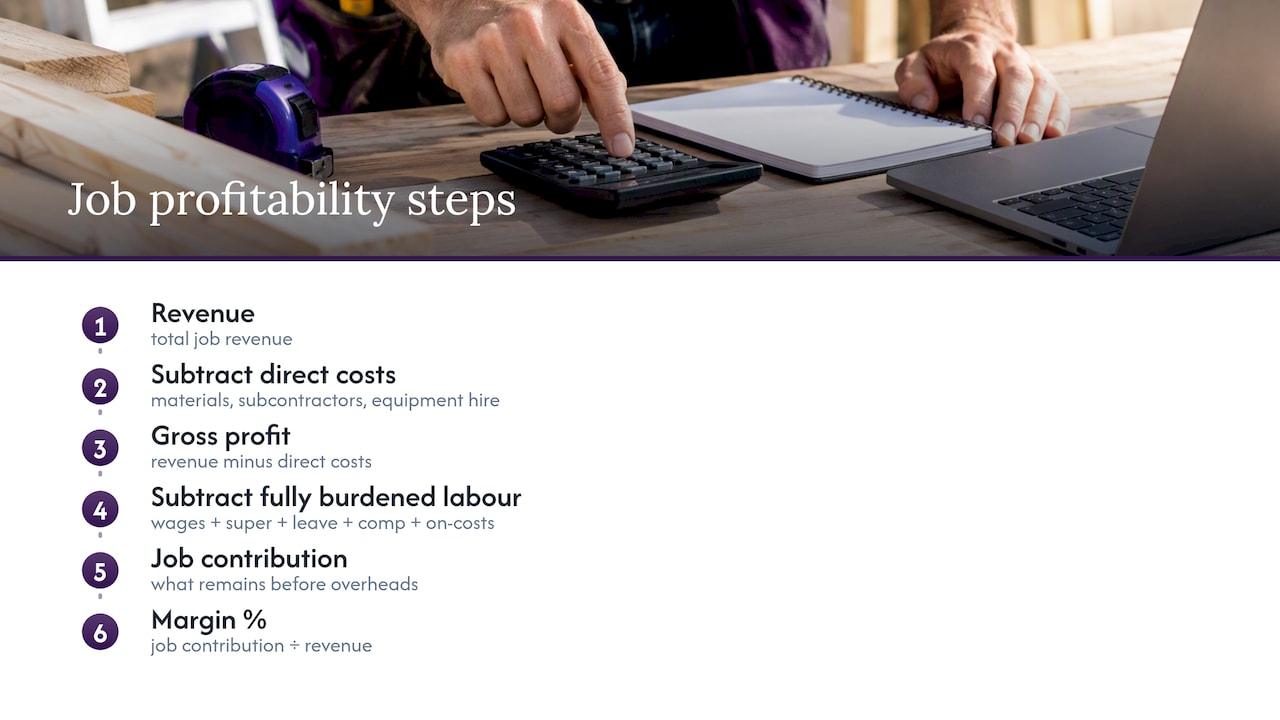
At its simplest, job profitability comes down to one formula: revenue minus direct costs minus fully burdened labour equals job contribution. Divide that contribution by revenue and you get your margin percentage for that job. It sounds basic, but most small service businesses never calculate it properly because they are missing one or more of the inputs.
Direct costs include materials, subcontractor payments and any equipment hire tied specifically to the job. Labour needs to be charged at the fully burdened rate, not the number on a payslip. That means wages plus super, leave loadings, workers’ compensation and other on-costs, which we will break down further below.
There is a difference between gross profit per job and contribution margin after allocated overheads. Gross profit tells you what is left after direct costs. Contribution margin goes a step further and subtracts a fair share of your fixed overheads, like the ute, insurance, office rent or admin wages. Xero recommends comparing actual project costs, labour, materials, subcontractors and overheads, against revenue to calculate the true margin, rather than relying on the quote alone.
This visibility changes how you price and who you work for. A job that looks healthy on revenue alone can be quietly losing money once you account for the hours it really took and the overheads it absorbed. Once you see that clearly, pricing decisions and client selection stop being guesswork.
Common costing mistakes that corrupt job profitability
Most job profitability numbers are wrong before anyone looks at them, and the errors usually come from the same handful of habits.
- Costing labour at base wages instead of the fully burdened rate, which ignores super, leave and workers’ compensation and can understate labour costs significantly.
- Ignoring overheads altogether, or spreading them with a flat percentage that has nothing to do with how the job actually used your time and resources.
- Recording costs after the job wraps up, or in a spreadsheet that never talks to your accounting software, which means you find out too late to fix anything.
- Letting the original estimate sit untouched even when the scope changes halfway through, so the “budget” you are comparing against is fiction by the time the job finishes.
The Xero guide to project profitability points to disconnected spreadsheets and late data entry as the most common failure points, and recommends integrating time, cost and project data with your accounting software so problems show up while the job is still running, not after.
Pro Tip: Update your job estimate the moment scope changes, even for a five-minute variation. A forgotten variation is the easiest way to turn a profitable job into a loss on paper.
Key metrics to track for job profitability analysis
You do not need a dashboard full of numbers to run useful job profitability analysis. A handful of metrics, tracked consistently, will tell you almost everything.
- Gross profit margin per job: revenue minus direct costs, divided by revenue, shown as a percentage.
- Contribution margin: gross profit minus an allocated share of overheads, which tells you what the job really contributed to the business.
- Billable utilisation: the share of paid hours that were actually billed to a job, a key signal of where labour is leaking.
- Budget variance: the gap between what you quoted and what the job actually cost, job by job.
- Realisation rate: how much of your quoted price you actually recovered once the job closed out.
Estimate accuracy varies a lot depending on how well a job is scoped. Industry research on construction estimating shows detailed bid estimates with complete drawings are commonly accurate to around −5% to +15%, while concept-stage estimates can swing far wider. That gap is exactly why budget variance needs tracking job by job rather than assumed from the quote.
If you want a cleaner read on labour efficiency specifically, our utilisation rate calculation guide walks through how to work out billable hours against paid hours for a trade business.
How to collect accurate job data: systems, time capture and payroll on-costs
Spreadsheets fail at job costing because nobody updates them in real time, and by the time someone does, the job is finished and the numbers are historical trivia. Integrating your project tracking with your accounting software, through something like Xero Projects, lets you compare estimate against actual while the job is still running.
Practical capture options worth considering include:
- Field time apps that let tradies log hours against a job from their phone on site.
- GPS-based punch clocks for crews moving between multiple jobs in a day.
- Voice capture tools like Ask Hayley, which let you log time and notes by talking rather than typing into a form.
- Daily job sheets for businesses not ready to go digital, as long as someone enters them the same day.
Whatever method you choose, the labour rate you apply has to be fully burdened. Fair Work Ombudsman and the ATO provide the baseline guidance on pay and super obligations, and the on-costs to build into your rate include the 12% super guarantee, leave entitlements, workers’ compensation premiums and, in some states, payroll tax. From 1 July 2026, payday super rules require employers to pay super contributions within 7 business days of the related wage payment, at the same 12% rate, which tightens the timing of an on-cost many tradies already underestimate.
Step-by-step: run a job profitability analysis (repeatable monthly process)
Running this monthly, rather than once a year, is what turns job profitability analysis into a management tool instead of a post-mortem.
- Set a clear job definition and initial budget before work starts, covering materials, subcontractors and estimated labour hours.
- Capture materials, subcontractor invoices and labour time against the job as they happen, not at job close.
- Apply fully burdened labour rates and allocate shared overheads using a sensible basis, such as labour hours, rather than a flat guess.
- Compare estimate against actual for each job, flag anything outside an acceptable variance, and assign someone to investigate why.
- Build a short top-5 jobs dashboard each month, both best and worst performers, and schedule a follow-up action for each one.
Pro Tip: Keep the monthly dashboard to one page. If it takes longer than five minutes to read, nobody will read it twice.
Worked example: two jobs with the same revenue but opposite profitability
Say two jobs both bill $20,000. Job A and Job B look identical on the invoice, but the numbers underneath tell very different stories once labour and overheads are properly allocated.
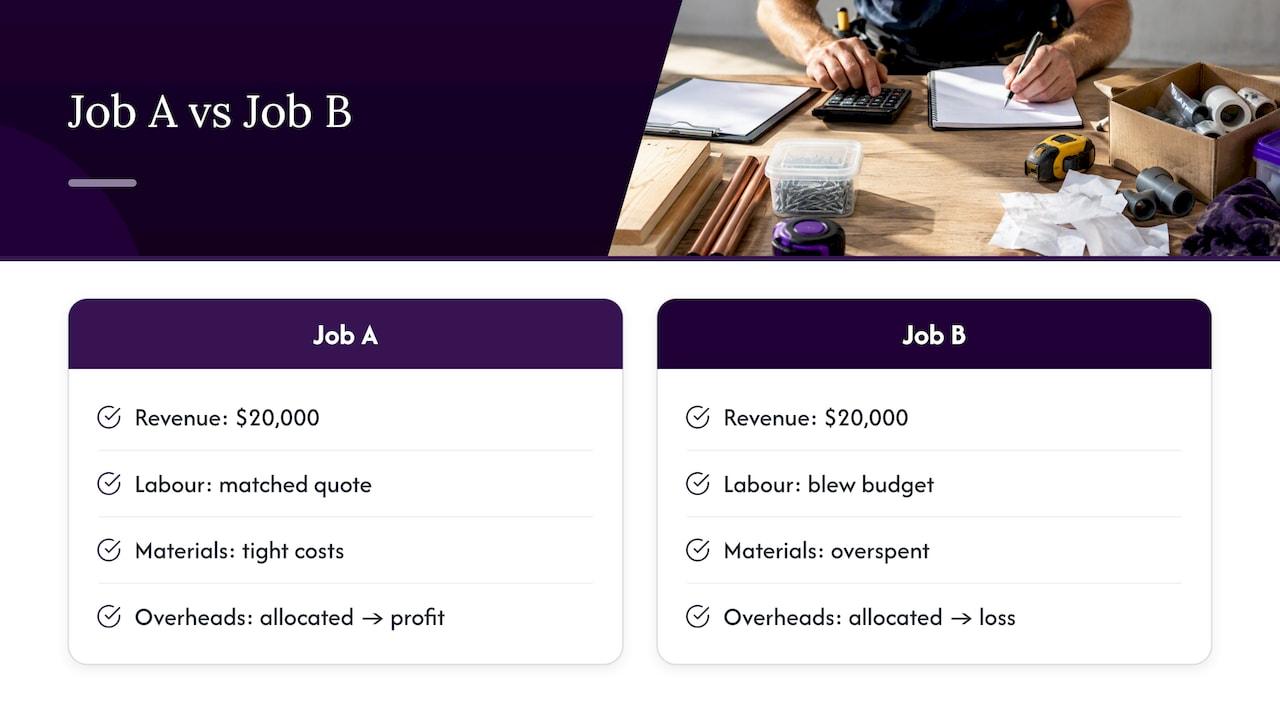
Job A ran efficiently: tight material costs and labour that matched the quote. Job B blew its labour budget and overspent on materials, and once overheads are allocated it is actually a loss. On paper, before this analysis, both jobs looked the same because they billed the same amount.
The management response differs for each. Job A is worth repeating: the scope, pricing and crew mix worked, so use it as a benchmark for future quotes. Job B needs a post-mortem: was the quote too low, did the scope creep, or did the crew take longer than planned? Without job-level analysis, that difference stays invisible.
Interpretation and action: pricing, resourcing and contract changes
Numbers only matter if they change what you do next. Once you can see which jobs make money and which do not, a few decisions usually follow.
- Reprice job types that consistently run thin margins, or move them to value-based pricing instead of a flat hourly rate.
- De-prioritise clients or job types that repeatedly show poor contribution margin, even if they are high revenue.
- Shift tasks to subcontractors or upskill your own crew where labour hours are consistently blowing out, guided by insights from managed IT services pricing for SMBs.
- Review procurement: a supplier switch or bulk ordering can shave material costs on repeat job types.
- Tighten contract terms, including quote expiry dates, progress claim schedules and clearly defined scope, so margin is protected before work even starts.
Our guide to quote expiry policies covers why a 30-day expiry on quotes protects you against rising material costs eroding a margin you already calculated. Progress claims matter just as much: our guide to progress claims explains how staged billing protects cashflow on longer jobs, which matters when a job’s profitability only becomes clear partway through.
Pro Tip: Before dropping a client over thin margins, check whether the problem is the client or the job type. Sometimes it is one repeat job that needs repricing, not the relationship.
Make it a habit: reporting rhythm, KPIs and governance for ongoing profitability
A single profitability review tells you about one month. A rhythm tells you about your business.
- Run a quick weekly check on jobs currently in progress, comparing hours logged against the budget.
- Consolidate a monthly profitability report across all closed jobs, using the top-5 dashboard format.
- Do a quarterly deep dive looking for patterns across job types, crews or clients rather than individual jobs.
| Dashboard element | What it shows |
|---|---|
| Top jobs by margin | Which job types and clients are worth repeating |
| Jobs at risk | Current jobs trending over budget before they finish |
| Billable utilisation | Whether paid hours are actually landing on jobs |
| Realisation rate | How much of the quoted price was actually recovered |
Assign clear ownership: someone enters job data daily, someone owns the monthly dashboard, and someone is responsible for acting on what it shows. Industry guidance recommends exactly this kind of monthly discipline to catch recurring under-pricing before it becomes a pattern across a whole quarter.
Practical implementation for tradies: how Ask Hayley and simple integrations reduce admin burden
Most job profitability analysis fails not because the maths is hard, but because the data never gets entered. Tradies are on site with their hands full, and typing time entries into an app at the end of a long day is the first thing to slip.
Voice-first capture solves that specific problem. Rather than opening an app and filling in fields, you talk, and the time, materials and notes land against the right job. Some systems fit into workflows that link quotes, work orders and invoicing back to accounting systems, so the labour hours and costs feeding your profitability numbers are the same ones driving your invoices.
A few habits make this work well:
- Record a quick voice note against the job the moment you finish a task, not at the end of the week.
- Set your overhead allocation rule once, based on labour hours, and apply it consistently rather than guessing each month.
- Use progress claims on longer jobs so cashflow and profitability tracking move together instead of waiting until the final invoice.
Our work order tracking page covers how job data gets recorded and who should own that responsibility day to day.
Why job-level profit visibility transforms small service businesses
Small service businesses most often lose margin on missed on-costs and late time capture, not bad pricing. Pick one job this month, run the numbers properly, and change one pricing or process decision based on what you find.
— Hayley
How Ask Hayley helps: a practical alternative to spreadsheets
If spreadsheets and sticky notes are how your job costs currently get tracked, the gap between your quote and your actual margin is probably bigger than you think. Ask Hayley is built around voice, so capturing time, costs and notes against a job happens on site, in seconds, without opening a laptop.
- Some plans handle call answering and lead qualification, so enquiries for new jobs do not get lost while you are costing the last one.
- Work order and quote tracking link through to your accounting system, keeping the labour and cost data behind your profitability numbers accurate.
- Add-on tools like AI sales agents and website chatbots help capture leads consistently, so pricing decisions are based on a full pipeline, not a partial one.
Ask Hayley also offers One Page Website, Tendering and Safety and Compliance Documentation services for tradies who want their quoting and compliance paperwork handled properly from the start. Pricing for these services is available on request. Book a free assessment at Askhayley to see where your admin is costing you job profit.

FAQ
What is job profitability analysis?
Job profitability analysis compares what a job earns against its true costs, including fully burdened labour, materials, subcontractors and a fair share of overheads. It reveals the real margin on a job rather than the margin implied by the original quote.
Is a 70% gross margin good for a company?
A 70% gross margin is strong for most trade and service businesses, though what counts as healthy varies by industry and cost structure. The figure matters less on its own than how it compares to your own historical job margins and your overhead load.
Is 20% a good net profit margin?
A 20% net profit margin is generally considered solid for a small service business, since it means a meaningful amount is left after all direct costs and overheads are covered. Whether it is good for your business depends on your overhead structure and how consistently you hit it across jobs.
How do payday super changes affect job costing?
From 1 July 2026, payday super rules require employers to pay the 12% super guarantee within 7 business days of paying wages, tightening the timing of an on-cost that must already be built into your fully burdened labour rate. Leaving super out of your labour costing, even before this change, understates your true job costs.
What are the most common mistakes in job costing?
The most common mistakes are costing labour at base wage instead of the fully burdened rate, ignoring or flat-rating overheads, and entering job costs after the job finishes rather than as they happen. Xero’s guidance points to disconnected spreadsheets and late data entry as the biggest drivers of inaccurate job numbers.
Sources
Check the ATO and Fair Work Ombudsman for payroll rules, Xero for job-costing tools, and your accountant for advice specific to your business.


