


The fastest way for a tradie to get consistent, high-quality jobs is to own the lead pipeline: a converting website and an optimised Google Business Profile, backed by faster follow-up. Paid ads can top up demand during quiet stretches, but they’re not a long-term substitute for channels you own. A voice-first intake option helps you capture and pre-qualify calls while your hands are full on site.
TL;DR:
- Building separate, suburb-specific service pages with clear contact details increases conversions and reduces the cost of lost inquiries.
- Actively maintaining and optimizing your Google Business Profile can generate more local calls faster than website improvements alone.
- Structuring your website around high-intent local keywords and providing useful local content can improve long-term rankings and lead quality.
- Using targeted, short-term paid campaigns with dedicated landing pages and call tracking minimizes wasted ad spend and increases booked jobs.
- Responding to leads within one to two hours and following a consistent qualification process boosts your win rate more than expanding marketing channels.
Table of Contents
- Website conversion: turn searches into booked jobs
- Google Business Profile: quick wins that produce more calls
- Local SEO: rank for suburb-level, high-intent keywords
- Paid search and call campaigns: use ads to fill quiet periods without wasting cash
- Shared lead marketplaces vs owning your leads: pros, cons and a practical decision guide
- Lead handling: follow-up speed, qualification and CRM basics that lift win rates
- Pricing, ROI and how much tradies should expect to pay for leads
- Compliance and consumer-protection risks: what Australian tradies must check
- Strategies for building and leveraging referral networks
- Content marketing tactics for attracting quality leads
- Social media advertising and engagement for tradies
- Email marketing and nurturing campaigns tailored for tradies
- Measuring lead quality and ROI from various channels
- Integration of traditional marketing methods with digital lead generation
- Author perspective: why we recommend a systems-first approach
- How Ask Hayley helps capture and qualify tradie leads
- Sources
- FAQ
Website conversion: turn searches into booked jobs
Your website has one job: turn a search into a booked call or quote request. Most tradie sites fail this test because they bury the phone number, skip suburb-specific pages, and make visitors hunt for proof you’re legitimate.
Build one page per service per suburb rather than a single generic “services” page. A plumber covering three suburbs needs distinct pages for each, with the service and location named clearly in the heading and copy.
- Put your phone number and a click-to-call button above the fold on every page.
- Add a short quote-request form visitors can complete in under a minute.
- Show a job gallery, a handful of testimonials, and your licence and insurance details together.
- Track calls, form submissions and conversion rate weekly, then run a 30-day test on one change at a time.
The construction sector employed about 1,277,200 people in the June 2025 quarter, so competition for search visibility is intense and a slow or vague homepage costs you real enquiries. For layout ideas that suit Australian trades, our guide to homepage layouts for tradies breaks down three proven structures.
Google Business Profile: quick wins that produce more calls
Your Google Business Profile often outperforms your website for local searches, and it takes an afternoon to tighten up.
- Set your primary category accurately and list every core service and suburb you cover.
- Ask happy customers for reviews straight after job completion, using a short text template, and follow up once if there’s no response within a week.
- Post recent job photos weekly and update service attributes so the listing reflects what you’re actually available to do.
- Check the calls and messages tab monthly to see which suburbs are generating the most contact.
- Respond to every review, good or bad, within a few days.
- Keep your hours and service area current, especially around public holidays.
A profile that’s actively maintained signals to both Google and homeowners that you’re operating and responsive, which matters more than any single ranking factor.
Local SEO: rank for suburb-level, high-intent keywords
Suburb-level searches convert better than broad ones because the person searching has already decided they need help nearby. Structure your site around that intent rather than trying to rank for generic trade terms.
- Build one page per service and suburb combination, and link related pages to each other internally.
- Add basic local business schema markup so search engines can confirm your name, address and service area.
- Check your listings on directories like Yellow Pages and Yelp for consistent business details.
- Include a small job gallery, a rough pricing example, and a short FAQ answering the questions homeowners actually type into Google.
- Track your top ten suburb keywords monthly and note which pages are generating calls, not just visits.
This is slow, compounding work. A page that ranks for “hot water system repair Blacktown” keeps sending leads long after you’ve stopped actively promoting it.
Paid search and call campaigns: use ads to fill quiet periods without wasting cash
Paid ads work best as a top-up, not a foundation. Use search campaigns when someone is actively looking to hire, and call-only campaigns when you want the phone to ring directly rather than driving traffic to a page.
- Start with a small daily budget, run it for two weeks, and measure calls and landing-page conversions before scaling up.
- Send traffic to a dedicated landing page for that service, never your generic homepage.
- Use a call-tracking number on every campaign so you know exactly which ad drove the enquiry.
- Exclude broad match keywords that pull in irrelevant searches and drain your budget fast.
Pro Tip: Pause any keyword that’s spent more than the value of one job without producing a booked lead.
Practical Google Ads tactics built for local service businesses, including call-focused campaigns for aircon cleaners, show how a tightly targeted campaign can outperform a broad one on half the spend.
Shared lead marketplaces vs owning your leads: pros, cons and a practical decision guide
Shared lead marketplaces sell the same enquiry to several tradies at once, which usually turns the follow-up call into a price race rather than a genuine pitch. That model has three practical downsides: you’re often competing against tradies who’ve never seen the job, lead quality varies wildly from one week to the next, and some contracts include automatic renewals that are hard to escape.
Owning your leads through your website and Google profile means every enquiry is exclusive to you, which tends to produce higher quote-win rates and better lifetime value from each customer.
- Choose owned channels if you have the time to invest in a website and profile over several months.
- Choose a marketplace short-term if you need volume immediately and can absorb lower win rates.
- Review any marketplace contract for renewal terms before signing.
- Reassess quarterly: are marketplace leads still profitable once you account for time spent quoting jobs you don’t win?
A comparison of solar lead generation providers in Australia walks through similar trade-offs between marketplace leads and owned channels, worth a look if you’re weighing both.
Lead handling: follow-up speed, qualification and CRM basics that lift win rates
How fast you respond matters more than which channel the lead came from. A qualification script and a simple tracking system will lift your win rate more than any new marketing spend.
- Set a response target of one to two hours during business hours and track how often you hit it.
- Use a short intake script for every call or voicemail: job type, suburb, timeframe, budget range.
- Keep four CRM fields at minimum: contact details, job description, quote status, follow-up date.
- Follow the same workflow every time: capture, qualify, schedule, follow up.
Pro Tip: A missed call during a job often means a lost customer within the hour, since most homeowners call the next tradie on the list.
Voice-first intake solutions fit here directly, answering and qualifying calls when your hands are full on the tools. Our follow-up cadence guide has templates you can adapt today.
Pricing, ROI and how much tradies should expect to pay for leads
Lead pricing models vary: pay-per-lead charges a flat fee per enquiry regardless of quality, subscriptions charge a fixed monthly rate for a set volume, and pay-per-call charges only when the phone actually rings.
Run a simple ROI check before committing to any channel: typical job value multiplied by your conversion rate, minus the lead cost, tells you whether a channel is actually profitable.
- Test any new paid channel for 30 days with a fixed budget before scaling.
- Success looks like a lower cost per booked job than your current average, not just more raw leads.
- Watch for contract red flags: unclear renewal terms, cancellation penalties or exclusivity clauses that lock you out of other channels.
The ACCC’s review found real concerns about consent and consumer harm in some lead generation practices, (ACCC review, July 2026). This is a reason to read any lead-supply contract carefully before you sign.
Compliance and consumer-protection risks: what Australian tradies must check
The ACCC’s review of unsolicited selling and lead generation raises concerns about whether consumers genuinely consent to having their details passed to multiple businesses, and about privacy handling more broadly.
- Ask any lead supplier for evidence that the homeowner consented to being contacted by multiple tradies.
- Check renewal and cancellation terms before signing, and look for a clear opt-out process.
- Keep a record of inbound leads and calls, including timestamps and outcomes, in case a dispute arises.
- Get legal advice before signing a long-term or exclusive lead-supply contract.
The ACCC’s public register on hipages shows past enforcement action around contract terms in this space, a useful reference before signing anything similar.
Strategies for building and leveraging referral networks
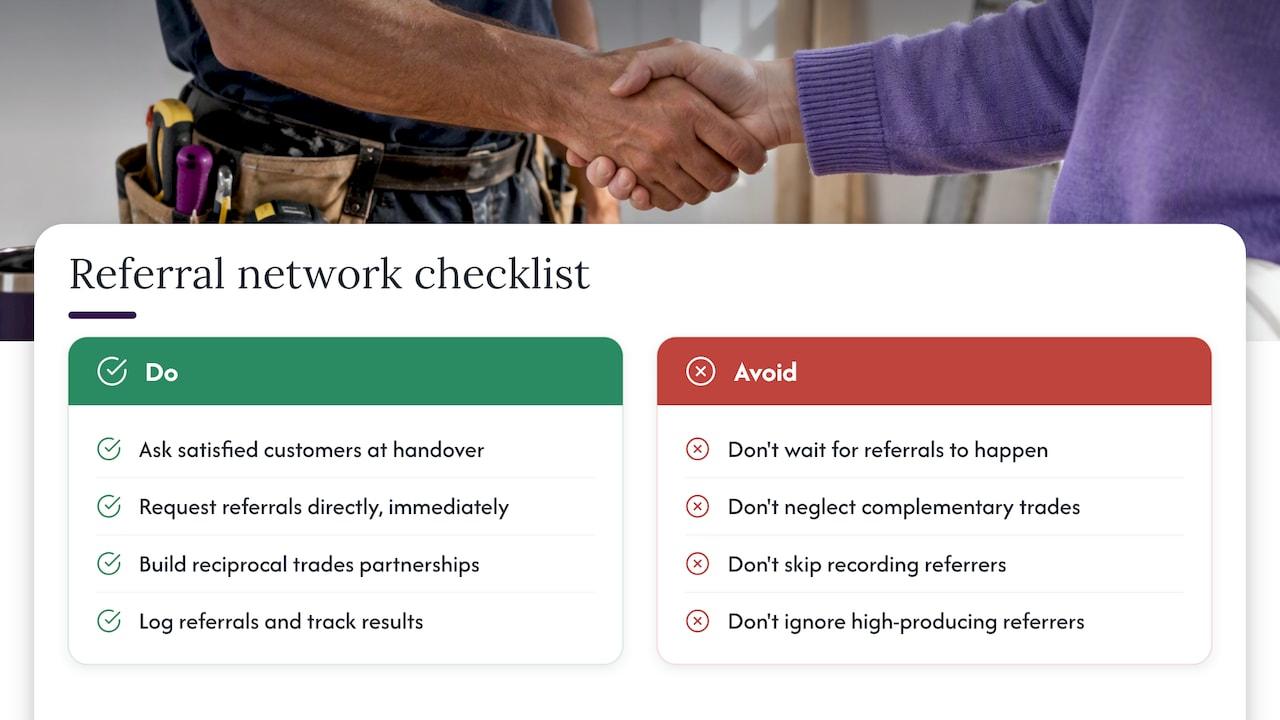
Referrals still produce some of the best jobs a tradie ever gets, because the trust is already half built before you pick up the phone. The trick is treating referrals as a system rather than something that happens by accident.
Ask every satisfied customer directly, at the point the job is finished and they’re happiest with the result. A simple line like “if you know anyone else who needs this done, I’d appreciate the introduction” works better than waiting for it to happen organically.
Build relationships with complementary trades. An electrician who refers work to a plumber, and vice versa, creates a two-way pipeline that costs nothing and keeps flowing as long as both sides deliver good work. Real estate agents, property managers and builders are also worth cultivating, since they see repeat opportunities across many properties.
Consider a small incentive for referrals, such as a discount on the referrer’s next job, though many tradies find a genuine thank-you and consistently good work is enough on its own.
Keep a simple log of who referred what, so you know which relationships are actually producing jobs and which need more attention. A referral that isn’t tracked is a referral you can’t nurture, and the ones that produce the most work deserve a phone call or a coffee now and then to keep the relationship warm.
Content marketing tactics for attracting quality leads
Content works differently to ads: instead of paying for attention, you earn it by answering the questions homeowners are already searching for. A blog post titled “how much does a hot water system replacement cost in Sydney” attracts people at exactly the point they’re ready to hire.
Focus on practical, specific content rather than generic advice. Before-and-after job photos with a short write-up of what the job involved, how long it took and roughly what it cost tend to perform better than lengthy articles nobody reads on site.
Video works well for trades because it shows your work in motion, not just in a static photo. A short clip of a completed switchboard upgrade or a bathroom renovation, posted to your website and shared on social media, does double duty as proof of quality and as searchable content.
FAQ-style content aimed at your service area answers the exact questions a homeowner types into Google before calling anyone, which puts you in front of them earlier in the decision than a competitor with no content at all.
Consistency matters more than volume. One well-written page a month, focused on a real job or a real question, will outperform a burst of generic content that never gets updated again.
Social media advertising and engagement for tradies
Social media works for tradies when it’s used to show real work, not to chase follower counts. Photos and short videos of completed jobs, posted consistently, build the kind of visual proof that homeowners look for before they call.
Facebook and Instagram both support local community groups where homeowners actively ask for trade recommendations. Answering those requests directly, rather than only running paid ads, often produces warmer leads because you’re responding to a specific need in real time.
Paid social ads can work well for visually strong trades like landscaping, tiling or renovations, where a scroll-stopping before-and-after photo does the selling for you. Keep the targeting tight to your actual service area rather than running a broad campaign across an entire city.
Engagement matters as much as reach. Responding to comments and messages promptly signals that you’re active and reliable, which is exactly what a homeowner is trying to judge before they hand over their address and their trust.
Treat social media as a supporting channel rather than your main source of leads. It builds recognition and trust over time, but it rarely converts as directly as a well-optimised website or Google profile.
Email marketing and nurturing campaigns tailored for tradies
Most tradies collect email addresses and then never use them again, which wastes a channel that costs almost nothing to run. A simple nurture sequence keeps your name in front of past customers and quoted-but-not-booked leads without any ongoing ad spend.
Start with the basics: a welcome email after a quote request, a follow-up if the job wasn’t booked within a week, and a seasonal reminder for maintenance-based trades like air conditioning servicing or gutter cleaning. These don’t need to be elaborate. Short, direct emails written in your own voice tend to perform better than anything overly polished.
Segment your list by job type where possible, so a homeowner who asked about a bathroom renovation isn’t getting emails about commercial fit-outs. Even a rough split between residential and commercial contacts sharpens relevance and improves response rates.
Use email to stay in front of past customers for repeat work and referrals, not just new leads. A homeowner who used you for a renovation two years ago is a strong candidate for maintenance work now, and a short check-in email costs you nothing to send.
Keep the list clean. Remove people who’ve asked to unsubscribe and avoid buying email lists from third parties, which raises the same consent issues the ACCC has flagged around unsolicited contact.
Measuring lead quality and ROI from various channels
Not all leads are equal, and treating them that way is one of the most common mistakes tradies make when judging where to spend their marketing time and money. A lead from your website that’s already read your pricing and seen your gallery converts differently to a cold enquiry from a shared marketplace.
Track three things for every channel: cost per lead, conversion rate from lead to booked job, and average job value from that channel. Multiplying conversion rate by job value and comparing it to lead cost tells you which channels are actually worth your time, rather than just which ones produce the most raw enquiries.
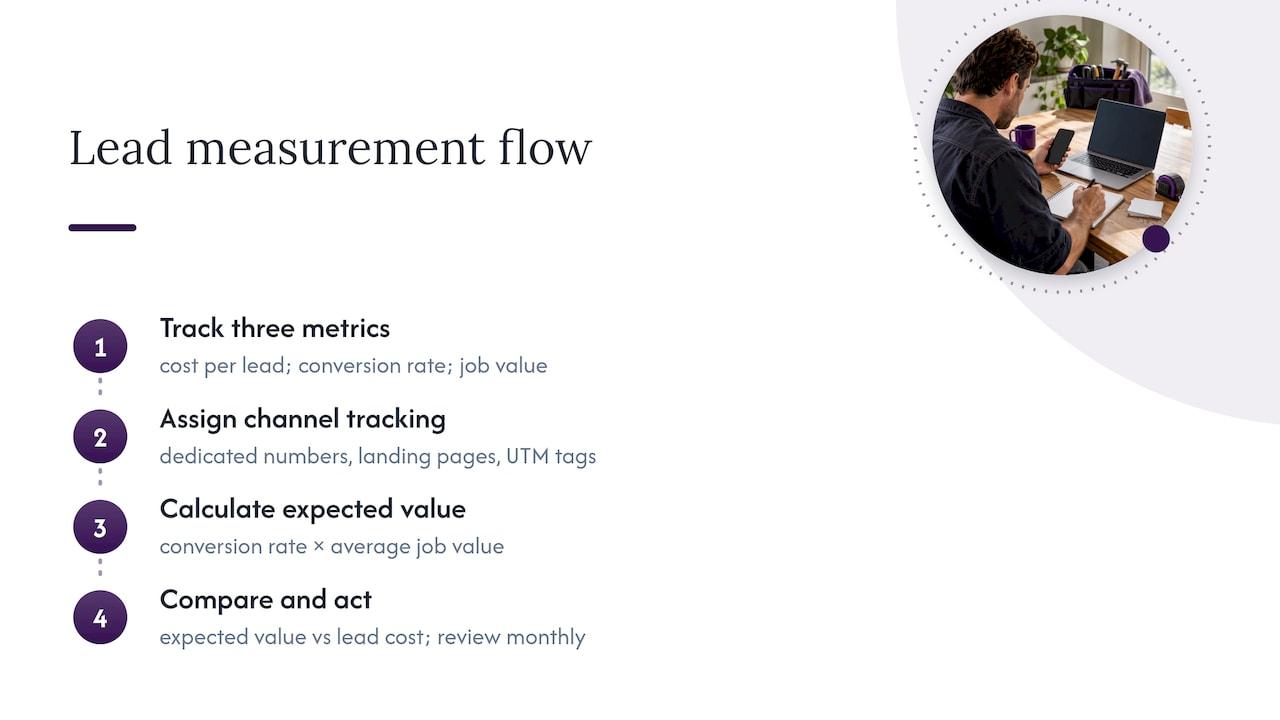
Give each channel its own tracking method. A dedicated phone number for Google Ads, a separate landing page for social campaigns, and UTM tags on any link you share all make it possible to see exactly where a booked job originated.
Review this monthly rather than daily. Lead volume fluctuates week to week for reasons that have nothing to do with your marketing, and reacting too quickly to short-term dips can lead you to abandon a channel that’s actually working over a longer stretch.
The channel matters less than how quickly and consistently you follow up on what it produces. A mediocre channel with fast follow-up will often outperform a strong channel with slow response times.
Integration of traditional marketing methods with digital lead generation
Traditional marketing hasn’t disappeared, it’s just changed its job. A ute wrap, a yard sign or a flyer in a letterbox still builds recognition, but its real value now is reinforcing what someone finds when they search for you online afterwards.
A homeowner who sees your ute at a neighbour’s job and later searches your business name expects to find a working website and an active Google profile waiting for them. If those don’t match what they saw in person, the trust built by the physical presence is wasted.
Business cards and yard signs work best when they point somewhere specific, such as a QR code linking to your Google review page or your one-page website, rather than just a phone number. That small addition turns a passive touchpoint into a trackable one.
Local sponsorships, trade show attendance and community involvement still build the kind of reputation that referrals depend on, particularly in regional areas where word of mouth travels fast. Pair that visibility with a consistent online presence and each reinforces the other.
The goal isn’t choosing between traditional and digital, it’s making sure they tell the same story about who you are and what you do.
Author perspective: why we recommend a systems-first approach
Most tradies lose jobs not from a lack of enquiries but from missed calls and slow follow-up while they’re mid-job with dirty hands and no time to check a phone. Voice-first intake solves the exact moment a lead is most likely to walk. Start this week by timing your own response speed to the last five enquiries you received.
— Hayley
How Ask Hayley helps capture and qualify tradie leads
You’ve done the hard part: built a converting website, tightened your Google profile, and set a follow-up target. Ask Hayley handles the part that’s hardest to control yourself, answering calls the moment you can’t, pre-qualifying the caller, and getting the details into your workflow before you’ve even wiped your hands.

- The Assistant plan answers and qualifies inbound calls through natural voice prompts, no dashboard required.
- The Office Manager plan extends that into day-to-day admin, keeping the details you need in one place.
- Optional add-ons, an AI Sales Agent and an AI Website Chatbot, extend coverage across calls, leads and enquiries.
If your website itself needs work first, our one-page website option gives you a converting presence fast. Visit the Ask Hayley homepage to see how it fits your business.
Sources
- Labour Account Australia, June 2025 | Australian Bureau of Statistics
- Unsolicited selling and lead generation: a review of the consumer experience and business practices | ACCC
FAQ
What are the best lead generation companies in Australia?
There’s no single best provider, since shared lead marketplaces, digital agencies and voice-first platforms each solve a different part of the problem. Marketplaces like hipages sell shared enquiries, while owning your website and Google profile, paired with fast follow-up, tends to produce better win rates over time.
How much should you pay for lead generation?
Pricing varies by model: pay-per-lead charges a flat fee per enquiry, subscriptions charge a fixed monthly rate, and pay-per-call charges only for calls received. The right amount depends on your typical job value and conversion rate, so run the ROI check (job value × conversion rate, minus lead cost) before committing to any ongoing spend.
What trade is most in demand in Australia?
Demand varies by region and season, but overall construction sector employment remains substantial, with the Australian construction workforce sitting around 1,277,200 people in the June 2025 quarter. Electricians, plumbers and carpenters typically see steady year-round demand, while specialist trades can be more seasonal.
How to get B2B leads for free?
Referral networks with complementary trades, active engagement in local community groups, and consistent content that answers real customer questions all generate leads without ad spend. Optimising your Google Business Profile and responding quickly to enquiries costs nothing beyond your time and often produces better-quality leads than paid channels.


