


A methodology statement tells the buyer exactly how you will deliver this contract, and it’s often the single most important non-price section of an Australian construction tender. Write it as an executable delivery plan, not marketing copy. The immediate job is to produce a sequenced programme with named responsibilities that mirrors the tender’s own questions, because that’s what earns marks.
TL;DR:
- A clear, specific opening statement naming roles, project type, site constraints, and relevant specification clauses boosts evaluators’ confidence in deliverability.
- Phased mobilisation plans with named leads, measurable milestones, and real past contract examples improve scoring compared to high-level or aspirational statements.
- A realistic construction programme addresses procurement lead times, staged works, and includes contingency or float to demonstrate practical sequencing and risk management.
- Well-structured safety sections list hazards, controls, licences, supervision details, and traceable SWMS, reflecting control rather than mere compliance.
- Fitting environmental, quality, and risk mitigation details into distinct, evidence-based sections with tangible examples enhances bid credibility and scoring.
Table of Contents
- Why the methodology matters in tender evaluation
- What sections belong in a tender methodology statement
- Project understanding and contract context
- Pre-start, mobilisation and site establishment
- Construction sequencing, programme and critical path
- WHS and safety approach (including SWMS)
- Environmental and sustainability controls (SESP, waste and circularity)
- Quality assurance, inspections and hold points
- Plant, equipment, materials and supply chain management
- Risk identification, mitigation and monitoring
- Stakeholder and community engagement, traffic and staging
- Completion, handover and close-out documentation
- Practical templates and where Ask Hayley can help
- Hayley’s practical view: common mistakes and quick wins for tradies
- Get hands-on help with your next tender submission
- Sources
- FAQ
Why the methodology matters in tender evaluation
Evaluators aren’t grading how well you write. They’re grading whether your business can deliver this specific contract without blowing the budget, missing a milestone, or creating a safety incident. Every sentence in your methodology statement is a chance to prove deliverability, show you understand the risks, and demonstrate you’ve read the specification properly.
On many government and council tenders, methodology and non-price criteria carry substantial weighting against price. That means a well-priced bid with a thin methodology can still lose to a slightly dearer bid that reads like a real plan. TenderWise’s guidance backs this up: assessors reward specific, evidence-based answers over generic capability statements, because named roles and comparable projects are things they can actually verify.
Three habits separate winning methodology sections from forgettable ones:
- Be specific. Name the supervisor, the plant item, the exact week.
- Be evidence-based. Point to a comparable contract you’ve actually delivered.
- Mirror the marking scheme. If the tender asks four questions, answer four questions, in that order, under matching headings.
Write for the assessor holding a scoring matrix, not for a prospective client browsing your website.
What sections belong in a tender methodology statement
A construction methodology statement typically runs two to five pages per core question, and most Australian tenders expect it structured around the same recurring blocks:
- Project understanding and contract context
- Mobilisation and site establishment
- Construction sequencing and programme
- WHS and safety approach
- Environmental and sustainability controls
- Quality assurance and hold points
- Plant, equipment and supply chain
- Risk identification and mitigation
- Stakeholder and community engagement
- Completion, handover and close-out
Label each section to match the tender’s own question numbering, not your internal template’s numbering. Where a page limit applies, cut adjectives before you cut evidence. Buying for Victoria’s procurement guidance makes the same point from the buyer’s side: a focused, clearly labelled response reduces evaluator burden and tends to score better than an unstructured wall of text.
Project understanding and contract context
Open by proving you’ve read the specification, not just skimmed the scope of works. Reference the Project Information Requirements or specific clauses the buyer has flagged as priorities, and use their terminology, not your own shorthand.
A strong opening does three things in two or three sentences:
- States the scope in the buyer’s own language.
- Names the site constraints that matter (access, heritage overlay, live operations nearby).
- Signals which specification clauses you’ve built your approach around.
A workable structure: “This project involves [scope] within [constraint]. Our approach addresses [specification clause] by [one-line method].” That’s enough to show comprehension before you get into detail.
Pre-start, mobilisation and site establishment
Mobilisation is where evaluators check whether your plan is real or aspirational. Break it into phases with named leads and durations, not a single paragraph claiming you’ll “mobilise efficiently.”
- Discovery and site handover, led by a named site supervisor, typically week one.
- Procurement commitments locked in before mobilisation, not during it.
- Site establishment: temporary services, fencing, inductions, and traffic interfaces scheduled against specific dates.
- One comparable contract where your mobilisation sequence actually worked, cited by name and outcome.
TenderWise’s review of winning bids found that tenderers who present mobilisation as a phased programme with named leads and measurable milestones consistently outscore those offering only high-level statements.
Pro Tip: Capture your mobilisation sequence as voice notes while you’re walking the site, then turn them into dated bullet points. It’s faster than trying to remember the detail back at the office, and it reads more credible because it’s specific.
Construction sequencing, programme and critical path
Your programme needs to show you understand what happens in what order, and why. A Gantt chart or equivalent programme view, paired with a written explanation of the critical path, does more work than a paragraph of prose ever will.
- Identify the critical path activities and what happens if any one of them slips.
- Show procurement lead times against the programme, particularly for long-lead items like structural steel or specialist glazing.
- Address staged or constrained works explicitly, including traffic interfaces or shared-access zones.
- Note supplier coordination points where a delay in one trade cascades into another.
Evaluators read sequencing sections looking for realism. A programme with no float and no contingency reads as either inexperienced or dishonest.
WHS and safety approach (including SWMS)
Your safety section needs to demonstrate control, not just compliance intent. Structure it around hazards, controls, supervision and reporting, then show how your Safe Work Method Statements sit underneath that structure at the task level.
- List the key project hazards and the specific control for each, not generic PPE statements.
- Reference site inductions, supervision ratios and incident reporting lines.
- Name relevant licences and competencies (plant tickets, high-risk work licences, supervisor qualifications).
- Cross-reference your SWMS to specific hold points so assessors can trace the paper trail.
SafeWork NSW’s procurement guidance recommends integrating WHS expertise directly into the evaluation of tender responses, often referencing ISO 45001 systems and, on larger jobs, ISO 19650 information requirements. A specialist WHS assessor is often reading your safety answer separately from the rest of the panel, so write it to stand on its own.
Environmental and sustainability controls (SESP, waste and circularity)
If the tender includes a Supplier Environmental Sustainability Plan requirement, treat it as its own mini-assessment rather than an afterthought bolted onto the methodology. SESP criteria typically cover corporate environmental performance, design decisions, climate considerations and circularity.
- Corporate performance evidence: policies, certifications, past reporting.
- Design and climate measures specific to this project, not generic sustainability language.
- Circularity and waste: diversion targets, plans to use recycled content where possible, reuse plans.
- Reference to Environmental Product Declarations where materials are specified.
The federal guidance on SESP evaluation is explicit that not every business can supply ecolabels, and other relevant evidence like invoices, specifications or third-party certifications is accepted. Fill the SESP template concisely and cross-reference your methodology section rather than repeating whole paragraphs twice.
Quality assurance, inspections and hold points
Your QA section proves the contract will be delivered to spec, not just on time. Define your hold points, what triggers an inspection, and what happens if an inspection fails.
- List hold points against programme milestones, not as a separate disconnected checklist.
- Reference ISO 9001 or your own accredited quality system if you hold one.
- State acceptance criteria for key trades and how non-conformance gets recorded and closed out.
- Cite a past contract where your QA process caught and fixed an issue before handover.
BidSquirrel’s guidance on scoring method statements puts it plainly: the response should be something evaluators could hand to your delivery team and watch happen. A QA section without a real inspection regime behind it won’t survive that test.
Plant, equipment, materials and supply chain management
Evaluators want to know whether the plant you’re claiming is actually available when you need it. State ownership or lease status for critical items, and name your backup position.
- List critical plant with ownership or lease status confirmed, not assumed.
- Flag specialised equipment (cranes, elevated work platforms) and their booking lead times.
- Name a secondary supplier for any long-lead material, with an approximate lead time.
- Explain your procurement logic: what gets ordered first and why.
A single sentence naming a backup supplier for a long-lead item often does more to reassure an evaluator than a whole paragraph about your “trusted supply chain.”
Risk identification, mitigation and monitoring
Pick your three to five highest-priority risks for this contract specifically, not a generic risk register copied from a template. Each risk needs a mitigation, a trigger, and a named owner.
- State the risk, the mitigation, and the specific trigger that activates it.
- Name who monitors it and how escalation works if the trigger fires.
- Tie each risk control back to your programme, QA regime or mobilisation plan so it reads as connected, not standalone.
- Avoid listing risks you have no real control over (market pricing, weather) without a genuine response.
Evaluators often assign specialist reviewers to different parts of a bid, so a WHS-trained reviewer may only be scoring your safety risks while a contracts specialist checks the commercial ones. Label subsections so each reviewer finds their relevant content fast.
Stakeholder and community engagement, traffic and staging
If the project touches a live site, public road or neighbouring business, your engagement plan needs to show you’ve actually mapped who’s affected and when you’ll talk to them.
- Map stakeholders by impact level and set a communication schedule against the programme.
- Name who holds the Traffic Management Plan and permit responsibilities.
- State liaison points for community notifications, particularly for noise, dust or access disruption.
- Reference a past project where your engagement approach reduced complaints or disruption.
Vague promises to “engage with the community” score poorly. A dated notification schedule scores well.
Completion, handover and close-out documentation
Buyers want assurance the paperwork will be right at the end, not just the concrete. Set out your close-out documentation early rather than treating it as an afterthought.
- List as-built records, commissioning certificates and test reports you’ll provide.
- State your handover timetable and who’s responsible for each document.
- Address defects management and the liability period explicitly.
- Cross-reference NCC compliance documentation and any client-specific handover checklist. Ask Hayley’s guide to project handover documentation provides a useful reference point for structuring this section.
Practical templates and where Ask Hayley can help
A template only earns its place if you adapt it to the exact wording of the question and the marking scheme sitting behind it. Copy the tender’s own headings into your template first, then write to fill them, rather than writing generically and hoping it lines up.
Front-load your strongest evidence in the opening sentence of each section. A few examples worth adapting:
- “Our team, led by [named supervisor], delivered a comparable [project type] worth $[value] for [client], completed on programme with zero WHS incidents.”
- “Mobilisation will begin in week one with [named lead] coordinating site establishment, with procurement for [long-lead item] confirmed prior to award.”
- “Our QA regime includes [number] hold points aligned to [specification clause], verified through [inspection method].”
That pattern, naming the role, the comparable contract, the critical path item and the first mitigation step, gives evaluators immediate proof without long exposition.
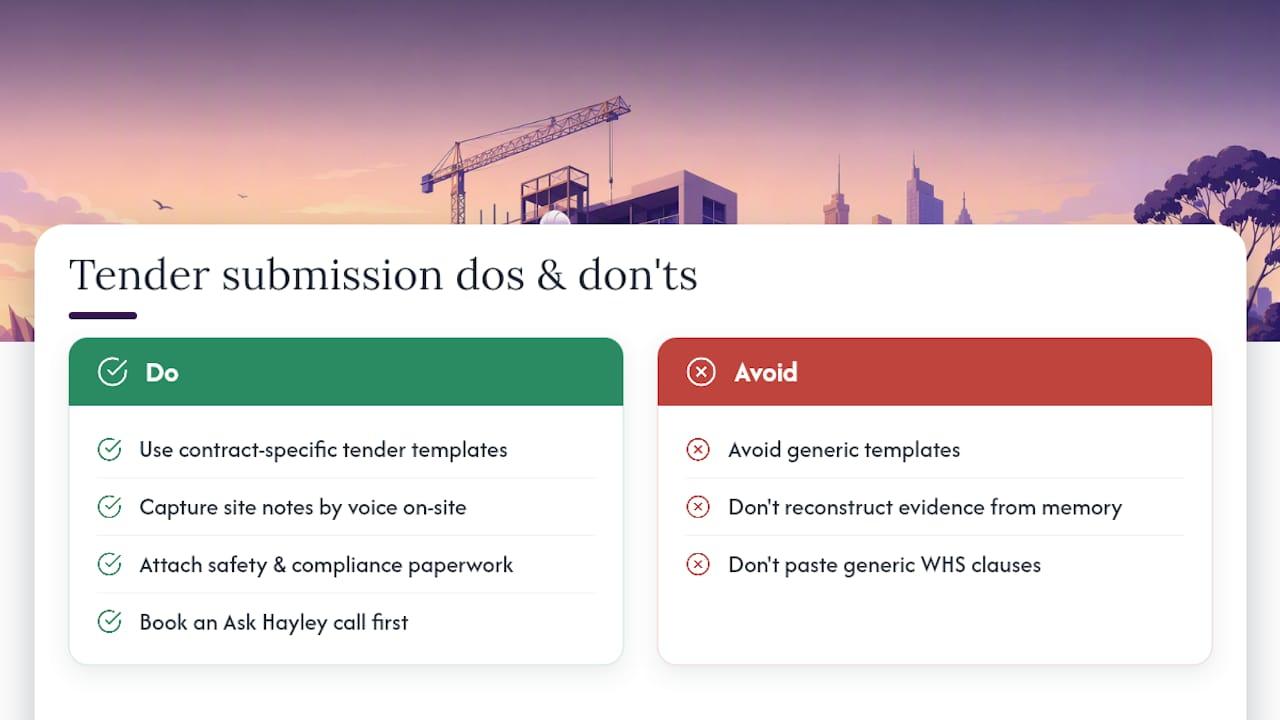
Ask Hayley supports Australian tradies preparing these responses with tendering documentation and templates built for construction and trade contracts, plus safety and compliance documentation that feeds directly into your WHS section. Because Hayley captures field notes and site diary entries by voice, you can log mobilisation detail and evidence on-site instead of reconstructing it from memory back at the office, using tools like site diary requirements to keep a running record.
Pro Tip: Keep a running folder of comparable contract evidence, values, outcomes, photos, before you need it for a tender. Scrambling to find a reference project the night before a submission is how good bids read weak.
Hayley’s practical view: common mistakes and quick wins for tradies
Most methodology statements lose marks before the evaluator even reaches the technical content, because the opening paragraph is generic. If your first sentence could be pasted into any other tender for any other contractor, it’s not doing its job. Name the role, the site, the constraint. That’s what earns the first tick.
The tradies who win consistently aren’t necessarily better writers. They’re better at capturing evidence while it’s fresh, a photo of a completed similar job, a note about how they handled a tricky access issue, rather than trying to invent detail from memory weeks later. Voice capture on-site beats a blank Word document every time.
Quick wins worth actioning before your next submission: match your headings to the tender’s question numbers, name a real supervisor and a real comparable contract in your opening sentence, and cut any paragraph that doesn’t answer a specific assessable criterion.
— Hayley
Get hands-on help with your next tender submission
Writing a methodology statement that scores well takes time most tradies don’t have between jobs, and a generic template rarely matches the specific marking scheme in front of you. Some tendering services provide documents built around your actual contract, your actual crew, and the buyer’s actual questions, so you’re not starting from a blank page or a mismatched template.
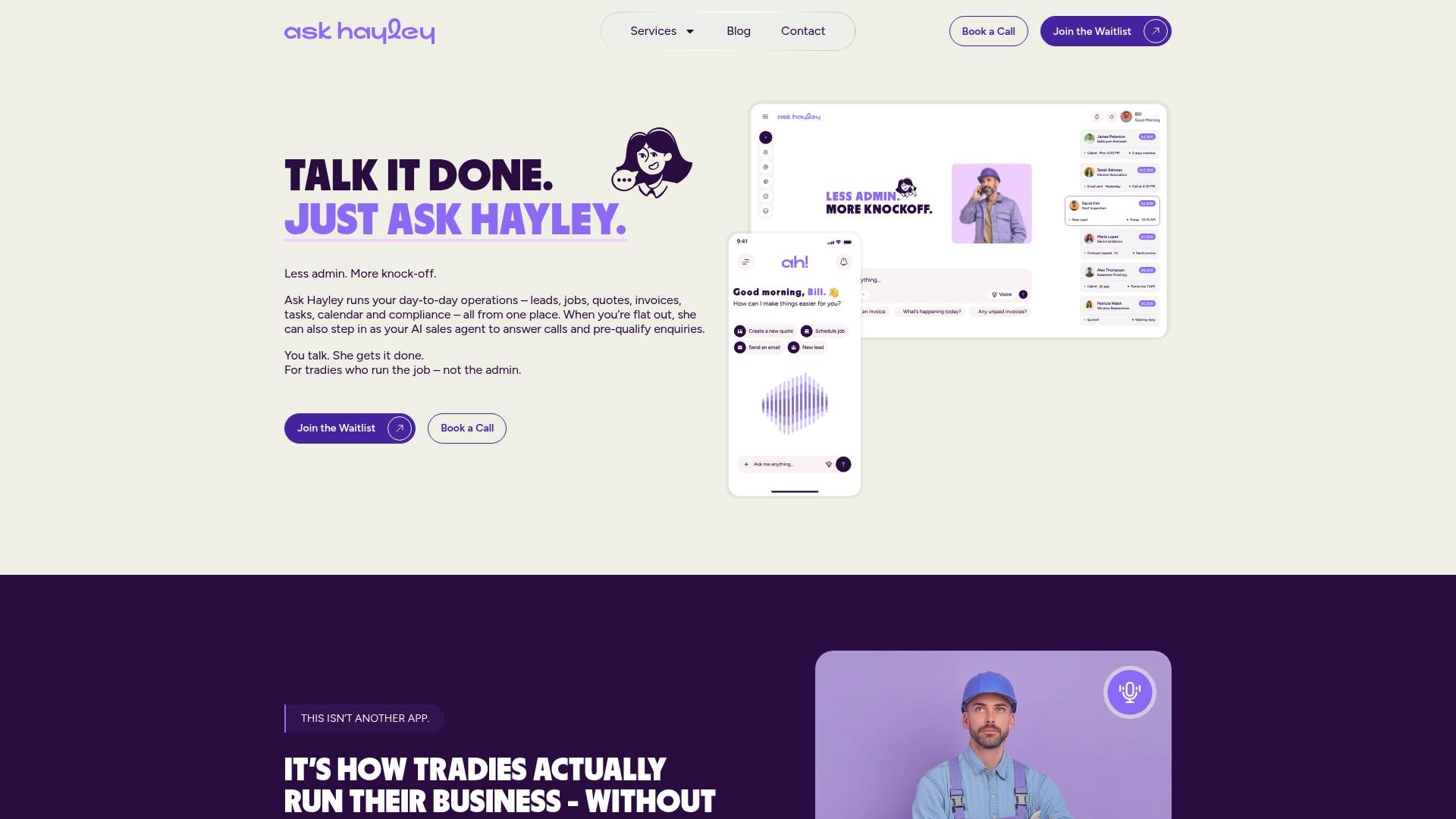
Because some platforms capture site notes and job detail by voice while you’re still on-site, the evidence going into your methodology statement can be fresher and more specific than anything reconstructed from memory later. That matters for the sections evaluators check hardest: mobilisation dates, named roles, comparable contracts. Pair the tendering service with safety and compliance documentation and you’ve got a WHS section backed by real supporting paperwork, not a copied clause.
If you’re preparing a submission now, the fastest next step is to look at Ask Hayley’s tendering page and book a call to talk through your specific contract before you start drafting.
Sources
A few Australian government and industry documents are worth citing directly in your methodology statement, not just reading for background.
- Guidance: Environmental sustainability plan – tender evaluation for construction services (DCCEEW)
- Guidelines to procurement, tendering and supply chain monitoring for BIM and WHS management (SafeWork NSW)
- Promoting efficiency in the tender process (Construction Guidance 3.3) — Buying for Victoria
- How to write a winning methodology for your tender (TenderWise)
For contractors also weighing up how their broader online presence supports bid credibility, construction-focused SEO guidance covers how digital proof points complement a written tender.
FAQ
What is a construction methodology statement?
A construction methodology statement is a written explanation of how a contractor will deliver a specific project, covering sequencing, safety, quality and risk. It’s assessed alongside price in most Australian government and council tenders, and a strong one reads as an executable delivery plan rather than a general capability pitch.
What are the stages of the tendering process?
The tendering process generally moves through planning and specification, advertising or invitation, tenderer registration, submission, evaluation against the marking scheme, negotiation or clarification, and contract award. Methodology statements are assessed during the evaluation stage, usually against a scoring matrix that weights them alongside price and other criteria.
What Australian standard is relevant to tendering?
There’s no single standard covering tendering itself, but methodology statements commonly reference ISO 9001 for quality management, ISO 45001 for WHS management systems, and ISO 19650 for BIM information management on larger projects. Referencing the specific standard your business holds strengthens your quality and safety sections.
What are some examples of tender documents?
Typical tender documents include the request for tender, specification and drawings, pricing schedule, methodology statement, WHS management plan, and the SESP where environmental criteria apply. Ask Hayley provides tendering documentation and templates built specifically for Australian trade contractors preparing these submissions.
How much does Ask Hayley’s tendering service cost?
Pricing for Ask Hayley’s tendering support is available directly on the Ask Hayley website rather than published as a fixed rate, since it depends on the scope of documentation required.


