


A work in progress (WIP) report tells you the real profit on every job you’ve got running right now, not the profit sitting in your bank account. If you’re not producing one monthly from certified progress and actual costs, you’re flying blind on margin and risking a nasty surprise with the ATO or QBCC. Run it every month. It’s the single habit that protects your cash and your licence.
TL;DR:
- A WIP report provides real-time insights into job profitability by comparing certified progress, costs incurred, and remaining work, preventing cash flow surprises.
- Consistent, accurate input from site updates, documents, and variations is essential; delays or errors in data capture undermine the report’s reliability.
- Using the percentage of completion method for long-term jobs and completing projects within one year with the basic approach ensures compliance with ATO rules.
- WIP figures directly affect GST reporting, tax obligations, and QBCC licensing thresholds, making precise reports critical for legal and financial compliance.
- Implementing a routine, fixed schedule for monthly WIP reviews and voice-based data capture minimizes errors and keeps the business early-warning system active.
Table of Contents
- What a WIP report shows and why it matters for tradies
- What to include in your WIP schedule: fields and accounting entries
- How to calculate WIP: basic approach vs estimated profits (percentage of completion)
- GST, tax and licence implications for WIP reporting in Australia
- Practical monthly process: produce a reliable WIP report from job data
- Common WIP mistakes, reconciliation checks and red flags
- How Ask Hayley helps tradies capture the inputs for reliable WIP reporting
- Author perspective: treat WIP as the business early warning system
- Get the inputs right and WIP takes care of itself
- Sources
- FAQ
What a WIP report shows and why it matters for tradies
A WIP report is a snapshot of every job you’ve got underway, built from real numbers rather than gut feel. It pulls together what a job is worth, what’s been spent, what’s been claimed, and what’s left to do, then works out whether that job is actually making you money right now.
This is different from your bank balance or your year-end profit and loss. Your bank balance tells you what’s landed in your account, not what you’ve earned. Your P&L tells you how the whole business performed over a full year, which is too slow to help you fix a job that’s bleeding money in March. WIP fills that gap. It’s job-level, it’s current, and it’s the only report that shows you margin erosion while there’s still time to do something about it.
A solid WIP schedule usually includes:
- Contract value: the total agreed price for the job, including approved variations.
- Certified progress: the portion of work formally signed off by the client or their representative.
- Costs to date: labour, materials, subcontractors and overheads charged against the job so far.
- Variations: extra work, whether approved, pending or in dispute.
- Retention: the amount the client is holding back until practical completion or the defects period ends.
- Materials on site: stock bought for the job but not yet installed or claimed.
- Amounts invoiced: what you’ve actually billed the client, separate from what’s been certified.
Put those together and you can see a job that looks fine on paper but is actually underwater, because costs have run ahead of certified claims. That’s the whole point of WIP. A builder can have a great-looking bank balance because of deposits on new jobs, while three older jobs are quietly losing money underneath. WIP is what catches that before it becomes a cash flow crisis.
What to include in your WIP schedule: fields and accounting entries
Building a usable WIP schedule doesn’t need to be complicated, but it does need consistency. Here’s a practical structure that works for most trades and small construction businesses:
- Job identifier and client name, so every entry ties back to a specific contract.
- Original contract value, plus a running total of approved variations.
- Certified claims to date, meaning the value of work the client or their representative has formally accepted.
- Costs incurred to date, split by labour, materials and subs where possible.
- Retention held, tracked separately because it’s owed to you later, not now.
- Materials on site not yet claimed, which sit as an asset until they’re built into certified work.
- Provisional sums, treated cautiously until actual costs and client agreement replace the estimate.
On the accounting side, the entries stay simple if you keep the fields above current. When you incur job costs, you debit WIP (an asset account) and credit cash, accounts payable or wages payable, depending on what generated the cost. When you certify progress and invoice the client, you recognise revenue and reduce the WIP asset by the value of work now recognised, while the invoice itself sits in accounts receivable until paid.
Retention needs its own treatment. Don’t recognise it as WIP once it’s certified, and don’t recognise it as revenue you can spend. It’s a receivable that’s simply delayed, usually until practical completion or the end of the defects liability period, and it should sit on its own line so you’re not fooled into thinking that cash is coming sooner than it is.
Provisional sums are trickier. Treat them as estimates until real costs and client sign-off replace them, and never let a provisional figure sit unchanged in your schedule for more than a month or two. If it hasn’t moved, it usually means nobody’s followed it up.
How to calculate WIP: basic approach vs estimated profits (percentage of completion)
Australian tradies generally use one of two accepted methods, and the ATO’s TR 2018/3 sets out what’s acceptable for long-term construction contracts. Whichever you choose, the ruling requires you to apply it consistently across similar contracts, not cherry-pick the method that flatters this month’s numbers.
- Basic approach: best for short jobs, usually those completed within a single income year. You simply recognise income and costs as the job progresses, without spreading estimated profit across periods, because there’s no need to.
- Estimated profits (percentage of completion): required for longer contracts that span income years. You estimate total contract profit, then recognise a proportion of that profit each period based on how much of the job is complete, using documented, reasonable percentages.
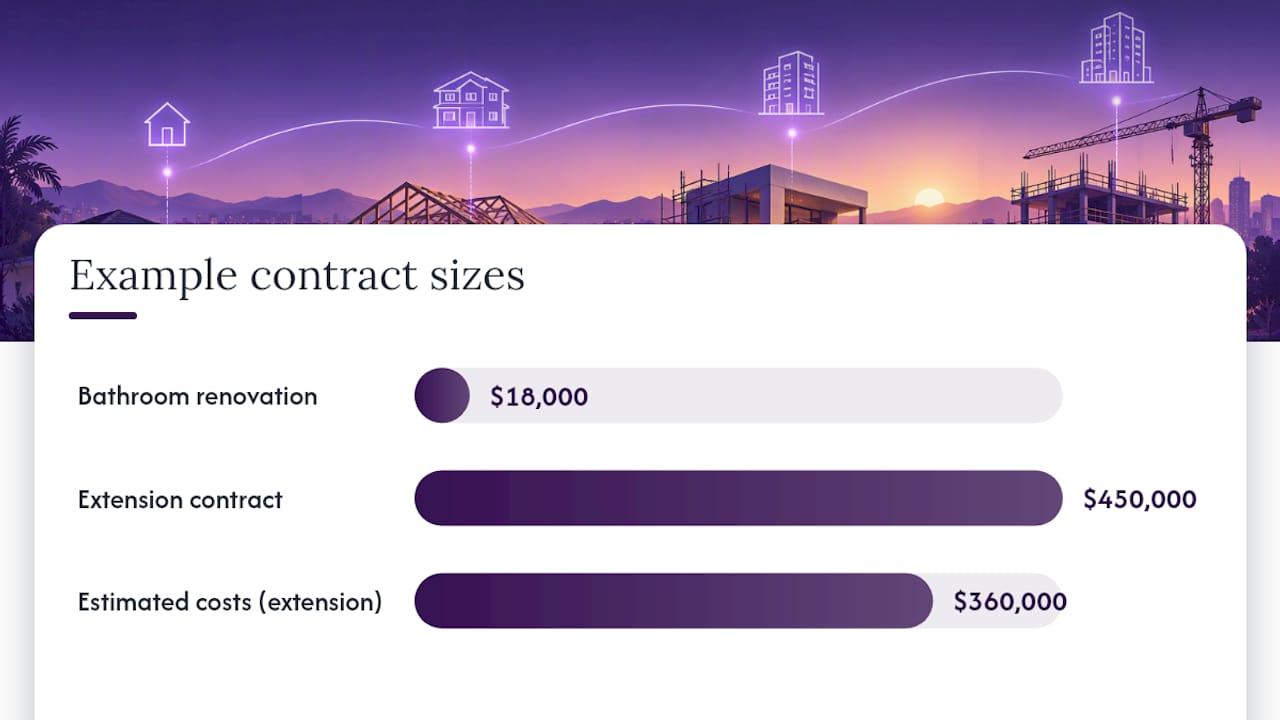
Here’s how the two look in practice. Say a bathroom renovation worth $18,000 takes six weeks and finishes inside one income year: you’d use the basic approach, recognising revenue and costs as they’re incurred and claimed, with no need to estimate a completion percentage. Now say a $450,000 extension runs for 14 months across two income years, with total estimated costs of $360,000 and an expected profit. At the end of year one, if certified progress shows the job is about three-fifths complete, you’d recognise the corresponding proportion of profit in year one and the remainder in year two, provided your percentage is reasonable and documented.
Pro Tip: Keep a simple file per job with your certified claims, site photos and any variation approvals, since TR 2018/3 expects contemporaneous evidence behind any percentage-of-completion figure you use.
TR 2018/3 confirms the estimated-profits basis is acceptable for long-term contracts, provided it’s reasonable, documented and applied consistently. That last word, consistently, is where most small operators trip up when they switch methods job to job.
As a rule of thumb: if the job wraps inside one income year, the basic approach is simpler and usually sufficient. If it spans two or more years, use estimated profits and keep your documentation tight from day one.
GST, tax and licence implications for WIP reporting in Australia
WIP reporting doesn’t sit off to one side of your tax and licence obligations. It’s directly connected to both, and getting it wrong has consequences beyond a messy spreadsheet.
On GST, the ATO’s guidance on progressive or periodic sales treats each progress claim as its own component of the sale, reported in the period it’s invoiced or paid, depending on whether you’re on the accounts or cash basis. That means your WIP schedule and your GST reporting need to line up, claim by claim, rather than being reconciled once a quarter after the fact.
On income tax, TR 2018/3 rejects the completed contracts method, meaning you can’t simply wait until a job finishes to declare the income. You need an acceptable method, applied consistently, and the estimated-profits basis is the usual fit for longer jobs.
Then there’s QBCC. Under the CPA Australia and CA ANZ joint FAQ on QBCC annual reporting, licensees are expected to monitor a 1:1 current ratio, and a Minimum Financial Requirements (MFR) report can be triggered if net tangible assets fall by a substantial percentage for categories 4 to 7, or a higher percentage for other categories. Your WIP figures feed directly into both of those checks, because they determine the value of your current assets and your true financial position.
Accurate WIP reporting is the primary tool licensees use to monitor the thresholds that can trigger an MFR report.
Records worth keeping to support your WIP figures include certified progress claims, written client sign-off, variation approvals, supplier invoices and site photos documenting completed stages. Keep them per job, not buried in a general folder, so you can produce evidence quickly if QBCC or your accountant asks for it.
- Progressive GST reporting must match each certified claim, not be batched at quarter-end.
- TR 2018/3 rules out the completed contracts method for tax purposes on long jobs.
- QBCC MFR checks rely on your WIP-driven current ratio and NTA position.
- Documentation (certifications, approvals, invoices, photos) is what makes your chosen method defensible.
Practical monthly process: produce a reliable WIP report from job data
A reliable WIP report comes from a routine, not a scramble at month-end. Here’s a process that works for most small trade businesses.
- Gather the month’s inputs: timesheets, purchase orders, the site diary, supplier invoices and any certified progress claims signed off by the client.
- Reconcile costs against the job ledger, checking that every invoice and timesheet entry has landed against the right job code.
- Confirm the percentage complete for each active job, based on certified claims rather than your own estimate of how the job “feels.”
- Calculate WIP for each job using the method (basic or estimated profits) you’ve already committed to for that contract.
- Post the journals: recognise revenue against certified progress, adjust the WIP asset account, and separate out retention.
- Review and sign off, ideally with a second set of eyes, whether that’s your bookkeeper, your accountant or a business partner.
The inputs matter more than the calculation. Voice capture on site, digital job entry and a direct feed into Xero all help close the gap between when work actually happens and when it lands in your books. The fewer manual re-entries between the site and the ledger, the fewer errors show up in your WIP.
Pro Tip: Set a fixed day each month, the first business day is common, to run WIP. A routine date means nobody’s chasing numbers three weeks late.
Sign-off matters too. Someone other than the person entering the data should check it, even if that’s just a second look by the business owner. Escalate straight away if a job’s certified progress hasn’t moved for two months, or if costs have jumped without a matching variation on file.
Common WIP mistakes, reconciliation checks and red flags
The same handful of errors show up again and again in small trade businesses, and most of them are easy to fix once you know to look for them.
- Using cash receipts instead of certified progress, which overstates or understates job profit depending on payment timing.
- Ignoring uncertified variations, leaving real costs on the books with no matching revenue.
- Double counting materials, once as stock on hand and again as a cost against the job.
- Missing or misclassified retention, which inflates receivables that aren’t actually due yet.
Run these checks monthly: job ledger against the WIP schedule, materials on site against your inventory count, and aged debtors against certified invoices. Watch for a falling current ratio or repeated negative margins on the same job, both are signs that need attention now, not next quarter.
How Ask Hayley helps tradies capture the inputs for reliable WIP reporting
The accuracy of a WIP report depends entirely on how quickly job data gets from the site into your books. That’s where most small trade businesses lose the thread, not in the calculation itself, but in the lag between work happening and someone typing it up.
The platform is built around voice, not forms. When updates like a completed stage, a variation, or a materials delivery are reported, that information is captured through natural conversation rather than a dashboard requiring manual entry after a long day on the tools. Because the system can handle inbound calls when users can’t, client queries about progress or invoicing don’t get missed and buried until month-end, when they’re harder to reconstruct.
A typical monthly flow looks like this: site updates come in by voice throughout the month, get logged against the right job, and feed through to your accounting setup, including Xero integration, so your bookkeeper or accountant is working from current job records rather than chasing paper at the end of the month. That shortens the gap between when a stage is actually certified and when it shows up in your WIP schedule, which is exactly the gap that causes overstated margins and compliance surprises.
This platform isn’t an accounting system and doesn’t replace bookkeepers. What it does is help ensure the raw inputs—site notes, calls about variations, confirmations that stages are done—reach the records instead of being lost or unrecorded.
Author perspective: treat WIP as the business early warning system
Most trade businesses that get into trouble aren’t short of work. They’re short of visibility. WIP reporting is the cheapest insurance you’ll ever run, and yet it’s the report most likely to get skipped when things are busy, which is exactly when you need it most.
Ignore it for a few months and you won’t notice the slow bleed until a job’s finished and the number’s already locked in. Run it monthly and you catch the problem while there’s still a chance to fix pricing, chase a variation, or have a hard conversation with a client before it costs you the job’s entire margin.
Make it a fixed date, a fixed process, and a habit. It’s not glamorous work, but it’s the difference between guessing at your business’s health and actually knowing it.
— Hayley
Get the inputs right and WIP takes care of itself
Most WIP problems aren’t calculation problems, they’re capture problems. Jobs move fast, calls get missed, and the site diary entry that should have happened on Tuesday gets typed up three weeks later, if at all. That lag is where accurate WIP reporting quietly falls apart for busy trade businesses.

This platform is designed to close that gap without adding another app to your day. You provide updates by voice, and the details from site calls, client updates, and job progress feed through to existing setups instead of sitting in a notebook. Alongside the core platform, Ask Hayley also offers tendering support and safety and compliance documentation, both of which produce the kind of consistent, dated records that make your WIP figures easier to defend at tax time or under a QBCC review.
If you’re ready to stop losing job data between the site and the ledger, have a look at what Ask Hayley can do for your business and see how it fits your current workflow.
Sources
For the figures and rules covered in this article, go straight to the source rather than relying on secondhand summaries.
For businesses wanting a broader view of how digital workflows support job documentation and client communication, Ibrand Media’s guide for builders is worth a look.
This article is general information, not a substitute for advice from a qualified financial advisor. Consult a qualified financial professional about your own circumstances before acting on anything here.
FAQ
What is included in a WIP report?
A WIP report typically includes contract value, certified progress, costs incurred to date, approved and pending variations, retention held, materials on site and amounts already invoiced. Together these show whether a job is actually profitable right now, not just what’s been billed or received.
How do you account for WIP inventory?
WIP inventory, meaning materials bought for a job but not yet installed or claimed, sits as an asset on your books until it’s built into certified work. Once the client certifies that stage, the WIP asset reduces and the value moves into recognised revenue and costs.
What is the accounting entry for WIP?
When job costs are incurred, you debit the WIP asset account and credit cash, payables or wages, depending on the cost type. When progress is certified and invoiced, you recognise revenue and reduce the WIP asset by the value of work now certified, following the method set out in TR 2018/3.
What are WIP schedules?
A WIP schedule is the working document that lists every active job with its contract value, certified claims, costs, variations and retention side by side. It’s the source data behind the WIP report and the tool most trades use to track job-level profit month to month.


